Guides
How to build a 2027 gas station preservation maintenance plan that holds up
Create a 2027 gas station preservation maintenance plan with routine inspections, evidence records, repair triage, moisture checks, and clear decision boundaries.
A gas station preservation maintenance plan is repeatable and spots change before a small defect becomes a large loss of historic material.
A former service station may have a flat roof, canopy, masonry or concrete walls, metal panels, windows. It may have signs, pump-island remnants, drainage paths, and new business use. Each can need attention, but not every mark needs replacement or emergency project.
This guide explains an editorial and owner-facing maintenance system for historic or former U.S. gas stations. It is not a building inspection, safety evaluation, environmental assessment, code determination, maintenance contract, or repair instruction for a specific property.
What to take away
- Set a recurring inspection rhythm and record what was actually observed.
- Separate monitoring, routine care, repair decisions, and specialist work.
- Track moisture paths, roof edges, drainage, openings, and mechanical changes.
- Use a change log so an article never turns an unverified repair into a preservation claim.
- Do not infer safety, contamination, compliance, or structural condition from appearance.
Treat maintenance as a record, not a vague promise
"Maintained" is often a compliment in a roadside article, but it says almost nothing alone.
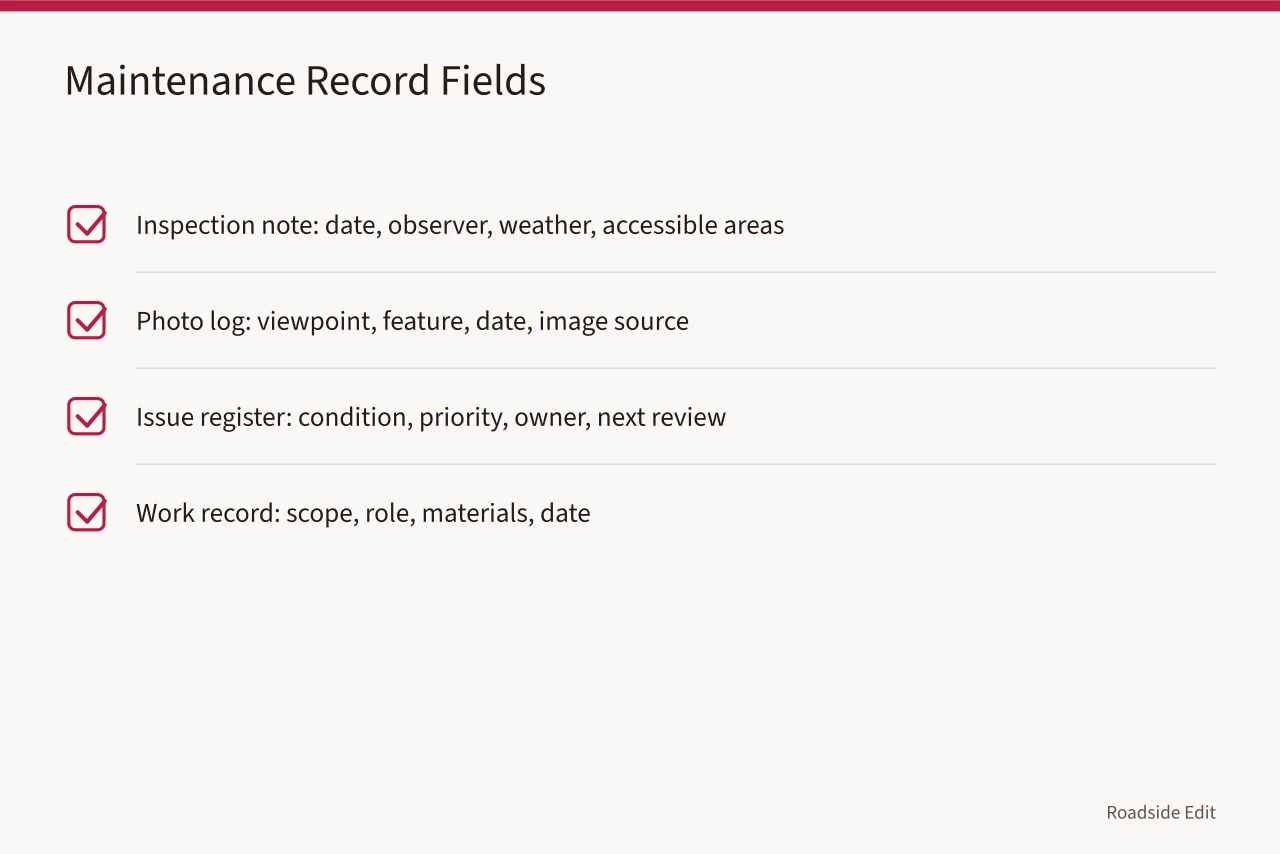
A useful maintenance plan names the feature, observation date, observed condition, and source of observation. It records the next action and who owns that action.
It preserves photographs and prior notes, so a reader can see whether a crack, leak, stain, or alteration is new, stable, or unresolved.
The National Park Service's Preservation Brief 24 recommends maintenance checklists, staff knowledge of equipment, and periodic inspection for historic buildings with mechanical systems. The specific system at a particular station requires its own qualified review. The broader lesson is sound: a maintenance plan needs a schedule and records, not a one-time promise to care for a building.
| Record | What to capture | Why it matters |
|---|---|---|
| Inspection note | Date, observer, weather, accessible areas | Gives later observations context |
| Photo log | Viewpoint, feature, date, image source | Prevents a single image from becoming the whole history |
| Issue register | Condition, priority, owner, next review | Keeps an unresolved item visible |
| Work record | Scope, contractor or volunteer role, materials, date | Distinguishes repair from speculation |
| Source file | Public record, supplied statement, or editorial research | Shows what supports each claim |
| Disclosure record | Sponsor relationship and supplied facts | Keeps commercial content separate from conclusions |
Start with the water path
For many older roadside buildings, water is the first maintenance question. Watch where rain lands, how it leaves the roof, and whether gutters and downspouts discharge away from the building.
Check whether site drainage leaves standing water near walls or foundations, and do not diagnose interior condition from exterior staining alone. Use observations to decide if extra review is needed.
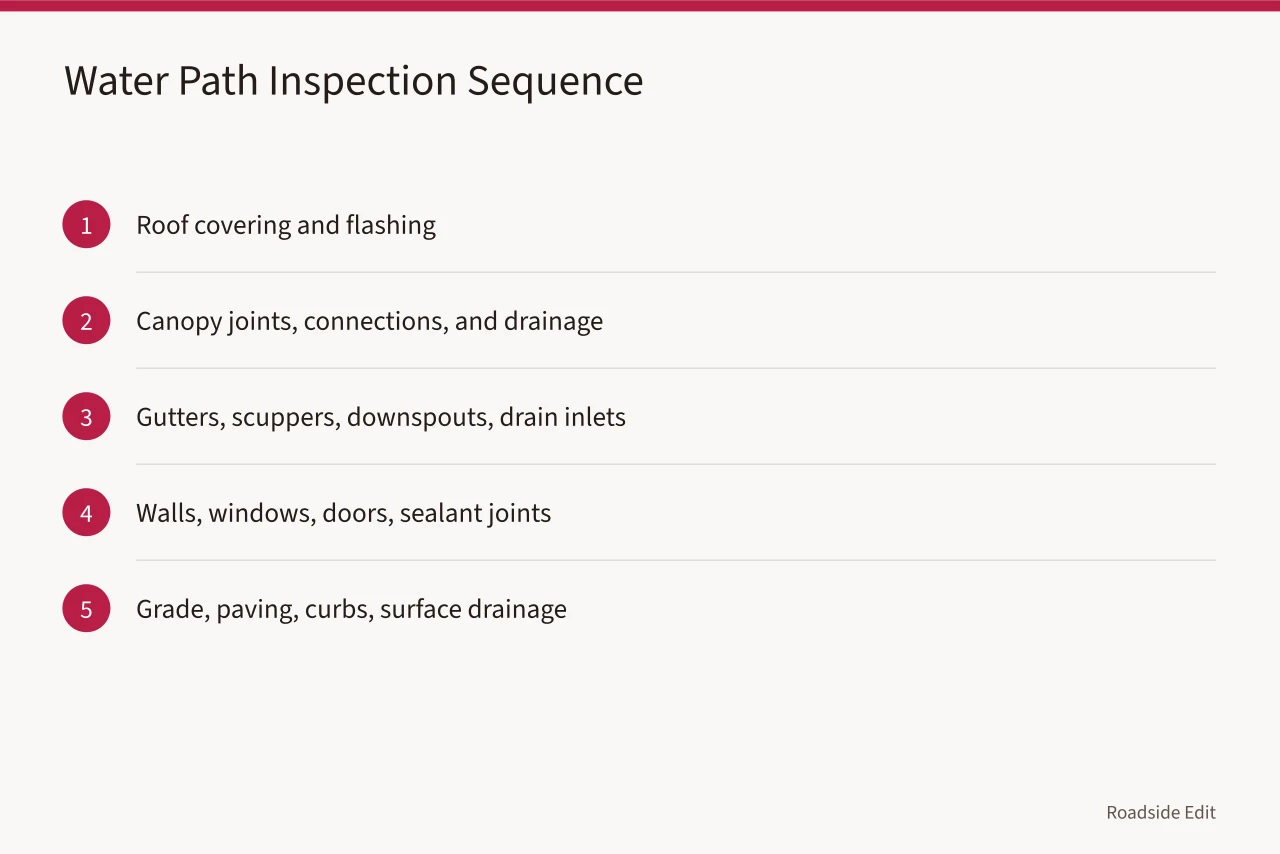
Look at the whole sequence rather than one feature in isolation:
- Roof covering and flashing.
- Canopy joints, connections, and drainage.
- Gutters, scuppers, downspouts, and drain inlets.
- Walls, windows, doors, and sealant joints.
- Grade, paving, curbs, and surface drainage.
This sequence makes a maintenance page more useful than a list of decorative fixes. A fresh coat of paint cannot correct a water path. Conversely, a stain does not prove that a whole facade needs replacement.
Create an inspection rhythm that fits the site
There is no universal calendar for every station. Exposure, roof form, climate, vegetation, active use, access, and previous conditions matter. Use a site-specific schedule, then adjust it when the records show a recurring issue.
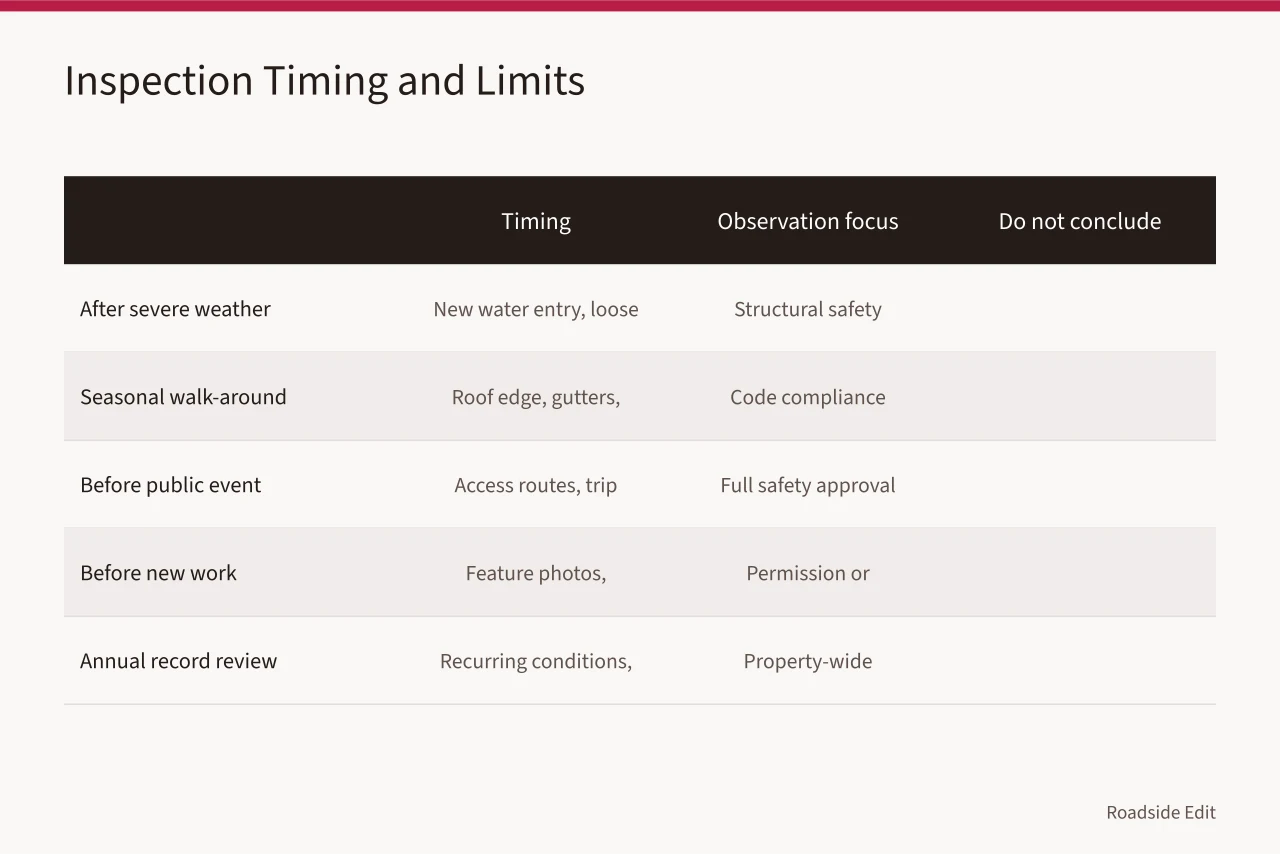
| Timing | Reasonable observation focus | Do not conclude without further evidence |
|---|---|---|
| After severe weather | New visible water entry, loose material, blocked drainage | Structural safety or full extent of damage |
| Seasonal walk-around | Roof edge, gutters, walls, openings, grade, vegetation | Code compliance or material failure |
| Before a public event | Access routes, visible trip hazards, signage, litter | Full safety approval |
| Before new work | Existing feature photos, measurements, known prior repairs | Permission or appropriateness of the work |
| Annual record review | Recurring conditions, completed work, missing data | A property-wide condition assessment |
The wording matters. A visible observation is not a professional conclusion. The maintenance record should describe what was seen, identify limits, and direct the issue to the correct person when the scope exceeds routine care.
Use repair triage instead of automatic replacement
An old station often looks better after every weathered surface is made new. That does not mean replacement is the right first response. Before publishing a repair claim, ask whether the feature is historic, whether the condition is documented, whether repair has been considered, and what work is actually proposed or complete.
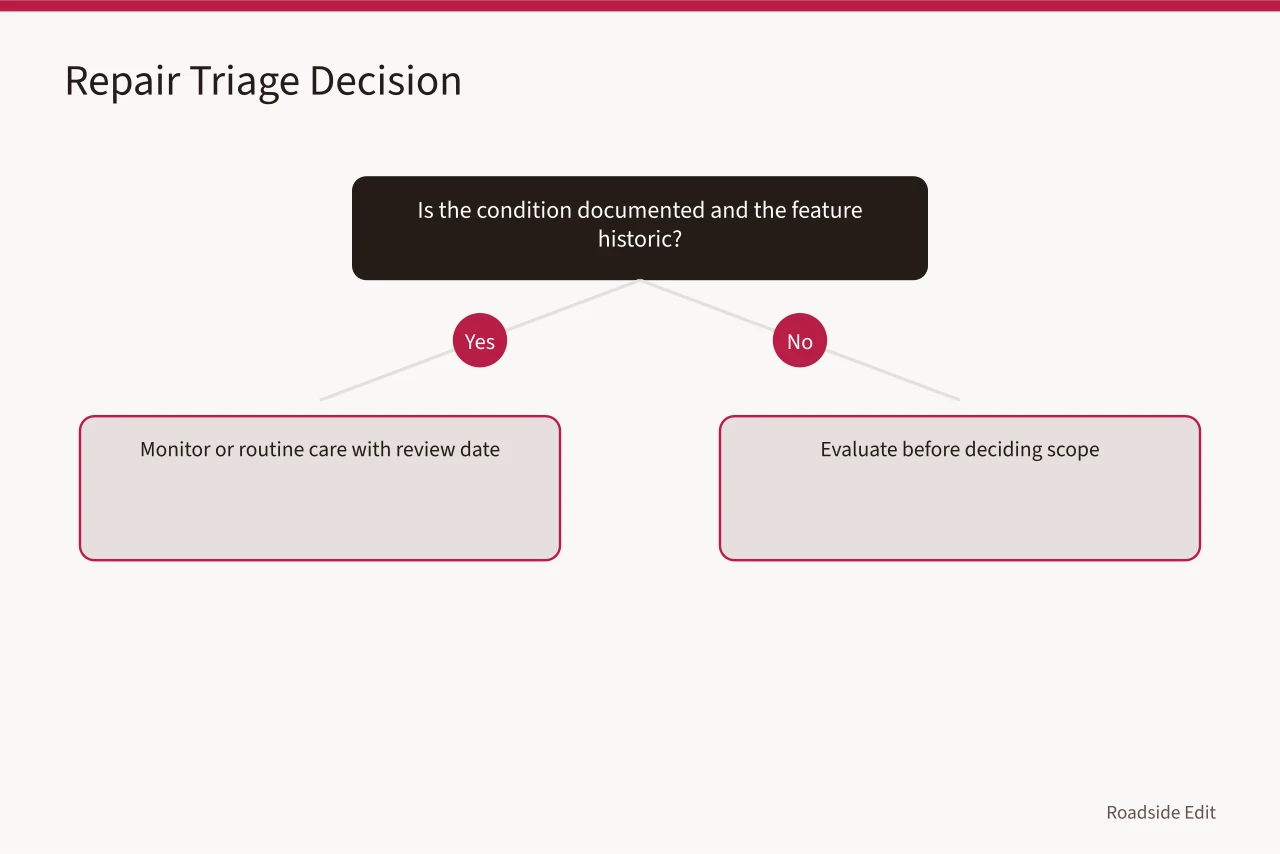
Use four plain categories:
- Monitor: note a condition and set a review date.
- Routine care: repeat a low-risk, documented task within the responsible team's ability.
- Evaluate: obtain property-specific information before deciding a scope.
- Repair or replace: document the reason, material, extent, and authorizing process.
This avoids two common failures: treating every weathered surface as a crisis, and leaving a known issue unrecorded because it is not yet a project.
Plan for systems without hiding them
A current tenant may need lighting, heating, cooling, plumbing, data, fire-safety equipment, and accessible circulation. Those needs do not disappear because a building is historic. They need a clear record of where equipment goes, how it is serviced, what historic features are affected, and how new work can remain legible.
Do not write that a new system is invisible, reversible, safe, or approved unless the relevant record supports that precise claim. An article can say, "The owner described a planned equipment upgrade," and separately state that any project-specific design and review remain outside the article's scope.
Prepare for absence as well as active use
Some stations are active businesses. Others are seasonal, vacant, or awaiting a project. A maintenance plan for limited occupancy should define who checks the site, how weather damage is documented, how unauthorized entry is reported, where emergency contacts are stored, and who can authorize work.
The purpose is not to make a vacant station look occupied, but to preserve an evidence trail and respond before preventable damage grows.
Keep editorial and commercial responsibilities distinct
Maintenance pages may attract contractors, local businesses, preservation groups, and property owners who want a profile. They can contribute useful, current information, but a paid relationship cannot purchase a favorable condition description, a claim that materials are historic, or an endorsement of a repair method. Attribute supplied information and state the date it reflects.
Editorial content should also avoid publishing a contractor's generic recommendation as if it were a diagnosis. The most credible local directory is one that names its inclusion rules, disclosures, and correction process.
The National Park Service's exterior-maintenance guidance describes maintenance as a way to spot and address conditions early. That supports an evidence-first routine of observing and recording exterior changes. It does not determine why a particular building has a stain, crack, or leak, nor does it prescribe a repair for a property this article has not assessed.
Keep the record system simple enough for a later editor. The National Archives' records-management overview describes managing records so they can be found and used.
Retain the source page, observation date, image provenance, and the exact statement the record supports. A clear file prevents old promotional copy or a vague maintenance note from becoming a fact by repetition.
Disclosure is part of maintenance reporting when a supplier, contractor, or owner pays for a profile. The Federal Trade Commission's endorsement guidance addresses material connections that can affect how readers judge an endorsement. Identify that connection near the supplied statement and reserve condition conclusions for source-bounded reporting.
Use visual material carefully
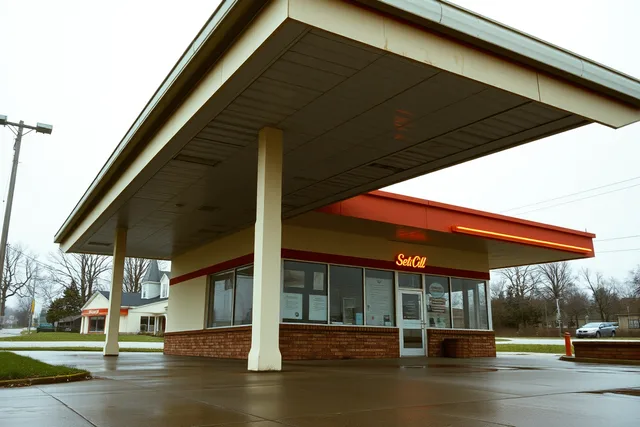
The image is illustrative and does not document another property's maintenance history, physical condition, current use, or required work.
Keep the file page, creator or collection where listed, license note, caption basis, and download date with every image. An image credit proves the provenance of the image, not the condition of the building shown or any other building.
Review the plan at least as often as the evidence changes
At each review, close completed work with a dated record, reschedule unresolved items, correct any article claim affected by new information, and remove claims that no longer have support. A plan can be short and still be useful if it tells the next reader what happened, what remains unknown, and when the site needs another look.
Make the plan usable on an ordinary day
The test of a maintenance plan is whether a new person can use it without inventing missing facts. Keep one current contact list, a map or simple site sketch, a key or access procedure where appropriate, the last inspection date, and the open issue register together.
Give recurring tasks a plain owner and due window. If the assigned person cannot safely complete a task, the record should say so. Do not rely on informal knowledge.
Review the plan after a tenant change, major weather event, completed project, or new information about the building. Those moments often change access, equipment, materials, or responsibilities.
A revised plan should keep the old record and state what changed. A future reader then gets useful history, without implying today's plan describes the building at every past point.
For publication, use the same discipline. Replace a claim only when the new source supports the wording. Keep a correction date when the change is material. An accurate, limited maintenance page will serve a local business or community group better than a polished page that makes promises the record cannot support.
Common questions
Does a maintenance plan replace a condition assessment?
No. A maintenance plan organizes recurring observations and routine action. A property-specific condition assessment requires the appropriate expertise and access.
Should every worn feature be replaced?
No. Record the feature and its condition, then determine the right level of review. Wear alone does not establish that replacement is needed.
Can a volunteer maintain a historic service station?
Volunteers can help with tasks within their training and authorization, but the plan should define boundaries and refer specialized or unsafe work to the appropriate people.
What should an article say when it does not know a repair history?
State that the repair history was not established in the available sources. Do not invent a maintenance story from an image.
In this guide
- Gas station preservation maintenance plan: how to build a 2027 visit recordGas station preservation care checklist for 2027: record visible conditions, repeat photos, flag moisture, and route repair questions for review.