Guides
Part of How to build a historic motel restoration maintenance plan owners can audit
Historic motel restoration questions to ask before you compare maintenance plans
Historic motel care questions for 2027 help owners separate visible changes, evidence gaps, review roles, and decisions that need documented support.
The right maintenance question often matters more than a quick answer. At a historic motel, an observation can be clear while its cause, urgency, and next step remain unknown. A question set keeps those categories separate.
What to take away
- Ask what was observed before asking why it happened.
- Match a question to the person who can answer it.
- Record an unanswered question as a valid result.
- Do not convert a forecast or a possibility into a property fact.
Ask from the evidence outward
National Park Service research on structural prognosis describes methods for forecasting condition that can assist condition-based maintenance. Review the NPS research overview on condition forecasting. This supports a careful distinction between evidence, forecasting methods, and a condition conclusion for a specific place.
For a motel record, begin with the evidence on hand. A dated image, staff report, invoice, or prior assessment can frame a question. None of them automatically answers it.
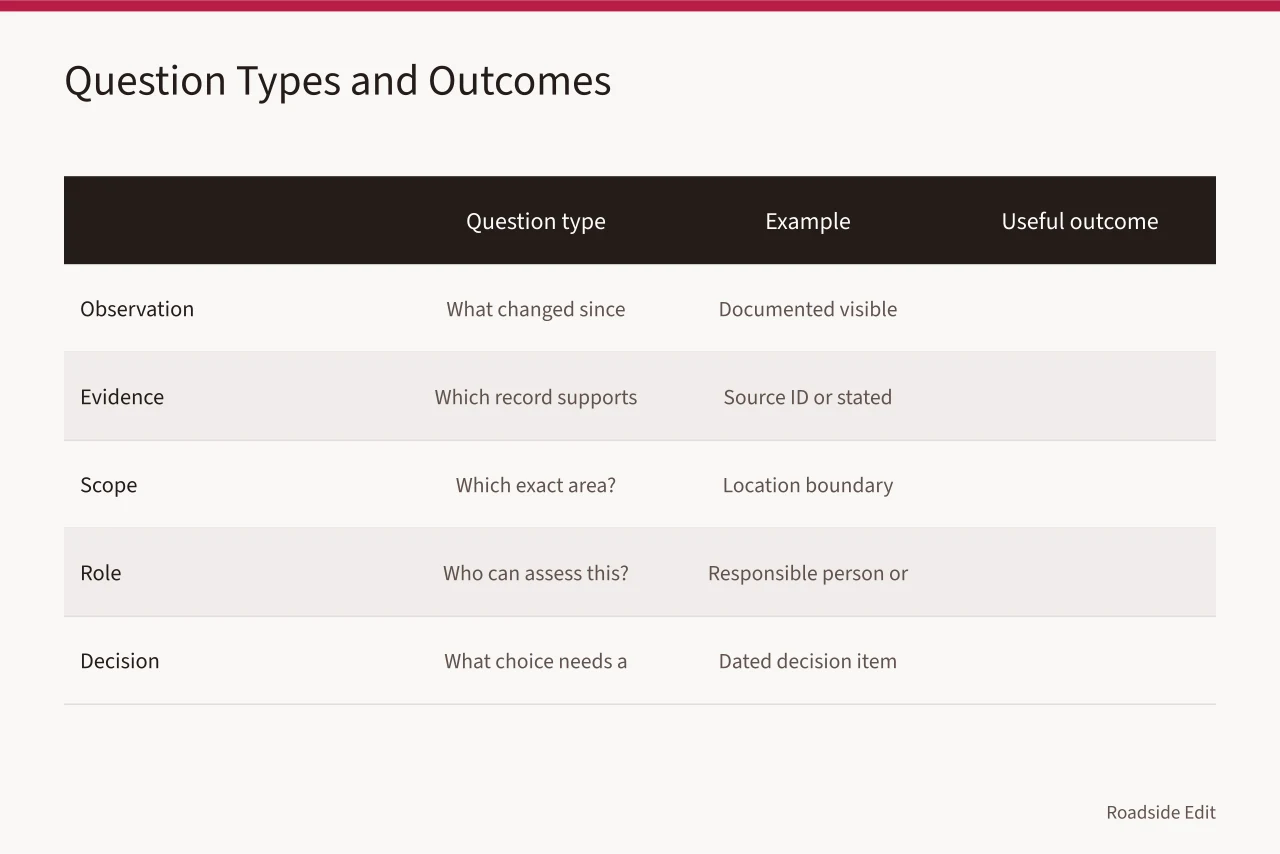
| Question type | Example | Useful outcome |
|---|---|---|
| Observation | What changed since the last dated photo? | A documented visible difference |
| Evidence | Which record supports this description? | A source ID or a stated gap |
| Scope | Which exact area does the note cover? | A location boundary |
| Role | Who can assess this question? | A responsible person or service |
| Decision | What choice needs a record? | A dated decision item |
Questions worth keeping open
Use questions that preserve uncertainty rather than disguise it.
- What exactly is visible, and where?
- When was the feature last photographed or described?
- Is the change new, recurring, or not yet comparable?
- What document gives the feature its historic context?
- Does the record identify a qualified person to review it?
- What decision is being requested, if any?
An open question is not an incomplete plan. It is a clear handoff. It tells the next reviewer what remains to be learned and prevents a public article from treating an assumption as settled.
Keep questions from becoming recommendations
Avoid phrasing such as "should be replaced" unless a supporting, site-specific record says that and the article is accurately reporting it. Instead, ask, "What evidence is needed before a material decision is made?" That form invites proper review without making the page sound evasive.
Date each question. If it is later answered, retain the original wording and add a response with its source. This makes the decision trail readable after staff, ownership, or publication systems change.
Ask questions in a useful order
Begin with the smallest question the record can answer. Identify the feature, location, and observation date. Then ask what earlier item can be compared fairly. A photo from another elevation or an undated staff memory may be useful context, but neither closes a question about this specific area.
The NPS documentation standards call for reliable sources and recognition of a source's limits. Use that standard as an editorial habit. Write down which part of the question is supported by a dated record and which part needs a new review.
| Question stage | Example prompt | Record that can answer it |
|---|---|---|
| Identify | What feature is under discussion? | Location map or photo key |
| Compare | What is different from the earlier record? | Comparable dated image |
| Interpret | What evidence supports a cause? | Defined report or assessment |
| Decide | Who has authority to choose a response? | Dated decision entry |
The Library of Congress guide to primary sources recommends observation and reflection before questions are answered. In this setting, that means recording what a document shows before treating it as a conclusion about condition or treatment.
Give unanswered questions a next action
An unanswered question should not vanish from the record. Give it an owner, a date for another look, or a clear statement that it requires a different kind of information. That small addition turns an uncertainty into a usable handoff.
The NPS overview of preservation planning and development describes documentation as information used in later planning work. A good question log preserves that information path. It should never imply that a pending review has already settled the issue.
For public copy, avoid turning a question into a recommendation. "What evidence is needed before a material decision?" is accurate when the record is incomplete. "Replace the material" is not, unless the article is reporting a documented, property-specific decision and gives the source.
Common questions
Can a question list include technical terms?
Yes, when the term comes from a defined source or qualified record. Pair it with a plain-language location note so other readers can follow it.
What happens when a question has no answer?
Keep it open, name the missing evidence, and identify the next review trigger. Do not remove it merely because it is inconvenient.
Is a photo enough to answer a maintenance question?
Usually it documents appearance at a date and location. It may not establish cause, condition, scope, or an appropriate action by itself.