Guides
Part of How to build a historic motel restoration maintenance plan owners can audit
How to keep historic motel restoration budget notes clear for 2027
Historic motel restoration budget notes work when each figure names its feature, its source and its status, so a later reader knows what the number proves.
Budget notes record what a figure covers, who supplied it, and what it does not prove. They are not a bid comparison or a recommendation to pick one material over another.
What to take away
- Label every figure by feature, source, date and status: allowance, estimate, approval, invoice, or paid.
- Read Preservation Brief 15 on historic concrete before a treatment decision, because significance guides the choice.
- Write a changed figure as a new dated row, never as an overwrite of the old one.
- Keep the evidence file, the survey photographs and the budget note in the same folder.
- Publish categories and arithmetic, never an owner's spending capacity.
Let significance set the scope before the number
The National Park Service's Preservation Brief 15 on historic concrete covers maintenance, repair and replacement, and holds that significance guides the decision. A 1950s poured-concrete canopy column with an intact integral color is a different object from a 1960s brick veneer pier beside it, even when both need repointing.
That order matters for a motel file. Decide what the feature is, and whether it carries the property's period of significance, before anyone prices the work. A number entered first will quietly become the scope.
Give each figure a status, not just a value
A staff planning allowance is not a contractor estimate. An estimate is not an approved commitment. An approval is not an invoice, and an invoice is not proof of completed work.
| Field | What it holds |
|---|---|
| Feature and location | The actual element, such as the north canopy soffit or the pump-island curb |
| Status | Planning allowance, estimate, approval, invoice, or paid record |
| Source and date | Who supplied the figure and when |
| Scope boundary | What is inside the figure and what is excluded |
| Decision link | The question the figure is meant to inform |
| Update row | A new dated line explaining what changed |
Write a line that survives a handoff
"Sign, 8,000" fails a reader twice. It names no sign, no scope, no date, and no status. A line that reads "Planning allowance entered March 22 for a future review of the north sign area; no repair scope or material choice established" tells the next person exactly how little it claims.
Where a figure is a share of a whole, write the arithmetic in named variables. A survey day rate times days, plus travel, plus fabrication, gives a total a reader can re-run with their own numbers. Do not carry a borrowed figure.
Keep the record current without erasing it
When a scope grows, add a row. The old estimate stays visible with its date, and the new row states what changed in scope, source or status. Overwriting destroys the trail that shows why the figure moved.
The GSA guidance on developing and managing project costs treats estimates as things that change as scope firms up. The same habit fits a restoration file, and the Roadside design studio cost budget notes show how to track estimates without a false total.
Keep cultural value out of the money column
The NPS preservation planning overview connects property documentation to planning and design work. That is the argument for keeping the evidence file beside the budget note rather than inside it.
A cost field should never decide whether a butterfly roof or a porcelain-enamel sign matters. Equally, a historic description should not be used to invent a price.
The NPS documentation guidance asks for reliable sources and stated limits. Name where each number came from. A figure copied out of a conversation is an unverified planning note, and it should be labeled that way.
Where the file meets the trades
A repointing or recasting scope that touches a canopy, a neon transformer or an underground tank is not a budget question first. It is a question for the licensed engineer, electrician or environmental authority, and the local authority having jurisdiction sets the requirement.
The same holds for easements, historic tax credits and cross-border import duties on salvaged booths or neon parts. Those belong with the attorney, accountant or customs broker, not in a planning note.
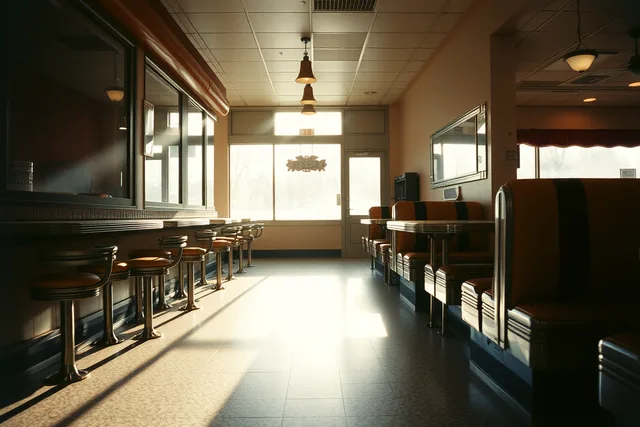
An exterior scope that changes materials should run through the State Historic Preservation Office or the local landmarks commission under the adopted ordinance and Section 106 review where federal action is involved. The diner interior budget notes show the same split between survey days, travel and fabrication on an interior scope.
Common questions
Is an estimate the same as a completed cost?
No. Keep allowance, estimate, approval, invoice and paid record in separate statuses so a reader can tell what each figure actually proves.
Can a maintenance plan just pick the cheapest option?
The plan can record how a decision was reached. The treatment choice itself needs property-specific evidence and the review the property requires.
Should budget notes be published?
Publish categories, arithmetic and labeled uncertainty. Private figures and unsupported assumptions stay out of public copy.