Guides
Part of How to build a historic motel restoration maintenance plan owners can audit
How to build a historic motel maintenance checklist for 2027
A motel observation checklist works when every entry names a place, a date, a photo ID and a visible condition, leaving causes for later review.
A care checklist gives a historic motel a repeatable way to record what a walk-through can see. Its job is the starting record, not the diagnosis.
What to take away
- Every entry carries a location, a date, an observer and a photo ID.
- Describe the visible condition first; the cause waits for evidence.
- Reuse the same location names on every visit so entries line up over time.
- Keep superseded notes and point them to the dated replacement.
- A checklist organizes evidence for a decision; it does not make the decision.
One row per feature, not per building
The National Park Service says a maintenance plan starts with documentation. Its stained glass guidance lists historical research, descriptions, measurements and photographs as useful elements. See the NPS discussion of documenting conditions.
That page covers stained glass, not motel features, but the recordkeeping model holds. Define what is present before deciding about it.
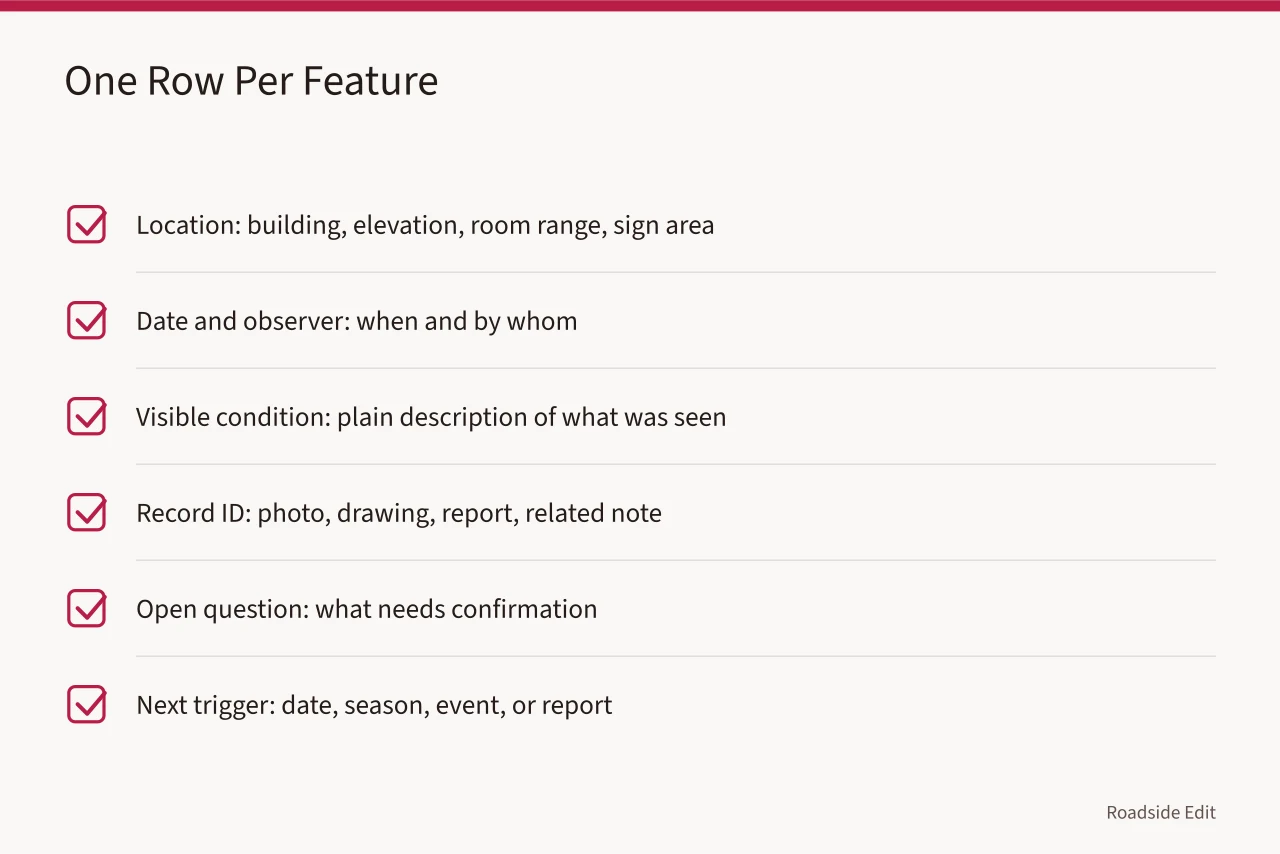
Use one row per feature or small area. Do not combine several locations into an entry called "front exterior." A future reader needs to know exactly where the note applies.
Write what a visitor could point to
"Paint is lifting near the bottom of the east door frame" is an observation. "Water is entering behind the frame" is a conclusion that needs support. When the cause is unknown, write that it is unknown.
Neutral wording keeps the file useful to several people. A manager can add a timely note. A preservation professional can review the record without untangling speculation. An editor can prepare a public update without presenting an unverified explanation as fact.
A walk-through sequence that survives staff changes
- Confirm the date and the part of the property being reviewed.
- Use the location labels already in the baseline file.
- Take a wide photo, then a closer one if needed.
- Record visible change in one short sentence.
- Add the photo ID and any report that triggered the review.
- Leave a question open when the evidence is incomplete.
Keep old entries. If an earlier entry is corrected, label it superseded and point to the dated replacement. A checklist earns its keep by holding the trail, not just the latest summary.
Separate the note from the record that supports it
A photograph can support a description of appearance at a particular time. A report may support a conclusion within its stated scope. A decision record can show that someone approved a next step. Do not compress those roles into one sentence.
The NPS standards for historical documentation call for source identification and careful treatment of conflicting evidence. In a motel log, keep the date and source beside a correction. If a later record changes the first description, add a brief correction line instead of silently replacing the older note.
The National Archives guidance for digital photographic records explains the value of identifiers and descriptive metadata for photographs. Give each checklist image a stable ID, date, location and plain caption. A folder name may help retrieval, but the checklist itself needs enough context to stand alone later.
The handoff test
Staff, ownership and software folders change. A simple record outlasts them. Put the property name and page date on each export, use ordinary location names, and define an internal abbreviation once if the team relies on it.
The NPS overview of preservation planning and development describes documentation as part of the work that informs scope and design. That is a useful stopping point for a checklist: it supplies organized evidence for a later decision, but it does not make the decision itself.
Then test it. Give one completed page to someone who did not make the entry. They should find the place, understand what was observed, identify the linked record, and see what is unresolved. If they cannot, add context rather than stronger claims.
Common questions
Is a care checklist a condition assessment?
No. It is a practical observation record. A condition assessment or diagnosis requires the appropriate evidence and the right professional role.
Should every item have a photo?
Not always, but a photo helps most when an item will be compared over time. Give it a date and a clear location label.
What if the observer does not know the feature name?
Use a plain location description and note that the feature name is unconfirmed. Do not invent a technical term to make the entry sound complete.