Guides
Part of How to build a historic motel restoration maintenance plan owners can audit
How motel owners can keep historic restoration records straight in 2027
Historic motel care records for 2027 explain how to log source roles, observations, decisions, corrections, and media credits without mixing their purposes.
A care record is a map of where each statement came from and what it is allowed to mean. It is especially useful when an article draws on photographs, historic material, owner notes, and technical sources at the same time.
What to take away
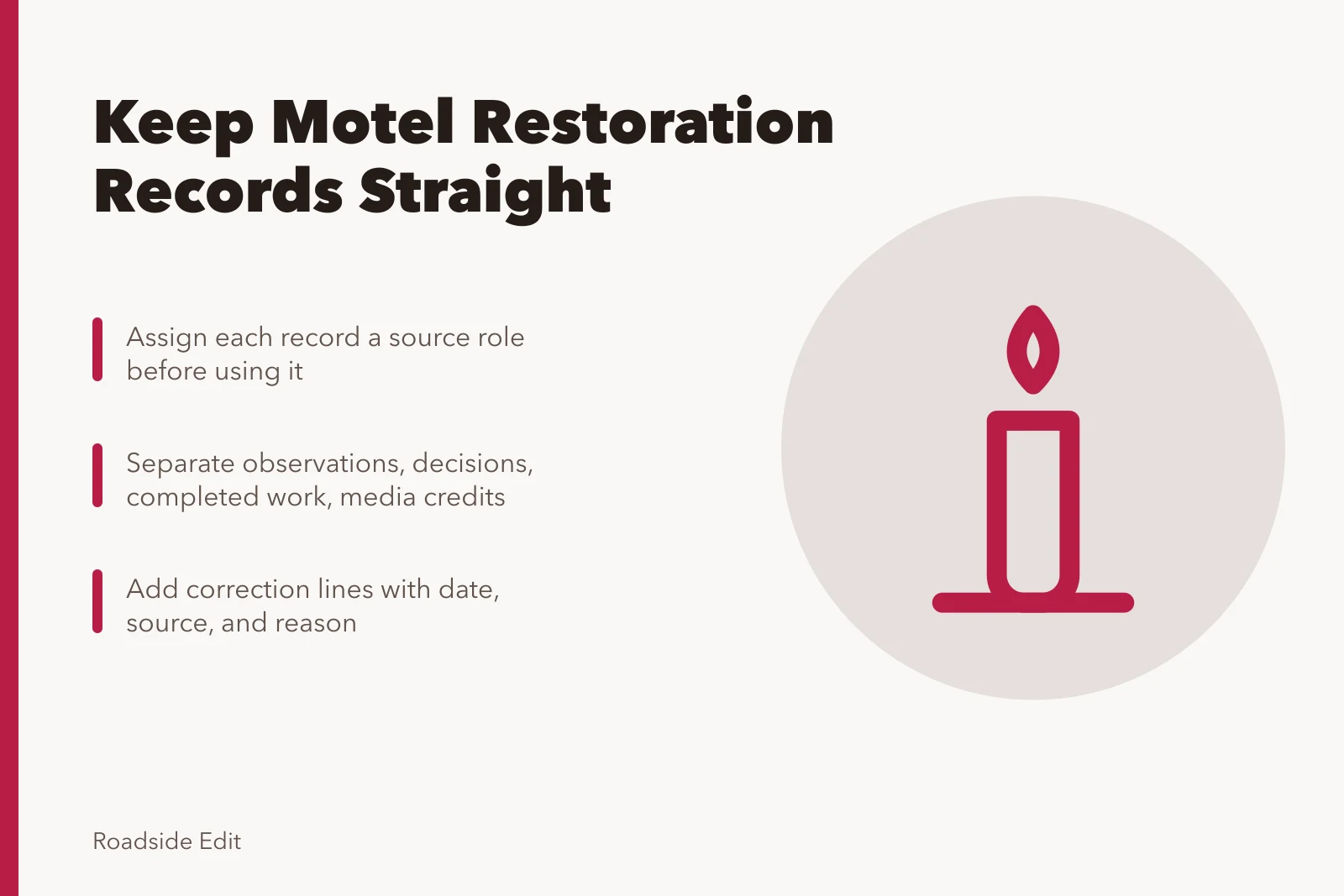
- Give every record a source role before using it in copy.
- Keep observations, decisions, completed work, and media credits separate.
- Preserve corrections with dates and reasons.
- Make uncertainty visible rather than smoothing it away.
Assign a source role
The National Park Service describes Conserve O Grams as focused technical guidance for collections-care staff. Browse the NPS Conserve O Gram series. That series is not a site-specific maintenance instruction for a motel, but it illustrates why source roles matter: a technical reference, a property record, and an image credit do different jobs.
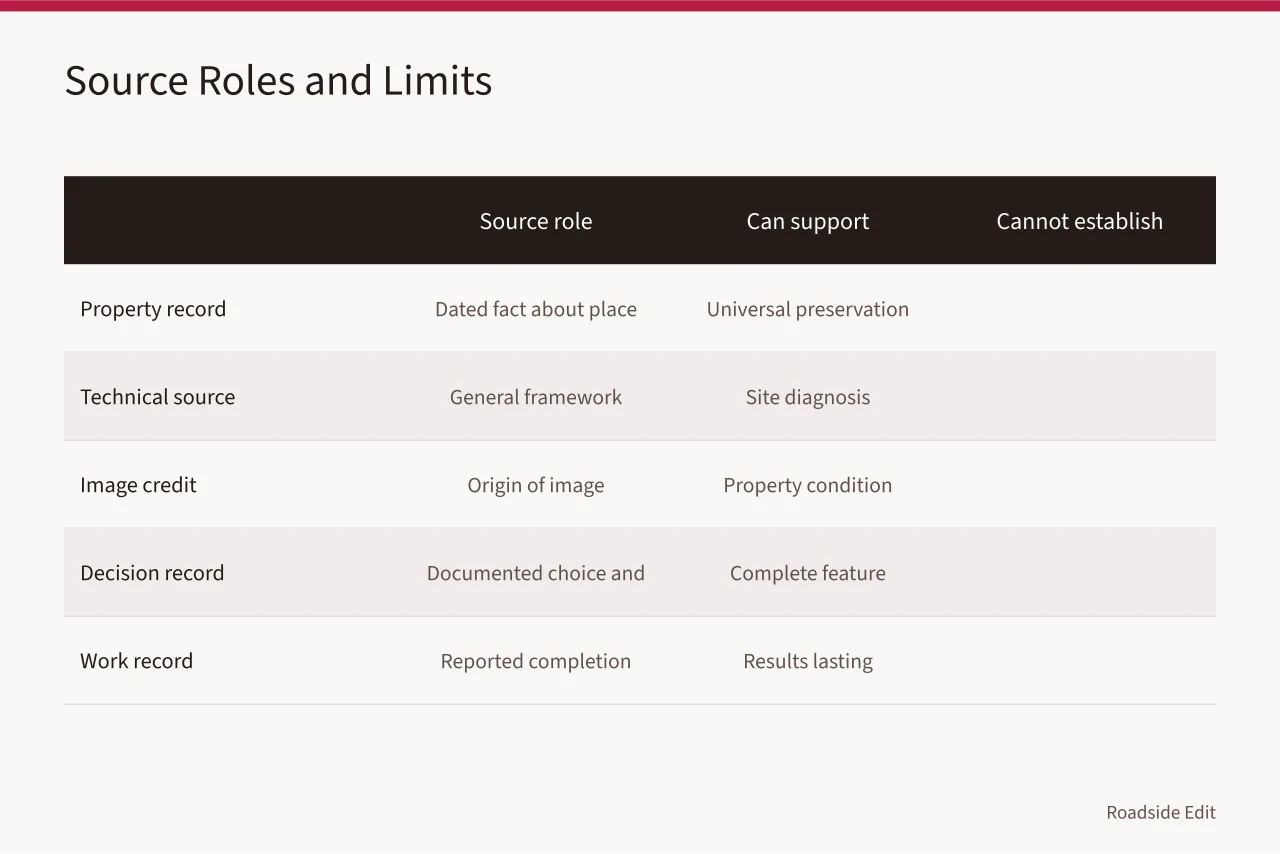
Use a small source register so a later writer does not borrow authority from the wrong kind of document.
| Source role | What it can support | What it cannot establish alone |
|---|---|---|
| Property record | A dated fact about a defined place | A universal preservation rule |
| Technical source | A general framework or terminology | A site diagnosis or approved project |
| Image credit | The origin of a published image | A claim about the depicted property's condition |
| Decision record | A documented choice and its date | A complete history of the feature |
| Work record | What was reported as completed | Whether results will last indefinitely |
Keep four kinds of entries apart
An observation says what a person saw. A source note says where a statement came from. A decision record says what someone approved or declined. A completed-work record says what documentation reports as finished. They can refer to the same feature, but they should not share the same status field.
This simple separation prevents a common error: an article starts with a photograph, adds a technical phrase, and ends by sounding as if a treatment decision has already happened. The record should make every jump visible.
Use a correction line
When a later source changes an entry, add a correction line instead of silently replacing the original text. Include the date, the new source, the part corrected, and the reason. For example, a photo caption may be updated after a location is confirmed. The earlier caption can remain in the record with a note pointing to the correction.
Do not use the correction process to make an uncertain claim look settled. If a fact remains unknown, retain that status. Clear limits are useful information for an owner, collaborator, or future editor.
Create a source register that stays readable
Give each record an ID, title, date, source role, location, and note about its limit. A source register is not busywork. It prevents a later writer from giving an image the authority of a technical report or treating a decision note as proof of completed work.
The National Archives guidance on digital photographic records describes the need to manage photographs with identifying and descriptive information. Apply that idea to every property image. Record the file ID, date, place, creator when known, and what the image can actually show.
| Entry type | Records | Does not prove |
|---|---|---|
| Observation | A visible condition at a stated time | The reason it appeared |
| Source note | Where a statement came from | That the statement fits every location |
| Decision entry | A documented choice | That work occurred |
| Work record | Reported completion of defined work | The long-term result |
Preserve evidence when a description changes
The NPS historical documentation guidelines address identifying sources and recognizing conflicts in the record. When a new source changes a location, material name, or caption, keep a dated correction line. The older entry stays visible with a note that points to the newer evidence.
The NPS preservation planning overview describes documentation as information used in planning and development. A record with clear roles can support later work because readers can see which statement came from which source. It should not be rewritten to make a tentative item sound settled.
When records are prepared for publication, remove private information and keep only statements that the published sources support. A clean public version can still point to a stable record ID without exposing internal notes.
Common questions
Can one source serve every role in a care record?
Usually not. A photo, technical article, and project document each have different limits. Identify the role before using the source.
What is the best format for a source register?
A spreadsheet, database, or organized document can work. The important fields are a stable ID, title, date, source role, location, and notes about limits.
Should a correction delete the original entry?
No. Keep the original with a clear dated correction so readers can understand what changed and why.