Guides
Part of How a roadside architecture maintenance plan keeps observation separate from repair work
How a roadside architecture maintenance checklist keeps exterior surveys repeatable
Roadside architecture maintenance checklist for 2027 gives U.S. readers a repeatable, safe way to document visible exterior changes and limits.
What to take away
- Use this list to record what you can see, not to diagnose a building.
- Repeat the same route, feature names, and photo positions each time.
- Pair every observation with a date, viewpoint, and a plain statement of what remained out of view.
- A detached feature or blocked public route calls for distance and a responsible reporting path, not closer inspection.
Set up a lawful observation round
This checklist suits a roadside motel, diner, service station, sign, attraction, or small commercial building in the United States. It is for a writer, volunteer, or property contact who needs a useful exterior record. It does not authorize entry, climbing, probing, or testing.
Start at a place you may lawfully stand. Give each visible item a fixed name, such as "east canopy," "office sign face," or "north storefront window." Those labels matter more than clever descriptions. A later reader can compare two notes only when both refer to the same item.
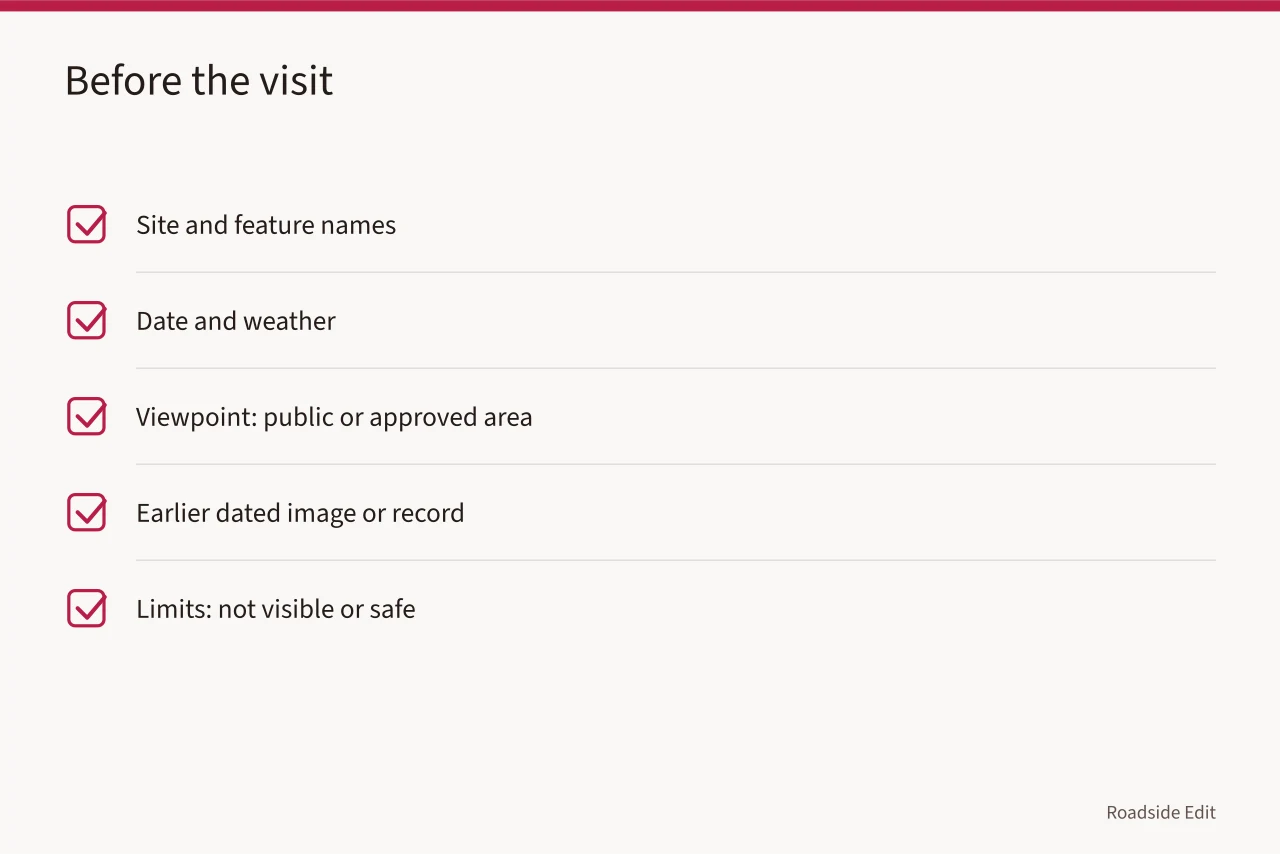
| Before the visit | Put in the log |
|---|---|
| Site and feature names | Names already used in the record |
| Date and weather | Enough context for a later comparison |
| Viewpoint | Public street, sidewalk, or owner-approved area |
| Earlier evidence | Prior dated image or work record, if one exists |
| Limits | Areas that were not visible or safe to approach |
The National Park Service says its exterior-maintenance brief covers regular inspection, monitoring, seasonal work, and maintenance treatments for historic building exteriors. See NPS Preservation Brief 47. Treat that material as general preservation guidance. It does not replace a site assessment.
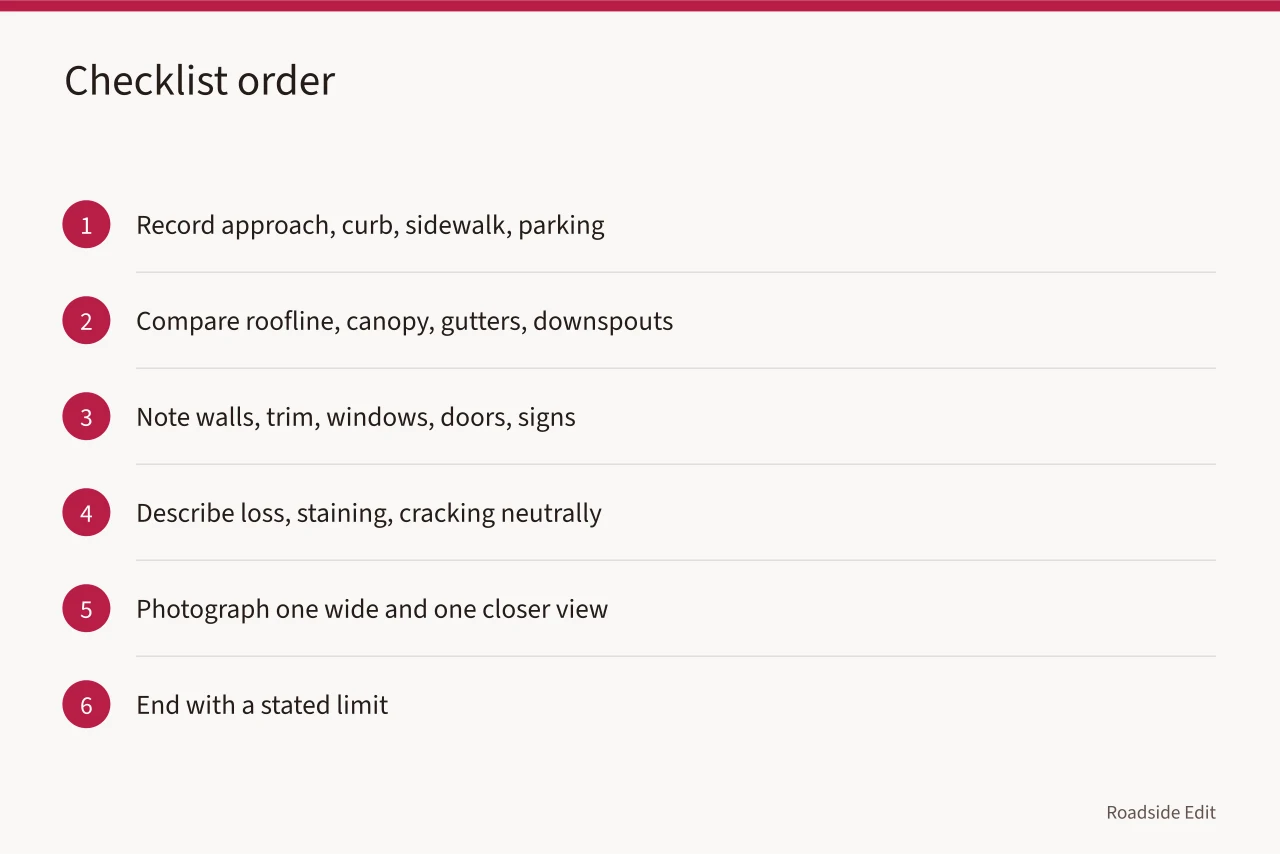
Follow the checklist in order
Complete a broad view before photographing details. A tight photo of peeling paint or a loose panel can lose its meaning without a wider image that shows the feature and its position. Take only images from the lawful point recorded in the log.
The NPS moisture brief recommends ongoing monitoring after moisture is managed and says that diagnosis differs with location, climate, soils, groundwater, and construction traditions. Review NPS guidance on unwanted moisture. That is why a visitor should record staining or pooled water as visible evidence rather than call it a leak, drainage failure, or structural problem.
Use a short condition vocabulary
A shared vocabulary reduces accidental claims. It also makes a spreadsheet easier to sort later.
| Record this phrase | It means | Do not turn it into |
|---|---|---|
| "Visible in current image" | The feature can be seen in one dated view | A conclusion about hidden conditions |
| "Different from prior image" | The comparison shows a change | Proof of the date or cause of that change |
| "Not observed" | The item was outside the visit's view or access | Evidence that it does not exist |
| "Needs follow-up" | The record should reach a responsible person | A repair specification |
For preservation work, NPS describes a documentation plan as part of work that retains existing form, features, and materials. Read NPS preservation treatment guidance. A simple field checklist cannot supply a formal documentation plan, but its dates, photographs, and stated limits give a later project team a cleaner starting record.
Mark the next action without prescribing work
The checklist's final line should state what happens to the record. Most notes are filed for comparison. A visible change may warrant notifying an owner, manager, public agency, or qualified professional through the property's applicable route.
If a condition appears to affect public access, keep clear and use the responsible party's safety or reporting process.
| What the checklist shows | Sensible record action |
|---|---|
| No meaningful visible change | File the entry with its images |
| A changed finish or missing small feature | Keep a dated comparison and log a question |
| A project notice or supplied work record | Attach the record and describe only its stated scope |
| A possible immediate access concern | Remain at a safe distance and report through the appropriate channel |
The NPS treatment standards say that their guidance is not case-specific advice and recommend early consultation with preservation professionals for project work. Read how NPS frames treatment guidance. Keep the checklist on its side of that line: observation, comparison, and routing.
Common questions
Is this checklist an inspection report?
No. It records visible conditions from a stated viewpoint. It does not assess structure, code compliance, hazardous materials, or repair needs.
What if a feature cannot be seen from the street?
Write that limit in the entry. Do not enter private property or fill the gap with an assumption.
Can the same form cover a sign and a building?
Yes, if each item has its own feature label and photographs. Do not combine a sign, canopy, and wall into one vague condition note.