Guides
Part of How a modern roadside design safety checklist works before work begins
How a modern roadside safety checklist keeps 2027 field notes usable
Modern roadside safety field checklists for 2027 help U.S. teams document route conditions, ownership questions, and findings for the proper review path.
A field review is a structured observation, not a safety certification. Its job is to record what a team can see from a safe, permitted position, identify what it cannot confirm, and hand the finding to the responsible person. Use it before an improvement, a vendor visit, an editorial photo session, or a recurring maintenance task.
What to take away
- State the task and boundary before walking the area.
- Observe the route used by real visitors and workers.
- Write conditions, not conclusions about compliance or cause.
- Give every open issue a named recipient and follow-up date.
Prepare before the visit
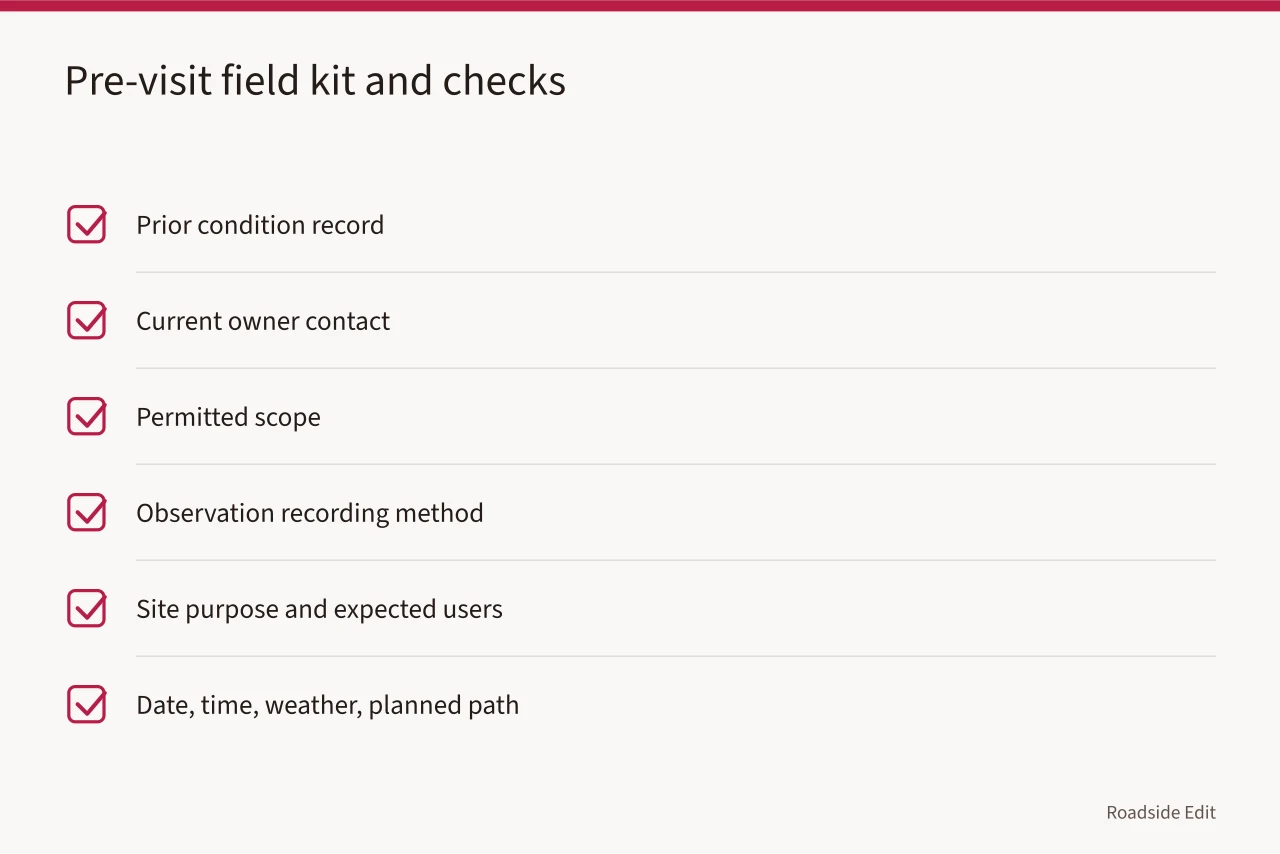
The Federal Highway Administration describes road safety audits as formal, multidisciplinary reviews that consider all road users, document findings, and require a formal owner response. A small field checklist is not a road safety audit, but FHWA's audit overview supports using a written finding and an owner response rather than treating a verbal impression as a completed safety review.
| Field item | Direct observation | Record owner |
|---|---|---|
| Arrival route | Walking, driving, or service approach used | Site manager |
| Edge condition | Curb, slope, vegetation, debris, or surface change | Responsible owner |
| Feature condition | Loose part, unreadable information, or visible damage | Designated reviewer |
| Work exposure | Traffic, equipment, weather, or lighting issue | Task lead |
| Unknown authority | Route, utility, permit, or public-area question | Owner contact |
Walk the ordinary route
Start where a person would arrive, not where a plan drawing begins. Note turns, crossings, uneven areas, obstructions, glare, delivery conflicts, and places where a visitor must choose a direction. Do not enter a traffic lane, climb an element, or move an obstruction to improve the view. If the route cannot be assessed safely, record that limit.
Close the field note
End with a short action table. Mark each issue as observed, referred, authorized, or closed. "Closed" should mean the accountable person has documented the outcome, not merely that a message was sent. Keep photos with their date, direction, and purpose; avoid publishing details that expose private access or security information.
Keep the record source-specific
The NPS standards for historical documentation require reliable sources and clear limitations. Apply that standard to each field note. A photograph can show the appearance of a defined spot at a date. It cannot establish a hidden condition, code status, or a final treatment.
The National Archives guidance for digital photographic records explains the importance of descriptive information with image files. Keep a stable ID, date, location, direction of view, and short caption. The media credit identifies the image source; it does not certify the feature in the image.
The Access Board guide to accessible routes describes connections from arrival points to accessible entrances. It may help a team identify which route facts need current review. It does not decide whether the route at this property meets applicable requirements.
Write a follow-up note before leaving the file. State what was observed, which source supports it, what remains unknown, and which role receives the question. This keeps an early field note from becoming a public conclusion.
Hand off findings with a usable record
Group observations by the person or office that can act on them. A field team may identify a surface change, but only a property manager, public agency, utility owner, or qualified reviewer can decide the next step.
For each item, write the exact location, observation time, a plain description, the person notified, and the requested response date. Keep original wording even when a later reviewer interprets it differently.
Avoid assigning a technical cause from one walk: "Water collecting at the entry edge after rain" is an observation. "Failed drainage design" is a conclusion needing more evidence.
The same distinction applies to visibility, accessibility, structural condition, and traffic exposure. A clear handoff lets the responsible person ask better questions, arrange a review, and report back without turning the field note into a claim it cannot support.
Common questions
Is a field checklist a safety audit?
No. It is a limited observation record and does not replace a formal review where one is needed.
Should staff fix a problem during the visit?
Only if the task is within the approved scope and can be completed safely. Otherwise document and report it.
What makes a finding useful?
An exact location, date, clear observation, record of the responsible recipient, and a next review point.