Guides
How a modern roadside design safety checklist works before work begins
Modern roadside design safety checklists for 2027 help U.S. owners define work limits, document hazards, plan escalation, and protect ordinary users and workers.
Roadside safety begins by recognizing what a general checklist cannot do. It cannot say whether a particular site is safe or who controls a public right-of-way. It cannot authorize a work zone or replace an owner, agency, engineer, or qualified safety professional.
What it can do is organize the questions to answer before maintenance, photography, a small improvement, an event, or a contractor visit creates an avoidable risk.
This guide is for a U.S. owner, manager, editor, or project team dealing with a roadside feature such as a sign, seating area, planting edge, parking approach, wall, marker, art feature, or visitor cue. Treat it as a record-building tool. Each answer should identify the observation, the source, the responsible role, and the next review.
What to take away
- Define the location, ownership boundary, and task before discussing safety.
- Separate an observed condition from a technical conclusion.
- Do not enter or create a work area near traffic without the responsible process.
- Give every condition a report route and a record owner.
- Pause when the task involves traffic exposure, utilities, structural concerns, or an unknown authority.
Start with a boundary map
"Roadside" can cover private land, an easement, a sidewalk, parking circulation, and a shoulder. It can also mean a state route or a local street, and those places may have different owners, access rules, and review processes.
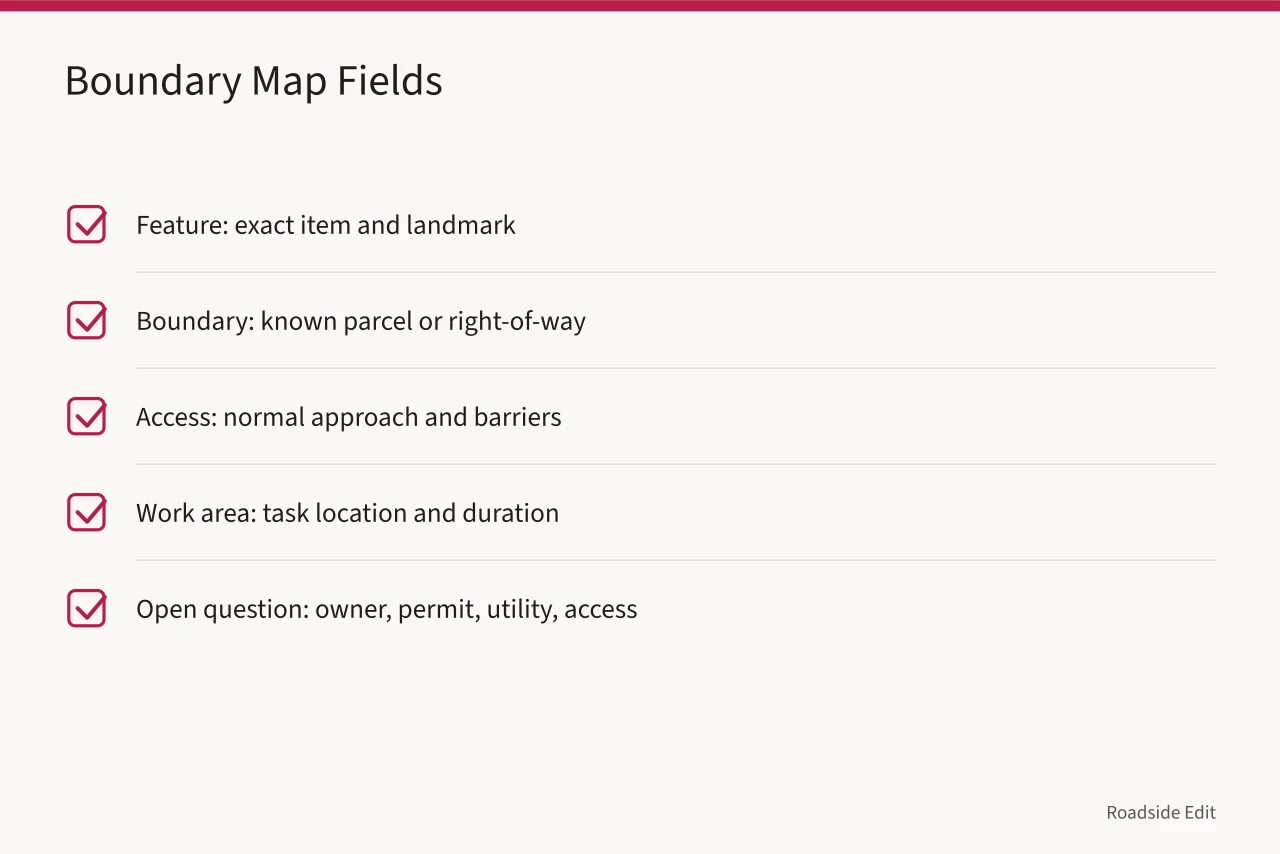
Before anyone works, draw a simple map of the feature and its immediate approaches, and mark known ownership and unconfirmed ownership.
Include arrival routes for people walking, driving, cycling, making deliveries, or doing maintenance. Note parking, drainage, slopes, gates, curbs, utilities, overhead lines, sightlines, and features that could affect the route. The map is not a survey or an approval. It prevents an informal task from quietly expanding beyond its lawful or safe boundary.
| Map field | Record | Do not assume |
|---|---|---|
| Feature | Exact item and nearby landmark | The public name identifies ownership |
| Boundary | Known parcel or right-of-way information | A paved edge is private property |
| Access | Normal approach and known barriers | A maintenance route is open to visitors |
| Work area | Proposed task location and duration | A small job needs no traffic planning |
| Open question | Owner, permit, utility, or access question | A missing answer is approval |
Define the task before the hazard list
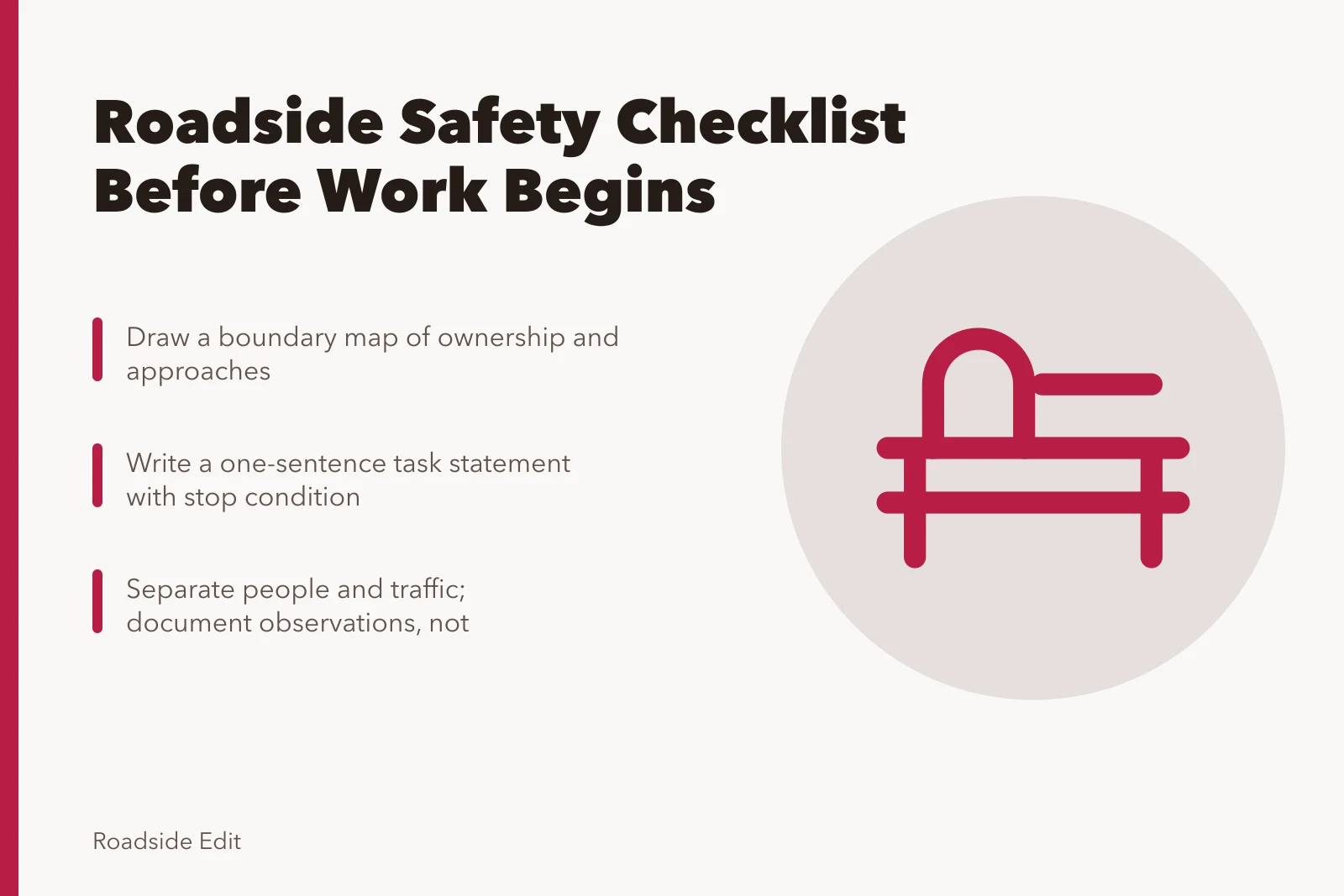
Safety questions depend on the work. A photographer in a legal public spot faces different exposure than someone washing a sign, trimming vegetation, excavating, replacing a light, or unloading materials. Write a one-sentence task statement with location, people involved, equipment, time of day, and expected duration.
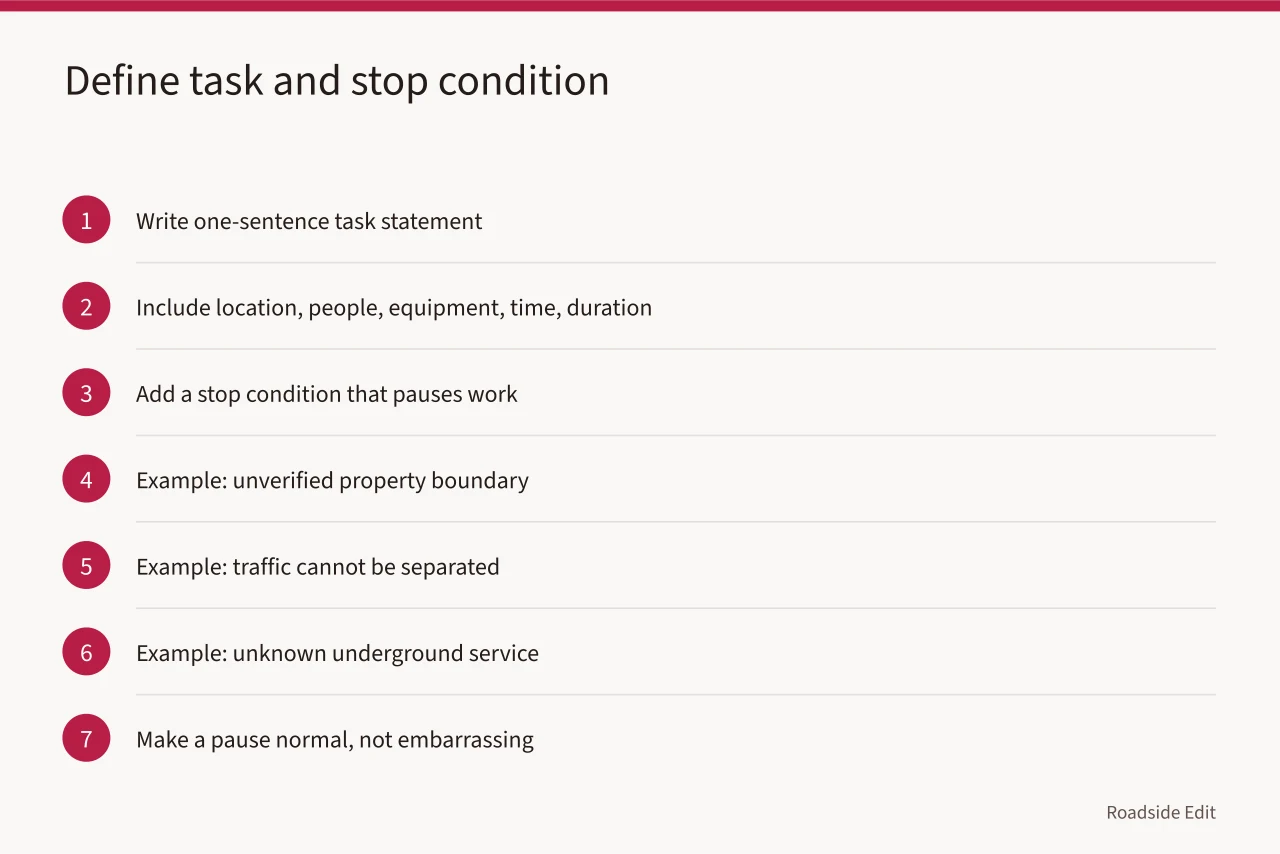
Add a stop condition: the fact that requires the activity to pause.
Examples of stop conditions include an unverified property boundary, traffic that cannot be separated from the task, an unknown underground service, a damaged or loose feature, poor weather, inadequate access, or a work step outside the assigned person's training. The point is not to predict every problem. It is to make a pause normal rather than embarrassing.
Keep people and traffic separate
Roadside work is not ordinary yard work when people, vehicles, or equipment move nearby. OSHA describes highway work-zone workers as exposed to hazards from outside and inside the work zone, including falls, electrical hazards, struck-by events, and caught-between events. Its highway work-zone overview also points readers to traffic-control guidance.
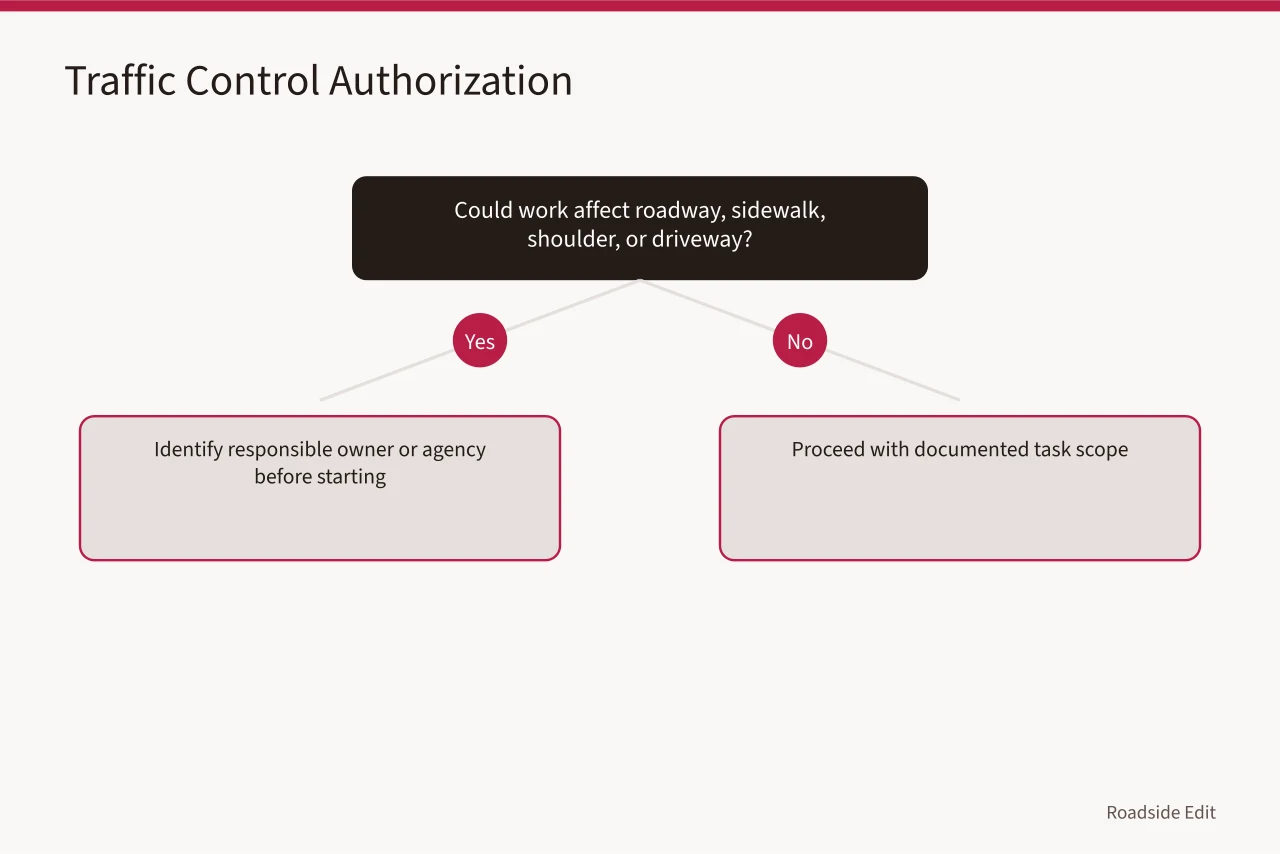
That source does not create a site plan for a reader. It supports the basic boundary in this article: do not improvise a work zone or assume a fluorescent vest alone solves exposure to moving traffic.
If work could affect a roadway, sidewalk, crosswalk, shoulder, or driveway, identify the responsible owner or agency before starting. Check public routes.
Do not block a route, place cones, direct traffic, create a detour, or use a vehicle as a barrier unless the responsible process has authorized and planned it. An owner should document the contact, date, question, and answer, not a verbal recollection later.
Observe access from the user's position
Safety and access overlap but are not the same, so start at the approach a visitor or worker uses. Is there a continuous, understandable path, with surface changes, loose items, low objects, glare, and drainage?
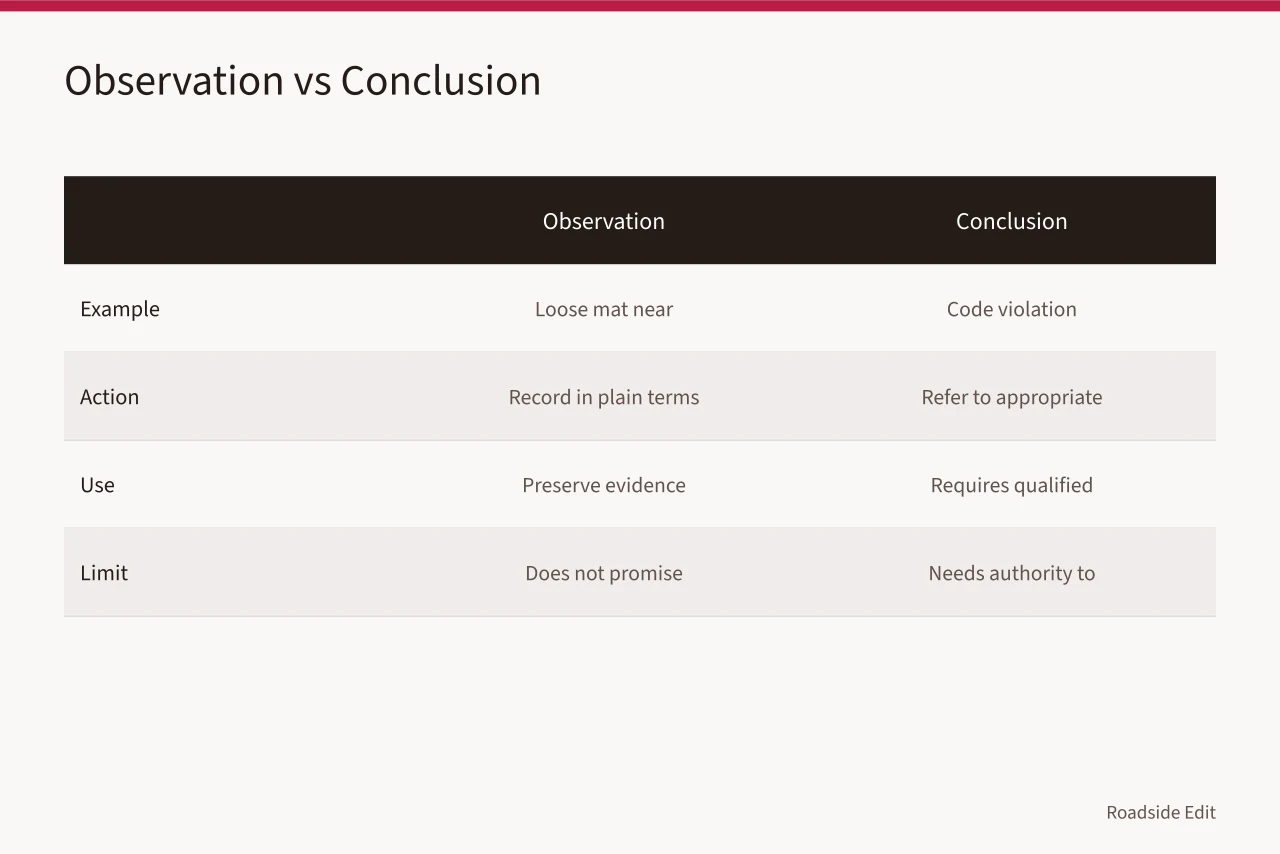
Check temporary obstructions or a route change someone could miss, and write observations in plain terms. "Loose mat near entrance" is an observation; "Code violation" is a conclusion needing the appropriate authority.
Do not promise that an existing route meets any standard based on a checklist. Public-right-of-way requirements, private-property duties, construction date, alteration scope, local adoption, and site conditions may all matter. The useful editorial job is to identify the route, preserve the evidence, and tell the reader where general advice ends.
Check the feature without touching it first
Visual review first, from a safe position: look for visible movement, missing pieces, sharp edges, broken glazing, or water. Then look for damaged supports, unprotected electrical elements, obstructed signs, erosion, or open covers. Note any changes after a storm or impact.
Do not climb, pull, probe, or test a feature for stability, because testing can create a hazard and can damage evidence.
Use a record that separates four things:
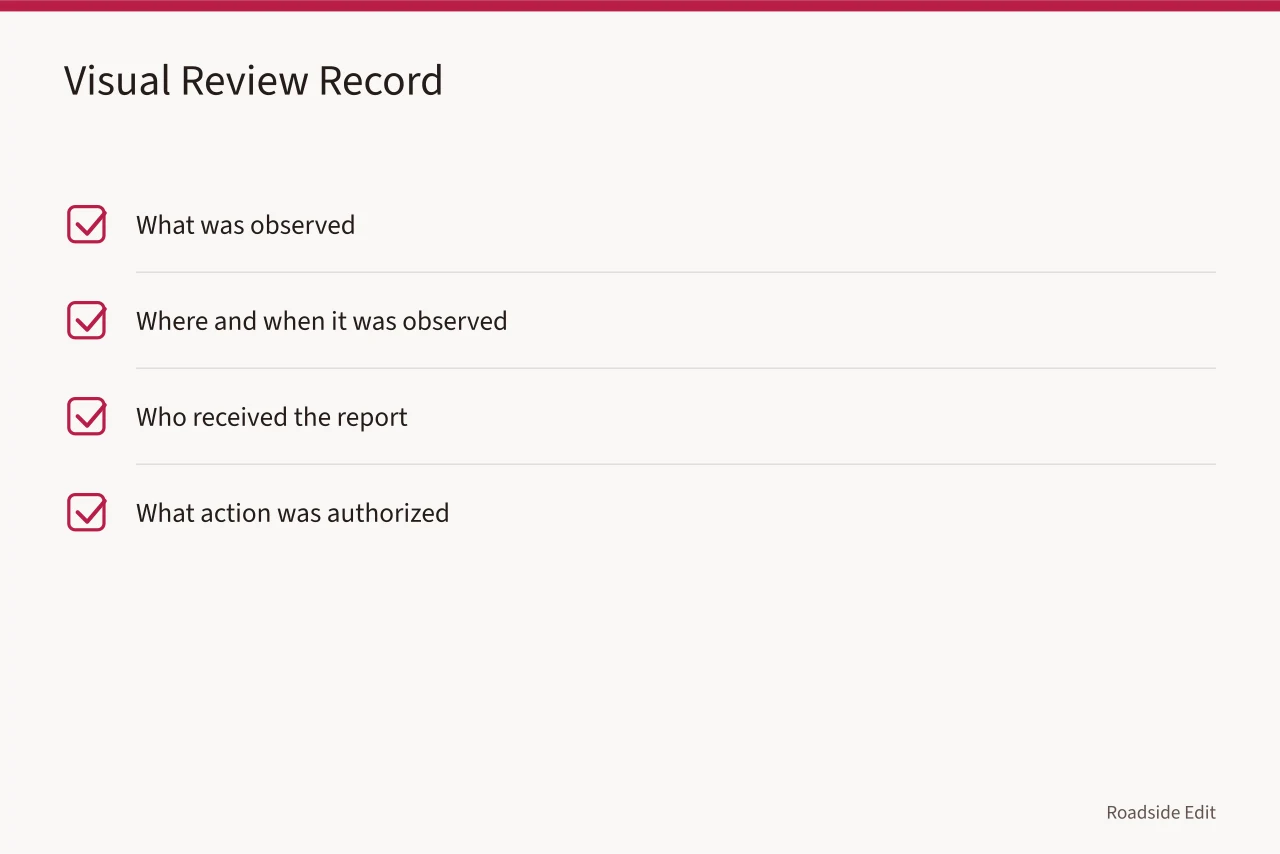
This distinction is vital for an article or project record. It allows a future writer to describe a condition accurately without claiming a cause, a repair outcome, or a safety finding the evidence does not establish.
Plan for weather and changing conditions
Conditions can change during a short task. Wet surfaces, heat, wind, lightning, low light, snow, flooding, debris, and visibility can affect access and work. Do not use a weather forecast as a guarantee. Instead, decide in advance who checks conditions, what condition pauses work, and how the group communicates a cancellation or reschedule.
Use site-specific practices for actual work. A general article should not tell a reader how close to work during lightning, how long to work in heat, or how to handle a flooded route. Those decisions depend on local procedures, tasks, and qualified guidance. The article can remind the team that weather is a work-planning input, not a footnote.
Ask who has authority to act
The owner of a feature may not control the approach, street, utility, sign message, drainage outlet, or historic resource. Identify the person or organization with authority over each relevant element. If the answer is unknown, record the unknown and pause the part of the task that depends on it.
| Question | Example response | Next action |
|---|---|---|
| Who controls the feature? | Private owner is documented | Confirm approved task scope |
| Who controls the route? | Not yet confirmed | Ask the relevant agency or owner |
| Who approves a change? | Property manager only | Obtain written decision before work |
| Who receives an urgent report? | Current local contact list | Confirm contact before the visit |
| Who closes the issue? | Named accountable role | Save the final record |
Avoid letting a vendor proposal fill this authority gap. A proposal says what the vendor offers. It does not prove permission, ownership, safety, or compliance. Keep vendor statements separate from the current project record.
Use a limited field checklist
A field checklist should fit on one page. It should include date, exact location, task, people present, route condition, visible feature condition, weather, known boundaries, stop condition, report destination, and closeout status. Include a space for photos only when they can be taken legally and safely. A photo should record its direction and purpose.
The checklist should also identify forbidden shortcuts. Do not ask an untrained person to handle wiring, enter a roadway, work near unknown utilities, climb a feature, move a barrier, remove a cover, or diagnose a structural condition. A clear "do not" line is more useful than a long list of generic cautions.
OSHA's walking-working-surfaces standard requires covered employers to inspect surfaces regularly and correct or guard hazardous conditions before employee use. It does not determine what a visitor may do at this site. It supports assigning a responsible follow-up rather than treating an observation as a finished safety action.
The 2010 ADA Standards for Accessible Design are technical standards for covered facilities. They cannot be applied to a particular route from a photo or general checklist. Keep an access observation separate from any compliance conclusion.
Escalate instead of repairing by instinct
The right first action may be a report, not a repair. Escalate possible traffic exposure, a damaged or unstable element, an unknown service, or a route obstruction. Also escalate unusual water movement, an injury, a near miss, or a condition outside the written scope.
Record the report and avoid writing that the issue was corrected until the accountable owner confirms closeout.
If someone may need urgent help, use the applicable local emergency process. This article cannot determine urgency for a real location. Keep current contact information in the project file, not in an evergreen public article where it may become stale.
Review after the work, not only before it
After a task, ask whether the route, site, or feature changed. Did materials remain in place? Was the work log complete? Did a new condition appear? Was a public or customer-facing route restored as planned? Does another person need the record? Closeout is the bridge between today's task and the next inspection.
An annual review can identify repeat conditions, recurring gaps in a vendor scope, trouble with access, or questions that should be built into the next budget. Retain prior versions of the checklist so readers can see what changed. Do not rewrite a history to make a project look simpler than it was.
If a business pays for a listing or submits a safety-related statement, readers need a clear label. The Federal Trade Commission's endorsement guidance addresses disclosure of material connections that could affect how readers evaluate an endorsement. Disclosure belongs beside the provider claim.
Common questions
Can this checklist tell me whether a roadside feature is safe?
No. It helps document conditions and direct questions to the responsible owner, agency, or qualified reviewer.
Should a small maintenance task use a work-zone plan?
If the task could affect traffic or a public route, contact the responsible owner or agency. Do not create or improvise traffic control from a general article.
What should happen when the owner is unknown?
Record the location and observed condition, identify the authority question, and pause the work that depends on that answer.