Guides
Part of How a modern roadside design safety checklist works before work begins
Modern roadside safety checklist: 2027 budget figures for owners
Use this 2027 checklist to price hard hats, vests, cones, barricades, arrow boards, attenuators, and intrusion alarms with public list-price ranges.
What to take away
- Use 2027 planning allowances, not 2025 quotes.
- Cover hard hats, vests, cones, barricades, and arrow boards.
- Add attenuators and intrusion alarms.
- Treat heat, access, traffic control, and documentation as budget lines.
- Compare bids on the same scope, exclusions, and condition assumptions.
- Keep a dated change record and closeout file before reusing any figure.
Roadside safety checklist costs are not an afterthought. The CDC and NIOSH recommend workplace controls, training, water, rest breaks, and acclimatization. They also recommend adapting work as heat conditions change. Their workplace heat-stress recommendations do not set a budget for a roadside site, but they support heat-aware scheduling as a planning input.
2027 roadside safety checklist
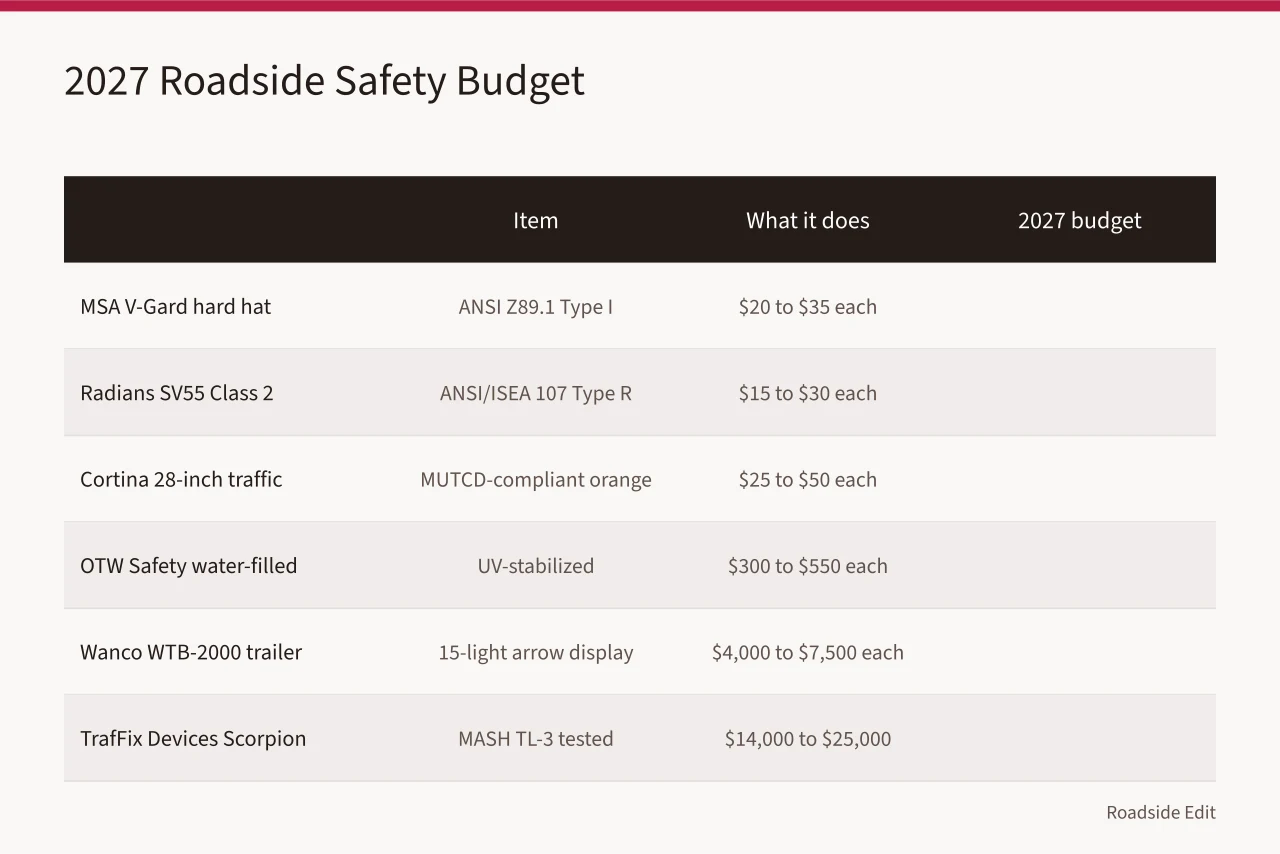
The table gives public list-price ranges for common items. Add shipping, taxes, mounting hardware, and training. Local dealer pricing can differ. Use these as 2027 budget allowances.
| Item | What it does | 2027 budget allowance |
|---|---|---|
| MSA V-Gard hard hat | ANSI Z89.1 Type I Class E head protection. Fits many faces and accessories. | $20 to $35 each |
| Radians SV55 Class 2 safety vest | ANSI/ISEA 107 Type R Class 2 visibility. Two-tone trim helps in daylight and low light. | $15 to $30 each |
| Cortina 28-inch traffic cone | MUTCD-compliant orange cone with reflective bands. Seven-pound base resists wind. | $25 to $50 each |
| OTW Safety water-filled barricade | UV-stabilized polyethylene barrier. Fill with water to add weight. | $300 to $550 each |
| Wanco WTB-2000 trailer arrow board | 15-light arrow display with solar option. Trailer mount moves between sites. | $4,000 to $7,500 each |
| TrafFix Devices Scorpion II truck-mounted attenuator | MASH TL-3 tested impact attenuator. Hydraulic unit mounts on a truck. | $14,000 to $25,000 each |
| IntelliZone portable intrusion alarm | Detects vehicles entering a work zone. Sounds an alarm for workers. | $2,300 to $4,000 each |
| PSS RoadQuake 2 temporary rumble strip | Portable, reusable strip that alerts drivers. Sections link across a lane. | $225 to $450 per section |
Add these to a site review: a short lane closure may need cones and vests, and a high-speed shoulder job may need an arrow board, attenuator, and intrusion alarm.
GSA guidance on managing project costs explains cost work develops as scope becomes clearer. Keep a safety budget note with source, date, scope version, and inclusions beside each figure. Add exclusions and status.
Compare proposals fairly
Make exclusions visible. A low figure may omit access planning, cleanup, documentation, weather delays, or permit coordination. It may also omit a qualified review. Do not call owner-supplied work free. Label it owner labor so later comparisons see the full resource need.
Review the NPS documentation standards for stated limitations that permit later verification. Do not calculate a financial result a source does not show. If a number is private or supplied by a participant, label it or keep it out of public copy.
Keep the change record
When a site condition changes the price, record the observation, source, decision-maker, and revised scope. That separates an honest change from an unexplained overrun.
Review the budget after the task and before it. Compare the approved scope with the completed record, then identify the condition that changed time, access, materials, or staffing. Do not turn a one-time delay into a permanent cost assumption. A dated explanation gives the next owner a better basis for planning and avoids false precision in future examples.
Use a closeout record before reusing a figure
When work ends, preserve approved scope, change notes, provider record, and stated completion date, then compare them before using a figure as an editorial example.
A quote may have assumed conditions that never occurred; an invoice may cover only part of a task. A completed record may explain changed timing, staffing, or equipment. Keep that context in the next budget note, not a copied total in a new site example.
For deferred items, state the missing evidence and review trigger. A reserve can support a later question, but it should not hide undefined work. The NPS preservation planning overview describes documentation used to inform later scope and design work. A budget note supports that work but does not establish approval or completion.
The record should name who may approve a change. A provider can describe a revised scope, but the article should not imply work was authorized until the responsible decision record says so.
This distinction helps when a site has multiple parties: an owner, manager, agency contact, or project reviewer. Keep the source of each decision in the same file as the budget note.
Common questions
Should a safety reserve be included?
Yes, when the specific unresolved condition is stated. A reserve does not replace defining the task.
Can weather affect a maintenance price?
Yes. It can change timing, access, required protections, and whether work should proceed at all.
What is the best way to compare quotes?
Use the same task, boundary, exclusions, condition assumptions, and closeout record for each proposal.