Guides
Part of How a roadside architecture maintenance plan keeps observation separate from repair work
How to document roadside architecture maintenance warning signs safely
Roadside architecture maintenance warning signs call for dated photos, careful wording, and a reporting route, never a diagnosis from the curb.
What to take away
- A warning sign is a prompt to photograph, date, and route the observation. It is not a finding.
- Write the visible condition and the viewpoint. Leave cause, severity, and legal meaning out of the record.
- Match the response to the record: file it, notify a contact, or stay clear and report.
- Photograph from a lawful public position. Never cross a fence or enter a closed forecourt for a better frame.
- Keep access details, private contacts, and close-up images of secured buildings out of anything you publish.
What a roadside view can and cannot show
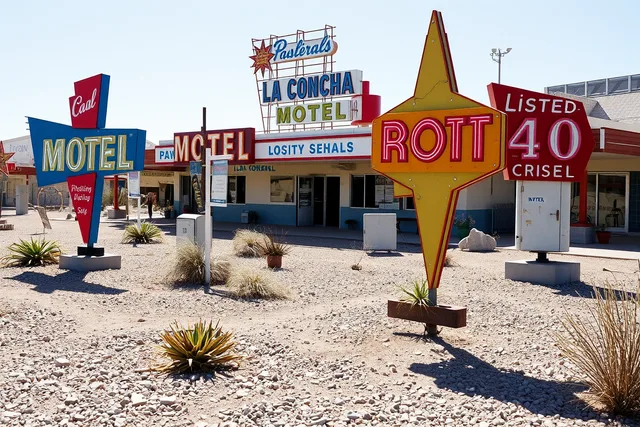
A 1950s porcelain-enamel station sign, a 1960s plastic-faced box sign, a motel's brick veneer, and a diner's chrome-edge trim all read differently from thirty feet away. Distance changes what you can honestly claim.
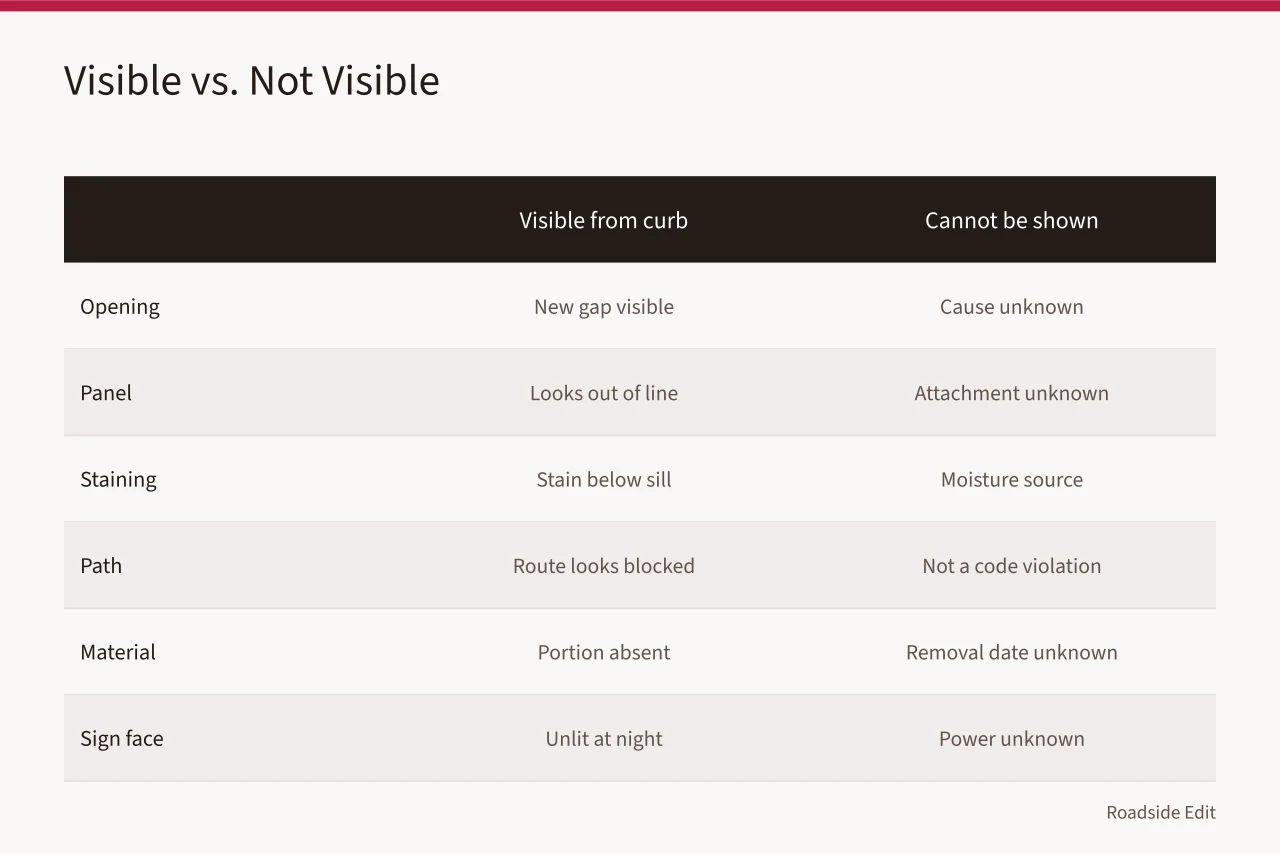
An exterior view can show a changed opening, a stain below a sill, a sign panel out of line, or a blocked public path. It cannot show what sits behind a wall, how a cabinet is fastened, whether a neon transformer is live, or what a canopy soffit carries.
Write down where you stood and what the frame missed. A photo without a stated viewpoint is an opinion with a timestamp.
| Visible condition | Safe wording for the record | Do not infer |
|---|---|---|
| A new gap or opening | "An opening is visible in the image dated today." | The cause or what lies behind it |
| A displaced-looking feature | "A panel appears out of line from the public view." | Whether it is still attached |
| Water staining | "Staining is visible below the opening." | The source of moisture |
| A blocked path | "The public route appears obstructed in this photo." | A code violation |
| Missing material | "A portion is absent from the view dated today." | When it was removed |
| A dark tube or sign face | "The sign face is unlit in this evening image." | Whether power is connected |
NPS documentation standards ask that records be prepared accurately from reliable sources and that limitations be stated so a reader can verify the work independently. Read the NPS documentation standards. A precise description of the frame outlives a dramatic label the evidence cannot carry.
Three response levels
Match the response to what the record actually shows. Most observations stop at level one.
- File it. A small visible change with no apparent issue on the public route gets a date, an image, a feature label, and a stated limit. Nothing more is needed.
- Notify a contact. When an owner, manager, or public office may want the dated record, send the observation and the reason for notice. Do not attach a repair recommendation.
- Stay clear and report. If a public path appears blocked, a feature appears newly detached, or something reads as an immediate concern from a lawful position, keep your distance and use the responsible party's reporting route. Do not approach, touch, or test anything.
NPS Preservation Brief 31 places stabilization of a storm-damaged or deteriorated building on a professional condition assessment, and notes that bracing may be needed before architectural evaluation. Review the NPS mothballing guidance. For anyone without that training, the rule is simple: a roadside observation is not an on-site examination.
Write the trigger, not the verdict
When an editor needs to tell a property contact something, the note should name the narrow trigger for the message. A current image differs from a dated prior image. A public route looks obstructed. It should not call a site failing, abandoned, or unsafe unless a reliable source makes that exact claim.
| Field | Example |
|---|---|
| Feature | West-facing sign cabinet |
| Trigger | Current image shows an opening not present in the 2024 image |
| Viewpoint | Public sidewalk across the street |
| Limit | Rear attachment and interior were not visible |
| Action | Observation sent through the listed property-reporting path |
The NPS architectural-preservation QA checklist covers existing-condition photographs, field reports, material data, and records of treatment. See the NPS QA checklist. It does not say one exterior photograph settles a technical question. Hold a news item, a corridor guide, or a local history piece to the same restraint.
Keep the record, not a map of weak points
Roadside places are often private, vacant, or closed. Leave security details, entry instructions, private phone numbers, and any close-up made through trespass out of the article. If a source confirms a responsible party was notified, say that and stop.
The NPS treatment standards describe preservation as maintenance and repair of existing materials and features rather than broad replacement and new construction. Read the NPS preservation standards.
It is a reminder that a visible concern deserves a documented response, not a rushed alteration. Over-painting original enamel, swapping neon for LED, and discarding provenance records are the same mistake at three scales: acting before the record exists.
Corridor surveys, SHPO files, and Section 106 review all depend on dated field evidence, so the observation you file this week may be the only record of a condition that changes next season. Set up the planning records for a roadside renovation before the first site visit, not after.
Common questions
Is a crack proof of structural failure?
No. A crack is a visible condition you can date and photograph. Its cause and its meaning need an assessment by someone qualified to make one, which a writer at the curb is not.
What should a writer do if a feature looks loose?
Stay back, shoot the lawful viewpoint, and use the responsible party's reporting route if you know it. Do not test the attachment, and do not publish the address of a secured building.
Can I call a vacant building unsafe?
No. Vacancy and safety are separate claims. A safety finding needs a reliable, relevant source, and most often that source is the licensed engineer or the authority having jurisdiction, not the article.