Guides
How to plan historic motel restoration costs for 2027 without guessing a price
Historic motel restoration cost planning for 2027 explains how to compare scope, dates, assumptions, and estimate stages without inventing a price.
Historic motel restoration cost planning begins by defining the number, not by finding one. A dollar amount might describe early research, an owner target, a concept estimate, a bid for a narrow task, a funding request, a completed project, or a future proposal. Those numbers are not interchangeable, even when they concern the same property.
This guide helps writers, owners, and community researchers talk about cost information without presenting a generic restoration price. It is not a bid, an appraisal, a financial forecast, a project scope, or advice to perform work at a particular motel.
What to take away
- A number is useful only when its scope, date, source, and role are stated.
- Do not add, compare, or repeat figures from different project stages as if they were one budget.
- An image, historic record, grant announcement, or marketing page does not establish a current project cost.
- Keep research effort, planning tasks, and property work in separate categories.
- A clear unknown is better than a confident but untraceable estimate.
Start with the cost question
The phrase "what will it cost?" can hide several questions. A writer may mean the cost of collecting historical records, developing a project description, reviewing a scope, repairing one feature, or completing a whole property project. Before looking for a figure, write the question in a form that names the item under discussion.
| Vague question | Cost-planning question |
|---|---|
| What will restoration cost? | What dated estimate, if any, describes a defined feature and scope? |
| Can the motel be fixed on a budget? | What work categories have been identified, and which are still unknown? |
| Is the project funded? | What funding source, amount, purpose, and time period does the record state? |
| Is that quote reasonable? | Does the available record describe a comparable location, scope, date, and estimate stage? |
This first step prevents a common error: using a number from an unrelated project to make a property-specific claim. A useful article can explain why an amount is not comparable. It does not need to fill every blank with a range.
Identify the estimate role
Each figure should have a role label. A label tells the reader why the number exists and how much confidence the source itself gives it. It also keeps a proposal from being treated as an invoice or a public funding award from being treated as total project cost.
| Role label | What it may represent | What it cannot prove alone |
|---|---|---|
| Research resource | Archive work, documentation, or editorial review | Property repair or construction cost |
| Planning allowance | A preliminary effort to define questions or scope | A final work price |
| Concept estimate | A high-level figure based on limited information | A firm quote |
| Detailed estimate | A source-bound calculation for stated work | Current market availability or a contract |
| Bid or proposal | A vendor's offer at a stated time | A completed project |
| Funding amount | A grant, loan, credit, or contribution | Total project cost or eligibility for another property |
| Completed amount | A recorded historical expenditure | Cost of doing the same work now |
The source date matters as much as the label. An estimate from an earlier year may describe a real project, but it cannot automatically be converted into a present price. A current article should report the date instead of silently updating the figure.
Define the work before discussing its value
Scope is the description of what a number covers. It can include a feature, location, drawing set, labor assumption, project phase, time period, or excluded work. If the scope is missing, a figure is context, not a cost conclusion.
The National Park Service's 2011 Cost Estimating Requirements Handbook shows a federal estimate structure with distinct direct construction costs and separate factors such as historic preservation, general conditions, overhead, and profit. Review the NPS cost-estimating handbook. That handbook is not a motel cost guide. It illustrates why an unlabelled total cannot reveal which assumptions, additions, or exclusions were used.
Use this scope record before quoting any amount:
| Field | Record it as written | Why it matters |
|---|---|---|
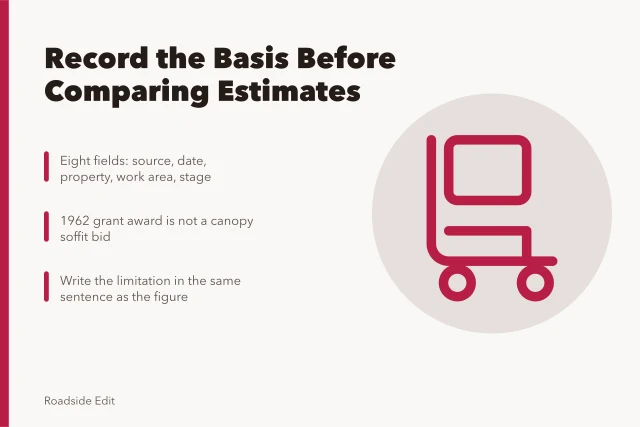
| Source | Exact title, issuer, and link or identifier | Allows the figure to be checked |
| Figure date | Date on the record | Prevents a historical number from sounding current |
| Property | Name and location used by the source | Avoids mixing similar places |
| Work area | Sign, room wing, facade, office, site feature, or entire site | Limits the claim |
| Stage | Concept, planning, bid, award, completed work, or unknown | Explains the number's role |
| Inclusions | Work expressly included | Shows what the number covers |
| Exclusions | Work the source leaves out | Shows why totals may not compare |
| Limit | What the record cannot establish | Keeps the article accurate |
Separate three cost conversations
An editorial team should avoid one large category called "restoration cost." Most early articles need three different conversations.
Research and documentation
This covers the effort to find, organize, and verify material. It may involve reviewing maps, directories, public records, photographs, permits, local histories, or institutional collections. A research budget does not estimate the condition of a property or the price of work.
Planning and scope development
This covers the work of defining questions, roles, records, alternatives, and decision limits. The result may be an outline, study, project description, or question log. It is not a construction document and should not be reported as one.
Property work
This concerns a defined feature or project. It depends on information an article often does not have, including access, observed conditions, applicable requirements, existing documentation, labor assumptions, material choices, project timing, and a written scope. This guide does not give property-work figures.
| Category | Example of responsible wording |
|---|---|
| Research | "The file needs a dated record review before the article can describe this feature more precisely." |
| Planning | "The available material supports a question list, not a final work scope." |
| Property work | "No source in this article establishes a current cost for work at this motel." |
Do not treat funding as a price tag
A grant, tax credit, contribution, loan, incentive, or public announcement can be important context. It still needs careful wording. A grant may cover only one part of a larger project. A credit may depend on facts not shown in the article. A request may be proposed rather than awarded. A financing plan may be incomplete.
When reporting funding, use this short form:
- Name the source and date.
- State the purpose the source gives for the amount.
- Say whether the record identifies a total project cost.
- State what the source does not show, such as completion, final eligibility, or current balance.
Avoid phrases such as "the renovation cost $X" when the source actually says "a grant of $X was announced." The difference matters to potential partners, preservation groups, and readers who may treat an article as a factual reference.
Compare like with like
Two figures can be compared only after their boundaries are visible. Start with the date, geography, physical feature, scope, estimate stage, and source type. If several fields do not match, the article should report the difference rather than calculate a simple ratio.
| Comparison field | Questions to ask |
|---|---|
| Date | Were the figures prepared in the same period? |
| Place | Do they describe the same market or location conditions? |
| Feature | Are they about the same building element or area? |
| Scope | Do they include the same tasks, exclusions, and contingencies? |
| Stage | Are both figures concept estimates, bids, awards, or completed costs? |
| Source | Does each record identify its author and basis? |
This method also protects list articles and project profiles. A list can summarize available public records, but it should not rank properties by apparent affordability when the records describe different scopes.
Write estimate language that stays true
Cost language often becomes too strong through small word changes. Review each sentence for the difference between a source statement and an article inference.
| Overstatement | Better wording |
|---|---|
| "The motel restoration costs $500,000." | "A dated source reports a $500,000 figure for the scope it describes; this article does not treat it as a current whole-property price." |
| "The project is fully funded." | "The source identifies a funding amount but does not establish the total project budget." |
| "The repair will be affordable." | "The available records do not provide comparable current cost information." |
| "This grant pays for the work." | "The record states the grant purpose; its relation to total costs is not established here." |
The goal is not cautious language for its own sake. It is traceable language. A reader should be able to see the exact boundary between the source and the article's explanation.
The U.S. General Services Administration notes that project cost management changes as scope and requirements become clearer. Read GSA's cost-management guidance. That supports treating each amount as a dated record with its own purpose instead of treating every figure as a whole-property cost.
NPS documentation standards call for reliable source material and stated limitations that allow another person to verify a record. See the NPS documentation standard. The limitation should be near the figure, where readers can see why the article does not make a broader claim.
The NPS Historic Property Project Documentation process relates existing property information to later scope and design decisions. Review the NPS documentation overview. Cost planning in an article should stay on the evidence side of that line unless a specific record identifies the decision and scope.
Build a cost record that can be updated
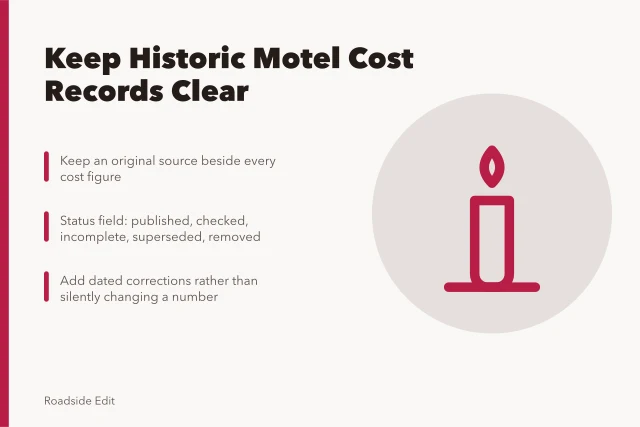
A cost record should be small enough to use and detailed enough to correct. Keep the original source, the selected figure, the wording around it, its date, a description of scope, and a note about exclusions. When a later document changes the figure, add a dated update rather than replacing the earlier context without explanation.
An update may be appropriate when a primary public record clarifies a scope, an award, a completed project, or an error. A new photo, marketing description, or casual estimate is not enough to revise a factual cost statement.
A practical editorial handoff
Before publication, attach a cost note with:
- The exact figure and source.
- The stated date and project stage.
- The property and feature boundary.
- Included and excluded items where known.
- A plain-language limitation.
- The event that would warrant an update.
This handoff gives an editor a way to check the claim without asking the article to become a full project estimate. It also protects future writers from repeating an amount with its scope stripped away.
Common questions
Can this guide estimate a historic motel restoration?
No. It explains how to describe and compare documented figures. A reliable project estimate requires a defined scope and property-specific information that this article does not provide.
Is a grant award the same as a total project budget?
No. A grant amount may fund only one element, phase, or portion of a larger effort. The article should use the purpose stated by the source and avoid assuming the remaining cost.
Why can an old project cost not become a 2027 price?
The source date, scope, project stage, conditions, and market context may differ. An earlier amount is historical context unless a current, comparable source supports a present claim.
In this guide
- Historic motel restoration cost checklist: what to verify before you compare a 2027 estimateA historic motel restoration cost checklist records the source, date, property, work area, and estimate stage before any figure is compared.
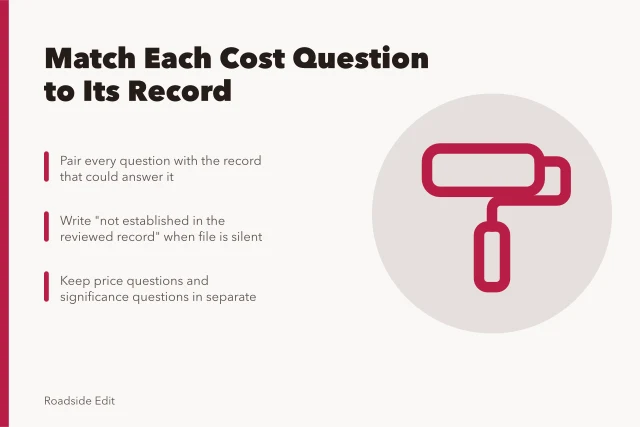
- Historic motel restoration cost questions to settle before you trust a 2027 estimateSettle historic motel restoration cost questions by matching each one to the record that could answer it, then writing the honest result when that record is missing.
- Historic motel restoration cost estimates: why stages and scope decide the numberHistoric motel restoration cost estimates vary because each figure reflects its own construction scope, project stage, site conditions and pricing date.
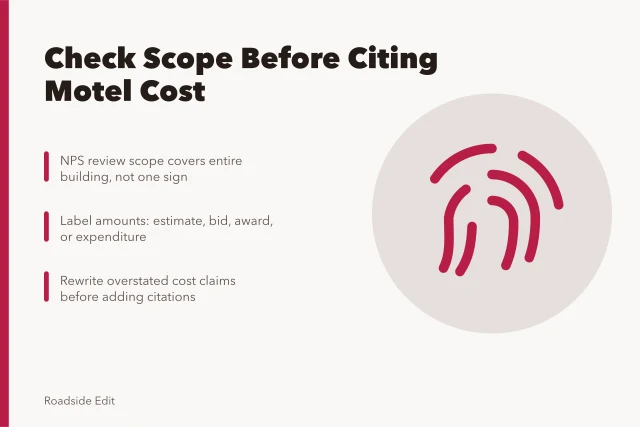
- Historic motel restoration cost warning signs: fix the scope before you citeHistoric motel restoration cost warning signs for 2027 show when an article has confused a building scope, funding amount, estimate, or final price.
- How to keep historic motel restoration cost records clear through 2027Historic motel restoration cost records for 2027 explain how to log figures, drawings, assumptions, dates, limits, and corrections without losing context.