Guides
Part of How to avoid common neon sign restoration mistakes before you publish
Neon sign restoration questions: check the claim before you file it
Neon sign claim review questions for 2027 help U.S. publishers separate photo evidence, historical sources, current statements, and property-specific questions.
Claim-review questions keep a neon sign article from treating a source as proof of more than it says. Ask them before a headline, caption, directory listing, or update goes public.
What to take away
- Ask what record supports the exact sentence.
- Separate historical context from current property facts.
- Ask a responsible party for a narrow answer rather than guessing.
- Retain the response source and date.
Use these questions
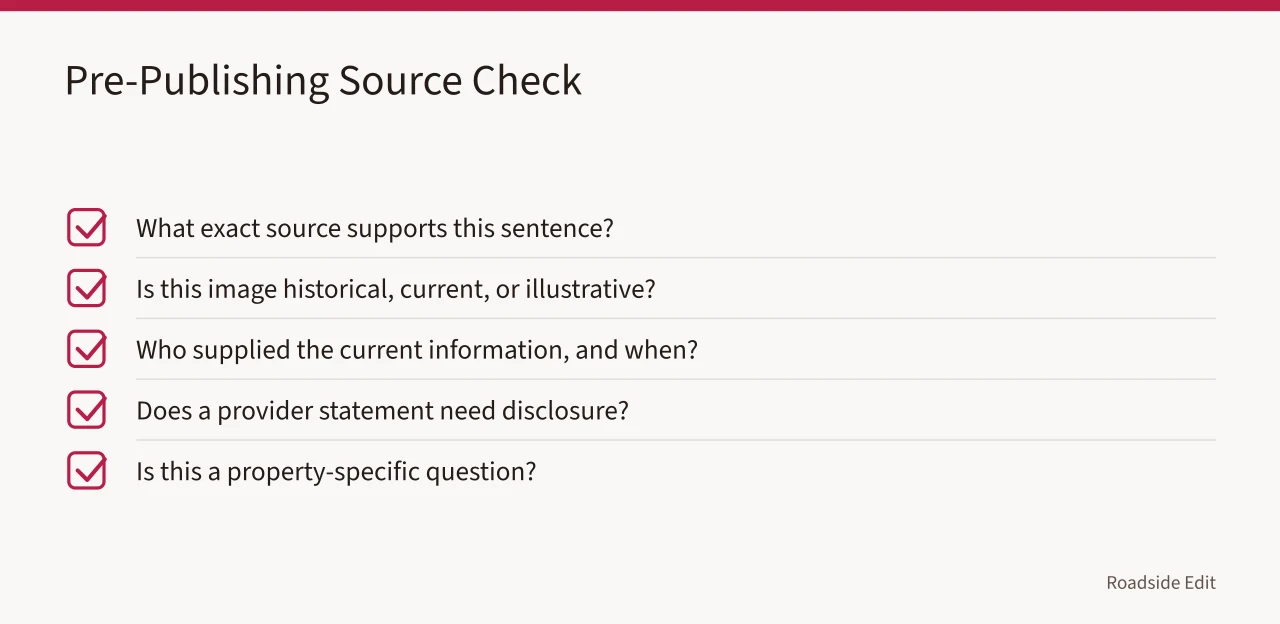
| Before publishing, ask | Why it matters |
|---|---|
| What exact source supports this sentence? | Stops a broad claim from resting on a vague reference |
| Is this image historical, current, or illustrative? | Prevents an image from being misread as a condition finding |
| Who supplied the current information, and when? | Keeps access and ownership statements attributable |
| Does a provider statement need disclosure? | Separates commercial material from editorial evidence |
| Is this a property-specific question? | Routes technical or local questions to the appropriate process |
The National Archives explains that a record can include photographs, maps, drawings, and other materials in its overview of records. The page does not tell a writer what conclusion to draw from each record. Its relevant lesson is that source types differ, so an article should identify the record and its context rather than treating every source as interchangeable proof.
Turn a weak question into a useful one
Replace "Is the sign safe?" with "Who is the appropriate responsible party to review the reported observation before public copy changes?" Replace "Was it restored?" with "Which source documents the reported work and date?"
The second version is answerable and avoids asking an article to make a technical finding.
Keep the answer with the question
When a source or responsible party responds, record the answer beside the original question, its date, and its limits. Do not turn a partial answer into a broader conclusion. A short response may clarify access, historical context, or a source location without resolving any other property-specific issue.
Ask what an image can support
Ask for the item record, stated date, place, creator when known, and rights information before using a photograph. Then ask a separate question about the sentence the image is to support.
A photo may show a visible appearance or record a historical setting. It does not by itself establish why the appearance changed, who owns the property now, whether access is allowed, or whether a technical conclusion is correct.
The Library of Congress Prints and Photographs collections provide image items with descriptive and rights information. They do not decide a site-specific claim. They support checking an image record before turning it into evidence in a public article.
Ask whether a historic term has a record behind it
Words like original, restored, landmark, or historic need the right source and scope. Ask which record uses the term, what date it covers, and if it is an official designation, attributed report, or editorial shorthand.
If the answer does not support the exact word, use a narrower description. That beats a dramatic phrase that fails source review.
The National Park Service documentation standards and guidelines concern recording historic properties. They do not assign a designation to a neon sign. They support keeping the source, date, and descriptive limits of any historic claim.
Ask how a commercial claim will be labeled
For a provider profile or sponsored list, ask what the business supplied, whether payment or another material relationship exists, what service area is claimed, and where the disclosure will appear. Do not ask a provider to settle an editorial historical or property-status question. Its statement can appear as attributable commercial information, not as independent proof.
The Federal Trade Commission's endorsement guides address endorsements and testimonials in advertising. They do not establish a provider's work on a particular site. They support transparent disclosure when commercial material is included in editorial content.
Save the question and answer together
Keep the original question, response, source, date, and publication decision in a single record. If the response later changes, add a new dated entry instead of overwriting the earlier one. This makes a partial answer less likely to become a broader claim through repeated edits.
Common questions
Can a writer make an inference from a photograph?
Only a limited observation about what is visibly shown. Do not infer cause, safety, ownership, or a treatment outcome without appropriate support.
Should a business answer historical questions?
It can provide an attributed statement, but independent archival or public sources may still be needed for a historical claim.
What if sources disagree?
Record the conflict, publish only what is supported, and keep the disputed point open until better evidence resolves it.