Guides
Part of How to avoid common neon sign restoration mistakes before you publish
Neon sign restoration: 7 warning signs publishers must catch before 2027
Seven warning signs in neon sign restoration publishing, from unsourced tube diameters to sponsored fabricator copy, and the fix each one needs.
Seven warning signs show up in neon sign restoration copy before it reaches print. Each one is a pattern an editor can name, check and fix. The warning signs that vary by region are a separate list; this one covers the editorial patterns that travel with the draft.
The clock matters. Route 66 turns 100 in 2026, and America250 marks the country's 250th anniversary the same year. Grant writers, National Register nominations and museum labels will cite whatever a magazine printed in 2025. Catch the seven patterns below before that wave lands.
What to take away
- A tube diameter, a transformer load or a gas mix stated without a survey source is the most common warning sign.
- Captions that call a sign original or restored need the record that says so.
- Sponsored fabricator copy must carry a visible label and keep the provider's own wording.
- A property-specific repair question gets a handoff to the licensed trade, never an answer in the article.
- Every claim keeps its source, date and scope with the final draft.
- The 2026 Route 66 centennial will pull old sign copy back into circulation, so verify a figure before it is reused.
The seven warning signs
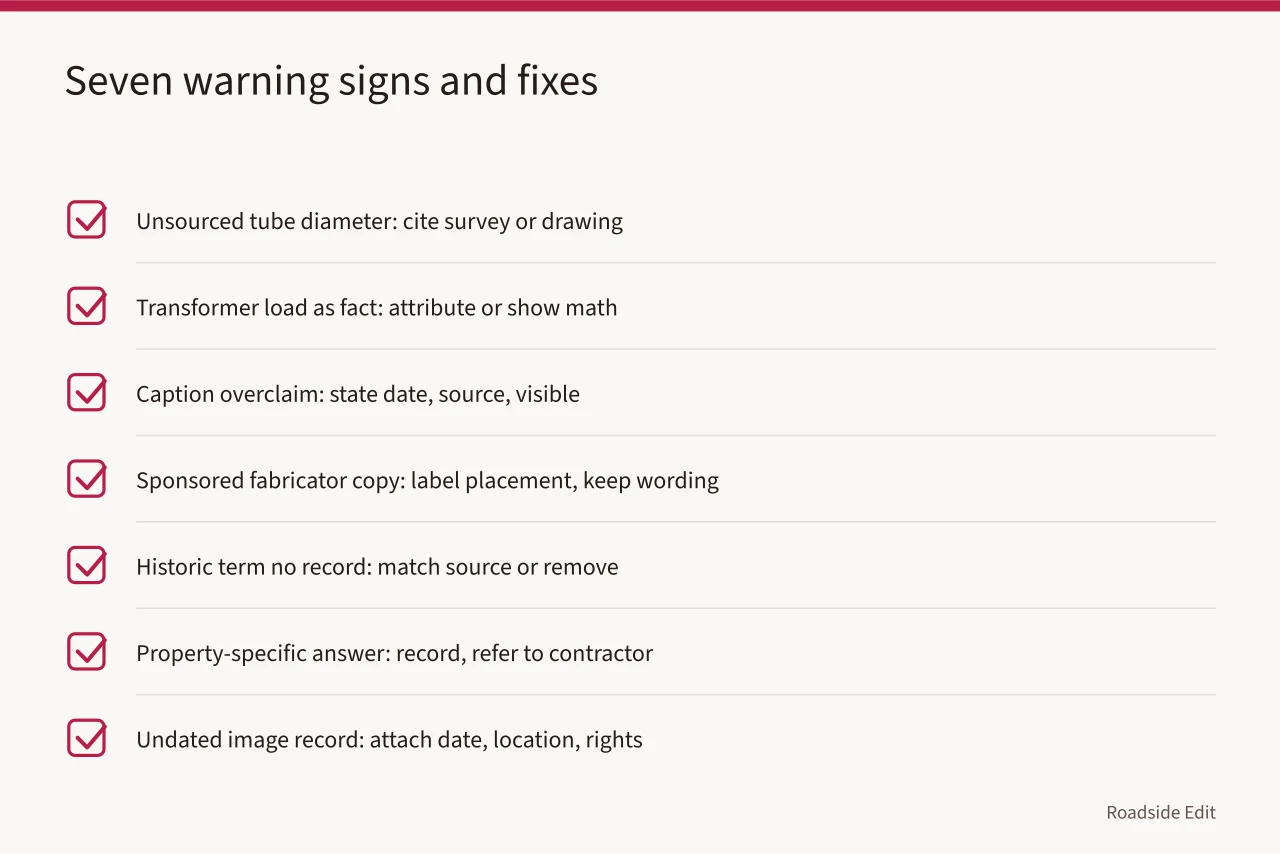
| Warning sign | What it looks like | The fix |
|---|---|---|
| 1. Unsourced tube diameter | "The sign uses 12 mm tubing" with no survey or shop record behind it | Cite the measured survey or the fabricator's drawing. Neon glass comes in 8 mm, 10 mm, 12 mm, 15 mm and 18 mm sizes, so a wrong figure still reads as plausible |
| 2. Transformer load stated as fact | A volt-ampere or load figure lifted from a listing or a memory | Attribute it to the electrician's record, or give the arithmetic in named variables. NEC Article 600 covers sign wiring and UL 2161 covers neon transformers |
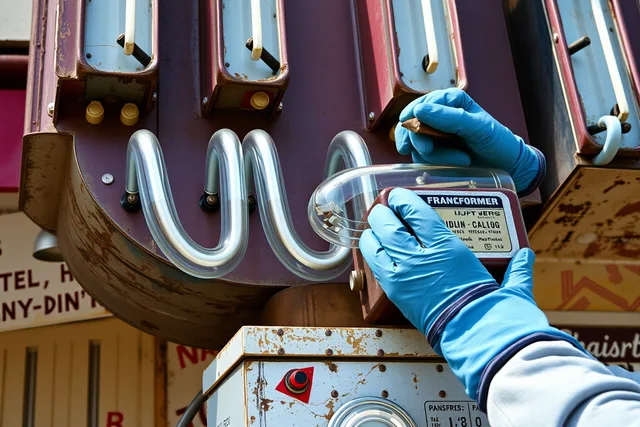
| 3. Caption overclaim | "Original 1950s neon" on a photo of a rebuilt face | State the date, the source and what the image visibly shows |
| 4. Sponsored fabricator copy | A shop's service paragraph reading as the publication's own assessment | Label the placement and keep the shop's wording |
| 5. Historic term with no record | "Landmark," "official" or "restored" with nothing behind it | Match the wording to the source that uses the term, such as a National Register nomination or a state survey, or remove it |
| 6. Property-specific answer | The draft starts solving one owner's repair or condition question | Record the observation and send the owner to a licensed sign contractor or electrician |
| 7. Undated image record | A striking sign photo with no date, location or rights line | Attach the item record before the image carries any factual claim. Wikimedia Commons asks for description, date, author and license |
Sign 1 and sign 2 read as technical authority and are the hardest to walk back. A diameter or a load figure in print gets copied into grant applications and nomination drafts. If the number came from a shop conversation rather than a measured survey, it is not evidence yet.
Why the technical signs come first
A 1950s porcelain-enamel station sign and a 1960s plastic-faced box sign fail in different ways, and the copy should say which one it is describing. Enamel chips and crazes; plastic faces yellow and crack at the fastener holes. A draft that applies one condition story to both is already wrong.
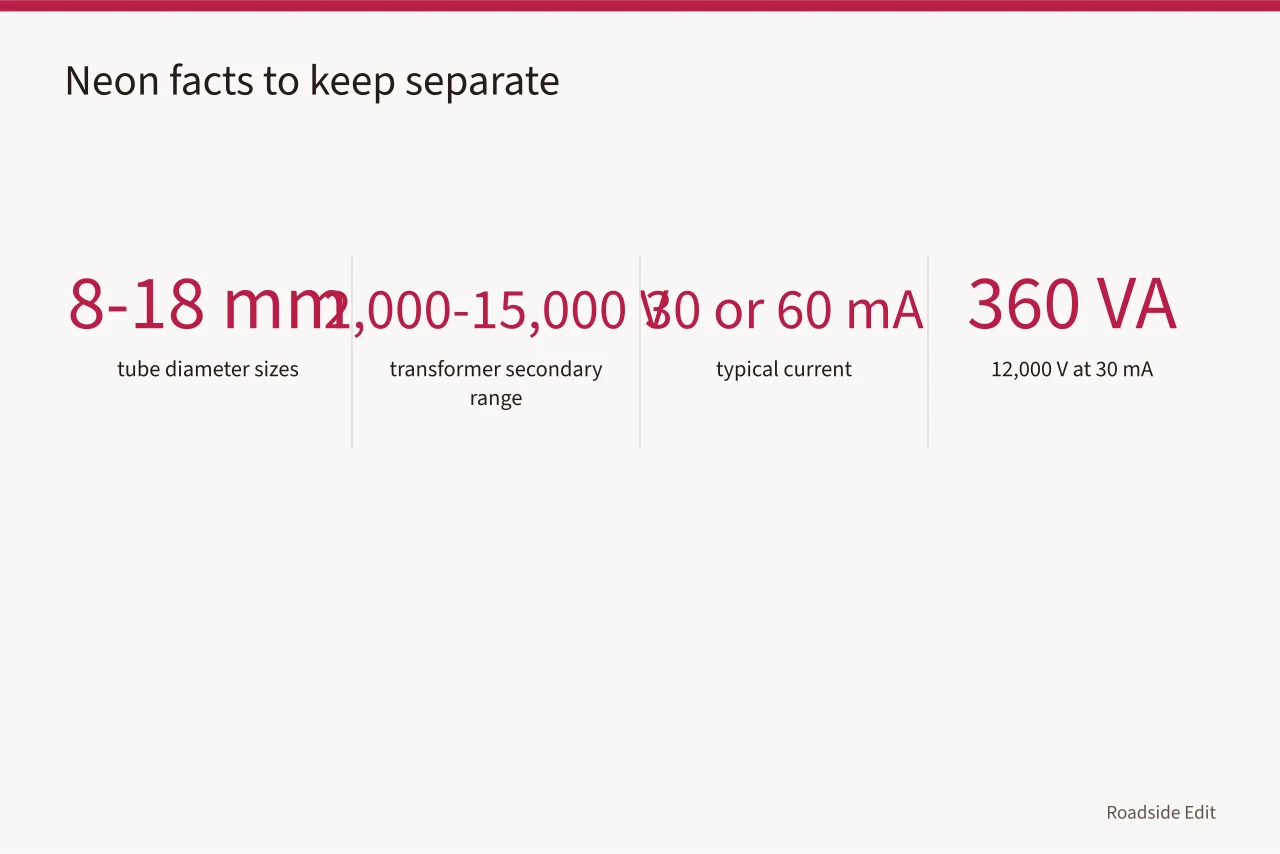
The same split runs through neon itself. Tube diameter, gas fill and transformer load are separate facts, each with its own record.
Neon glows red-orange on neon gas, blue on argon with mercury, and other colors on krypton or xenon. Typical transformer secondaries run 2,000 to 15,000 volts at 30 or 60 milliamps, and 12,000 volts at 30 milliamps works out to 360 volt-amperes.
A write-up that folds all of it into one "restored to original specification" line has skipped the documentation the claim depends on.
Museums that keep those records separate are the models to copy. The Neon Museum in Las Vegas holds more than 200 rescued signs, most of them unrestored in its outdoor Boneyard. The Museum of Neon Art in Glendale, California, has collected neon art and historic signs since 1981.
The National Park Service documentation standards and guidelines cover how historic properties are recorded. They do not measure a tube or rate a transformer. They support keeping the source, date and descriptive limit behind any historic statement in the draft.
Audit the opening before the body
Read the headline, the first paragraph, the lead image, its caption and any disclosure as one unit. Those five elements travel furthest when a piece is shared or summarized, and they are where signs 3, 4 and 5 usually sit.
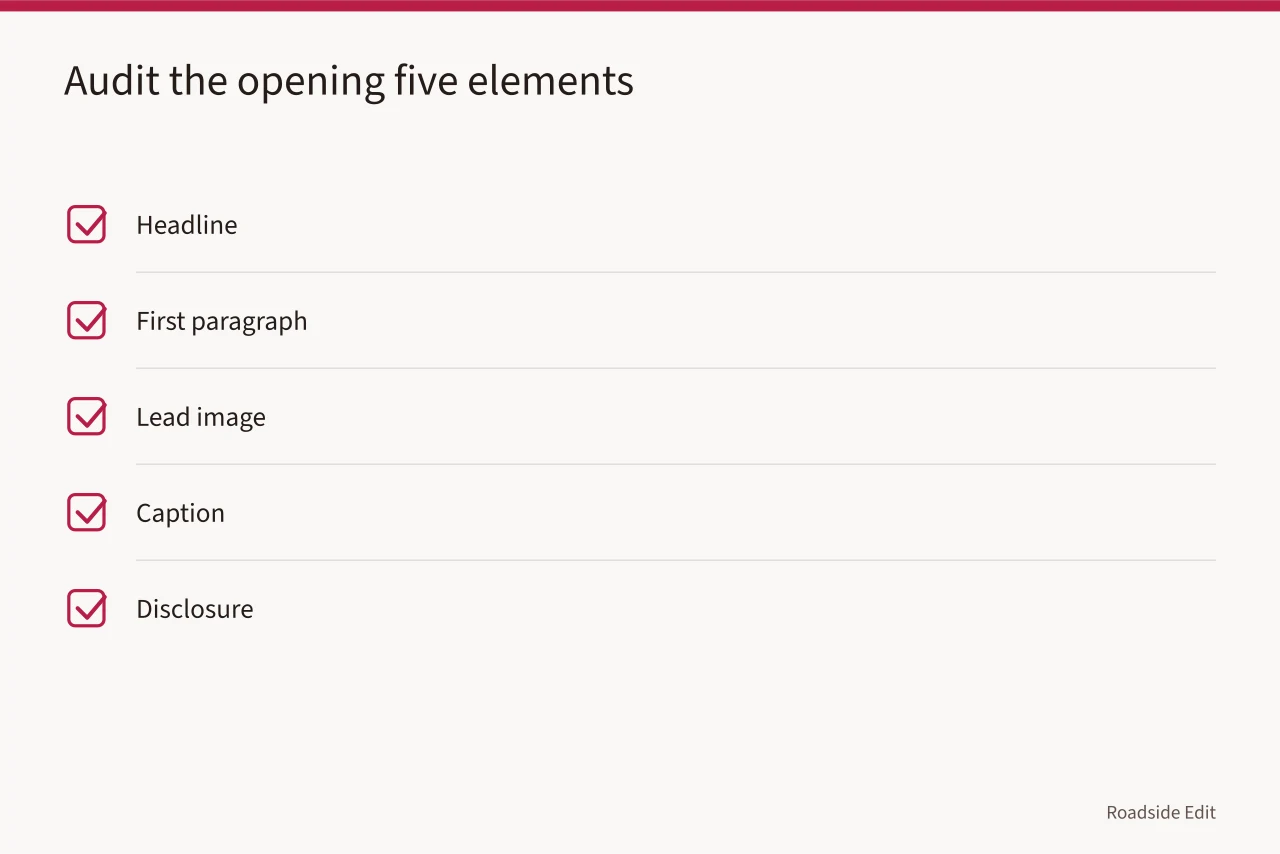
A carefully qualified paragraph on page two does not repair an overstated caption on page one. Fix the opening first, then check the body against it.
Keep the wording inside the record
A review can be described as pending. A visitor instruction can be attributed to the owner who gave it. Copy stays inside what the record supports, and the draft cannot guess at a cause or imply a conclusion no responsible process has reached.
The Library of Congress Prints and Photographs collections hold image records with descriptive and rights information attached. They will not answer a question about a sign's present condition. They are the check to run before a photograph is asked to carry a factual claim.
The National Archives' family-archives guidance covers storage and preservation conditions for photographic records. It is not a method for assessing a roadside sign. Its use here is narrower: it shows what a real care-and-condition source looks like, so a draft can tell the difference.
Commercial copy is the fourth sign
Provider profiles, testimonials, paid list placements and supplied service claims all need a visible label. Keep the provider's original wording and the disclosure decision in the editorial file.
Do not rewrite a fabricator's paragraph so it reads as though the publication inspected the sign, chose the treatment or verified the result. If the relationship is not disclosed, hold the item until the wording is clear.
The Federal Trade Commission's endorsement guides govern endorsements and testimonials in advertising under 16 CFR Part 255. They do not verify a shop's work or a sign's status. They support clear disclosure and attribution for commercial material. For a repair question, the International Sign Association keeps a searchable member directory.
Run the final evidence check
Before publication, save four things with the final draft: the supporting source, its date, the scope of the claim, and the disclosure decision. Then reread the draft against the seven signs above.
If the piece touches a nomination or a rehabilitation credit, the Secretary of the Interior's Standards for Rehabilitation set the wording bar. The federal historic tax credit covers 20 percent of qualified rehabilitation costs on income-producing certified historic buildings.
Common questions
Is a sponsored feature automatically misleading?
No. It turns misleading when the sponsorship is hidden, or when a shop's material is presented as the publication's own assessment.
Can a writer call a sign historic?
Only when a specific source supports the term and the draft's wording stays inside that source's scope. A date range from a survey or a National Register nomination is support; a general impression is not.
Which sign should an editor check first?
Sign 1, the unsourced tube diameter. It is the figure most likely to be copied onward and the easiest to verify against a survey or a shop drawing.