Guides
Part of Neon sign restoration safety checklist: what to document before anyone visits
Neon sign restoration safety checklist questions before you publish
Neon sign restoration safety checklist questions for 2027 help you turn an old site observation into a narrow request the responsible party can answer.
A porcelain-enamel station sign and a 1960s plastic-faced box sign fail in different places, and neither failure is something a writer should diagnose in public. The useful neon sign safety question asks who reviews a dated observation, not what the repair should be.
What to take away
- Ask who reviews the observation, not what the fault is.
- Put a date, a location and a material on every observation before you send it.
- Keep access questions, condition questions and history questions in separate threads.
- Record who answered, their role, the date, and which question they answered.
- Label commercial material as commercial, separately from site findings.
Start with the decision that is actually needed
"Is the sign okay?" invites a vague answer that becomes a public claim nobody can defend. A stronger question names the decision: who reviews a reported change, what visitor instruction the owner wants published, or which record supports a historic statement.
OSHA's hazardous-energy control standard requires employer programs with procedures, training and periodic inspections where unexpected energization or stored-energy release could injure someone. It says nothing about neon tube diameter, transformer load or canopy soffit condition.
Its relevance is procedural. Hazardous equipment belongs inside a defined, responsible process, not an editorial thread. Name the licensed electrician or engineer and the authority having jurisdiction; the article does not carry the procedure.
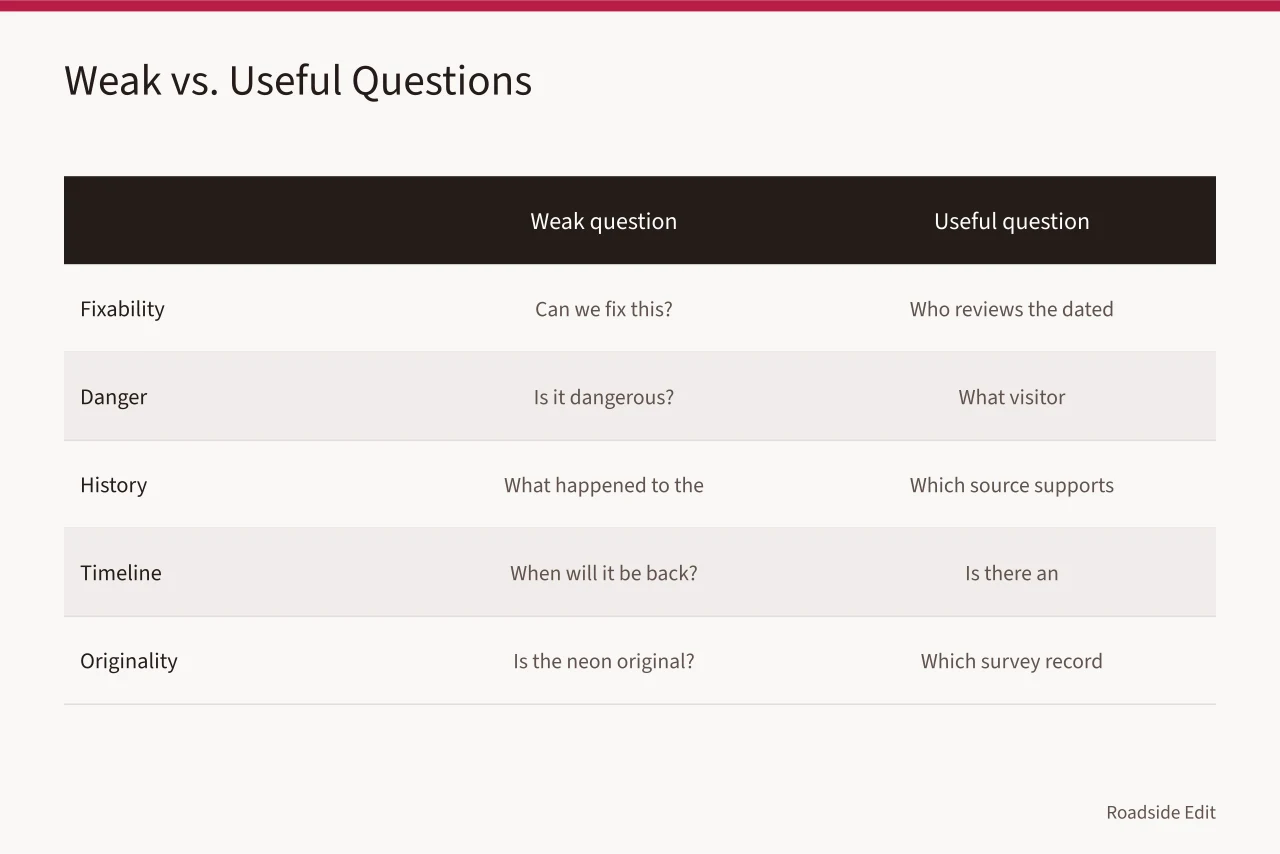
Compare weak and useful questions
| Weak question | Useful question |
|---|---|
| "Can we fix this?" | "Who reviews the dated observation before any public claim changes?" |
| "Is it dangerous?" | "What visitor instruction does the responsible party want published while review is pending?" |
| "What happened to the sign?" | "Which source supports the reported date or prior-work history?" |
| "When will it be back?" | "Is there an owner-approved update date or public contact method?" |
| "Is the neon original?" | "Which survey record documents the tube and transformer as found?" |
The useful column resolves nothing physical. It identifies the person, record or instruction needed next.
Separate the questions by purpose
Access, condition and history are three threads. Combine them and the reply answers one while the article implies all three. An owner may confirm a gate is locked at dusk and say nothing about the box sign's ballast.
A dated archival photograph can support a caption about a 1958 canopy and still tell you nothing about today's dry-stand pipe. Keep each answer attached to its own question.
Record the answer with its limits
Note who supplied it, their role, the date, and exactly which question it answers. Label a preliminary statement as preliminary. A privacy request or a temporary access instruction is not a certification of condition.
For material questions, the Secretary of the Interior's Standards and Guidelines for Federal Agency Historic Preservation Programs govern how a property gets documented. They do not assess a sign. They support asking for dated, identifiable evidence before a historic claim sits beside a current observation.
Ask for a publishable status, not a prediction
An owner can confirm that a review is pending, that a contact channel exists, or that public wording changed. That is different from predicting an outcome or a date.
Phrase it so the reply publishes without extension: "What status may we state as of this date?" Keep the answer as received, with any publication conditions.
The National Archives guidance on preserving personal digital records covers file formats and descriptive context for digital material. It is not a notice-writing rule. It supports keeping the dated source copy behind a status line so a later editor does not read a temporary answer as a finding.
Ask separately about paid information
If a fabricator, salvage dealer or booth supplier offers a quote, testimonial or directory entry, ask three things. Ask what is supplied, whether payment is involved, and how it will be labeled. Keep that thread away from access and roadside building basics.
A commercial reply can serve a directory reader. It is not independent evidence about a specific site.
The Federal Trade Commission's endorsement guides cover endorsements and testimonials in advertising. They do not assess a sign. They support clear labeling when a question produces commercial material.
Common questions
Can a writer ask a contractor for a quote?
Yes, but a quote is commercial information. Keep it attributed, dated, and separate from any independent assessment of condition or history.
Should every concern be published?
No. Publish what serves a clear public purpose and rests on an owner-approved or otherwise supportable basis. Everything else stays in the working file.
What if no one answers the question?
State only what is confirmed, keep the question in the record, and leave the gap open. A conclusion invented to fill it is the failure this process exists to prevent.