Guides
Part of Neon sign restoration safety checklist: what to document before anyone visits
How to set a neon sign restoration safety checklist scope before work starts
Neon sign restoration safety checklist for 2027 gives U.S. owners a clear boundary for records, visitor notices, role assignment, and qualified handoffs.
The first item in a neon sign restoration safety checklist is scope. Decide what an owner, writer, volunteer, visitor, or contractor is responsible for recording, and what must be routed to a qualified party. This keeps a helpful checklist from becoming informal technical advice.
What to take away
- State who owns the record and who may change public copy.
- Keep site observations separate from safety conclusions.
- Make visitor instructions traceable to the responsible party.
- Route electrical or access questions through a qualified, documented process.
Assign roles before a question arrives
An owner can confirm a site contact and approve a public notice. A writer can preserve a source note, caption a dated photograph, and disclose a commercial relationship. A volunteer can report what is visible from a lawful public viewpoint. None of those roles should be assumed to include technical evaluation or physical work.
OSHA's training-requirements rule addresses training for employees who face electrical risks in their job duties. It is not a certification test for readers. The relevant planning point is that roles and training matter, so a general publication should not blur a contributor's recordkeeping role with a qualified worker's property-specific responsibility.
Use a short scope statement
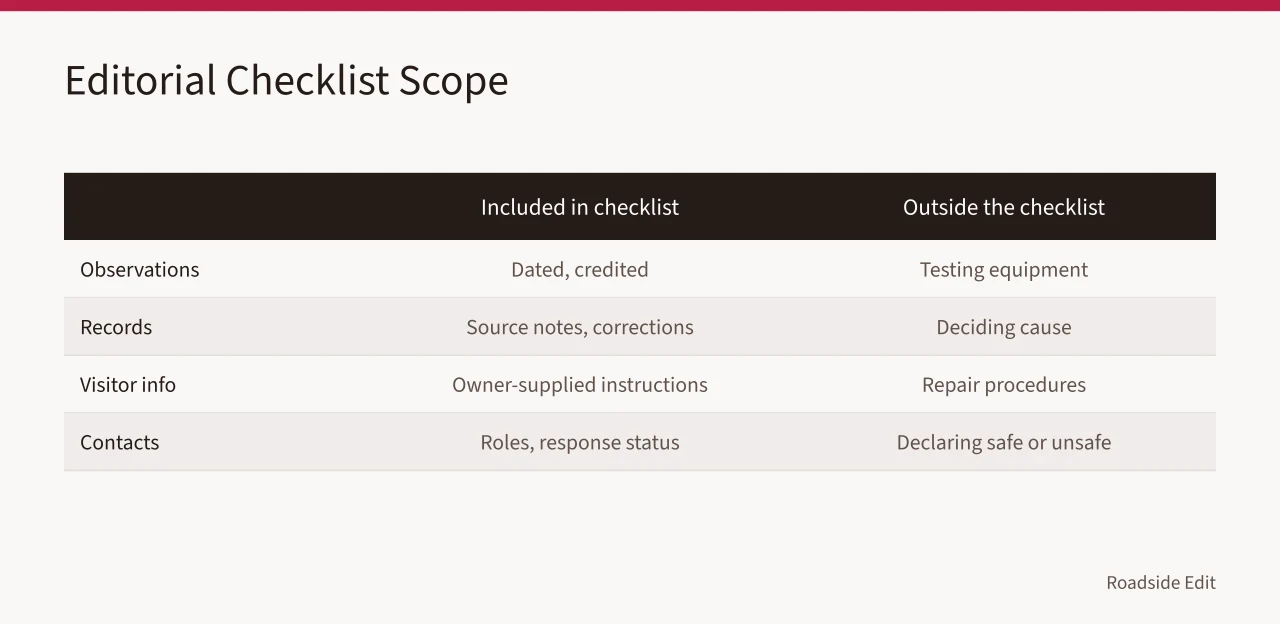
| Included in the editorial checklist | Outside the editorial checklist |
|---|---|
| Dated observations and image credits | Testing or handling electrical equipment |
| Source notes, correction history, and disclosures | Deciding the cause of a visible change |
| Owner-supplied visitor instructions | Giving a repair, cleaning, or access procedure |
| Contact roles and response status | Declaring a property safe or unsafe |
Place this table near the record index. It gives a staff member a defensible answer when someone asks for a conclusion that the record cannot provide.
Keep access notices factual
If the responsible party provides a visitor instruction, record it verbatim with the date and general area it covers. A public note can explain that a review is underway. It should not make unsupported claims about an exact hazard, a closure duration, or a technical outcome.
Make handoffs easy to read
A handoff note needs four facts: what was observed, when and where it was observed, what evidence is attached, and the focused question that needs an answer. Add a fifth field for the contact role and the date sent. This is enough for a later editor to follow the history without adding a diagnosis to the file.
Preserve observations without turning them into findings
Use ordinary, visible language in the record. Write that a letter was not illuminated in a dated photo, not that a component failed; write that a barrier was visible at a given time, not that an area was compliant or dangerous.
This protects readers from confusing a record with a technical conclusion. Record the source, photographer when known, date, viewpoint, and any limits on access or visibility.
The National Park Service documentation standards and guidelines address how historic properties can be documented. They do not determine a neon sign's condition. They support retaining dates, images, and descriptive context when an editorial team records what it can actually verify.
Set a visitor-message review rule
When an owner supplies a public message, keep the received wording. Identify the person or organization that supplied it. Before republishing, check its date, stated area, and whether it includes an outcome the owner has not confirmed.
Replace vague safety language with a factual status statement when possible. If the message is no longer current, remove it instead of extending its meaning in a new article.
The National Archives personal digital archiving guidance concerns organizing and preserving digital files. It does not set visitor-notice policy. It supports keeping source copies and descriptive information so editors can trace what was supplied and when.
Keep commercial material separate from notices
A provider may pay for a directory placement or submit a profile. That material needs a disclosure and a clear label. It should never be used as evidence that a particular sign, access path, or public area has been assessed. Keep advertising copy in its own folder or record field, apart from owner notices and dated observations.
The Federal Trade Commission's endorsement guides address endorsements and testimonials in advertising. They do not give safety advice. They support identifying commercial relationships instead of allowing paid material to appear as an independent public finding.
Common questions
Does a checklist tell a visitor how to inspect a sign?
No. It tells the publication team how to preserve observations and use a responsible handoff.
Who can approve a public safety statement?
Use a specific, supportable source and the responsible party's documented information. Do not infer approval from an old article or photo.
Can a volunteer contribute a photo?
Yes, if the image is lawfully obtained, dated, credited, and described as an observation rather than a technical finding.