Guides
Part of How to plan historic motel restoration costs for 2027 without guessing a price
Historic motel restoration cost questions to settle before you trust a 2027 estimate
Settle historic motel restoration cost questions by matching each one to the record that could answer it, then writing the honest result when that record is missing.
Cost questions work best as a log you can answer, not a list you argue about. Each question gets matched to the record that would settle it, and the result gets written down even when the record is missing.
What to take away
- Pair every question with the record that could answer it before you go looking.
- Write "not established in the reviewed record" when the file is silent, and leave the question open.
- Keep price questions and significance questions in separate columns; a grant award says nothing about a butterfly roof.
- Read the source's own label first. A planning allowance, a bid, an award and an invoice are four different documents.
- Never let a 2027 estimate inherit a scope it was not written against.
Price questions and significance questions do not mix
A reported dollar amount and a National Register eligibility finding answer different questions, and merging them produces a sentence that is true of neither.
Price questions ask what a figure covers, when it was made, and who made it. Significance questions ask what the property contributes and under which criterion.
The National Park Service's Historic Property Project Documentation process links existing property information to scope and design decisions, which is the handoff point where the two sets of questions touch. See the NPS documentation overview.
A motel can hold real significance with no public estimate anywhere, and a published number establishes nothing about designation, condition or treatment suitability.
The question log
Four columns. Question, record that could answer it, honest result when the record is missing, and whether the question is price or significance. Fill the fourth column first; it decides where the answer belongs in your writing.
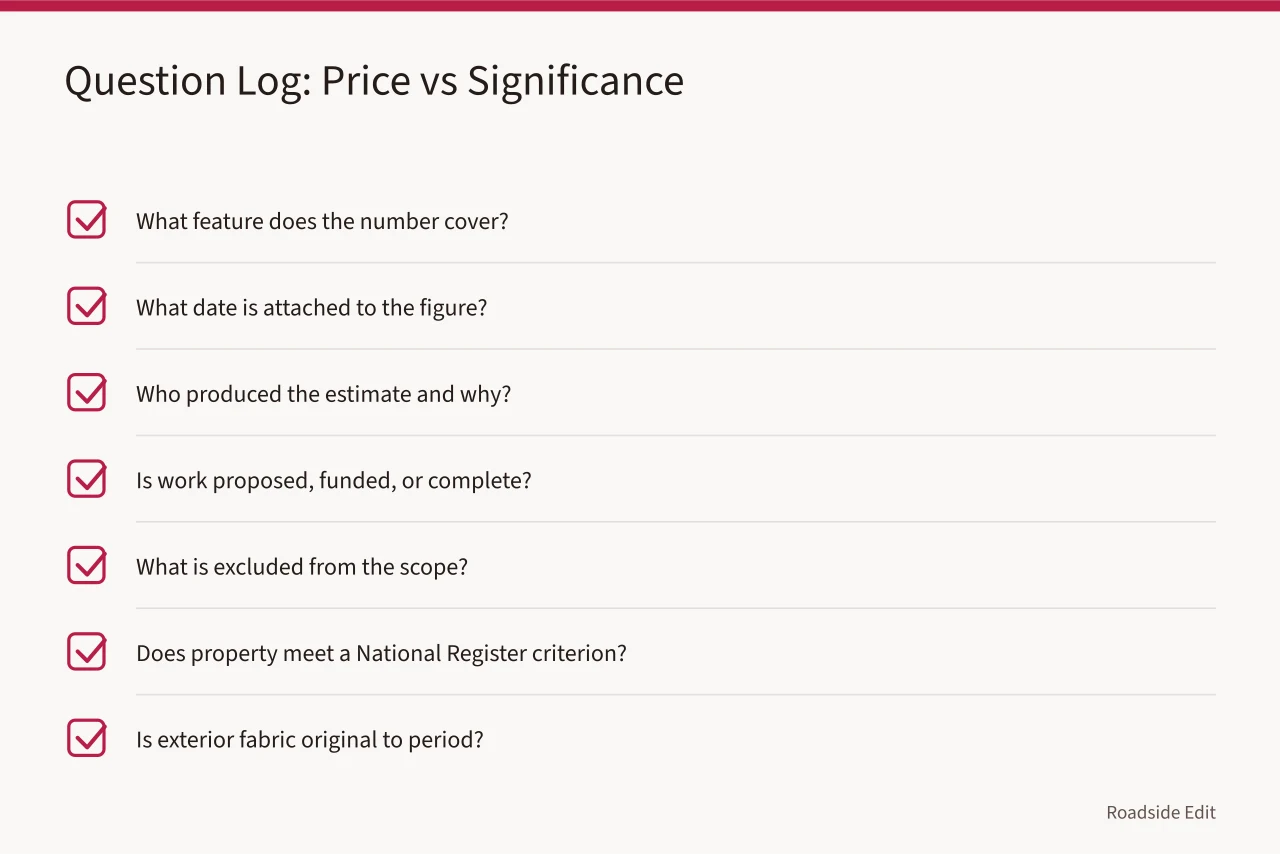
| Question | Record that could answer it | Honest result when missing | Type |
|---|---|---|---|
| What exact feature does the number cover? | Scope narrative, measured drawings, work description | Scope not established | Price |
| What date is attached to the figure? | Date on the estimate or completion record | Report a dated amount only | Price |
| Who produced the estimate, and for what stated purpose? | Signature block, cover letter, RFP response | Producer and purpose unknown | Price |
| Is the work proposed, funded, under contract, or complete? | Award notice, executed contract, dated completion record | Stage not established | Price |
| What is excluded? | Stated inclusions and exclusions | Exclusions not listed | Price |
| Does the property meet a National Register criterion? | SHPO concurrence letter or nomination | Eligibility not determined | Significance |
| Is the exterior fabric original to the period of significance? | Dated survey photographs, materials analysis | Fabric date not established | Significance |
A recent National Park Service request for proposals on historic properties required each offeror to verify property condition, develop a detailed scope of work, and price its own proposal. Read the NPS project-scope example. That is one agency's procurement rule for three specific properties, not a universal motel standard, but it shows the order: condition, then scope, then number.
Where the log breaks down
Two failure modes recur in roadside preservation writing.
The first is a scope substitution. A figure priced for a canopy soffit and dry-stand pipe inspection gets quoted as a whole-property restoration cost. The number is real; the transfer is not. Your log catches this in the first row.
The second is a fabric substitution. A 1960s plastic-faced box sign gets described as the 1950s porcelain-enamel original, and every cost question downstream inherits the wrong object. Dating comes before pricing, always.
The U.S. General Services Administration treats cost management as a process that changes as requirements and scope become clearer. Read GSA's cost-management guidance. An early number is not wrong for being early. It becomes misleading when an article calls it final.
Writing the result in one sentence
State the amount and its documented role, or state that the reviewed record does not establish a transferable cost. Both sentences serve a reader. Neither invents a scope.
NPS documentation standards require reliable source material and stated limits that let another person check the work. Review the NPS documentation standard. A stated limit is not a weakness in the article; it is the part that makes the rest checkable.
Site-specific questions about structure, electrical service or underground tanks go to a licensed engineer, electrician or the environmental authority with jurisdiction. Compliance rulings go to the State Historic Preservation Office or local landmarks commission under the adopted ordinance.
Cross-border salvage, neon parts and diner booths go to a customs broker. Your log records who was asked and what they said.
Common questions
Can a grant amount answer the total-cost question?
Rarely. An award usually funds a named portion of a larger project, so the amount and its stated purpose travel together. Log both, and log what the award does not cover.
What do I do when two sources conflict?
List both with their dates, producers and scopes, and say where they diverge. Do not pick the easier number to quote. The divergence itself is often the most useful fact in the article.
Should the log hold technical questions?
Yes, as questions. Record who holds the answer, name the licensed professional or authority, and leave the technical conclusion to them.