Guides
Part of How to keep a roadside architecture field guide that lasts
Roadside architecture preservation warnings: what to check before your project moves ahead
Roadside architecture preservation warnings for 2027 identify common evidence, safety, access, and scope mistakes before an article or project moves ahead.
Roadside architecture preservation warnings help writers and project teams recognize when they need better evidence or professional advice. They are not a substitute for a building assessment, code review, legal advice, or owner authorization. The most common problem is simple: a visible feature is treated as proof of history, condition, or permission when it is only a clue.
What to take away
- Do not call a feature original, historic, safe, or eligible without supporting evidence.
- Do not enter a vacant-looking building or private site to improve a record.
- Separate a photographic observation from a diagnosis of structural or material condition.
- Stop when a source conflicts with the draft, then correct the draft.
Watch for evidence warnings
A popular caption, old postcard, or social-media post may be interesting, but it is not automatically reliable proof of a date or design history. Confirm where the image came from, what it depicts, and when it was made. A missing date is not an invitation to create one from a visual impression.
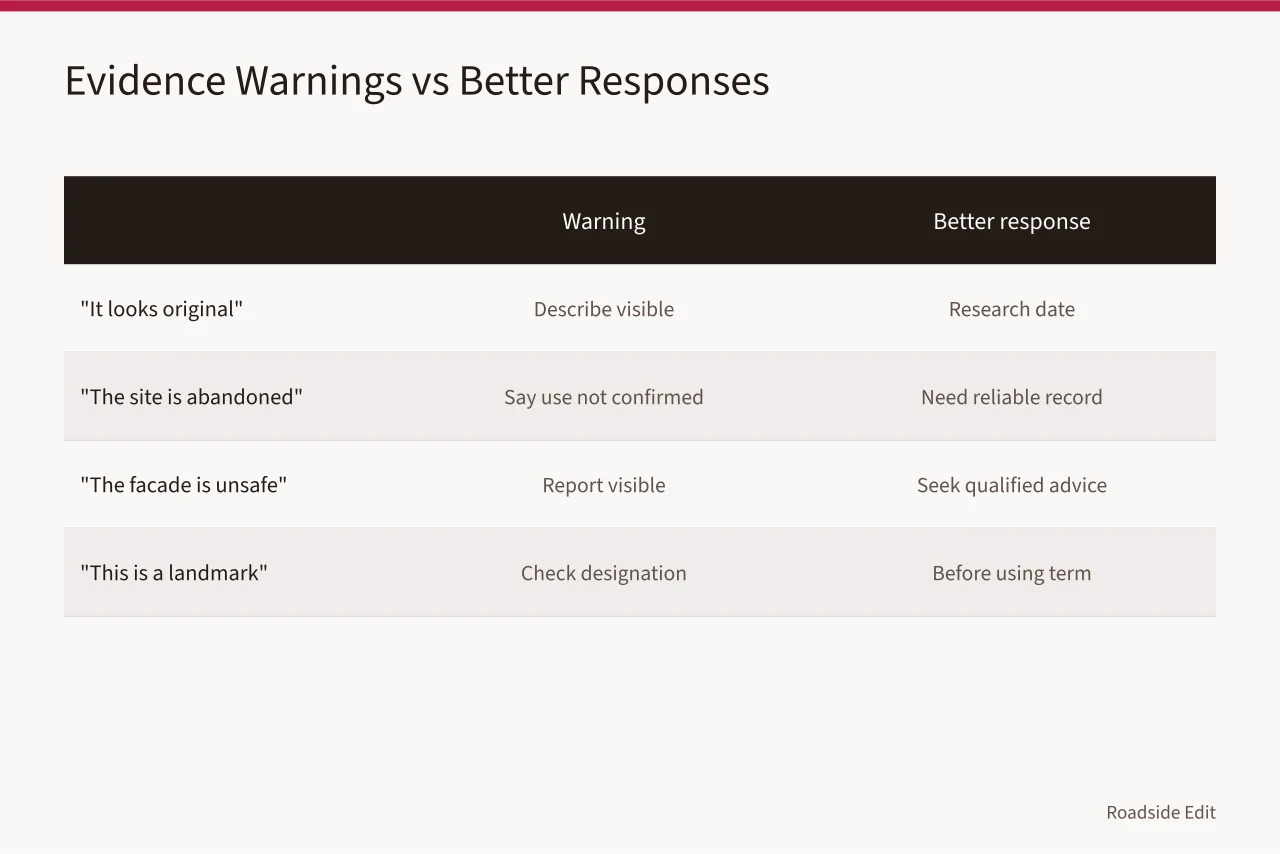
| Warning | Better response |
|---|---|
| "It looks original" | Describe it as visible and research the date |
| "The site is abandoned" | Say use is not confirmed unless a reliable record supports it |
| "The facade is unsafe" | Report the visible condition and seek qualified advice |
| "This is a landmark" | Check the relevant designation record before using the term |
Watch for setting changes
Roadside places do not stay still. A roadway can be rerouted, parking can be restriped, a sign can move, and a new utility line can change the view. The National Park Service notes that historic roads may retain overall design while features such as bridges, culverts, and guardrails change over time. Review the NPS page on Yellowstone historic roads.
That example does not determine the history of a local property. It supports the need to treat present conditions and past conditions as separate questions.
Watch for safety and access errors
Never climb, enter, or move something to get a better image. Photograph from a lawful, safe place. If vegetation, fencing, traffic, or distance blocks a view, record that limit. A field note can say "the rear elevation was not visible from the public right-of-way." It should not pretend that a blocked view was inspected.
The National Park Service's preservation standards distinguish preservation, rehabilitation, restoration, and reconstruction as different treatments. Review the Secretary of the Interior's Standards. The standards do not diagnose a roadside building from a photograph. They support using treatment terms carefully. Avoid claiming that visible work meets a preservation standard without appropriate evidence.
Preserve the original observation
When a later record supplies a date, use, or designation status, add it as a dated research finding. Do not rewrite the field note as if that fact was visible during the first visit.
The National Archives describes records management as a lifecycle including creation, maintenance, use, and disposition. Review the National Archives basic records-management concepts. This keeps the initial observation distinct from later research.
If a photo includes people, license plates, active business activity, or other private details, do not assume publication is appropriate. The NIST Privacy Framework is a voluntary privacy-risk resource. It supports considering whether information is necessary for the article and handled through established practices. It does not grant permission to access a property or publish private material.
Stop-and-check list
Pause before using words such as original, abandoned, unsafe, restored, or landmark. Ask which source supports the word and whether the source applies to the feature being described. If a designation record, permit, assessment, or owner-approved statement is not available, write only what can be observed.
The same rule applies to dramatic descriptions of deterioration. A careful note can document peeling paint, missing glass, or a blocked entrance without claiming a cause, a condition rating, or a required repair for the entire site today safely.
Common questions
Does peeling paint prove that a building is in danger?
No. It documents a visible surface condition. A qualified assessment is needed before making a safety or structural claim.
Can I use the word restoration in a first article?
Use it only when a credible project record supports that description. Otherwise, describe the visible work and what is known.
What if a source contradicts an article draft?
Fix or remove the contradicted statement. A preferred narrative is never a reason to keep an unsupported claim.