Guides
Part of How to keep a roadside architecture field guide that lasts
How to build a roadside architecture site record guide that lasts
Roadside architecture site record guide for 2027 shows how to organize images, observations, sources, permissions, and updates for a clear publication file.
A roadside architecture site record guide keeps an article from losing track of its images, field notes, sources, permissions, and corrections. It can be a folder, spreadsheet, or simple database. The format matters less than the ability to answer basic questions later: what was observed, when, by whom, from where, and which source supports each historical statement?
What to take away
- Give the site one stable label and use it in every note, image, and source entry.
- Store observations, research, image credits, and permissions as separate record types.
- Add a date and access note to every outside source.
- Preserve corrections rather than silently replacing a material claim.
Use five simple sections
Set up one folder for the place, then create a record for each type of material. Avoid putting everything in one undated document. A future editor should be able to identify the original photo, the public source, and the reason a sentence changed.
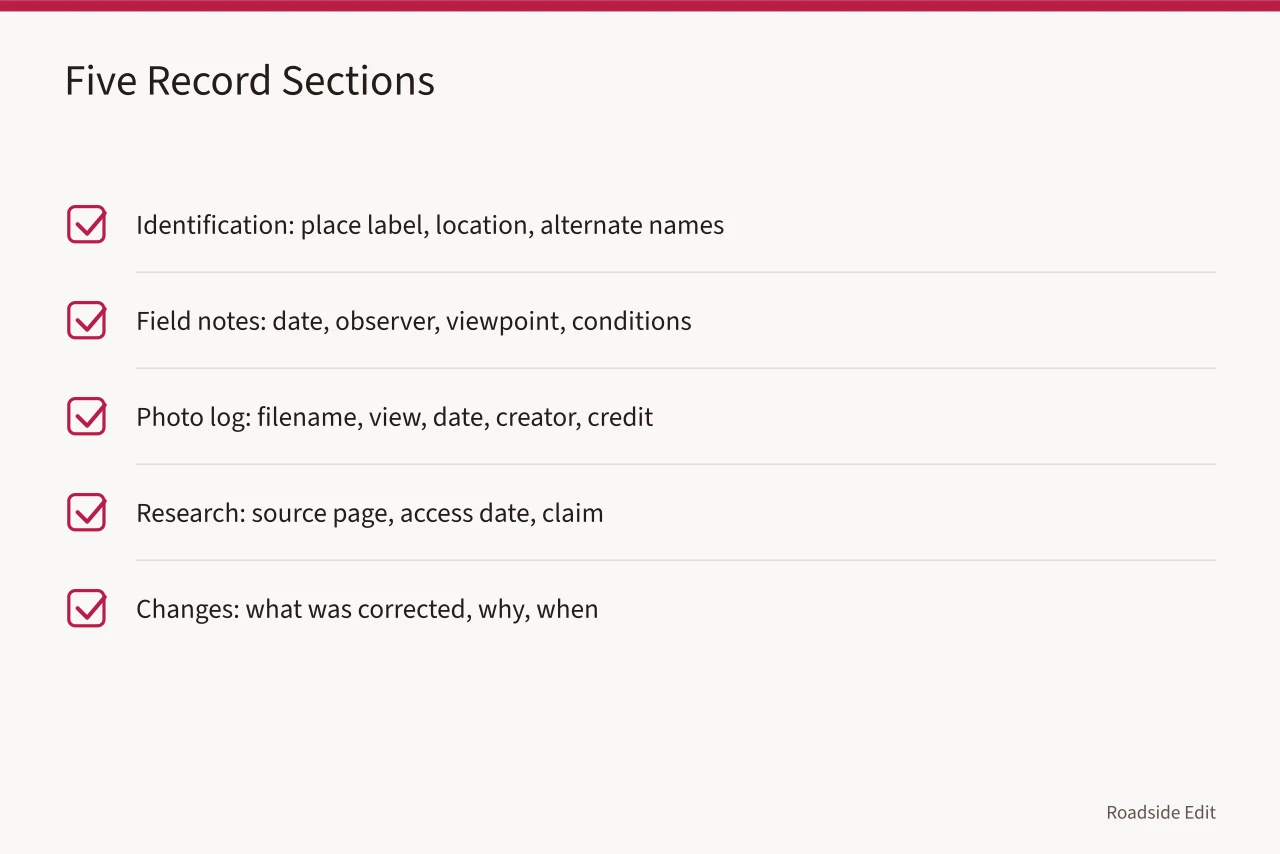
| Section | Include |
|---|---|
| Identification | Current place label, location, and alternate names |
| Field notes | Date, observer, viewpoint, and visible conditions |
| Photo log | Filename, view, date, creator, and credit source |
| Research | Specific source page, access date, and supported claim |
| Changes | What was corrected, why, and when |
Describe records at their own level
Do not rewrite a public listing as if it were a condition assessment. Do not turn an owner conversation into a broad historical fact. Do not label a photo as evidence for something outside the frame. The record should name the kind of source and the narrow statement it supports.
The National Park Service's Acadia transportation decision covers avoiding or minimizing effects on identified historic properties, viewsheds, and character-defining features when adding modern features (Read the Acadia transportation decision).
A local site record does not do that. The useful takeaway is organizational: describe the specific feature, setting, and proposed change, not a vague label like "historic character."
The National Archives identifies metadata elements such as title, creator, creation date, and rights information in its electronic-record guidance. Review NARA's electronic-record metadata guidance. Its federal-record context is different, but the field list helps a site record remain understandable when the original editor is unavailable.
Add corrections openly
If a date, name, or feature description changes after publication, keep a short correction note. State what the article said, what the source now supports, and the update date. Do not expose personal information or private correspondence. The point is to make the public record more accurate.
The National Archives describes records management as a lifecycle including creation, maintenance, use, and disposition. Read the National Archives basic records-management concepts. Preserve the earlier record and the correction as dated entries so the change remains explainable.
Do not store resident contact information, account data, or restricted access instructions in a public record package. The NIST Privacy Framework is a voluntary privacy-risk resource. It supports considering whether material is necessary for a published description and handled through established practices. It does not give permission to disclose private records or enter a property.
Site-record maintenance routine
Use one editor-facing checklist when a new source or image arrives. Confirm the site label and exact source page. Add the received date, the creator or issuer if stated, and the narrow claim the material supports. Mark whether the item is public, internal, permission-limited, or unknown. Update the correction log if the new material changes published wording.
This routine keeps a folder from becoming a group of attractive images and disconnected links. It also gives an authorized editor a clear starting point when a reader asks how a claim was confirmed.
When a location name changes, keep the current and historical names in separate fields. Do not assume they are the same building without a source that makes the connection.
If several images show similar roadside structures, record exact locations and observation dates before using them as context. A clean site record leaves uncertainty visible until reliable research resolves it.
Common questions
What makes a source entry useful?
It names the specific page or record, gives a date or access date, and identifies the exact statement it supports.
Should I keep a copy of every web page?
Keep the citation, access date, and permitted research copy or notes. Follow the source's terms and do not republish restricted material.
Who should edit the site record?
Use an authorized editor who can verify sources and preserve the reason for each material correction.