Guides
Part of How to keep a roadside architecture field guide that lasts
Roadside architecture survey checklist: how to record a site on your first visit
Roadside architecture survey checklist for 2027 helps writers make a clean first-visit record of setting, route access, visible features, and photos.
Use a roadside architecture survey checklist to make a first-visit record that someone else can understand. It is not a National Register nomination or a professional condition assessment. It is a disciplined way to record a place from a lawful observation point before research, restoration talk, or nostalgia changes the story.
What to take away
- Record the date, observation point, and current setting before describing details.
- Photograph broad views and useful context, not only a favorite sign or facade.
- Use "visible," "appears," and "not confirmed" when a fact needs research.
- Keep field observations separate from old maps, interviews, and public listings.
Start with the site basics
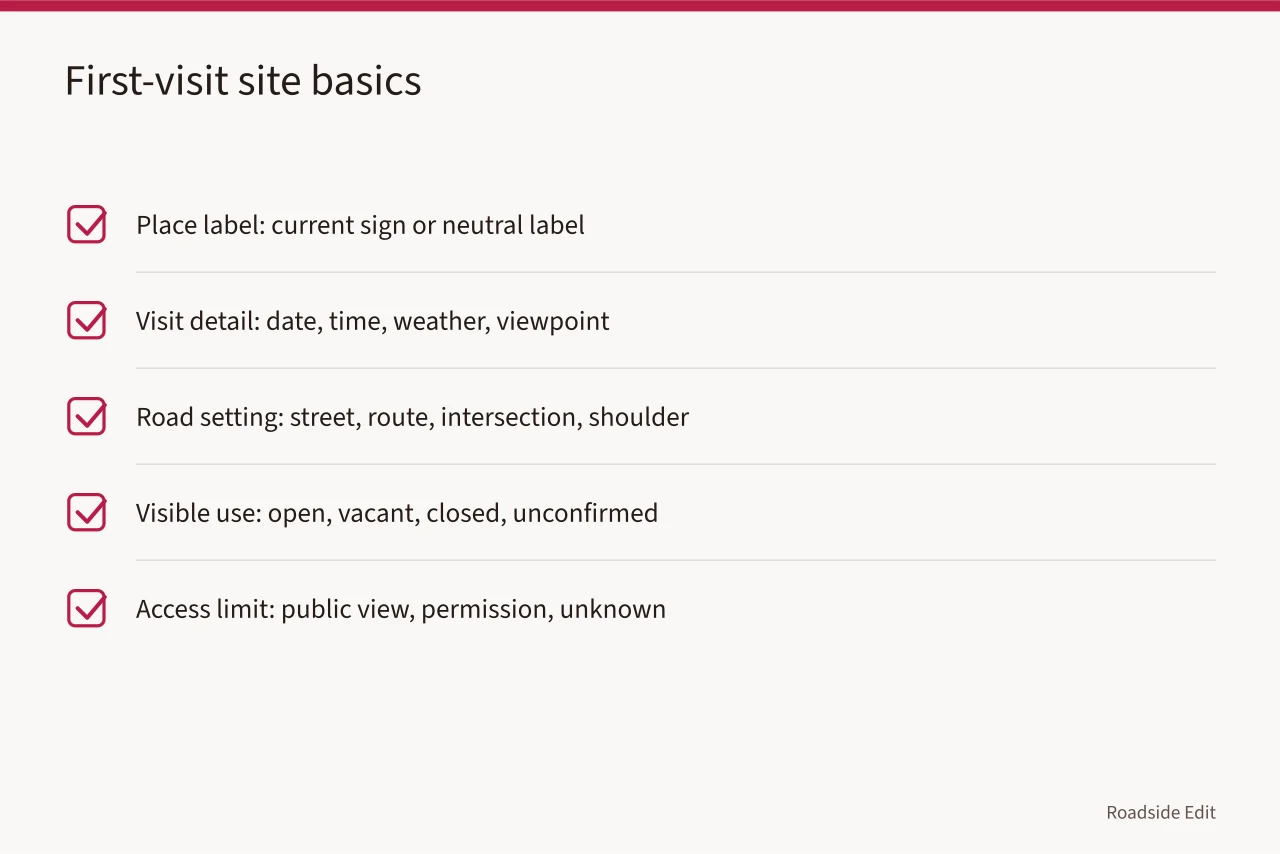
Open your note with the present-day location, date, time, and the route or street name you can verify. Add the direction you faced when taking the first image. If an address is uncertain, write that it is approximate rather than guessing. A good checklist preserves uncertainty instead of hiding it.
| Entry | What to record |
|---|
Follow a five-part walk-around
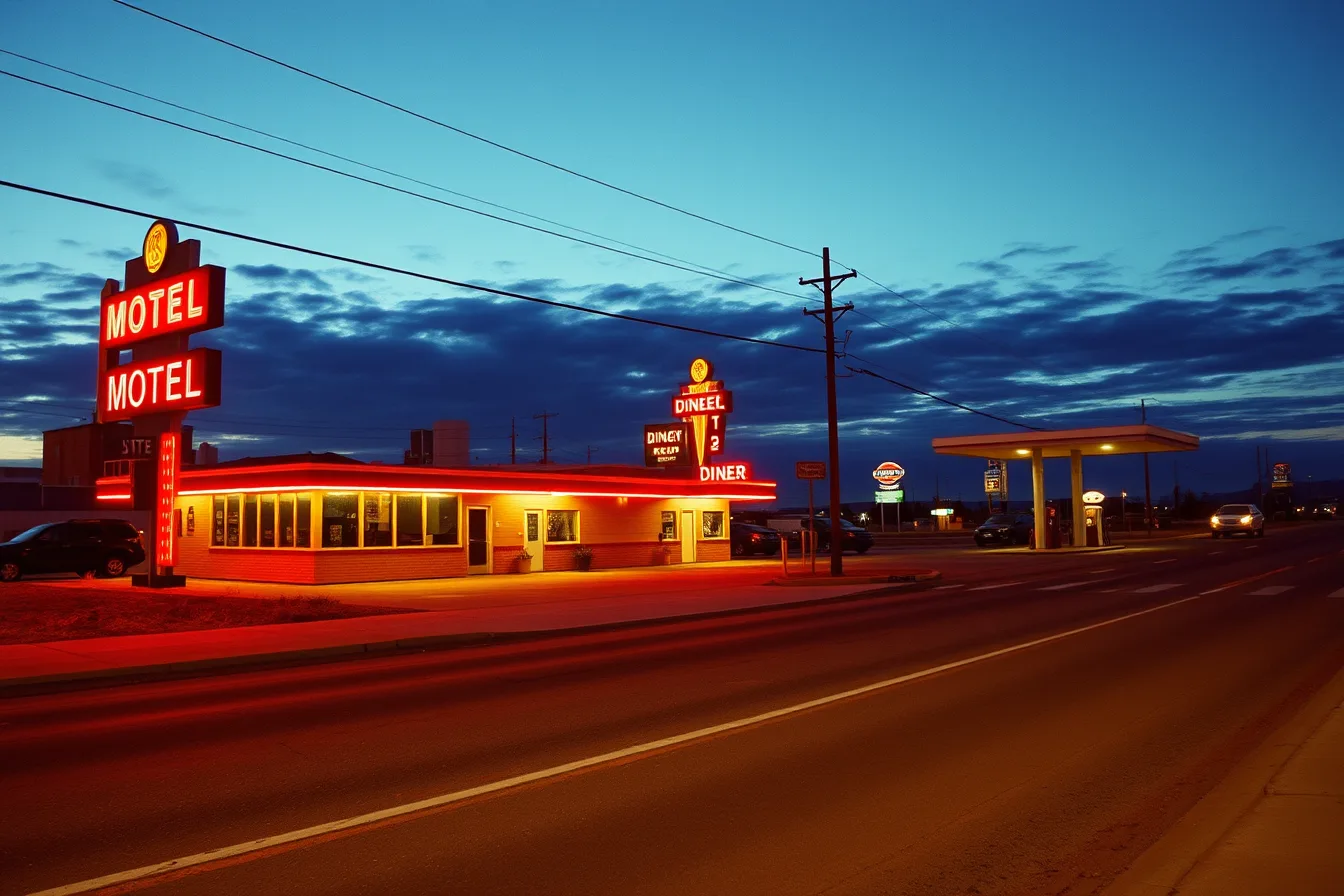
- Take one wide image showing the place and the road.
- Note the driveway, parking area, sidewalk, and visible circulation.
- Describe the overall building form and visible materials.
- Photograph signs, roofline, openings, and other details separately.
- Finish with research questions instead of unverified history.
The Library of Congress describes formal HABS, HAER, and HALS records as a combination of drawings, photographs, and written histories. Review the Library of Congress note on documentation. A basic survey is not formal documentation, but the three-part logic is useful: distinguish what you photographed, what you wrote down, and what later research confirms.
The National Park Service's guidance for National Register documentation explains that photographs should show the resource and its setting. Read the National Park Service photograph guidance. It concerns formal nominations, not informal roadside surveys. Its useful lesson is simply to include context instead of photographing only a decorative detail.
Give every photo a job
A photo log prevents a folder of attractive but unusable images. Write a short description while you are on site, then use the same phrase in the filename or caption. If a detail cannot be placed in the larger site, add a wider companion image.
| Photo type | Purpose |
|---|---|
| Wide setting | Shows the road and neighboring context |
| Approach | Shows what a traveler first sees |
| Elevation | Records one side of the building |
| Detail | Captures a sign, material, opening, or fixture |
| Context | Shows surroundings, parking, or adjacent development |
Never walk into a road lane, onto private property, or past a barrier to complete the list. Note the restriction and move on. A limited but honest record is better than a risky one.
Separate observation from later research
Write field notes in present tense and label later history as research. A historical map, interview, newspaper item, or public listing may add context, but it should not overwrite what was visible during the visit.
The National Archives describes records management as a lifecycle: creation, maintenance, use, and disposition. Review the National Archives basic records-management concepts and preserve the original field note, adding later findings as dated entries.
If a photo includes people, license plates, business transactions, or private information, do not treat it as automatically ready for publication. The NIST Privacy Framework is a voluntary privacy-risk resource. It supports considering whether the image is necessary for the story and handled through established practices. It does not determine access rights or permission to enter private property.
Final field-note check
Before leaving, read the checklist once more. Confirm that every image has a viewpoint note, every uncertain fact is labeled, and every access limit is stated. A complete note can still be brief when it identifies what was observed, what remains unknown, and where later research should begin.
Common questions
Should I include an architectural style in a first survey?
Only if a reliable source supports it. In a first note, describe the visible form, materials, and details instead.
What if a building is partly hidden?
Record which views were blocked and why. Do not fill the gap with a guess from an online image.
Can this checklist be used for a working business?
Yes, if you respect the business, customers, and property boundaries. A visible-use note should never imply owner permission or public access.