
Guides
Neon sign restoration maintenance plan: how owners keep records that hold up
Neon sign restoration maintenance plan for 2027 helps U.S. owners maintain baseline records, document changes, assign decisions, and use qualified handoffs.
A maintenance plan for a historic neon sign is a written record that helps an owner notice change, retain evidence, organize decisions, and route site-specific questions to the appropriate qualified process. It is not a set of instructions for testing, cleaning, wiring, energizing, repairing, moving, or removing sign components.
What to take away
- Establish a dated baseline before describing a change.
- Record what is observed, what is reported, and what remains unknown.
- Keep inspection notes, photographs, source records, and decisions together.
- Treat a condition log as information for a responsible handoff, not a diagnosis.
- Keep commercial and paid-placement disclosures separate from condition claims.
Begin with a baseline record
The first maintenance record should describe the sign's identity, general location, business association, source date, visible context, and known history. It should not claim original colors, current safety, ownership, or cause of deterioration unless a source supports that exact statement.
The National Park Service notes that condition documentation can help identify preservation needs, establish baseline information, and support prioritization. Its documentation guidance concerns historic cemeteries, not roadside signs. The limited lesson that applies here is organizational: collect background records, current dated documentation, and recurring observations before making a larger claim about change.
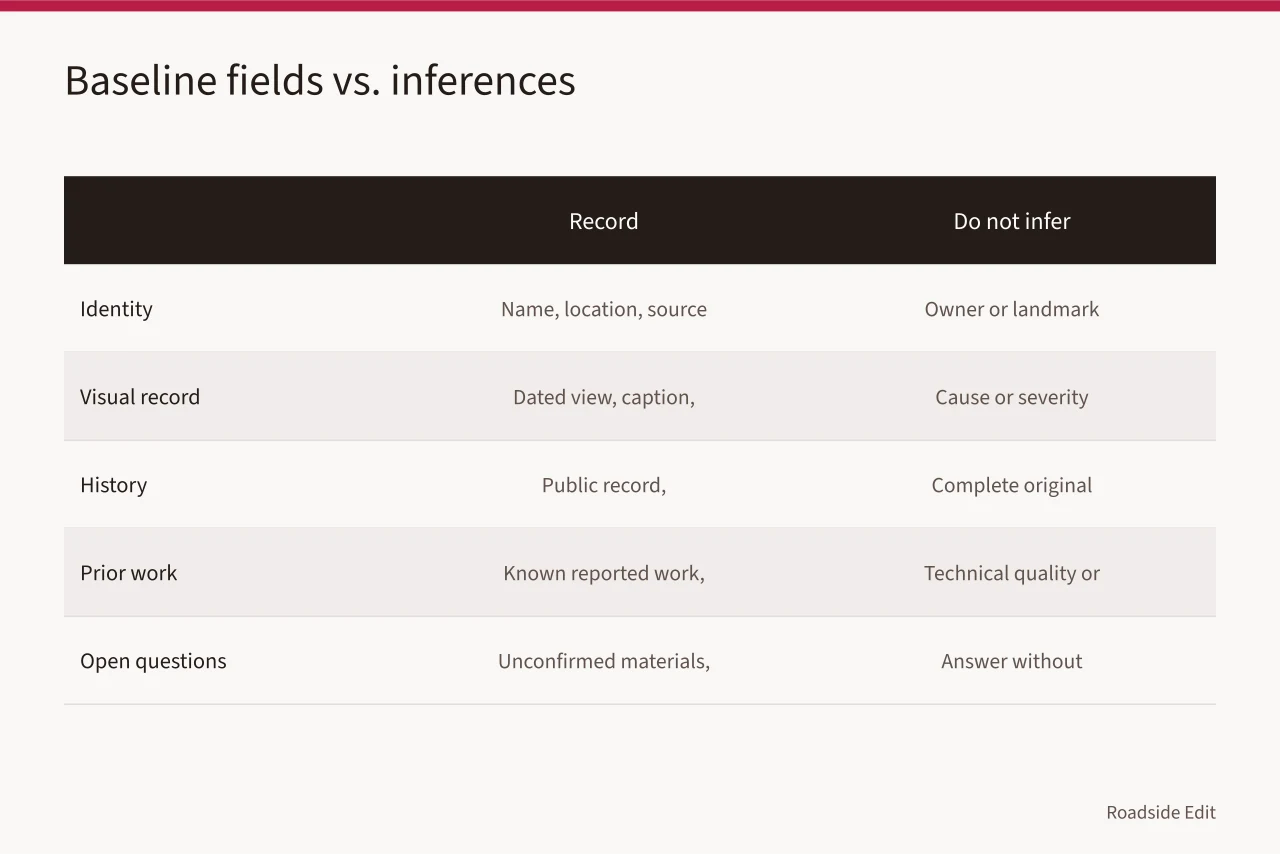
| Baseline field | Record | Do not infer |
|---|---|---|
| Identity | Name, location, association, and source date | Current owner or landmark status |
| Visual record | Dated view, caption, file source, and viewpoint | Cause or severity of a condition |
| History | Public record, attributed memory, or publication | Complete original appearance |
| Prior work | Known reported work and source | Technical quality or outcome |
| Open questions | Unconfirmed materials, authority, access, or review needs | An answer without evidence |
Use observations, not conclusions
A reliable note says what the record shows. For example: "A photo dated May 2027 shows surface wear on the lower cabinet," or "the owner reports the sign has been inactive since a stated date." Those statements trace to an image or source.
They should not become "the system failed" or "the sign is unsafe" in a general editorial record.
This distinction protects an owner and publisher. A general article does not have enough information to decide a technical or safety issue. It can preserve the observation, state the date, and identify who should address a property-specific question. The most useful maintenance plan is one that makes a qualified handoff easier.
Create a recurring condition log
The log can be simple. Record the date, source of the observation, what was visible, whether comparison images exist, open questions, responsible party, and next action. Avoid asking staff, writers, or volunteers to diagnose a sign. Their role is to retain a clear record and report the observed change through the right channel.
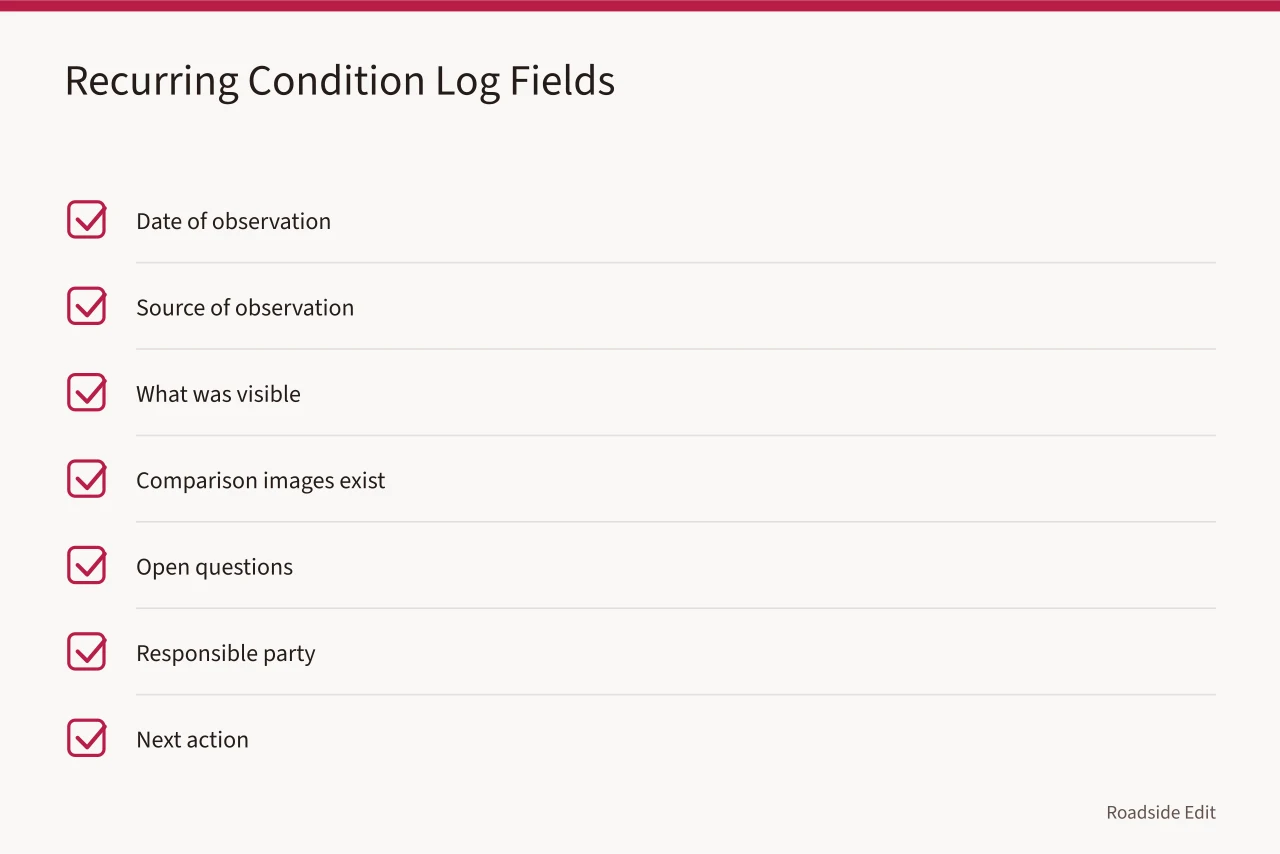
| Date | Observation source | What was recorded | Next action |
|---|---|---|---|
| YYYY-MM-DD | Dated photo or attributed observer | Visible feature or context | File record or request qualified review |
| YYYY-MM-DD | Public source | Historical or ownership statement | Confirm source or label as reported |
| YYYY-MM-DD | Provider or sponsor submission | Submitted service or project information | Label and disclose the relationship |
Keep the same viewing point and naming pattern where possible. A consistent record does not turn a photograph into an assessment, but it allows a later reviewer to compare like with like. Use descriptive file names such as YYYY-MM-DD_sign_general-view_v01, not file names that claim a diagnosis.
Separate daily stewardship from site work
An owner or editor can maintain records, organize sources, update a public description, and keep a list of contacts. Some questions require someone with appropriate responsibility for the actual property. These may involve physical condition, electrical systems, structural support, high access, local rules, public rights-of-way, hazardous materials, or emergency response.
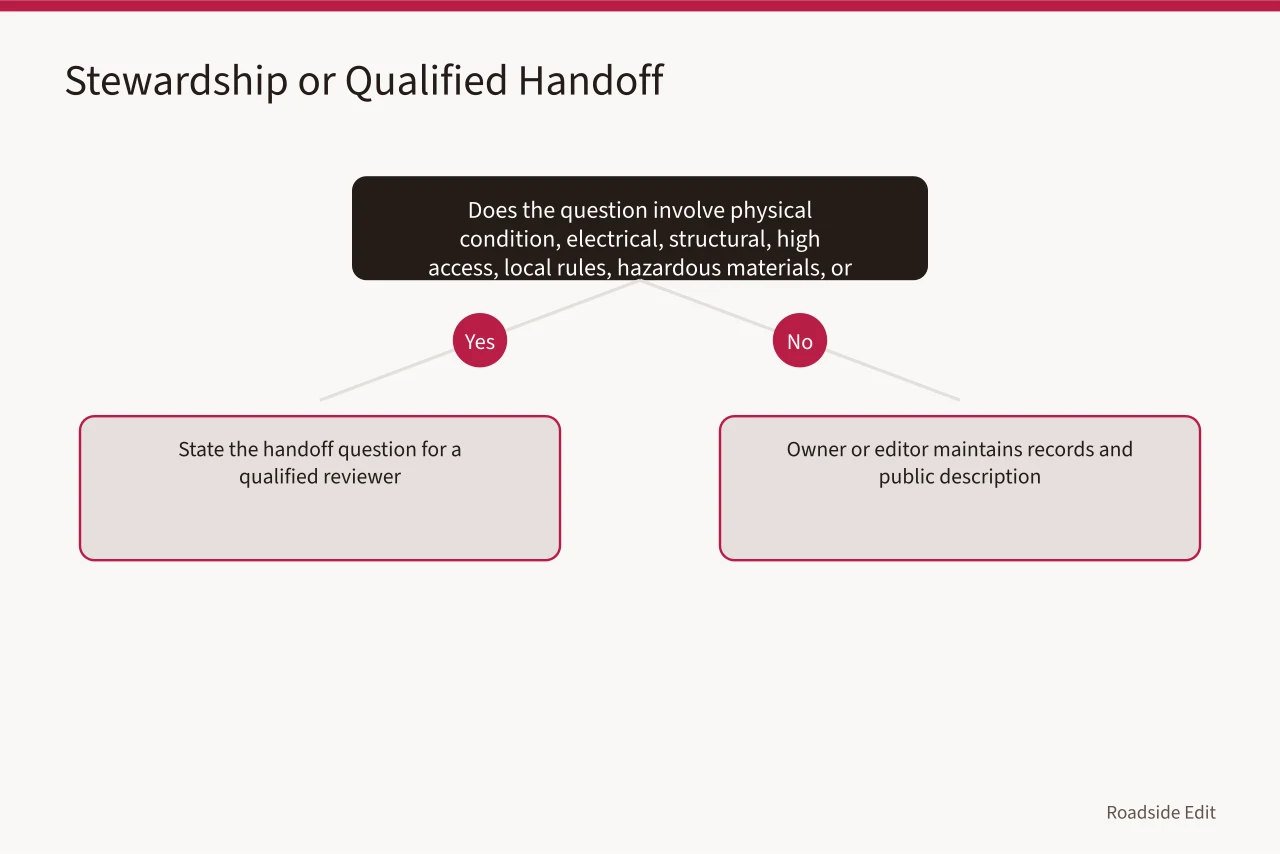
The plan should state the handoff question, not solve it. For example: "Who should review the observed change before a public claim is updated?" Or: "Which responsible local process applies to the proposed activity?"
A generic do-it-yourself instruction gives no starting point. A stated question documents where the right conversation begins.
Maintain the public record too
Maintenance information often appears in articles, listicles, business profiles, or funder updates. Each public statement should match the evidence it cites. If a provider describes its own work, label the information as provider-supplied. If a sponsor or paid placement is involved, disclose it. Do not allow a commercial relationship to turn a reported detail into an editorial certification.
Before changing a public claim, check the dated source log and the previous article version. If the information is uncertain, say so. If a claim cannot be supported, correct or remove it. A correction note can be brief, but it should preserve the date and reason.
Prioritize recordkeeping categories
A maintenance plan does not need to predict a cost. It should identify categories that may need attention: baseline documentation, historical-source review, image management, recordkeeping, communication, qualified review, and emergency contacts. Keeping categories visible is better than presenting an average price for unrelated properties.
For paid-placement content, a directory can state what a company offers and how it was included. It should not suggest that a listing has assessed a particular sign. A clear editorial method protects readers and lets legitimate businesses understand how to participate without blurring advertising and evaluation.
Review the plan on a schedule
Set a date to review the file, not an instruction to perform physical work. At review, check whether the owner contact changed, new records were received, published descriptions remain accurate, disclosures are current, and open questions were answered or need a new handoff. Record the review date and update the decision log.
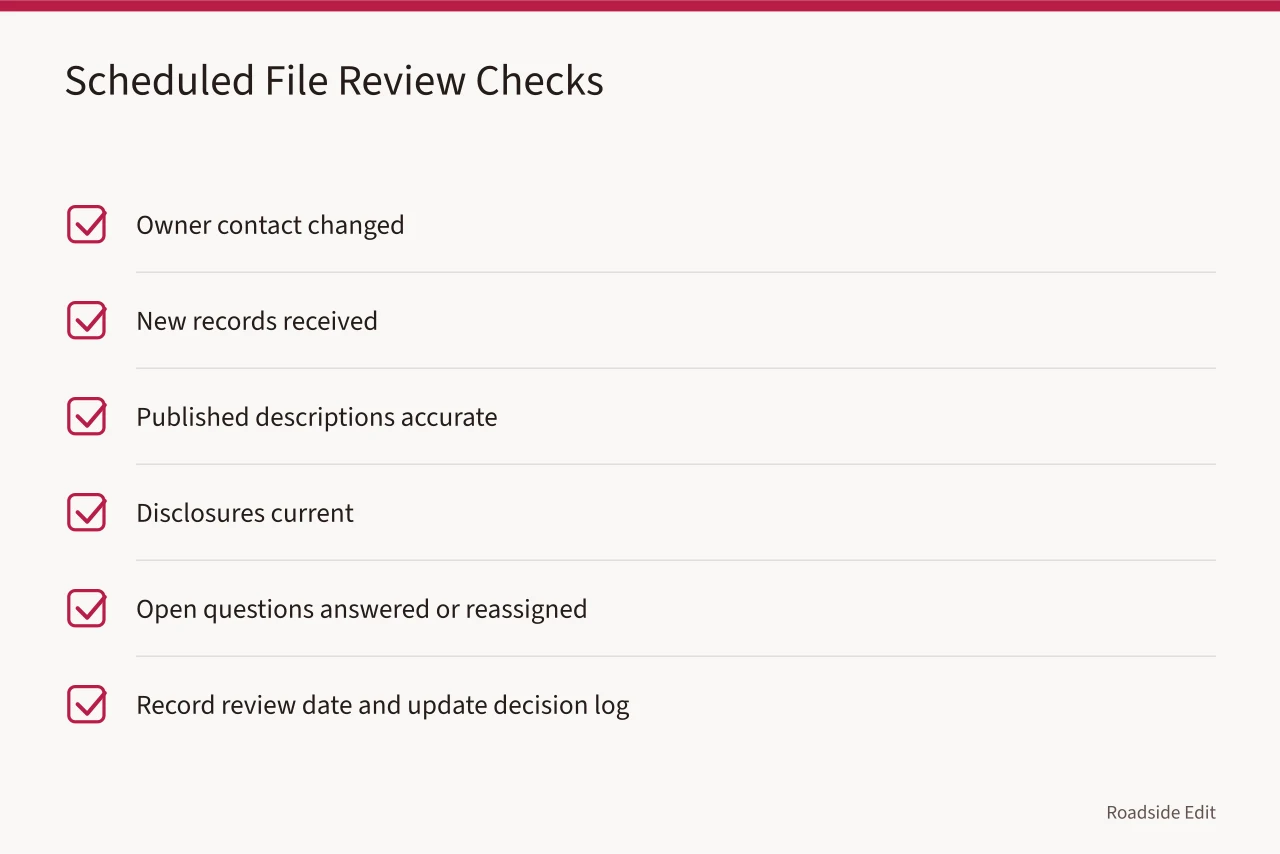
The plan can change as evidence improves. A photo may be newly dated, a local archive may provide a historical source, or an owner may clarify a business association. Preserve the earlier record and identify the update. That keeps the history of the information as clear as the history of the sign.
Assign roles before a record is needed
A plan should name roles, not assume every contributor makes every decision. An owner or designated steward may supply access information and confirm a public statement is current.
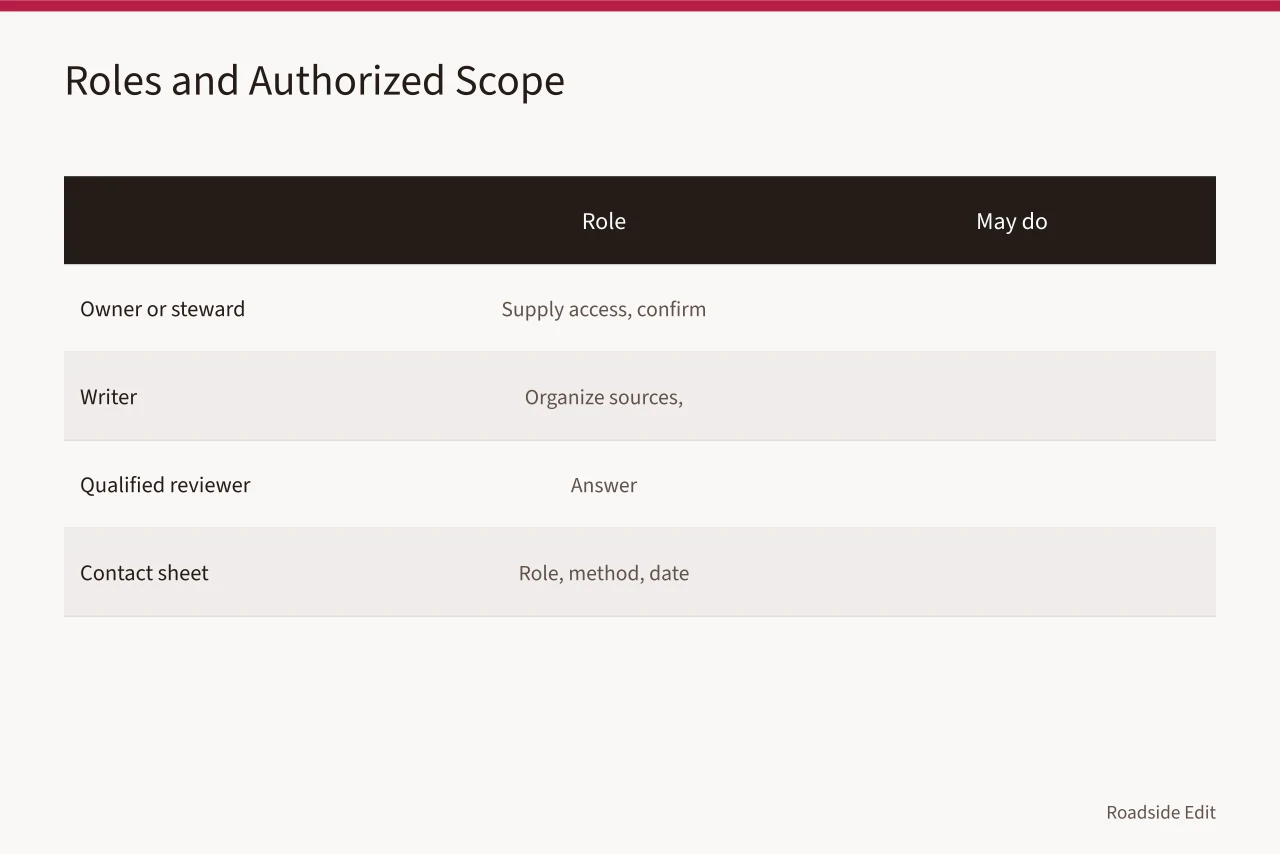
A writer can organize sources, captions, corrections, and disclosure language, and a qualified reviewer may answer a property-specific question within appropriate scope. Roles can overlap, but the record should show who supplied each piece of information.
Use a contact sheet with a general role, a preferred contact method, the date last confirmed, and any limit on what the person may authorize. Do not publish personal contact information without permission.
When a public update is needed, give readers a stable channel the responsible party has approved. Not a contributor's private number or a stale social-media post.
Preserve the difference between evidence and promotion
Roadside places often collect evocative stories. Some are well documented. Others are memories, marketing language, or repeated internet claims. The maintenance file should preserve that distinction. A source-backed historical statement belongs in the research record; an owner's current statement belongs in an attributed owner note; an advertiser's offer belongs in a clearly labeled commercial section.
That structure does not make a feature less interesting. It makes it more durable. Readers can enjoy a sign's local story while seeing what has been confirmed, what is reported, and what remains open. It also gives a future editor a practical route to correct a date, remove an unsupported claim, or update a disclosure without rewriting the entire article.
Keep the plan usable in a year
A maintenance file should be easy to reopen after months of ordinary business activity. Put the review date and record owner near the top, then use the same headings every time: observations, source notes, public updates, decisions, and contacts.
Add unanswered questions. A future writer can scan the index and find the underlying evidence without asking a former contributor to reconstruct it from memory.
At each review, remove nothing just because it is inconvenient. Mark outdated contact details, superseded public copy, or corrected source notes clearly. Keep the date and reason for the change.
This gives continuity without pretending the current record was always complete. It helps the owner tell a newly reported fact from a long-standing assumption never checked.
The National Park Service treatment standards support retaining evidence before public descriptions change. The National Park Service preservation briefs show why a preservation question should be matched to the right expertise. The National Archives preservation program also supports retaining dated records and clear handling decisions. These sources do not provide sign-repair instructions; they support cautious documentation and qualified review.
Common questions
Does a maintenance plan instruct someone to repair a sign?
No. It organizes evidence, observations, responsibilities, and questions. Physical work requires the appropriate property-specific process.
What is the most important first record?
A dated baseline of the sign's identity, visible context, source material, and unresolved questions.
Can a business be mentioned in the plan?
Yes, when its role and any commercial relationship are accurately described. A provider statement should remain attributed to that provider.
When should public content be corrected?
Correct it when new evidence changes a material statement, a source cannot support the existing claim, or a sponsorship or provider relationship needs clearer disclosure.