Guides
Roadside building mistake questions: an editor's pre-publication check
Roadside building mistake questions for 2027 help U.S. editors test local claims, compare records fairly, and remove unsupported conclusions before publication.
A roadside building article can go wrong long before a sentence is published. A photo is mistaken for an inspection, and a route map is treated as proof an entrance is accessible. A historic designation becomes a claim that the structure is open, restored, or even still standing.
The fix is not a prettier paragraph but a better question before the claim is written.
What to take away
- Ask whether the record identifies the exact property, not merely a town or highway.
- Keep historic evidence, current condition, access, and hazard information in separate lanes.
- Record the source date beside any conclusion that might change.
- Remove a conclusion when the source cannot bear its weight.
Start with the claim, then test the record
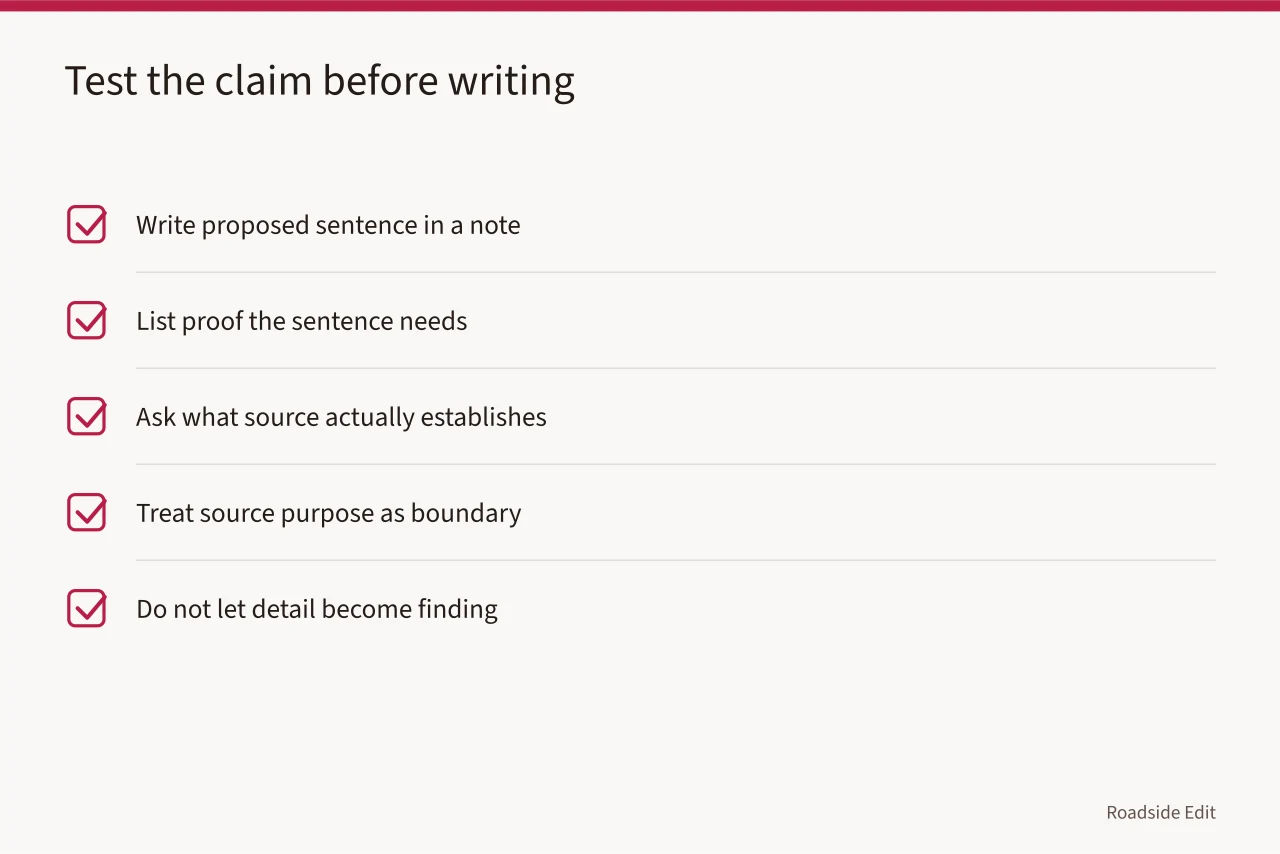
The most useful question is simple: what does this source actually establish? Editors often begin with the most appealing detail in a scan, photograph, or local announcement. That habit creates a chain of assumptions. Instead, write the proposed sentence in a note and list the proof it needs.
| Proposed statement | Question that prevents an error | Record that could support it |
|---|---|---|
| "The building is open to visitors" | Does a current operator or public agency say it is open? | Current official visitor or business information |
| "The facade was restored" | Does a project record name the facade and say work was completed? | Completion notice, permit record, or responsible organization update |
| "The property is historic" | Which designation, survey, or document identifies it? | Designation or survey record |
| "The entrance is accessible" | Is there a current, property-specific access statement? | Current operator information or qualified review |
A source title does not answer those questions by itself. "Historic photo," "main street plan," and "route guide" may all be useful records, but each has a different job. Treat the source's stated purpose as a boundary. It keeps a compelling detail from becoming an unsupported finding.
Questions about names, addresses, and dates
Ask whether the source gives a street address, parcel, coordinates, or another stable identifier.
A building name can change. A motel may have a new sign, a former trade name, or a nearby property with a nearly identical name. If the record identifies only a highway and town, say that; do not supply a precise location from an unsourced directory listing.
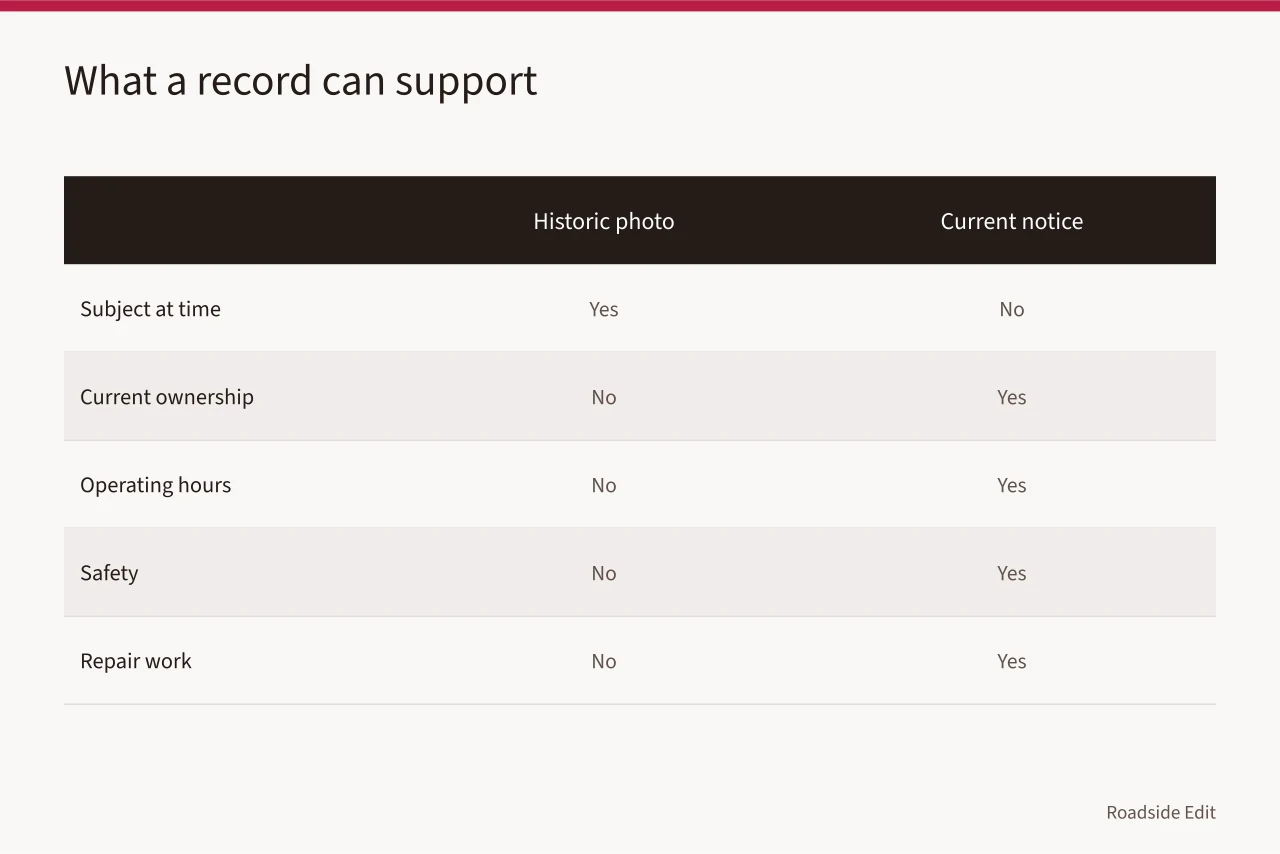
Next, ask when the record was made and whether its date matters to the reader. A 1940 photograph can support a statement about the photograph's subject at that time. It cannot establish current ownership, operating hours, safety, or repair work. A current notice can be useful for those later facts, but it should not be used to rewrite history.
Good citations make these distinctions easier to check. The National Archives says a citation should give enough information for another person to locate the source. Use the National Archives guide to research citations.
For a roadside building article, keep the collection name, record title, date, and identifier when available. A vague reference like "an old archive photo" leaves room for a wrong match.
Questions about preservation and project language
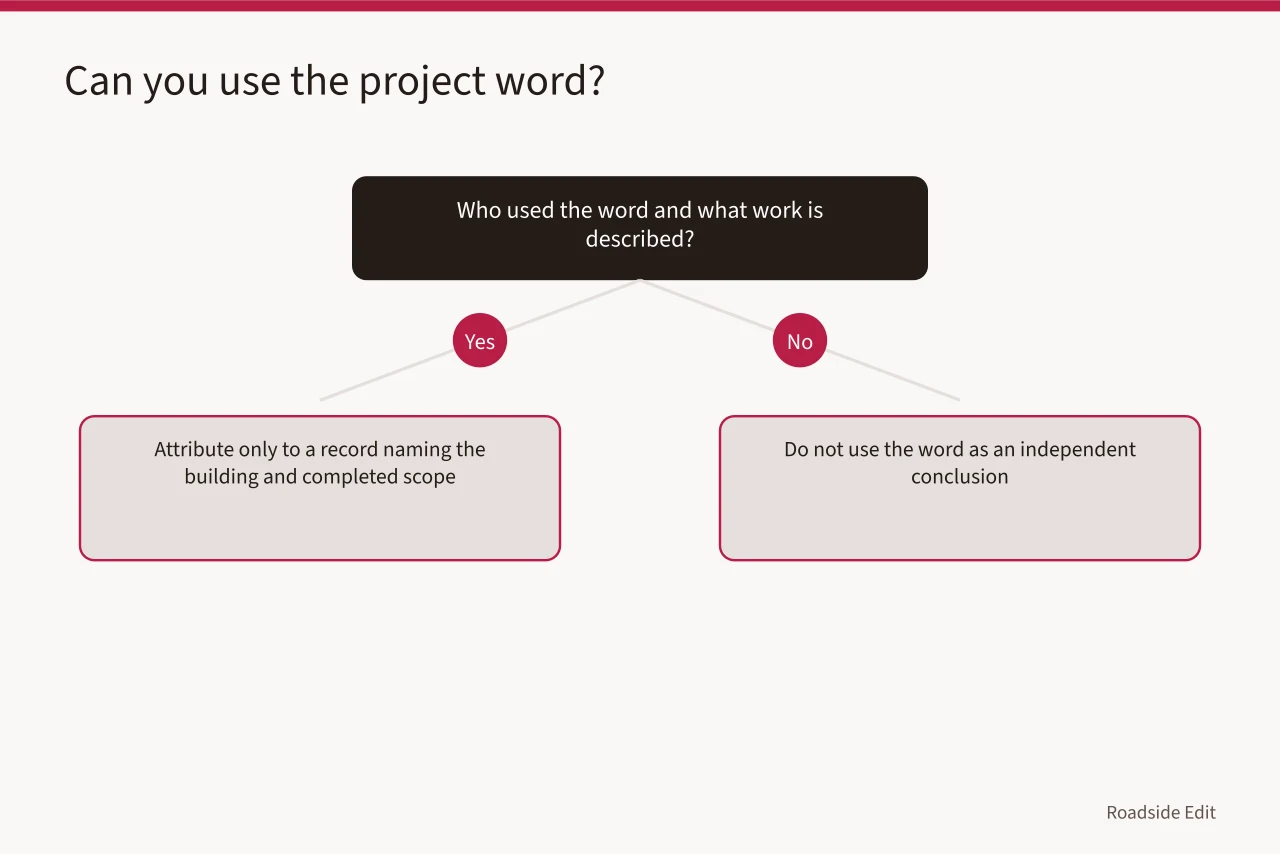
Words such as "preserved," "rehabilitated," "rebuilt," and "restored" are not interchangeable. Before using one, ask who used it and what work that source describes. Did the project address a sign, roof, storefront, site, or entire building? Was the work proposed, funded, underway, or finished? Is the source speaking about physical work or only about a plan?
The National Park Service publishes the Secretary of the Interior's Standards as guidance for work on historic properties. Read the NPS explanation of the preservation standards. They explain vocabulary and review framework but do not prove a roadside building received work under them.
Attribute that property-level claim only to a record naming the building and describing the completed scope.
This distinction also protects paid placements and organization profiles. A sponsor may accurately describe its services or its stated project role. The article should label that account as a provider statement. It should not translate a marketing claim into an independent conclusion about outcomes, public access, or historic approval.
Questions about access and safety
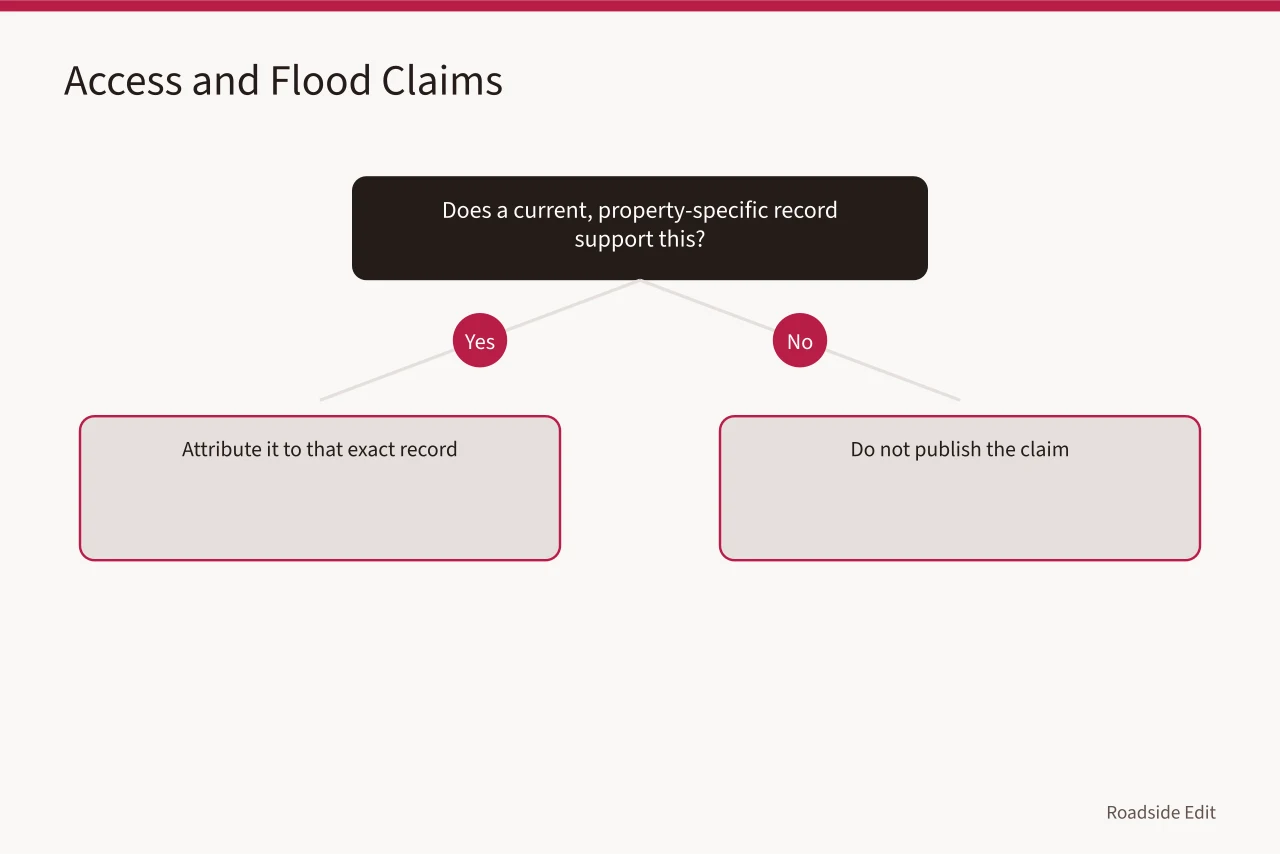
Never turn a visible ramp, curb cut, doorway, or parking space in an image into an access claim. Readers need current, property-specific information. Accessibility questions depend on the facility, route, alteration history, and applicable requirements.
The U.S. Access Board's guide explains technical provisions for accessible routes. Review the Access Board guide to accessible routes. Use it to understand terms in a source, not to make a compliance ruling from a photograph.
Flood and weather facts need the same restraint. A regional flood map can identify a mapped hazard area. It cannot describe a building's present water damage or tell a reader whether a particular project is required.
FEMA describes the National Flood Hazard Layer as a federal flood hazard map resource. Check FEMA's National Flood Hazard Layer information. Name the map and its date when it adds context. Do not label a building "flood-prone" unless a suitable property record supports that exact statement.
Questions to ask when records disagree
Disagreement is not a defect to hide. It is a research result. One image may use a former building name while a newer municipal document uses the current name. One project announcement may describe planned work while a later update is silent. Note the difference, identify each record's date, and seek a more direct source before choosing a winner.
Use this short review sequence:
- State the narrowest fact each record supports.
- Compare property identifiers, dates, and record purpose.
- Keep both accounts if they refer to different moments or scopes.
- Delete the sentence if neither record supports the conclusion.
The fourth choice is often the right one. Removing an attractive but weak claim is better than publishing a correction later. Readers can still get useful history, travel context, and project information when the article makes clear what is known and what remains unconfirmed.
Read images as records, not verdicts
The Library of Congress catalog is the source for the image identification. The image can illustrate the documented view. It does not by itself confirm a current building condition, business relationship, operating status, or access feature. Keep those claims out unless a current and direct record supports them.
A final editor check before publication
Read every present-tense sentence again. Ask whether a dated document, an image, or an announcement carries more meaning than it should. Check that a place name is not standing in for an address.
Check that a source citation takes the reader to the exact record, not an agency homepage. Then test the article's most consequential statement against its best source.
This process is not slow once it becomes routine. It gives an editor a clean way to decline a weak submission, revise a draft, or ask a contributor for a better record. More importantly, it gives readers a clear line between verified information and an inference that should not be published.
Common questions
Can I call a building restored because a historic photo looks well kept?
No. A historic photo only records the view and date described by its catalog. Use a direct project or property record for a restoration claim.
Can a citywide plan prove work at one roadside property?
No. A plan may give useful context, but it does not establish that a named property was included, funded, or completed.
What should I do if the best source is old?
Keep the date in the sentence, limit the claim to what that record shows, and look for a newer responsible source for current details.