Guides
Roadside building mistake prevention checklist before you publish
Roadside building mistakes checklist for 2027 gives U.S. editors a clear pre-publication review for claims, record dates, image captions, and commercial mentions.
Roadside building mistakes checklist for 2027 is a final editorial pass for pages about U.S. roadside places. Use it before publication to keep an attractive historical story from making a claim that the sources cannot prove.
What to take away
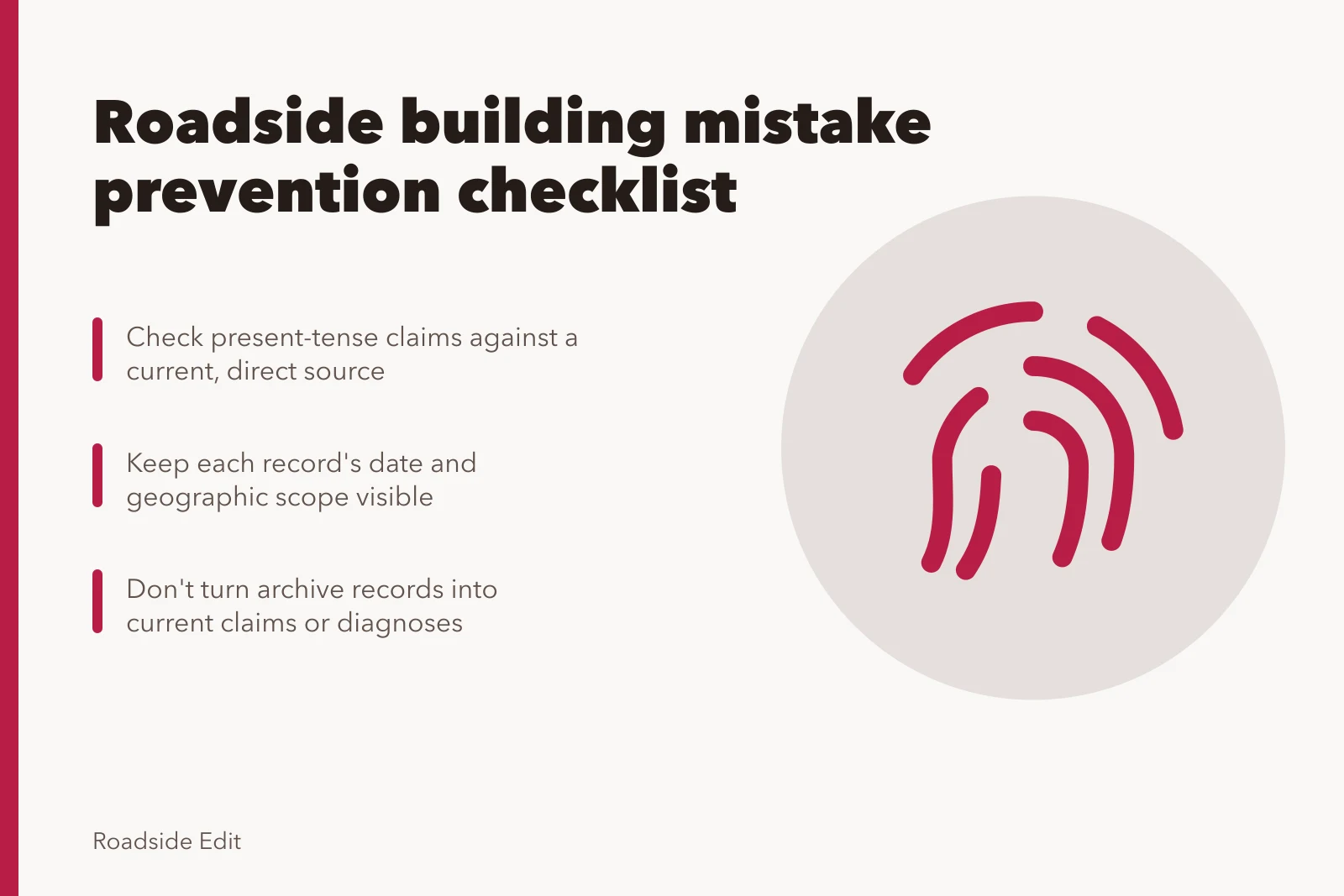
- Check every present-tense statement against a current, direct source.
- Identify whether each reference is a photo, archive record, plan, announcement, or assessment.
- Keep a record's date and geographic scope visible.
- Verify commercial details without turning them into endorsements.
Pre-publication checklist
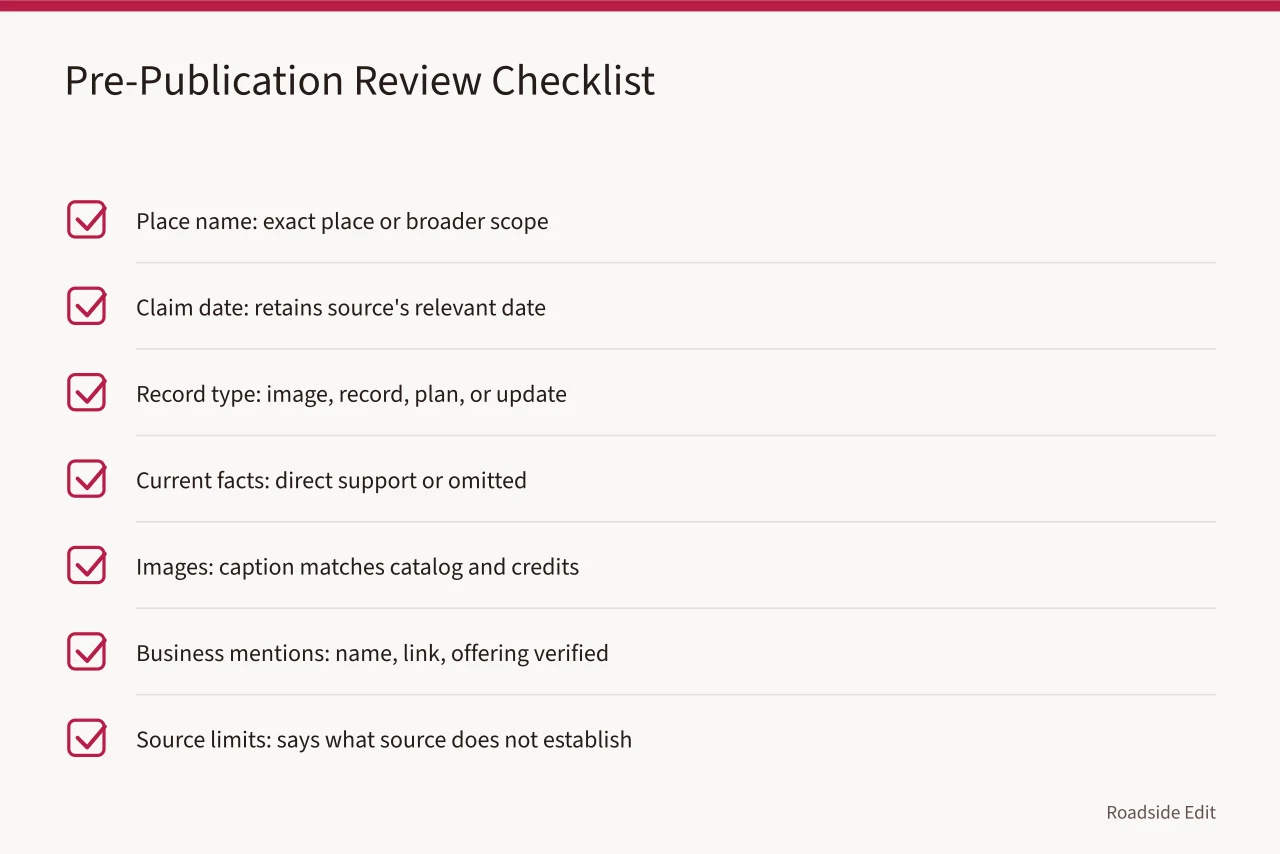
| Review item | Pass condition |
|---|---|
| Place name | The source identifies the exact place or the article states its broader scope |
| Claim date | The article retains the source's relevant date |
| Record type | Caption or prose names the record as an image, record, plan, or update |
| Current facts | Ownership, access, operations, price, and condition have direct current support or are omitted |
| Images | The caption matches the source catalog and credits it with a direct link |
| Business mentions | Name, link, and stated offering are verified; praise and promises are not added |
| Source limits | The text says what the source does not establish when that matters |
The National Park Service's preservation-plan requirements call for photographic documentation of existing conditions at the time a record is made. Review the NPS preservation-plan requirements. For publishing purposes, this supports a simple distinction: an existing-conditions record describes the point in time it documents. It is not automatic evidence of what changed afterward.
How to use the checklist
Read the article once for storytelling and once for evidence. On the evidence pass, underline every sentence that describes condition, operation, ownership, completion, availability, cost, safety, or a recommendation. For each line, locate the source that supports it. If the source is archival or regional, narrow the sentence. If no source can support it, remove it.
Do not use this checklist to make a property decision or a technical recommendation. It is an editorial workflow. Its purpose is to show readers where the information came from and to make later updates more reliable.
Avoid four repeat mistakes
Do not turn an archive record into a current claim, a photograph into a diagnosis, a proposal into completed work, or a provider submission into independent evidence.
National Park Service's documentation standards and guidelines call for reliable sources and clear limitations so a record can be checked. Use each source for the fact it states; preserve the unanswered question.
Do not hide commercial relationships. The Federal Trade Commission says advertising designed to look like independent content should be recognizable as advertising. Read the FTC native-advertising guide. It does not evaluate a roadside business. It supports disclosure and a separate commercial file for submitted or paid material.
When new evidence changes a published claim, retain the old wording and add a correction note. The National Archives' information-quality guidelines describe identifying affected information and documenting the response. The editorial parallel is simple: show what changed and why.
Source image
The Library of Congress catalog identifies this image as the Hotel El Rancho in Gallup, New Mexico.
Make a final claim sweep
Read every title, heading, image caption, table cell, and sentence that names a property. Ask whether it states a fact, an attributed report, or an inference. Keep facts near a source that directly supports them. Label reports with their sender and date. Remove inferences that sound certain but have no appropriate record.
Check that every external link reaches the exact supporting page and that the same target is not linked twice. This final sweep catches most avoidable errors before a reader sees them.
Keep a short internal checklist result with the publication date, reviewer role, unresolved facts, and planned review date. If a later update adds evidence, apply it to the narrow statement it supports rather than rewriting every part of the article. This preserves the reader's trust and avoids making a new source appear older or broader than it is.
Common questions
Must every historic statement have a source?
Yes. Keep a direct source for each factual statement that is specific enough to matter to a reader.
Is a caption enough to prove current status?
No. A catalog caption describes its own record. Find current, direct evidence for a current-status statement.
Can a sponsored listing appear after this review?
Yes, if its factual details are verified and it is disclosed according to the site's publishing policy.