Guides
Part of How a 2027 motel exterior maintenance plan keeps records and repairs on track
Motel exterior maintenance checklist: how to build your 2027 care file
Motel exterior care checklist for 2027 gives U.S. owners a clear routine for inspections, service notes, safe escalation, seasonal work, and record reviews.
Exterior care is easier to manage when a motel team treats it as a repeatable record, not a once-a-year rush. This checklist helps an owner or authorized manager notice visible changes, assign the next action, and preserve enough context for the next review. It is not an engineering opinion, permit determination, or repair instruction for a specific building.
What to take away
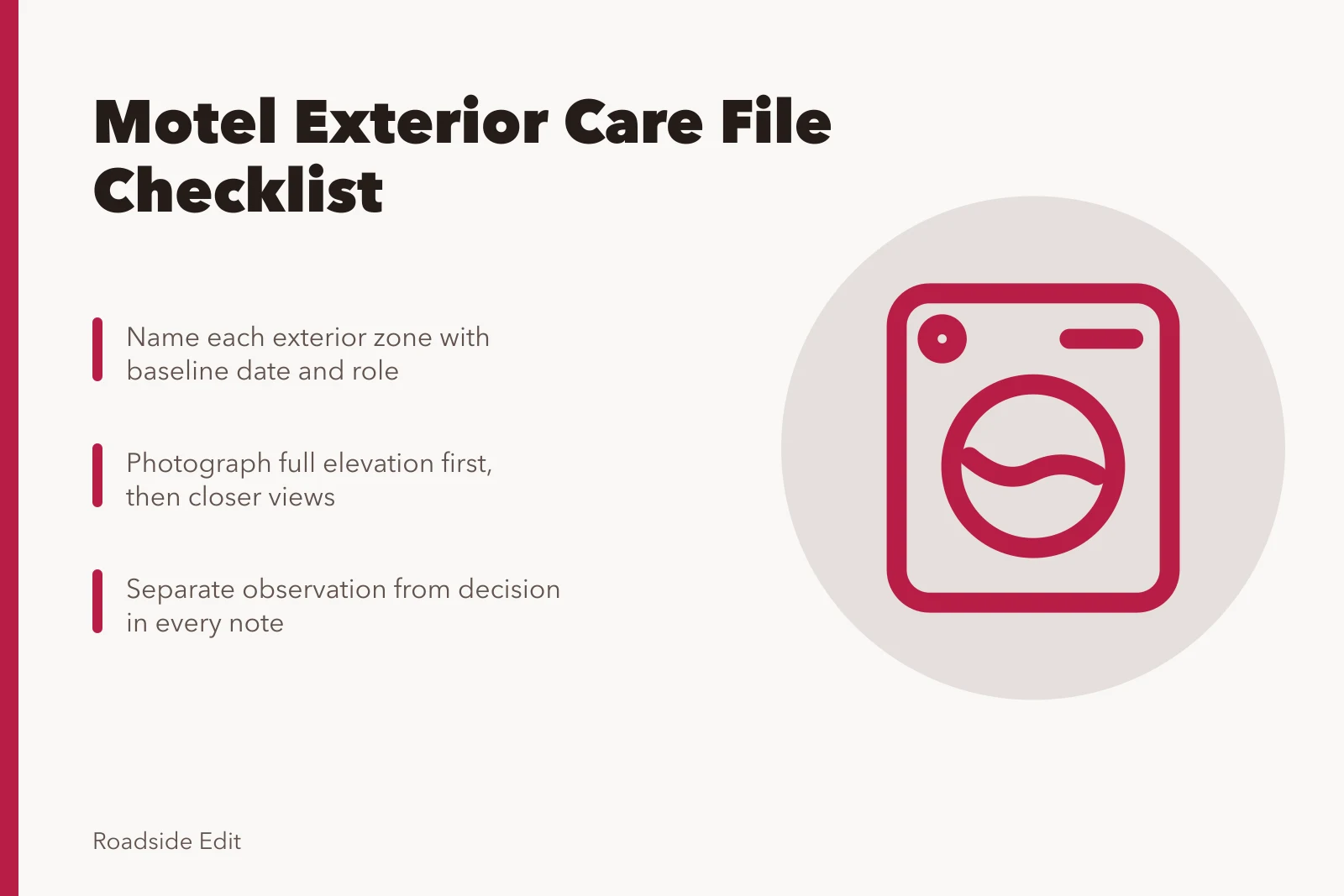
- Give every exterior zone a name, a baseline date, and a responsible role.
- Record what is visible before deciding why it happened or how to fix it.
- Use seasonal reviews and an extra review after unusual events.
- Stop and get qualified help when access, utilities, structural questions, or urgent hazards are involved.
- Keep a dated service record so work does not disappear when staff changes.
Set up the care file before the first walkaround
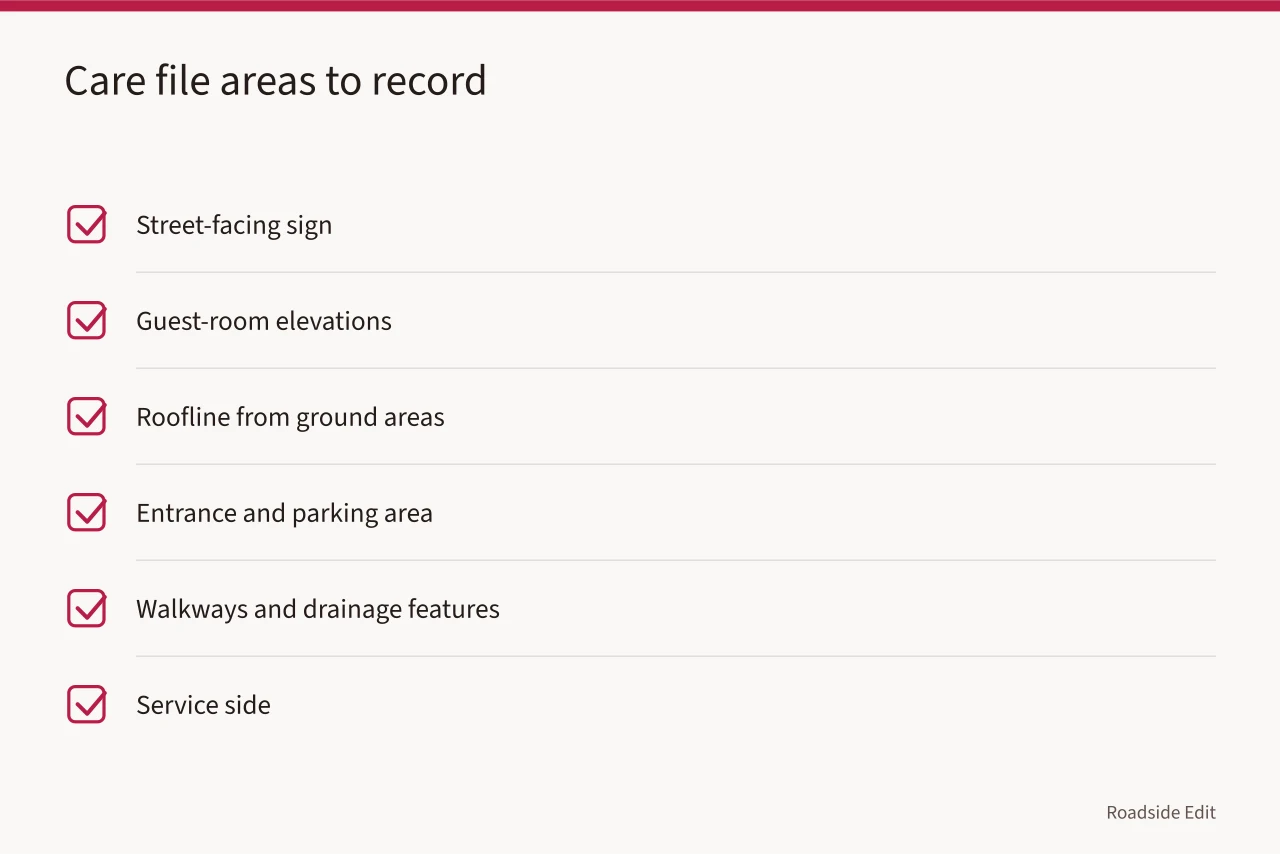
Create one short file for each part of the property: street-facing sign, guest-room elevations, roofline visible from authorized ground areas, entrance, parking area, walkways, drainage features, and service side. The file can be a spreadsheet, a shared folder, or printed pages. Its format matters less than consistency.
Start with a baseline photo set. Label each image with date, area, viewpoint, and photographer or source, and add a sentence on what is visible and what is not.
A ground-level photo of a gutter may show staining or debris but cannot confirm the condition behind the fascia, ladder route stability, or the right repair.
The National Park Service's Preservation Brief 47 on exterior maintenance describes preventive maintenance as a planned, cyclical effort that can address small problems before they become larger ones. The brief concerns historic buildings, but its recordkeeping point transfers well: look regularly, define the feature being observed, and follow up on evidence rather than memory.
| File field | What to enter | Why it helps |
|---|---|---|
| Area name | North guest wing, main sign, or rear walk | Makes later notes comparable |
| Baseline date | Date of first organized record | Separates old from new observations |
| Visible condition | Plain description, not a diagnosis | Keeps the note accurate |
| Next owner | Role responsible for the next decision | Prevents an open item from drifting |
| Review date | The next scheduled look | Turns a note into a routine |
Run the regular inspection checklist
Walk only from a safe, authorized location. Carry a phone or notebook, but do not let documentation pressure anyone into climbing, entering restricted areas, or touching equipment. Work from the same route when practical. That makes changes easier to compare.
Building face and roofline
- Note visible staining, loose-looking elements, openings, vegetation, or water paths.
- Photograph the full elevation first, then one closer view of each observation.
- Record the weather and lighting if they affect what can be seen.
- Mark inaccessible areas as unobserved. Do not fill in a guess.
Doors, windows, signs, and lighting
- Record visible damage, failed illumination, missing labels, or new obstructions.
- Keep electrical questions separate from appearance notes.
- Log the location and time of a lighting issue so an authorized person can assess it.
- Preserve manufacturer paperwork or service invoices when the responsible party provides them.
Walkways, parking, and drainage paths
- Note visible debris, standing water, surface changes, damaged markings, or blocked routes.
- Describe the location by a stable reference point rather than a vague phrase such as "near the front."
- If a condition may affect safe access, notify the responsible party promptly and document the notification.
Federal workplace rules require employers to inspect walking-working surfaces regularly and as necessary, and to correct or guard hazards before an employee uses the surface. OSHA's walking-working-surfaces standard covers covered workplaces, not every guest-area decision.
It remains a useful reminder that a care log should name the condition, the person responsible, and the time of follow-up, not treat a photo as the final action.
Use a calendar that fits exposure, not habit
There is no universal inspection interval for every motel. Weather, materials, traffic patterns, local rules, and known conditions differ. Instead of copying a generic schedule, use a simple cycle and revise it after a season of real records.
| Timing | Review purpose | Output |
|---|---|---|
| Start of a season | Compare high-exposure areas with the baseline | Dated photos and open-item list |
| After a severe event | Capture visible change and access limits | Event note and responsible contact |
| Before planned work | Confirm the work area and unanswered questions | Scope note, not a diagnosis |
| After work is reported complete | Preserve what was reported, by whom, and when | Service record and new photo set |
The National Park Service has required maintenance plans for certain historic-property agreements to include inspection procedures, timelines, a cyclic schedule, and basic maintenance details. Its Gettysburg historic-properties maintenance-plan requirement is a specific federal document, not a rule for private motels. It supports the narrower idea that a useful plan names timing, procedure, and responsibility instead of leaving each review undefined.
Separate an observation from a decision
This distinction protects the entire file's accuracy. An observation might say, "A dark streak is visible below the second-floor gutter at the east end, photographed from the parking area at 9:15 a.m."
A decision might say, "The authorized manager will ask a qualified provider to review the area." They are not the same statement.
Do not write, "The gutter is failing," "The wall has mold," or "This repair will solve the problem" unless a qualified, property-specific source supports that conclusion. The care file should make unanswered questions visible. It should not turn a routine walkaround into a technical report.
Use four labels consistently:
- Observed: a dated fact that is visible or documented.
- Reported: information supplied by an owner, vendor, or staff member.
- Proposed: a possible action that has not been approved or completed.
- Completed: work recorded as completed by the responsible party, with date and supporting record.
Keep service notes that another person can understand
A care program breaks down when only one person knows what the notes mean. Each entry should answer five questions: Where was it seen? What was visible? When was it recorded? Who owns the next step? What remains unknown?
The National Archives explains that records connected to the same project, transaction, study, or subject should stay together when that relationship provides context. Read the National Archives recordkeeping requirements. Those rules govern federal agencies, not motel operators.
The lesson is modest but useful: keep a condition image, its date, the related service note, and the later correction together so a reader can follow the record.
| Service-note field | Example |
|---|---|
| Date and time | June 14, 2027, 8:40 a.m. |
| Location | West walk, outside room 118 |
| Source | Authorized manager's dated photo |
| Visible fact | Leaves blocking the visible drain opening |
| Next action | Manager to arrange authorized cleaning |
| Closeout | Date, provider record, and new image if supplied |
Do not store payment details, private guest information, access codes, or unrelated staff information in a public-facing care file. Keep editorial content, private operations records, and any paid placement material apart.
Know when routine care must stop
Stop the routine checklist. Contact the responsible owner, relevant utility, emergency service, local authority, or qualified professional if there is an immediate safety concern, a downed line, a gas odor, a blocked required exit, or suspected structural instability.
Also contact them if a condition cannot be safely viewed.
The checklist does not authorize access and does not decide a permit path. A manager can record that an area was not accessed and raise the question. That is often the most accurate action available.
Review the checklist itself
At the end of each season, read the past entries. Remove tasks that have no owner. Clarify location names that confused staff. Add a new photo point if an older view was not useful. Keep corrections dated rather than overwriting the original note without explanation.
The best maintenance record is ordinary enough that people will actually use it. Clear words, specific locations, and modest claims make handoffs easier. They also give a future reviewer a better starting point when real expertise is needed.
Common questions
Can a maintenance checklist diagnose a building problem?
No. It can document a visible condition and route the question to a responsible person. Diagnosis needs appropriate, property-specific review.
Should every photo trigger a repair request?
No. Some images simply establish a baseline or show that an item should be monitored. Record the next review date and avoid claiming more than the image proves.
What belongs in a closeout note?
Include the date, location, person or organization that reported completion, any supporting record, and a note of remaining questions. Do not represent work as verified if the record only says it was reported.