Guides
Part of Historic motel restoration: 8 planning mistakes to avoid before 2027
Historic motel restoration: how owners can keep mistake records straight in 2027
A correction record for a historic motel names the original entry, the source that changed it, the date, and the part of the description that moved.
A correction record is how a motel survey file improves without losing its history. It names the original entry, the source that changed it, the date, and the part of the description that moved.
What to take away
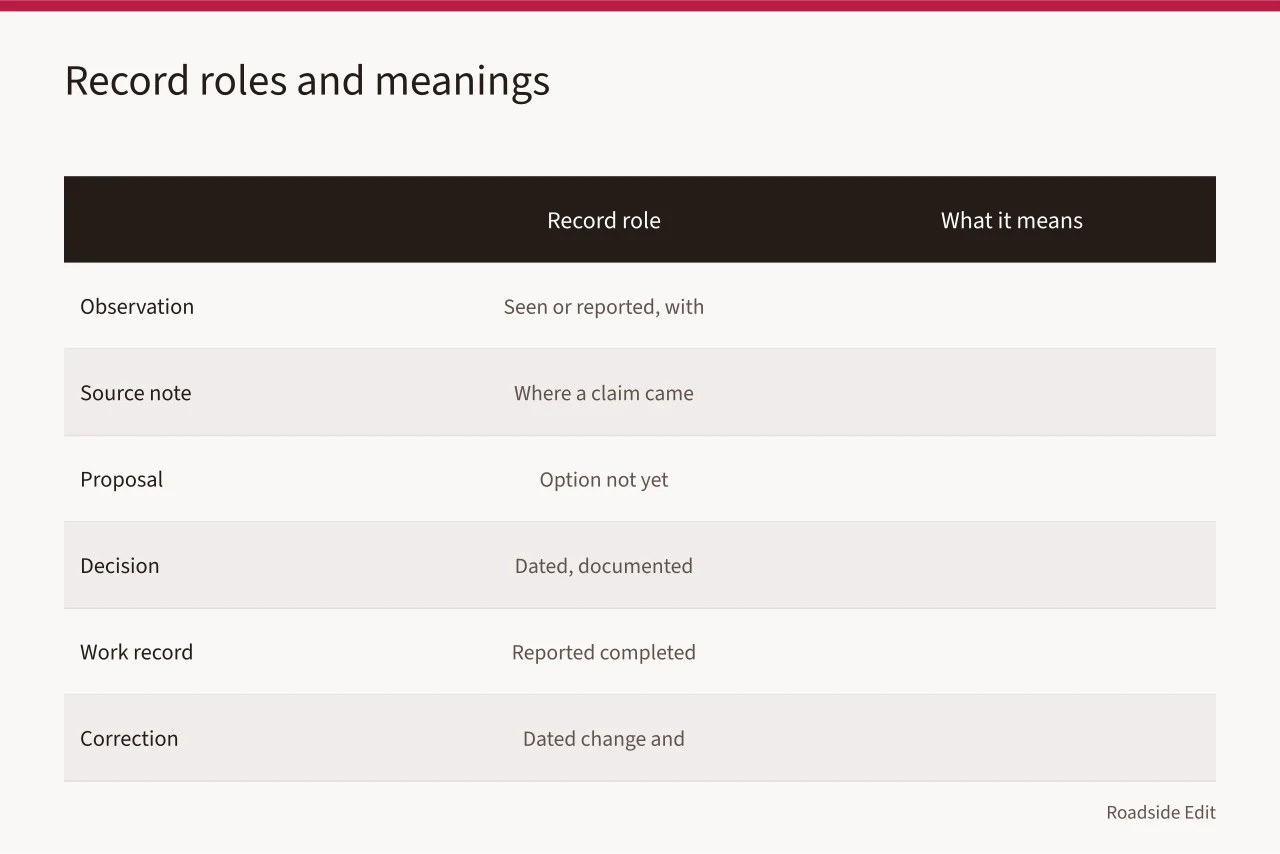
- Give every entry a role: observation, source note, proposal, decision, work record, or correction.
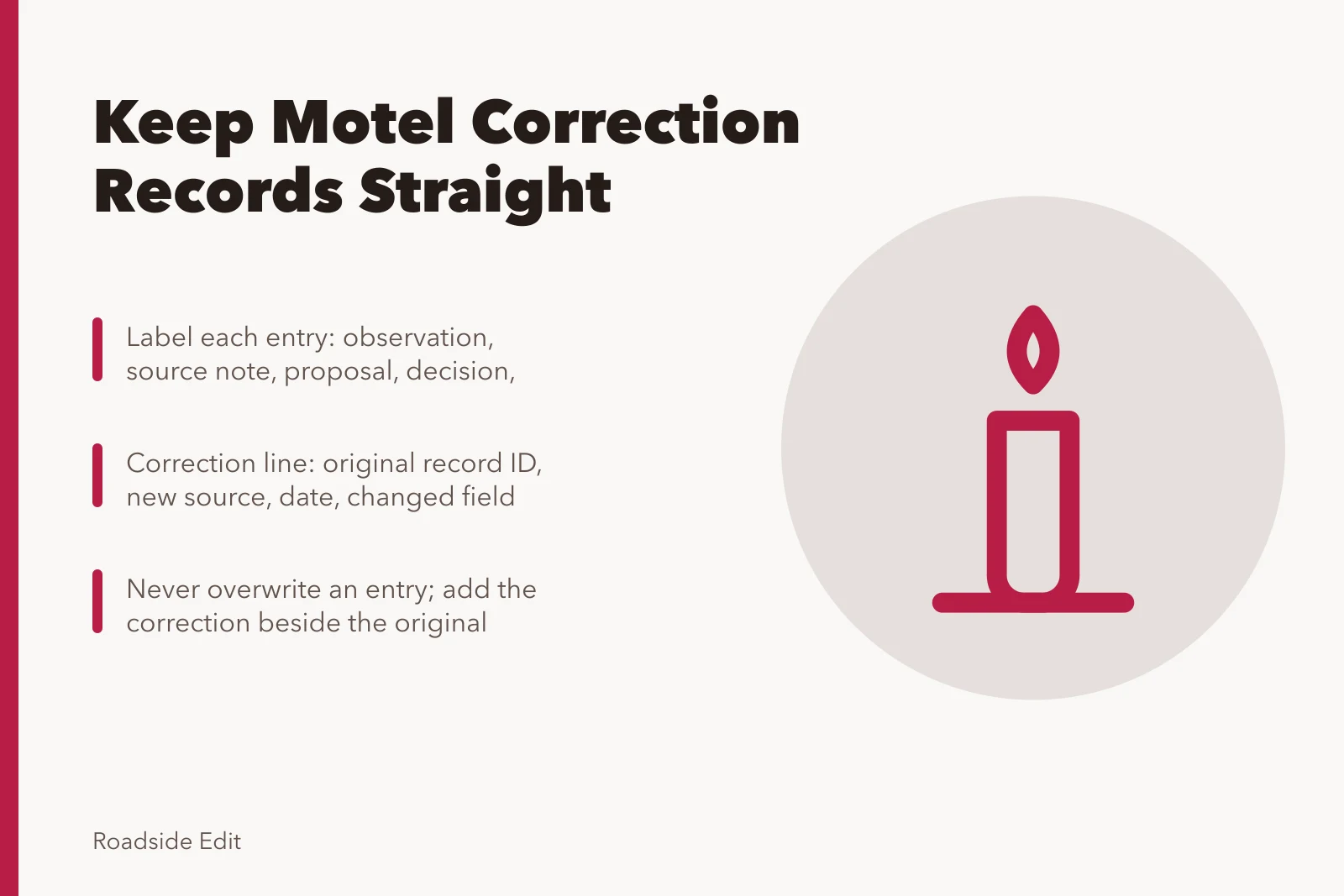
- A correction line carries four fields: original record ID, new source, date, and the specific field changed.
- Never overwrite an entry. Add the correction beside it and keep the original visible.
- Separate the public article from controlled material such as access details, private contacts, and budgets.
- Before reusing an old sentence, re-check its date, location, and role against the primary record.
Give every entry a role
Most muddled motel files fail at the same point: a proposal, an observation, and a completed scope sit in one column with no label. The reader cannot tell what the record can support.
A postcard is an observation of appearance on a known date. It is not a work record, and it does not establish what the canopy soffit is made of.
Write a correction line that survives review
Four fields, in this order: original record ID, new source, correction date, and the field that changed. Then say what the change was.
"Updated" alone tells a later reader nothing. "Record 214, parapet material changed from stucco to painted brick on the 1962 wing, per the 2019 survey photographs, corrected 2027-03-04" tells them everything.
Keep the original line. A correction that replaces its own history is a rewrite, and a rewrite cannot be audited.
An uncertain record is not a defective record. It becomes defective when a later writer strips the limitation and prints the claim as fact.
Keep the public version narrow
Emergency details, access information, private contacts, and security notes belong in the controlled system. Project budgets also belong there, not in the article. A public piece can explain the recordkeeping method without publishing anything that creates risk.
The NPS Historic Property Project Documentation overview describes how property documentation feeds later planning work. That workflow is publishable. The client's gate code is not.
Match each record to what it can support
A clean register states what a record can carry and where it stops. The National Archives guidance on digital photographic records covers managing photographs alongside their identifying and descriptive information.
Give each image a stable ID, date, location, creator when known, and caption. The image is evidence of appearance at a time, not proof of an unseen cause.
| Record | Supports | Does not establish alone |
|---|---|---|
| Dated photograph | Visible appearance and setting | Material composition or treatment need |
| Historic source | A past account with stated limits | Current property condition |
| Decision note | A documented choice | Completed work |
| Work record | Reported scope and date | Long-term outcome |
The NPS documentation standards ask for reliability and clear limitations so a reader can check the information independently. That is the test a correction entry has to pass.
Reuse checks before an old line enters a new article
Compare the sentence against the original file. Confirm date, location, source role, and status. If the new article narrows or widens the claim, say so in the text.
A source that covers one room, one sign, or one earlier date should not stretch into a whole-property statement. A 1958 postcard of the office does not date the guest wing.
NPS preservation guidance on historic woodwork notes that harsh paint removal can destroy historic material and erase paint evidence. Read Preservation Brief 10 on exterior paint problems. The brief addresses woodwork, not motel enamel or neon, but the recordkeeping lesson holds: a fast decision can take evidence with it.
This check also separates research from promotion. A product mention, a business listing, or a paid placement belongs in its own labeled material. It is never evidence that a feature has a given condition or that a decision was approved.
Common questions
Should a correction delete the old text?
No. Keep the earlier entry and tie the correction to it by date and record ID, so the change stays traceable. A deleted line cannot be checked by anyone who arrives later.
Is a media credit a factual source?
No. It identifies where the image came from. Use it to trace the file, never to prove a condition or a project fact.
What if an old source contradicts a new one?
Keep both, state the conflict, and send it to the qualified reviewer. Choosing the preferred result without evidence is how a file loses its value.