Guides
Historic motel restoration: 8 planning mistakes to avoid before 2027
Historic motel planning mistakes to avoid in 2027 include unsupported claims, missing records, unclear scope, and treatment language without qualified review.
Most planning mistakes begin before anyone chooses a material or hires a contractor. A record is incomplete, a photo is treated as a diagnosis, a broad source is applied to one property, or an open question becomes a confident sentence. Those mistakes are avoidable when an article has clear boundaries.
This guide helps writers, owners, and project partners identify the weak points in a historic motel planning record. It does not diagnose a motel, select a treatment, or determine legal, safety, or code requirements.
What to take away
- Identify historic character and evidence before describing a change.
- Separate observations, proposals, decisions, and completed work.
- Keep general guidance from becoming a property-specific recommendation.
- Preserve missing information and corrections instead of hiding them.
- Label media credits, sponsorships, and project records by their real roles.
Mistake 1: Starting with a solution
It is tempting to begin with a desired result: a new entrance, a new finish, a new sign, or a new use. But a historic property record should begin with what is known about the existing place. This includes physical features, historical information, previous changes, and the limits of the available documentation.
National Park Service guidance on historic additions says historic character should be identified before decisions are made about the extent or limitations of change. Read Preservation Brief 14 on additions to historic buildings. The source provides general preservation guidance; it does not identify a feature or approve a change at a particular motel.
Write a question before writing a solution. For example, "What evidence identifies the character of the south office entrance?" is a planning question. "The south office entrance should be rebuilt" is a conclusion that needs property-specific evidence, scope, and qualified review.
Mistake 2: Calling an observation a diagnosis
An observation is what a person saw, heard, or received in a report. A diagnosis explains cause or condition. They belong in different fields.
"Paint is lifting on the east trim in the dated photo" is an observation. "Moisture is damaging the entire wall" is a diagnosis that cannot be established by the photograph alone. The difference protects readers from overconfident articles and gives qualified reviewers a clean account of what needs to be evaluated.
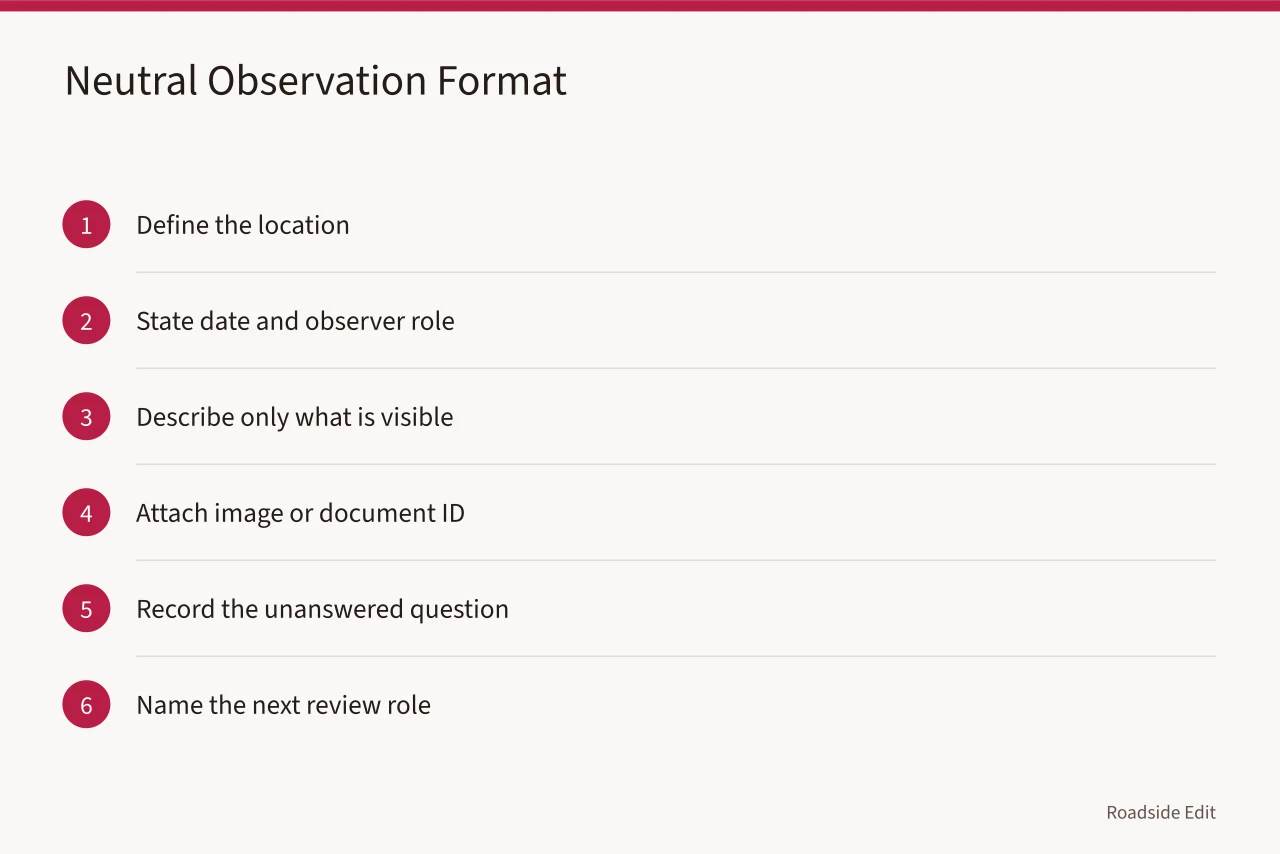
Use a neutral observation format:
- Define the location.
- State the date and observer role.
- Describe only what is visible or reported.
- Attach the relevant image or document ID.
- Record the unanswered question.
- Name the next review role.
Do not add technical vocabulary to make an entry sound more authoritative. If the source does not establish the term, use plain language and mark the terminology as unconfirmed.
Mistake 3: Losing the source trail
A planning record becomes fragile when no one can find the source behind a statement. Every factual claim needs a source role and date. A source may be regional context, property history, a current observation, a regulatory page, a decision record, completed-work documentation, or a media credit. Do not let one role stand in for another.
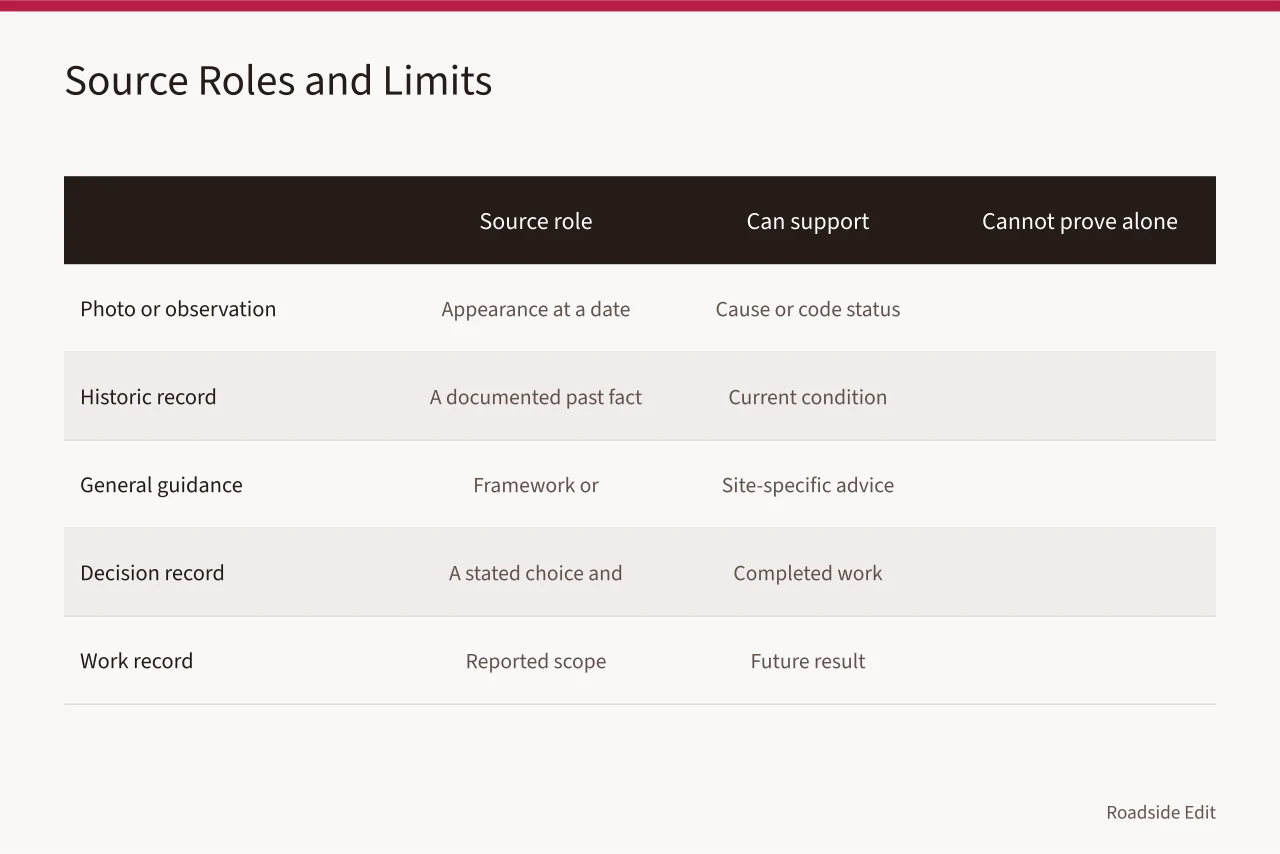
For instance, a media credit identifies an image origin. It does not prove the image represents the motel being discussed, its current condition, or an appropriate project outcome. An invoice may report work but not prove long-term performance. A general preservation page may explain a planning framework but not set a local requirement.
| Source role | It can support | It cannot prove alone |
|---|---|---|
| Photo or observation | Appearance at a date and location | Cause or code status |
| Historic record | A documented past fact | Current condition |
| General guidance | A framework or terminology | Site-specific advice |
| Decision record | A stated choice and date | Completed work |
| Work record | Reported scope completed | Future result |
Mistake 4: Treating a proposal as completed work
Project writing often slides between "considered," "approved," and "completed." This makes an early conversation appear to be a finished project. Keep separate statuses and use them consistently.
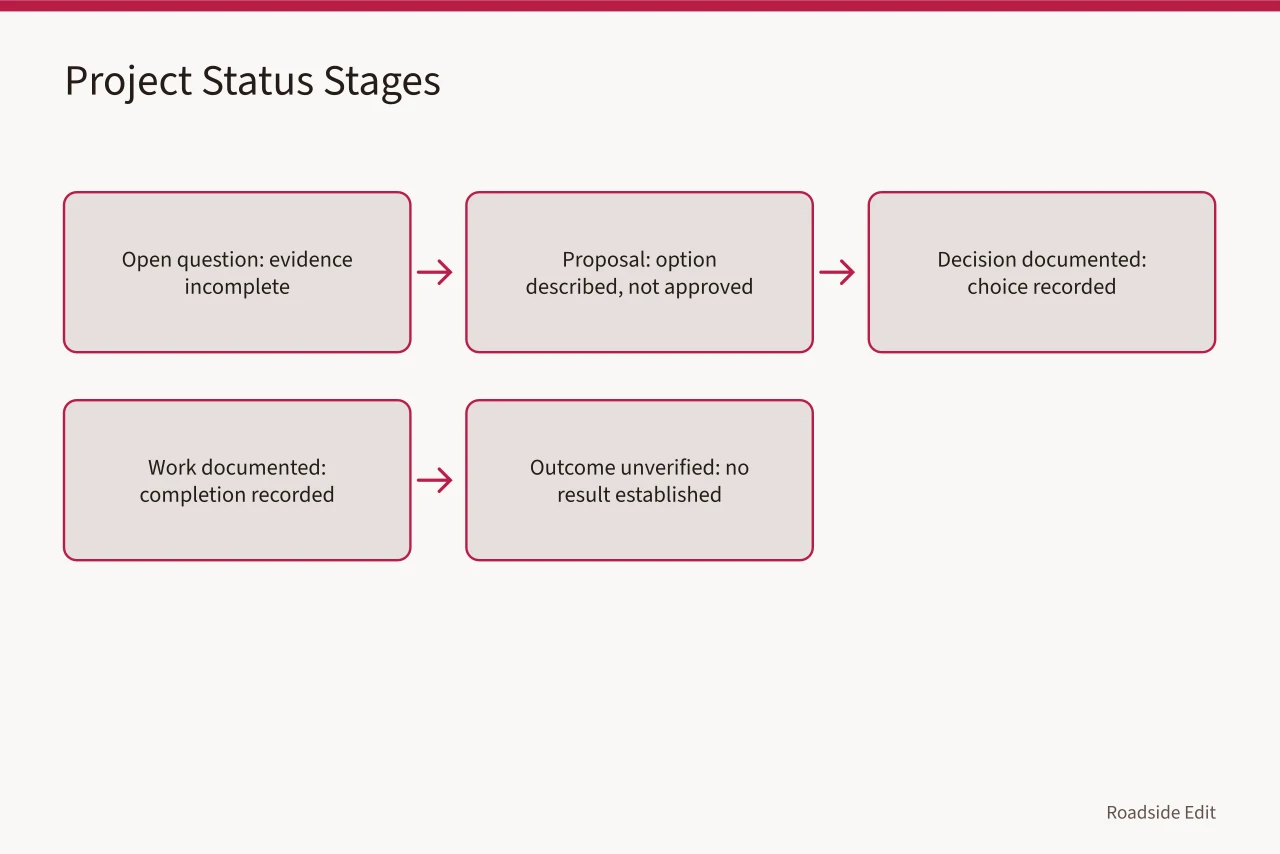
Each status needs a date. If a project changes course, retain the older entry and add a correction rather than overwriting it. This preserves the record for future staff, potential advertisers, agencies, or publishers who need to understand what actually happened.
Mistake 5: Generalizing a source past its scope
A national guide may offer useful language, but it is not a local inspection, permit, bid, or decision. A planning page from one location does not automatically apply in another. A source may also change over time.
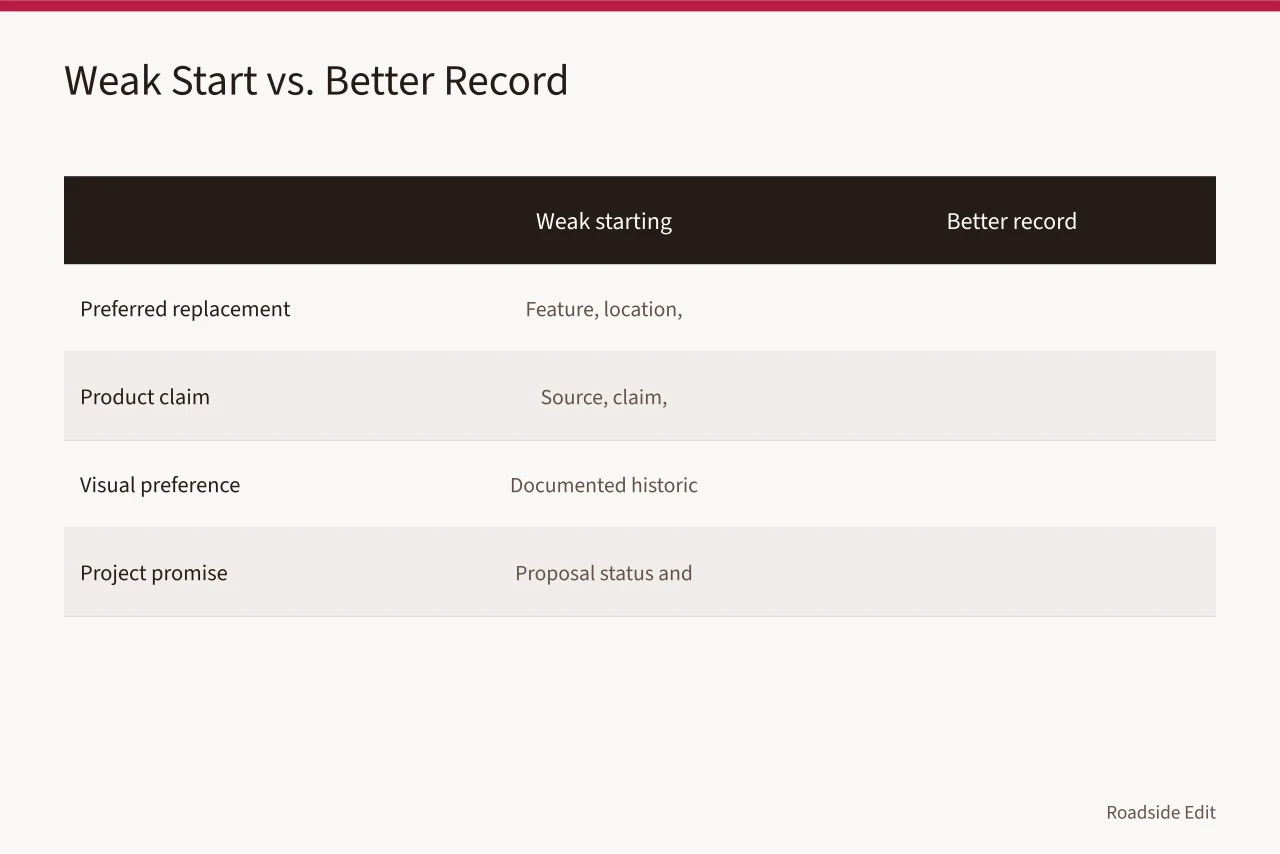
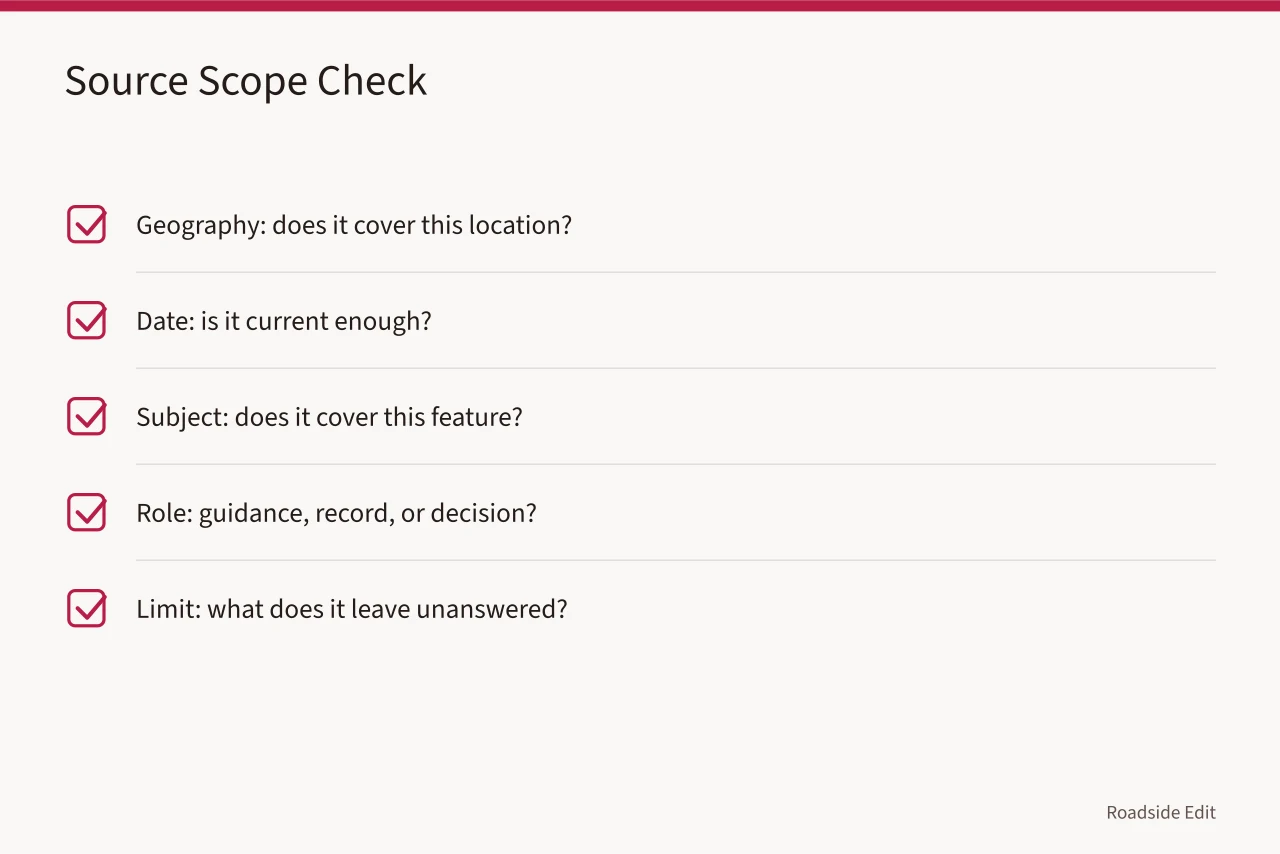
Before using a source, compare its scope with the sentence:
If the source does not match, reduce the sentence. "This framework may inform a local review" is more accurate than presenting a generic source as an answer.
Mistake 6: Removing uncertainty
Unknown is not a flaw in a record. It is a result. Record it with enough detail that another person can continue the work: what was checked, what was not found, why the question remains open, and what would trigger a later review.
Do not make an article sound complete by deleting the uncertainty. That may make a page smoother to read, but it makes it less useful and can make a future paid placement, review, or claim appear better supported than it is.
Mistake 7: Publishing sensitive or promotional material as evidence
Keep security details, access information, personal contacts, emergency procedures, and private budgets out of public planning copy. If an article later includes a business, professional, product, or paid placement, label the commercial relationship. Keep the promotional statement separate from the factual property record.
The same restraint applies to project photographs. Credit the image, describe it accurately, and do not use it as proof about a different motel. Clear labels are a service to readers and to legitimate business partners.
Mistake 8: Confusing research with review
Research can collect facts, identify terminology, and show that a question matters. Review evaluates whether a source applies to a defined property and decision. An article should say which step it has completed. "Research identifies a question for local review" is accurate. "Research confirms the project is appropriate" is not, unless the cited record and reviewer actually establish that conclusion.
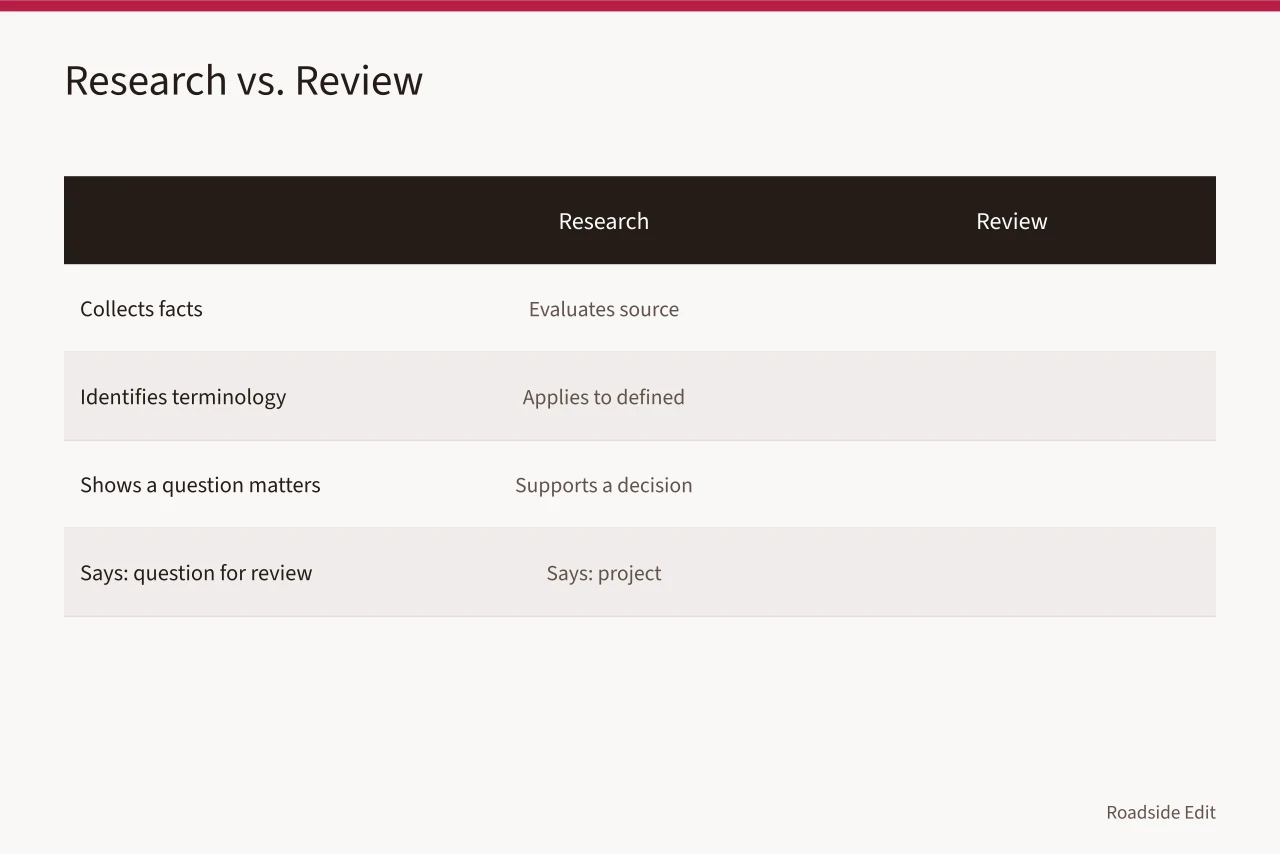
This difference is important when a page is later used in a pitch, directory entry, or placement proposal. A business may be relevant to a topic, but its appearance on a page does not verify a property's condition or authorize a project. Preserve the source and status of each commercial statement as carefully as any preservation claim.
Mistake 9: Using a record without a time frame
Every source has a date. A historic photo may describe an earlier appearance. A planning page may reflect a specific policy period. An invoice may document a past scope. Add the date next to the source role and state whether the material describes the present, past, or an undated claim.
Time framing prevents an old concern from appearing current and prevents a current proposal from appearing complete. When a date cannot be determined, record that limitation. A precise unknown is safer than a false current status.
Mistake 10: Skipping the final claim check
Before publishing, compare every property statement with the source beside it. Ask whether the sentence says more than the source, whether a citation really supports the nearby claim, and whether a later document changed the status. This final check does not need to be complicated. It needs to be deliberate and documented.
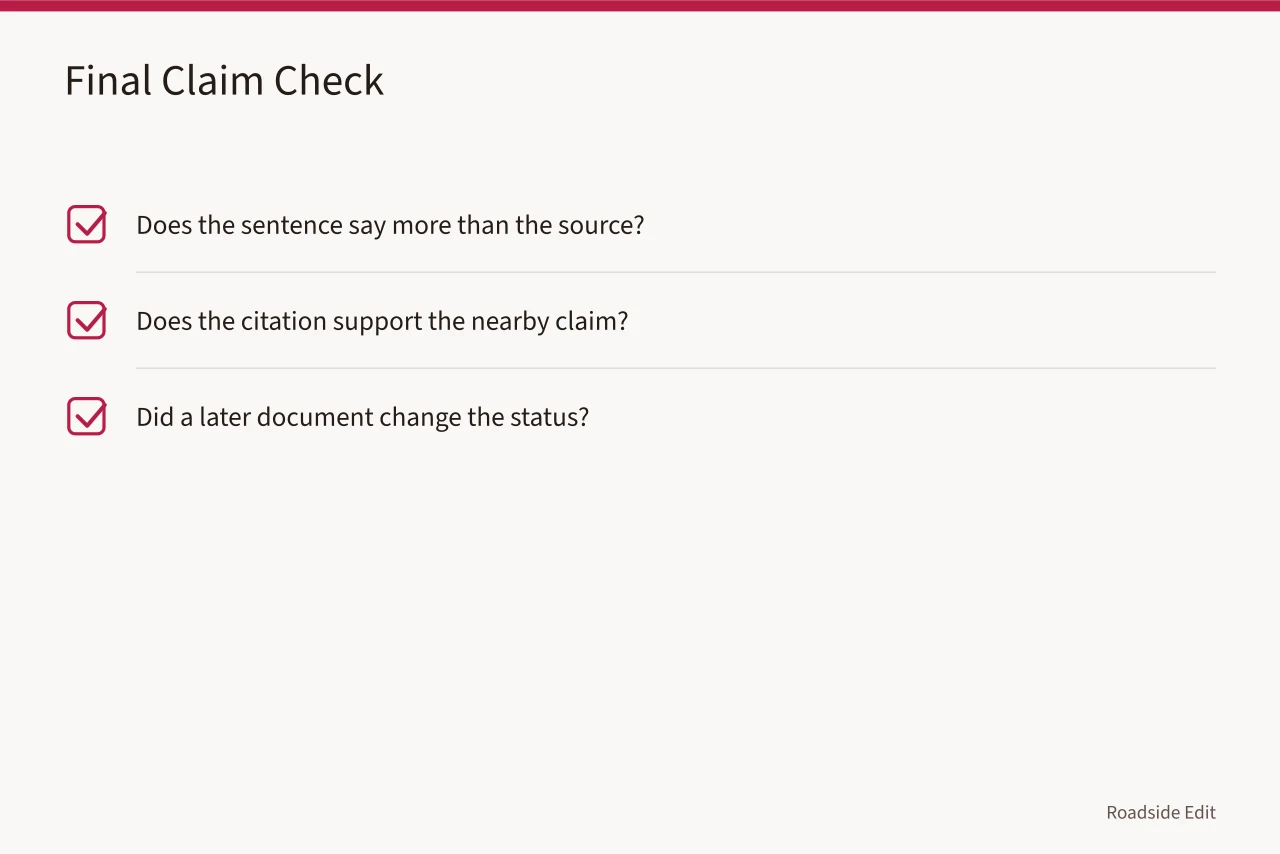
A final pre-publication check
The NPS standards for architectural and engineering documentation state that documentation should be accurate, come from reliable sources, and disclose limits so readers can check the information. That provides a practical editorial test. A source belongs next to the claim it supports, and a limitation belongs in the same section rather than in a distant disclaimer.
The National Archives guidance for digital photographic records describes identifiers and descriptive information as part of managing image records. Treat every project photo the same way. Record its source, date, depicted place, and descriptive caption. Credit alone establishes the origin of the image, not the condition of an unrelated property.
The NPS project documentation overview describes documentation that informs later planning and design work. It supports keeping each stage visible: a source establishes context, an observation identifies a question, and a documented decision records what the responsible party chose. An article should not compress that sequence into a promise.
Before publishing a historic motel planning article, ask:
- Does every property-specific statement have a source or an explicit limitation?
- Are observations separate from diagnoses and recommendations?
- Are photos clearly credits or property evidence, not both by accident?
- Do proposal, decision, and work status use different labels?
- Are general sources described as general?
- Has a later correction been preserved with a date?
The purpose is not to make the record cautious for its own sake. It is to make it useful, trustworthy, and easier to continue.
Common questions
What is the most common planning mistake?
Starting with an answer before the property evidence and planning question are defined. A clear record begins with location, source, date, and limit.
Can a general preservation source tell an owner what to do?
No. General sources can provide frameworks and terminology. Property-specific decisions need the appropriate evidence and review.
Should an article remove an old error?
Correct it, but preserve a dated correction note. Readers should be able to understand what changed and why.