Guides
Part of How to plan vintage diner interiors coverage with an evidence-first workflow
How owners can keep vintage diner interiors planning records straight
Vintage diner planning records guide for 2027: preserve source notes, room evidence, image credits, disclosures, update requests, and editor handoffs.
An editorial planning file is the bridge between research and a publishable diner-interior article. It lets a writer build an accurate outline, and it lets the next editor understand why a source, image, disclosure, or correction belongs on the page. The file does not need to be public. It does need to be organized.
What to take away
- Keep the question, source, claim limit, and image purpose in one project record.
- Build separate fields for historic evidence, current updates, and supplied material.
- Save direct source pages, not generic organization names.
- Preserve the exact public disclosure language with the relevant relationship.
- Leave a short handoff note before the article moves to publication.
Open the planning file with the article brief
Start with a short brief that names the planned subject, the central research question, audience, and boundaries. The brief should say what the feature will describe and what it will not attempt to determine. For example, a profile may describe features visible in dated records. It should not promise to certify a room's originality, condition, or treatment needs.
The General Services Administration P100 submittal matrix includes existing-condition documentation and photo documentation among possible project inputs. It does not govern editorial work. Its narrow value here is organizational: document the existing source basis before describing an existing interior.
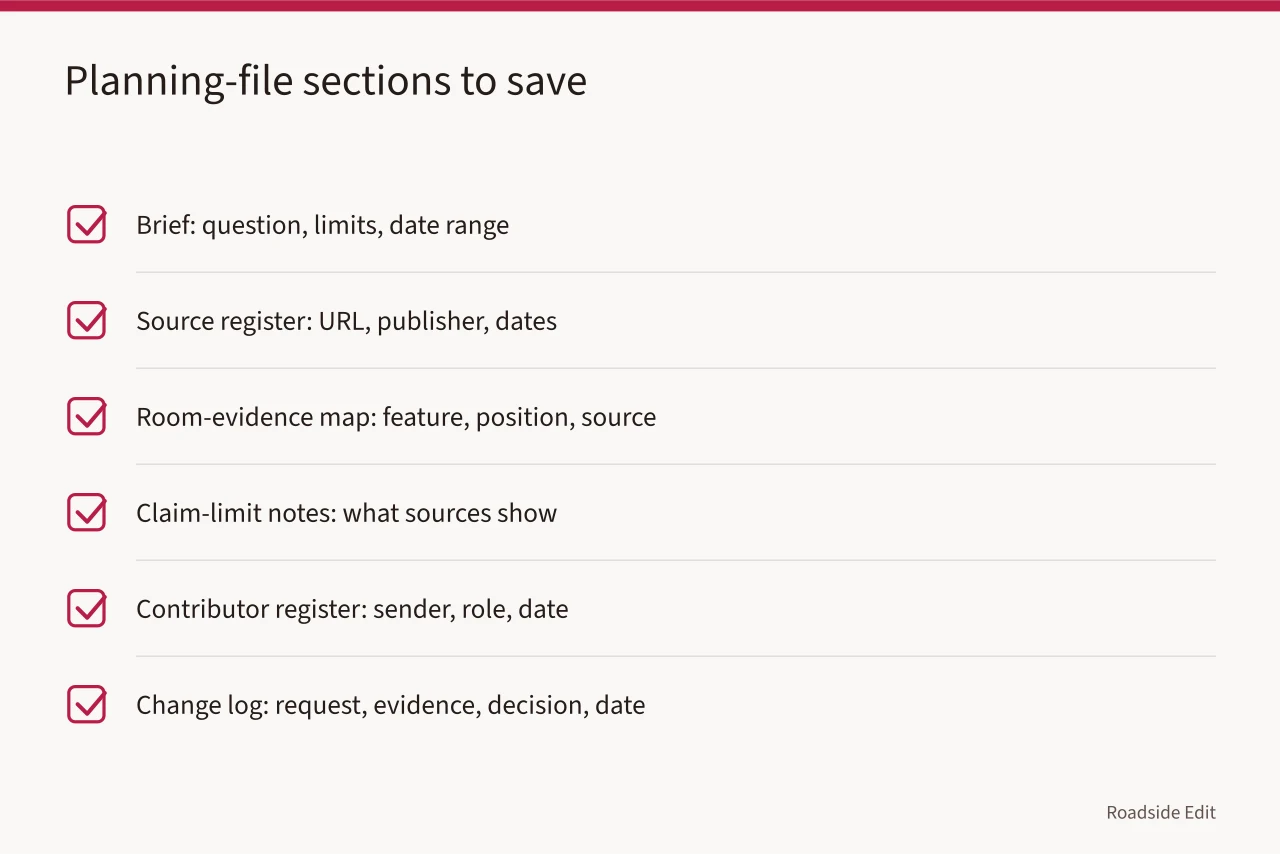
| Planning-file section | Save | Use at publication |
|---|---|---|
| Brief | Question, limits, planned date range | Check headline and introduction |
| Source register | Direct URL, publisher, date, access date | Support factual claims |
| Room-evidence map | Feature, position, source, image date | Draft dated descriptions |
| Claim-limit notes | What each source does and does not show | Prevent overstatement |
| Contributor register | Sender, role, received date, supplied wording | Attribute current accounts |
| Change log | Request, evidence, decision, date | Add correction notes |
Build the source register before writing
Each source entry needs the exact page or document, a title or identifier, the publisher or creator, the relevant date, and the access date. Then add the planned claim. This makes it obvious when an appealing source cannot support the sentence a writer wants to use.
The National Archives records-management overview describes the management of records over time. For article planning, traceability is the useful idea. A note that says "from a collection" does not tell a future editor which item was reviewed or what the original source said. A direct link and a source note do.
Write a claim limit beside each entry. A historic photo might support a visible counter in a dated room. It may not support an installation date, a current condition, or a material diagnosis. A current owner statement might support what the owner reported this month. It does not independently establish the whole history of the interior.
Make a room-evidence map
Use a simple table, sketch, or annotated image to tie proposed descriptions to evidence. Record the visible location of the counter, booths, doors, windows, service opening, ceiling, floor, and any signage. Do not add a feature simply because it is common in diner imagery.
The Library of Congress primary-source analysis guide begins with observation before reflection and investigation. Let observation fill the map. Let the map identify questions. Then seek another record if the article needs a historical explanation.
This record also helps an editor separate case evidence from contextual imagery. An image of another diner can be used as illustration when its caption says so. It should never be entered as evidence for the featured room.
Keep relationships and updates in a separate register
Record business-provided photos, descriptions, project amounts, and corrections separately from institutional or collection sources. Note who supplied each item and when. When a relationship could affect how a reader weighs a positive statement, plan the disclosure next to the statement rather than adding it later in a footer.
The Federal Trade Commission's endorsement guidance says material connections that could affect how readers evaluate an endorsement should be disclosed clearly and conspicuously. A disclosure gives readers relevant context. It does not turn supplied material into independent reporting.
For a correction request, retain the original wording, the requested change, supporting record, decision, and date. A public correction note can be brief. The planning file should still make clear why the page changed.
Leave a handoff note
Before assigning, publishing, or updating the article, write four short answers: What source is strongest? Which claim is only attributed? What remains unresolved? What must be checked before the next revision? This handoff note makes the file useful to an editor who did not conduct the original research.
Common questions
Should the public see the entire working file?
No. Publish the sources, attribution, disclosures, and update notes readers need. Keep internal editorial details organized in the planning record.
How often should records be reviewed?
Review them before a scheduled update and whenever a material correction arrives or a source changes.
Can a diner send new images?
Yes. Record the source, date, credit, and supplied-material label before deciding whether the image supports a public claim.