Guides
How to report regional adaptation in vintage diner interiors without overpromising
Use this 2027 vintage diner interior regional guide to report climate context, source limits, local records, imagery, corrections, and disclosures responsibly.
A vintage diner interiors regional adaptation article can give readers useful context when it explains what a dated source says about a place. It cannot predict the condition of a diner, select a treatment, or provide climate, insurance, building, or safety advice. This 2027 guide is an editorial framework for reporting regional context with clear limits.
What to take away
- Regional climate information is context, not a diagnosis for a diner.
- Keep a source date, place, and stated limit beside every claim.
- Treat local records and owner reports differently from independent evidence.
- Correct stale or overbroad language instead of extending it.
Start with the actual region
The United States has many climate patterns. A coastal archive, a desert diner, a Great Lakes lunch counter, and a Gulf Coast restaurant face different weather histories and public planning contexts.
A useful article names the region covered by its source, then stops. It should not convert a broad trend into a prediction about one building's interior, equipment, finishes, business operation, or future cost.
The National Park Service notes that changing wind, precipitation, humidity, and temperature can affect historic buildings. Its cultural-resources climate overview supports a limited editorial point: climate context should be tied to a specific geographic and historical record. It does not establish a current condition at a diner discussed here.
Build a regional evidence note
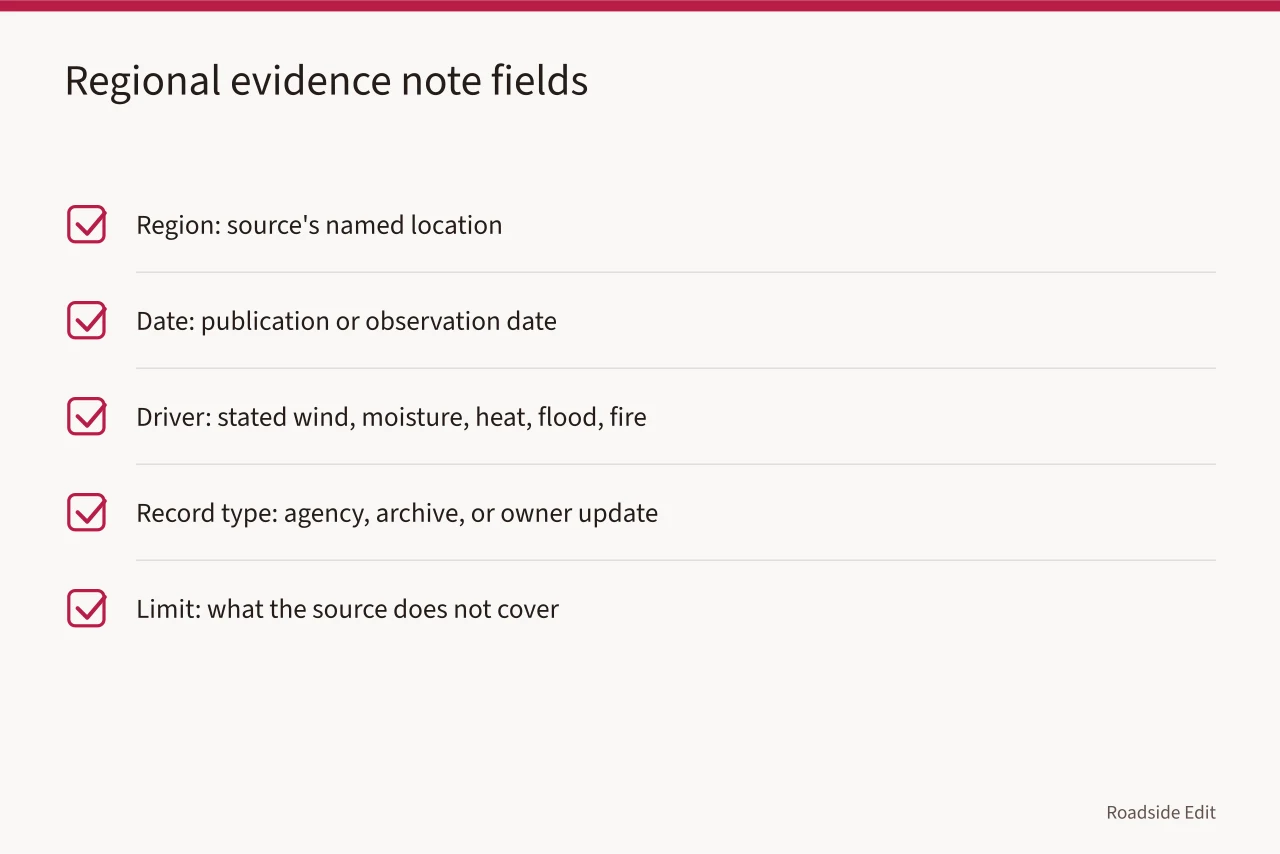
| Field | Include | Do not infer |
|---|---|---|
| Region | Source's named location | Conditions at another diner |
| Date | Publication or observation date | Current status from an old report |
| Driver | Wind, moisture, heat, flood, or fire context stated by source | A property-specific cause |
| Record type | Public agency page, archive, or owner update | Equal authority for all sources |
| Limit | What the source does not cover | A recommended action |
This note helps write honest captions and list entries. A historical photo can show an interior at a point in time, while a current owner can report a change.
A local agency can publish an official plan, but no single record authorizes a writer to announce a diner is resilient, vulnerable, safe, or in need of specific work.
Use local sources carefully
Regional articles gain value when they link a named place to a specific record. A public climate page, preservation study, historic designation, or emergency notice can establish part of the story, so read the page closely.
If it addresses a county, do not say it assesses an individual diner, and if it describes a past flood, do not make it a forecast. If it names a public project, describe only the documented scope.
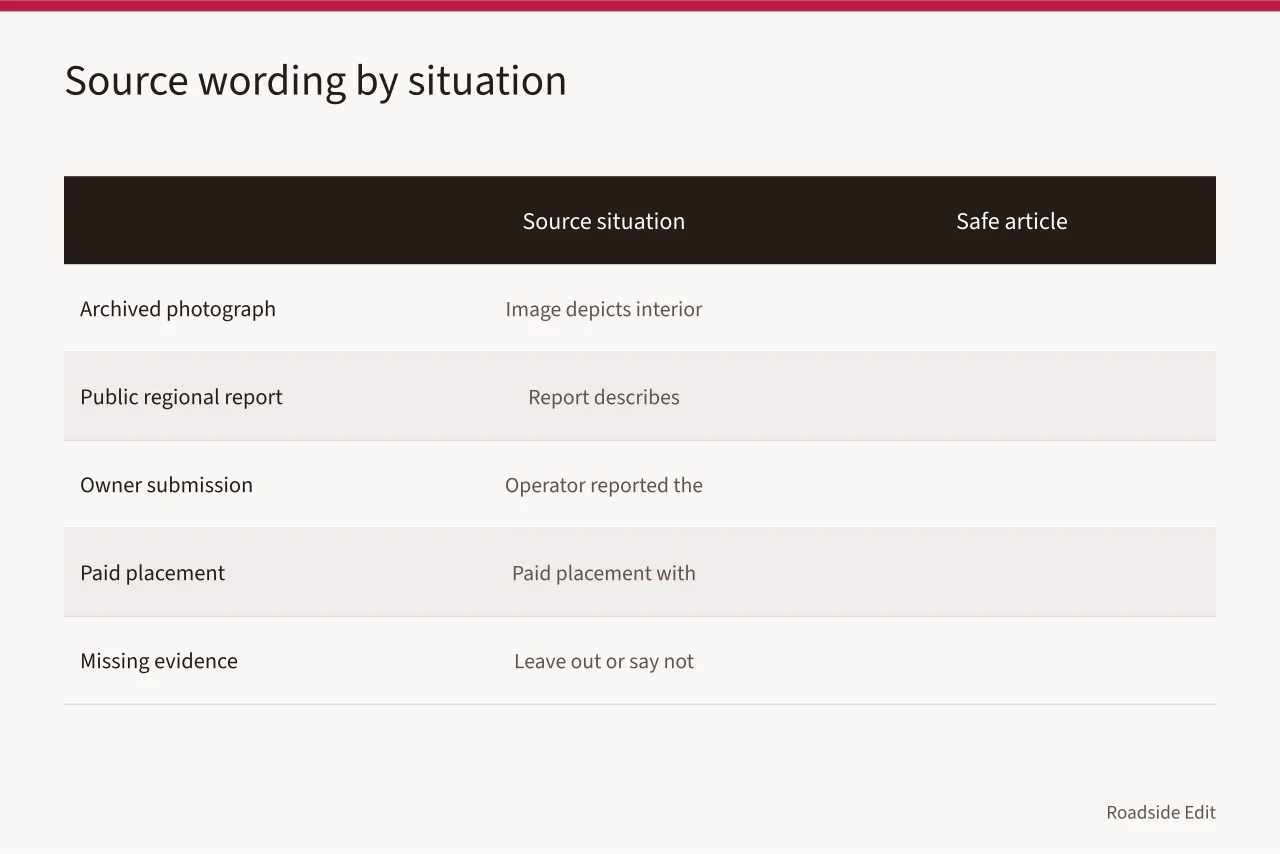
| Source situation | Safe article wording |
|---|---|
| Archived photograph | "The image depicts the interior on its stated date." |
| Public regional report | "The report describes conditions in the named area." |
| Owner submission | "The operator reported the update." |
| Paid placement | "Paid placement" with clear disclosure |
| Missing evidence | Leave the claim out or say it is not established |
Keep commercial material visible
Businesses may want inclusion in regional guides, especially when agencies or visitors use listicles to find distinctive places. Establish an inclusion basis before publishing: public historical record, documented local project, attributed operator description, or disclosed paid placement.
Do not treat payment as evidence of quality or environmental performance. Do not place a sponsor above another entry to imply an editorial climate rating.
Compare records, not regions
Two diners in the same city can differ in history, location, materials, ownership, and records. Operating conditions can vary from one diner to another as well.
A well-researched regional report may omit the block, building, room, or time period you have in mind. Compare sources instead of treating a broad label as a shared property fact. A county-level public plan and a neighborhood archival image are both useful but answer different questions.
Make that difference visible in the writing. Say whether a page is a public climate overview, a preservation planning record, a historic image, a business update, or a local project file. Then explain why it appears in the guide.
Readers can judge the relevance when the source type is clear. They cannot when every record reads as if it has the same authority.
Create a modest local profile
A local profile should be a map of evidence, not a scorecard, and it can collect a diner's named location, years shown in public records, credited photos, and reported updates. It can collect relevant agency pages and correction history.
Use neutral language for uncertain details. Avoid labels like climate-ready, protected, repaired, flood-safe, or disaster-proof unless a specific source supports that exact claim for that property and date.
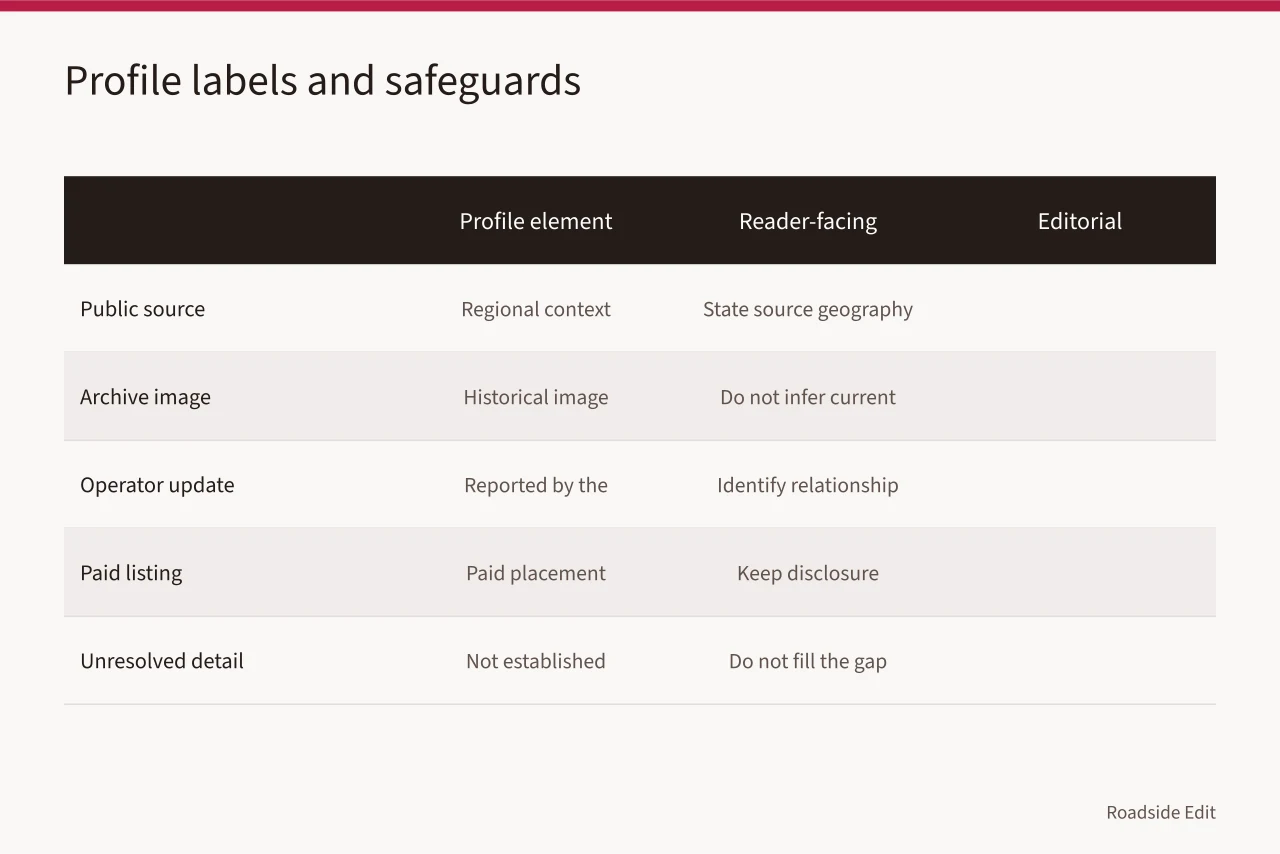
| Profile element | Reader-facing label | Editorial safeguard |
|---|---|---|
| Public source | "Regional context" | State source geography and date |
| Archive image | "Historical image" | Do not infer current condition |
| Operator update | "Reported by the operator" | Identify relationship |
| Paid listing | "Paid placement" | Keep disclosure conspicuous |
| Unresolved detail | "Not established" | Do not fill the gap |
This approach also helps when a local business wants a placement. The site can publish useful facts and preserve a fair correction process without exchanging a fee for stronger environmental claims. A sponsor can provide a source, but the source, not the payment, determines what the article may say.
Use revisions as a quality check
Every correction can improve the guide's method. If an old caption confused readers, add a clearer date field; if a regional source was too broad, show its geographic scope in future entries.
If a contributor supplied a current record, keep the attribution instead of rewriting it as a general fact. These small improvements stop the network from collecting near-identical, overstated regional pages over time.
Use regional terms without overpromising
Words such as coastal, humid, dry, wildfire-prone, flood-exposed, winter-heavy, or storm-affected can be useful descriptors when a specific source uses them for a specific location. They become misleading when they are attached to an individual interior without supporting evidence. Avoid language that sounds like a forecast, inspection, or repair instruction.
Instead, explain the source's relevance: it offers context a reader may wish to understand while researching a diner or local preservation story. Then name the limit. This style is direct, useful, and less likely to confuse a regional pattern with a property fact.
Record changes and corrections
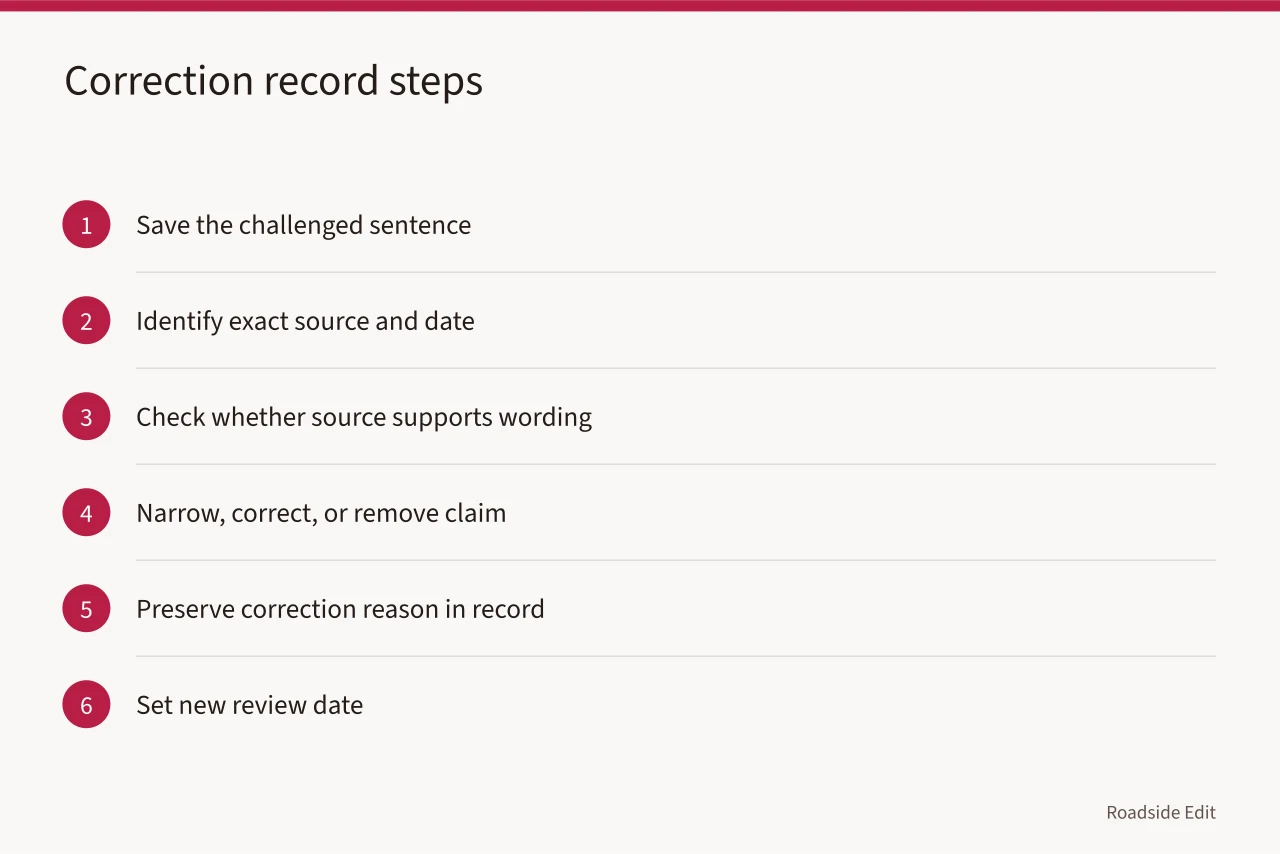
Regional information changes. A source page may be updated, a business may change hands, a historic image may receive a better caption, or an agency may clarify its coverage. Keep a correction record with the old wording, source submitted, review date, decision, and new wording. Make any paid relationship visible again after a revision.
Publish context, not instructions
Before a regional guide is scheduled, perform one final claim-by-claim check. Verify the primary keyword is used as a topic label, not as a promise. Confirm the source link is close to the sentence it supports.
Read captions without the surrounding paragraph. Ensure they do not imply more than an image can show. Check that no local business has been described as reviewed, protected, or recommended merely because it appears in a list.
Distinguish past, present, and future grammar. A historical record may say what happened. An owner update may report what the operator says occurred. A regional plan may describe objectives or scenarios.
None of those source types proves what will happen next at a particular diner. Direct language about these distinctions is not a weakness. It is the mechanism that lets readers use the guide without mistaking it for a site-specific consultation.
Set a revision rule before publication. Reopen the record if the cited agency updates its material, a business requests a factual correction, the credited photographer asks for removal, or new public documentation changes the historical context.
Record both the action and the reason. That discipline keeps a regional guide useful over time without accumulating stale, copy-like claims.
Regional reporting works when it helps readers understand records without pretending that a local-interest site has inspected every diner it covers. The article can organize maps, histories, public reports, archival imagery, and attributed updates. It should not prescribe alterations, promise outcomes, or label an individual property according to a general climate source.
The National Archives records-management overview supports retaining the source, review date, and decision behind a claim that may need correction. For a regional guide, the working record keeps a public context page connected to its stated geography without turning it into an assessment of a local business.
The Library of Congress primary-source analysis guide distinguishes observation from reflection and investigation. That approach supports the guide's central boundary: describe what a dated record identifies, then seek appropriate additional evidence before stating a current property condition.
The Federal Trade Commission's endorsement guidance supports a clear paid-placement label where compensation could affect a reader's evaluation. Disclosure identifies the relationship without making the business or its claims appear independently endorsed.
Common questions
Can a regional report prove the condition of a diner interior?
No. It provides context about the area covered by the report, not a property assessment.
Can a business submit a local update?
Yes. Attribute the report, identify the date and relationship, and disclose paid placement if applicable.
Should an old image be presented as current evidence?
No. Describe it as a dated historical record and do not extend its meaning into the present.
What should happen when a source changes?
Review the related claim, correct the wording if needed, and record the reason for the update.
In this guide
- How to build a vintage diner interiors regional checklist for source notesUse this 2027 vintage diner interior regional checklist to document climate sources, locations, image limits, owner updates, disclosures, and corrections.
- Before you compare vintage diner interior budgets, check the regional sourceA regional diner award covers many buildings. Report the scope, the source date and the disclosure, and never divide one figure across individual diners.