Guides
Part of How to compare roadside architecture treatment options before you choose
How to test roadside architecture restoration evidence before you date a building
Roadside architecture restoration evidence for 2027 explains how to test period claims against dated photographs, records, material evidence, and source limits.
Restoration claims need evidence for a particular period and feature. A historic postcard, map, photograph, drawing, or project record can be useful, but each source has a boundary. A front-view photograph may support lettering and a roofline while saying nothing about rear walls, hidden materials, or a later alteration.
What to take away
- Name the period before describing work as restoration.
- Match each feature claim to a source that shows or describes that feature.
- Keep source dates, viewpoints, and limits in the working file.
- Change the draft when evidence conflicts with it.
Begin with a defined period
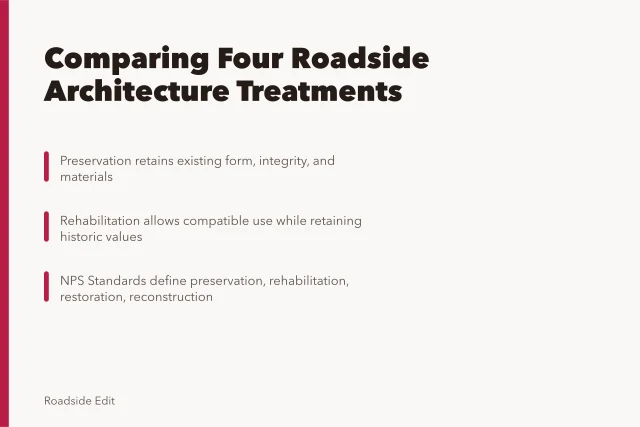
The National Park Service distinguishes restoration from rehabilitation, preservation, and reconstruction. Read the NPS overview of treatment approaches. Restoration seeks to reestablish a property at a particular past time. That is why a writer needs a period, not just an old-looking image.
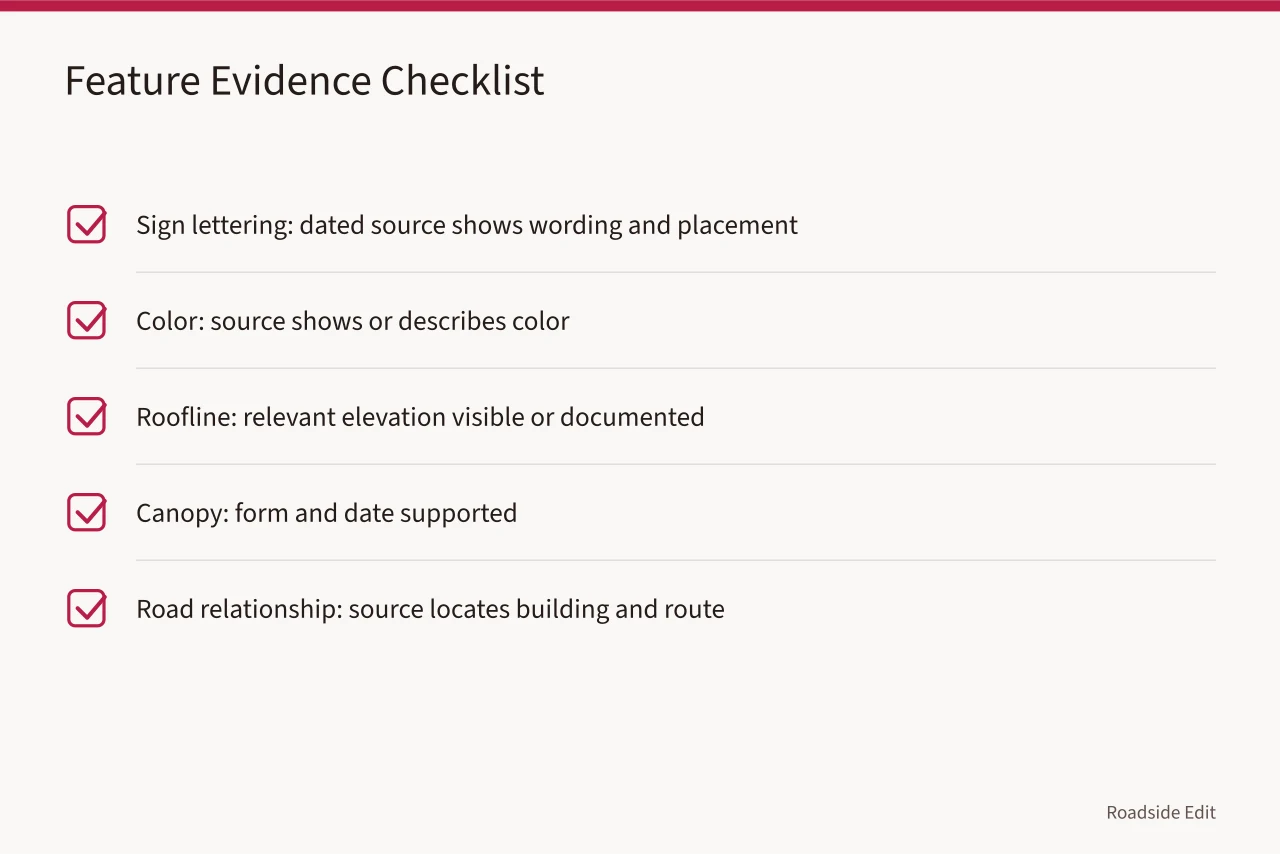
State the period in the research note, then list the features the article plans to discuss. "Road-facing sign and facade as documented in 1958" is a usable boundary. "The building's original appearance" is not, unless the sources establish what original means for that property.
| Feature | Evidence question | Common limit |
|---|---|---|
| Sign lettering | Does a dated source show the wording and placement? | A photo may not identify original materials |
| Color | Does the source show color or describe it? | Grayscale images cannot establish a palette |
| Roofline | Is the relevant elevation visible or documented? | One view may omit the rear roof form |
| Canopy | Is its form and date supported? | A later photo may show a replacement |
| Road relationship | Does the source locate the building and route together? | A map may not establish business use |
Use a feature-source map
Create one row per claim. Record the source title, date, creator when known, exact supporting detail, and limitation. This map keeps a draft from turning a close image of lettering into a complete description of a facade.
The NPS treatment guidelines say restoration is considered when a property is to be depicted at a particular time and when enough evidence exists to avoid conjecture. Review the NPS treatment guidelines for restoration. The guideline is not a decision about a local roadside project. It explains why a restoration claim must be based on more than a preferred image.
Read each source at its own scale
Photographs are strong for visible form. Maps may support road alignment, location, or a name label. Project drawings may identify proposed components. Oral recollections can point toward new sources but should be attributed as recollections. None should be asked to establish a fact outside its reach.
The Library of Congress advises researchers to consider a primary source's creator, purpose, context, and agreement or conflict with other material. Use the Library of Congress guidance for analyzing primary sources. Apply those questions before publishing a period claim. A tourist postcard and a contractor's drawing may both be valuable, but they are evidence of different things.
When sources conflict, do not force a single answer. Check whether they show different years, locations, or parts of the building. Then state the conflict, use a narrower claim, or leave the feature out until a better source appears.
Keep the project record separate from the article
The working file should hold the full evidence map, image credits, rights notes, and version history. The article needs only the claims that the evidence supports. If a source proves an earlier sign existed, say that. Do not add an installation date, manufacturer, material, or complete color scheme unless a source establishes it.
The NPS historical-documentation guidance calls for research results to identify their sources and describe conflicts in source material. Read NPS guidance on reporting historical documentation. A short publication can follow the same discipline with a dated citation and plain wording about what remains uncertain.
Check the caption as carefully as the body text. A caption can introduce an untested date, feature name, or material claim. Keep it to what the credited image or cited record directly establishes.
Common questions
Can one historic image prove a full restoration design?
Usually not. It can support the features visible in the image. Other elevations, materials, dates, and details need their own evidence.
What if two sources show different details?
Check their dates, locations, and purpose. State the difference or reduce the claim until the evidence supports a clear conclusion.
Does a project need every possible source?
No. It needs source-specific evidence for every material claim it makes, plus clear limits where evidence is incomplete.