Guides
How to compare roadside architecture treatment options before you choose
Roadside architecture treatment options for 2027 compare preservation, rehabilitation, restoration, and reconstruction without treating labels as project advice.
Roadside architecture treatment options help a reader distinguish four often-confused words: preservation, rehabilitation, restoration, and reconstruction. They are not the same.
Each describes a different approach to work on a historic property. A roadside motel, station, diner, sign, or attraction may need a site-specific evaluation before deciding which approach fits, if any.
What to take away
- Preservation, rehabilitation, restoration, and reconstruction describe different treatment approaches.
- A visible building condition does not tell you which approach applies.
- The documented history, current condition, proposed use, and available evidence all affect a treatment discussion.
- An article can explain these terms without recommending work on a specific property.
- Do not call ordinary repair work restoration or reconstruction unless the project record uses that term and supports it.
Why the terms matter
Words shape public expectations. If an article calls a repainting project a restoration, readers may expect the building to return to a documented past appearance. If it calls a rebuilt sign preservation, readers may assume original material remains. Clear language keeps a public story from promising more than the work record supports.
Start by separating three questions:
- What is visible at the site today?
- What does the record establish about earlier form, materials, or use?
- What work is actually proposed or completed?
The first question comes from field observation. The second comes from records, photographs, drawings, permits, or other evidence. The third comes from an authorized project document. None of them should be replaced by a catchy treatment label.
Compare the four approaches
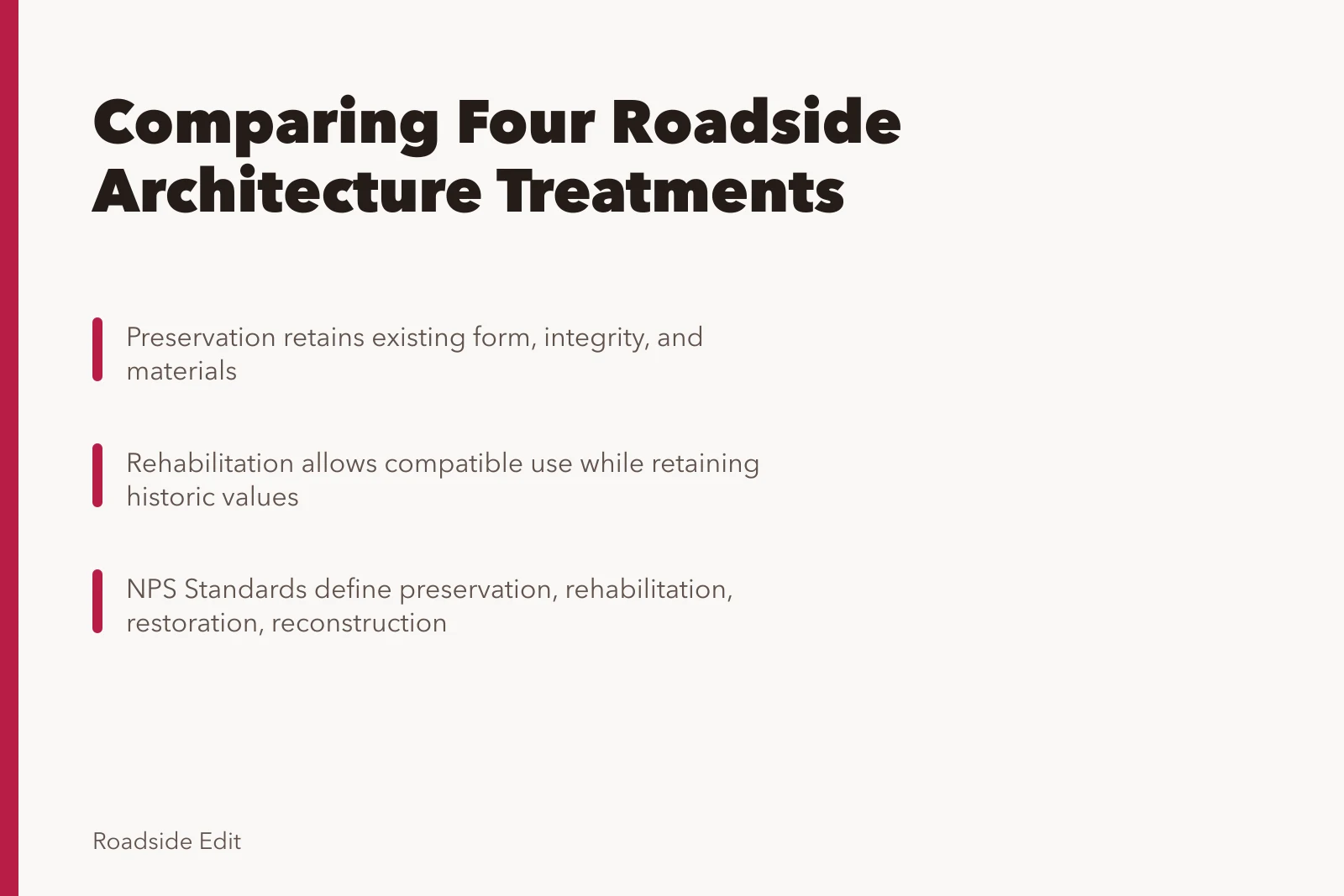
The National Park Service describes four treatment approaches in the Secretary of the Interior's Standards: preservation, rehabilitation, restoration, and reconstruction. Read the NPS overview of treatment approaches. The page explains federal standards and a general framework. It does not decide the appropriate approach for a particular roadside property.
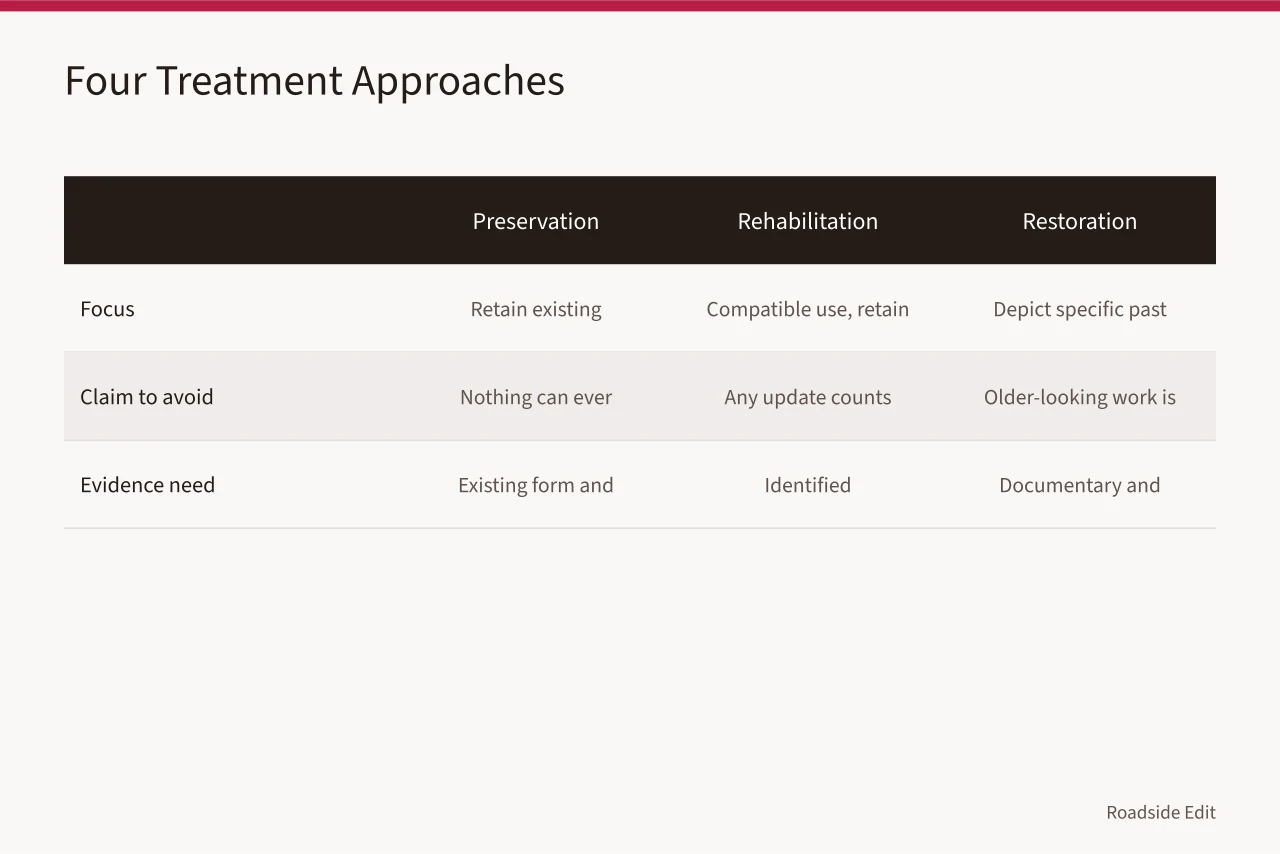
| Approach | Plain-language focus | A claim to avoid |
|---|---|---|
| Preservation | Retaining and maintaining existing historic character and material | "Nothing can ever change" |
| Rehabilitation | Supporting compatible use while retaining character-defining features | "Any update counts as rehabilitation" |
| Restoration | Depicting a property at a specific past period with supporting evidence | "Older-looking work is restoration" |
| Reconstruction | Re-creating a non-surviving resource under narrow evidence-based conditions | "A replica is automatically historic" |
These terms are not a ranking system for every local project. They describe an approach and its evidence needs.
A working business can have contemporary needs. A vacant place can have safety needs. A small repair can still need careful documentation. The right article states the project scope and record rather than forcing every site into one category.
Preservation: keep the current record readable
Preservation focuses on retaining the historic character and material that remain. In everyday writing, that may mean describing maintenance, repair, protection, or stabilization only as the actual project documents describe them. Do not assume that a weathered surface should remain untouched or that new work is prohibited. Those are project decisions that depend on the property and the governing process.
The NPS defines preservation as sustaining existing form, integrity, and materials, with emphasis on maintenance and repair rather than extensive replacement or new construction. Read the NPS preservation treatment standard. The source defines the federal treatment language. It does not establish the history or condition of a particular roadside building.
For a roadside article, preservation language works best when it stays close to observable facts. You can say that a project record describes repair to an existing sign face, for example. You should not say that the sign is original, significant, or safe unless a source supports each claim.
| Write this | Instead of this |
|---|---|
| "The project record describes repair to the existing sign face." | "The sign was preserved for future generations." |
| "The article does not assess the building's structural condition." | "The structure is sound." |
| "The visible material appears weathered in the 2027 photograph." | "The material has survived unchanged." |
Rehabilitation: allow a documented use change
Rehabilitation is often the most misunderstood term in public writing. It does not mean making an old building look polished. In the NPS framework, rehabilitation can accommodate a compatible use while retaining the elements that convey a property's historic, cultural, or architectural values. That language has a specific purpose in the standards.
The NPS explains rehabilitation as making compatible use possible through repair, alterations, and additions while retaining identified values. See the NPS rehabilitation treatment standard. It also notes that the term does not itself document whether a local project meets those standards.
A local article should identify what was changed and what source says so. A new accessible entrance, mechanical system, service counter, or addition may be part of a project, but the article should not announce that it meets a standard unless the appropriate record confirms it. Describe the visible work, the stated project purpose, and the date.
Restoration: name the period and evidence
Restoration ties to a specific time period and needs more than a taste for vintage looks. The article should name the period, the feature addressed, and the supporting evidence.
If those are unknown or private, use a neutral phrase like "the sign was repainted" or "a prior color scheme was referenced in project materials."
The NPS describes restoration as depicting a property at a particular period and requires documentary and physical evidence for missing features from that period. Review the NPS restoration treatment standard. That distinction is why a vintage-looking update should not be called restoration without a dated, feature-specific record.
Do not use a historic photograph as a license to infer missing details outside its frame. A front-facing postcard may show lettering but not roof material, side elevation, or interior arrangement. The source should support the sentence beside it, not a larger story the article would like to tell.
Reconstruction: distinguish a copy from surviving fabric
Reconstruction deals with a resource that no longer survives, not with replacing a deteriorated board, repairing a sign, or reusing a building.
That distinction matters because readers may see a rebuilt roadside feature and assume its physical fabric is historic. A clear article can call a feature reconstructed when a project record uses that term and gives supporting context.
The NPS definition of reconstruction concerns new construction that depicts a non-surviving property or feature at a specific historic time and location. Read the NPS reconstruction treatment standard. Its standards also call for adequate evidence, minimal conjecture, and clear identification of the new work as a contemporary re-creation.
Avoid vague descriptions such as "rebuilt exactly as before" unless the source states that and explains the basis. A careful phrase is more useful: "The project describes a reconstructed feature based on identified documentation." It tells the reader what the source claims without inventing a level of certainty.
Use a decision record, not a label alone
A treatment label should never be the whole record. Keep a small table or note that identifies the property, date, proposal or completed work, relevant source, and limits. This protects an article when the project changes or new evidence appears.
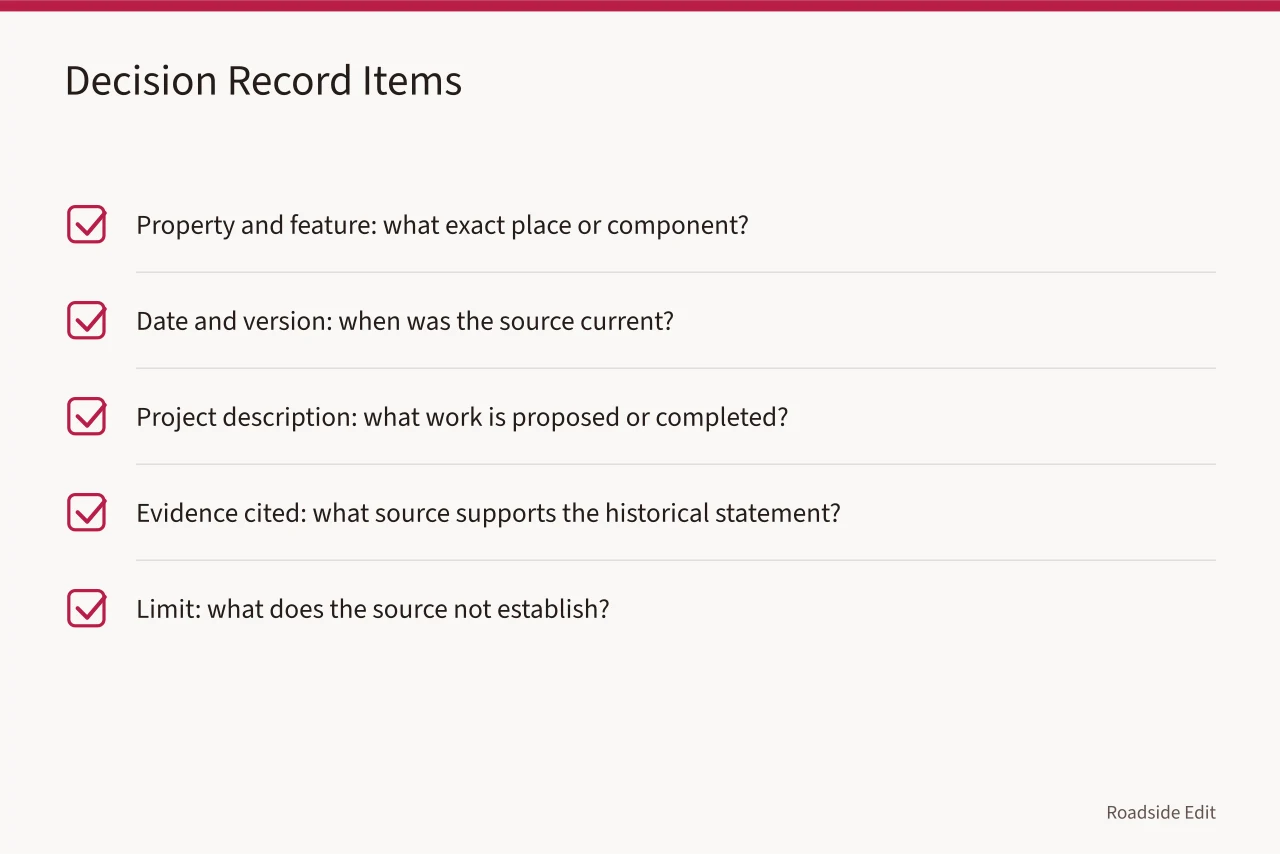
| Record item | Question it answers |
|---|---|
| Property and feature | What exact place or component is discussed? |
| Date and version | When was the source current? |
| Project description | What work is proposed or completed? |
| Evidence cited | What source supports the historical statement? |
| Limit | What does the source not establish? |
This record also helps writers avoid a common problem: treating a local nickname as a formal designation. If an organization calls a project a restoration in a press release, attribute that wording. If a formal application, study, or report uses the term, cite the specific page. If neither exists, describe the work without a treatment claim.
Write for a live place, not a museum label
Roadside places often remain businesses, homes, community facilities, or private property. They can change hands, use, signage, and circulation patterns. An article can explain why a particular facade, sign, roofline, or roadside view draws interest without presenting the site as frozen in time. This matters especially when readers may visit an operating business.
Keep access and privacy in mind. Do not encourage entry onto private property. Do not publish security details or personal information. Do not use an article about historic character to imply that an owner must take a particular action.
A short editor's review
Before publication, read every treatment word as a claim. Ask whether the article identifies the place, period, source, and scope. If the source is only a historic image, say what the image shows. If the source is a project record, identify the document and date. If the record is incomplete, use a narrower sentence or leave the claim out.
Keep terms separate from marketing language
Project announcements often need a short headline. An article can quote it, but the headline should not carry the facts.
If a group calls its work a revival, renewal, or restoration, find the scope, source, date, and physical feature. Expand the claim only after that.
The reader deserves to know whether a new sign, a cleaned facade, a repaired canopy, or a larger project is discussed.
When language is uncertain, use a neutral verb. "Repaired," "repainted," "removed," "installed," and "documented" can be accurate when a source confirms the action. Those words are usually clearer than a treatment label that implies a period, standard, or level of historical evidence the article cannot demonstrate.
They also make later corrections easier, because each verb can be checked against a specific dated source rather than an impressionistic description.
Common questions
Does a fresh coat of paint count as restoration?
Not automatically. A project record would need to establish the intended period, feature, and evidence behind that treatment description.
Can rehabilitation include a new use?
The NPS treatment framework describes rehabilitation as making compatible use possible while preserving parts of a property that convey its values. A specific project still needs its own documentation.
Is reconstruction the same as repair?
No. Reconstruction concerns a non-surviving resource. Repair addresses an existing feature and should be described according to the actual project record.
In this guide
- Roadside architecture rehabilitation questions to ask before you publish a compatible-use claimRehabilitation, restoration, preservation and reconstruction mean different things on a roadside project, and each one needs its own dated evidence.
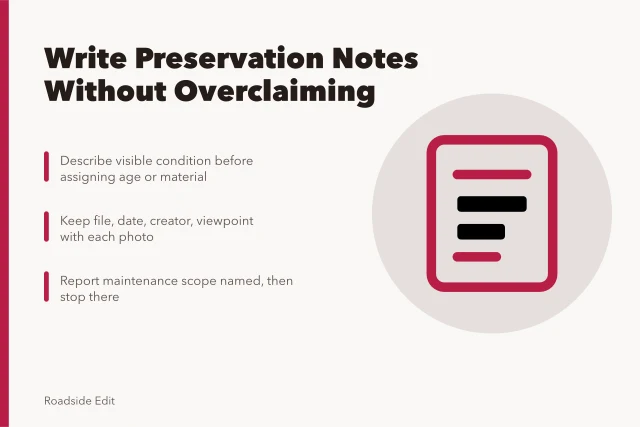
- How to write roadside architecture preservation notes without overclaiming a feature's historyRoadside architecture preservation notes for 2027 explain how to record visible material, maintenance, evidence, and limits without overclaiming a feature's history.
- How to test roadside architecture restoration evidence before you date a buildingRoadside architecture restoration evidence for 2027 explains how to test period claims against dated photographs, records, material evidence, and source limits.
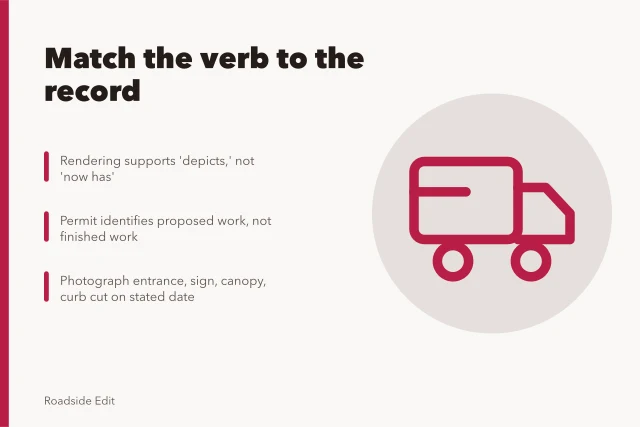
- Roadside architecture adaptation questions to ask before you describe a changeMatch each verb to the record behind it so a rendering, permit or completion note never reads as a finished roadside change you cannot source.
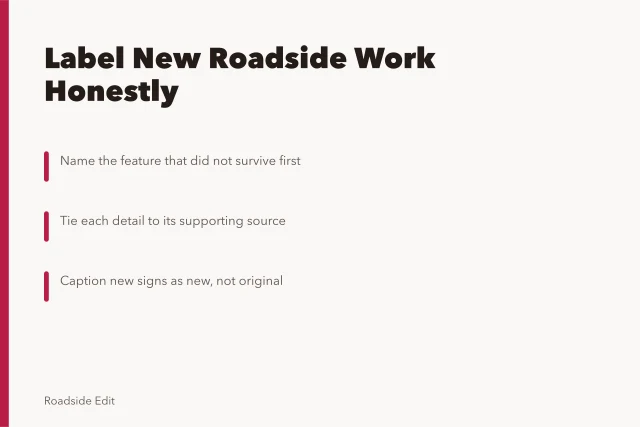
- How to set roadside architecture reconstruction limits and label new workRoadside architecture reconstruction limits for 2027 explain how to label new work, separate surviving material, and tie claims to evidence for a lost feature.