Guides
Part of How to compare roadside architecture treatment options before you choose
Roadside architecture rehabilitation questions to ask before you publish a compatible-use claim
Rehabilitation, restoration, preservation and reconstruction mean different things on a roadside project, and each one needs its own dated evidence.
"Rehabilitation" is a term of art, not a synonym for renovation. A 1950s porcelain-enamel station sign repainted last spring was altered. It was not rehabilitated unless a project record says so. Writers covering a roadside building should describe the physical change and name the document that establishes it.
What to take away
- The four NPS treatments are preservation, rehabilitation, restoration and reconstruction, and each one permits different work.
- Match the verb to the evidence: a rendering supports "proposes," a permit supports "authorized," a completion record supports "built."
- Describe the physical change by name: entrance, addition, access feature, sign face, canopy soffit.
- A treatment label comes from a project record or a qualified report, never from a photograph.
- When the record is thin, date the claim and cut it back rather than rounding it up.
The four treatments, and what each one allows
The National Park Service separates four approaches to a historic property. Read the NPS definition and standards for rehabilitation. See the NPS overview of the four treatment approaches.
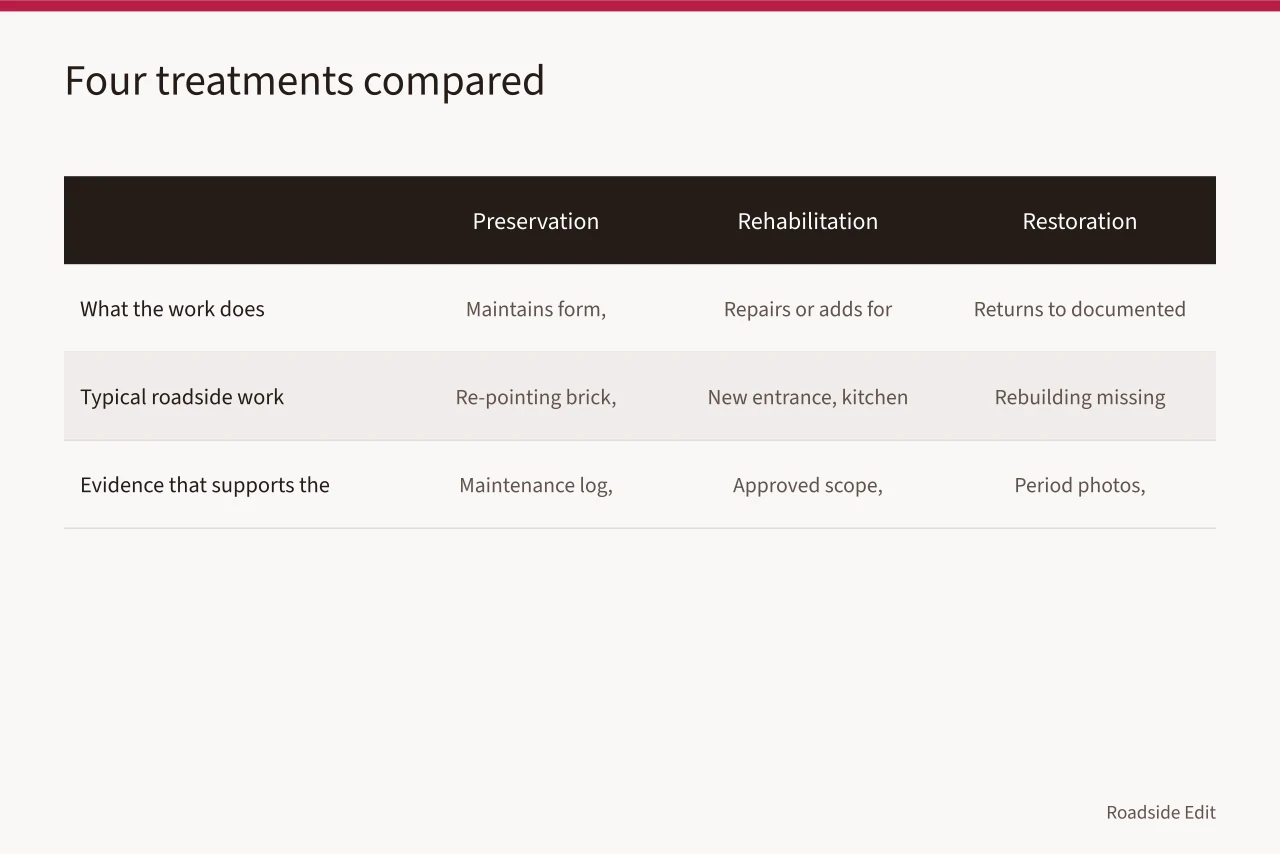
| Term | What the work does | Typical roadside work | Evidence that supports the word |
|---|---|---|---|
| Preservation | Maintains existing form and material, minimal intervention | Re-pointing brick veneer, cleaning a porcelain-enamel sign face | Maintenance log, condition survey |
| Rehabilitation | Repairs, alters or adds to support a compatible use while keeping character-defining features | New entrance in a blank wall, kitchen addition behind a diner | Approved scope, permit, review record |
| Restoration | Returns a property to a documented earlier period | Rebuilding a missing neon sign to match 1958 tube diameter | Period photographs, physical evidence, historic structure report |
| Reconstruction | Builds new work that recreates a resource that no longer exists | Rebuilding a demolished pump island | Documentation of the lost resource, new-construction drawings |
The table is the whole point. A repainted sign face is preservation work if the paint matches the original enamel color and the sign is intact. It is restoration if the sign was over-painted in 1974 and the project is putting back the 1958 scheme. Same brush, different word.
Match the verb to the evidence type
Most bad roadside writing comes from a verb that outruns its source. A rendering shows intent. A permit shows authorization. A completion record shows the work exists.
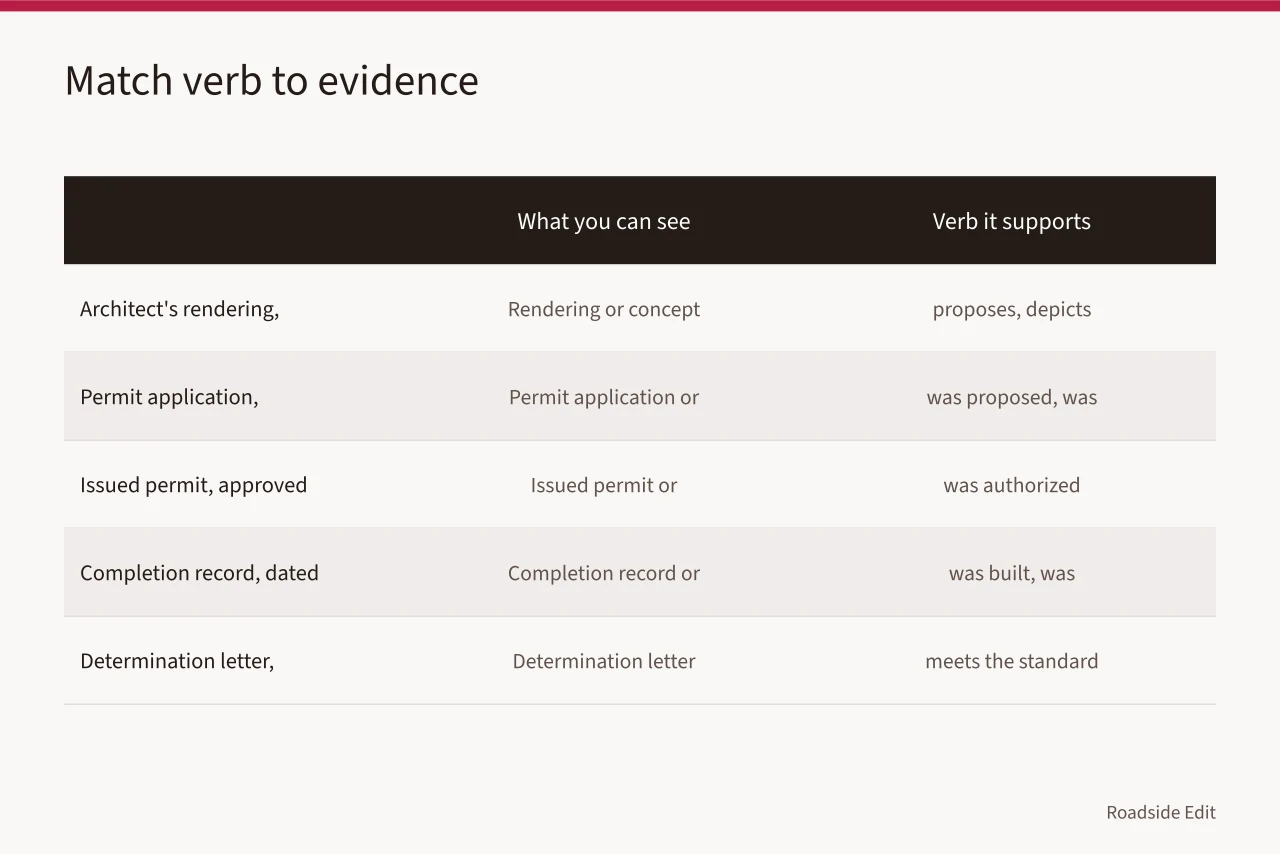
| What you can see or cite | Verb it supports |
|---|---|
| Architect's rendering, concept board | proposes, depicts |
| Permit application, hearing packet | was proposed, was submitted |
| Issued permit, approved scope | was authorized |
| Completion record, dated photograph | was built, was installed |
| Determination letter, certification | meets the standard |
A rendering supports only the proposal, not the other claims:
- A rendering of a new entrance on a 1962 motel office supports "the 2027 proposal depicts a new entrance."
- It does not support "the motel has a new entrance," and it certainly does not support "the motel was rehabilitated."
- Three different sentences, three different evidence types.
Describe the physical change, not the outcome
Readers want to know what happened to the building. Name the feature and the intervention.
Write "the 2027 scope adds a vestibule at the north entrance and replaces two window units." That is checkable. Write "the building was modernized for a new use" and the reader learns nothing they can verify.
For a neon sign, name the tube diameter, the transformer count and the face material, because those are the details that separate a restoration from a replacement. For a canopy, name the soffit material and whether the dry-stand pipe was retained. For a diner, name the booth laminate and the chrome-edge trim.
The neon sign restoration planning workflow shows how those details get recorded before a scope is written.
Worked example: one sign, two correct sentences
A 1955 porcelain-enamel station sign came off its pole in 2019 and sat in a shed. In 2027 a shop re-hung it on a new pole at the original corner, with new neon and a rebuilt transformer.
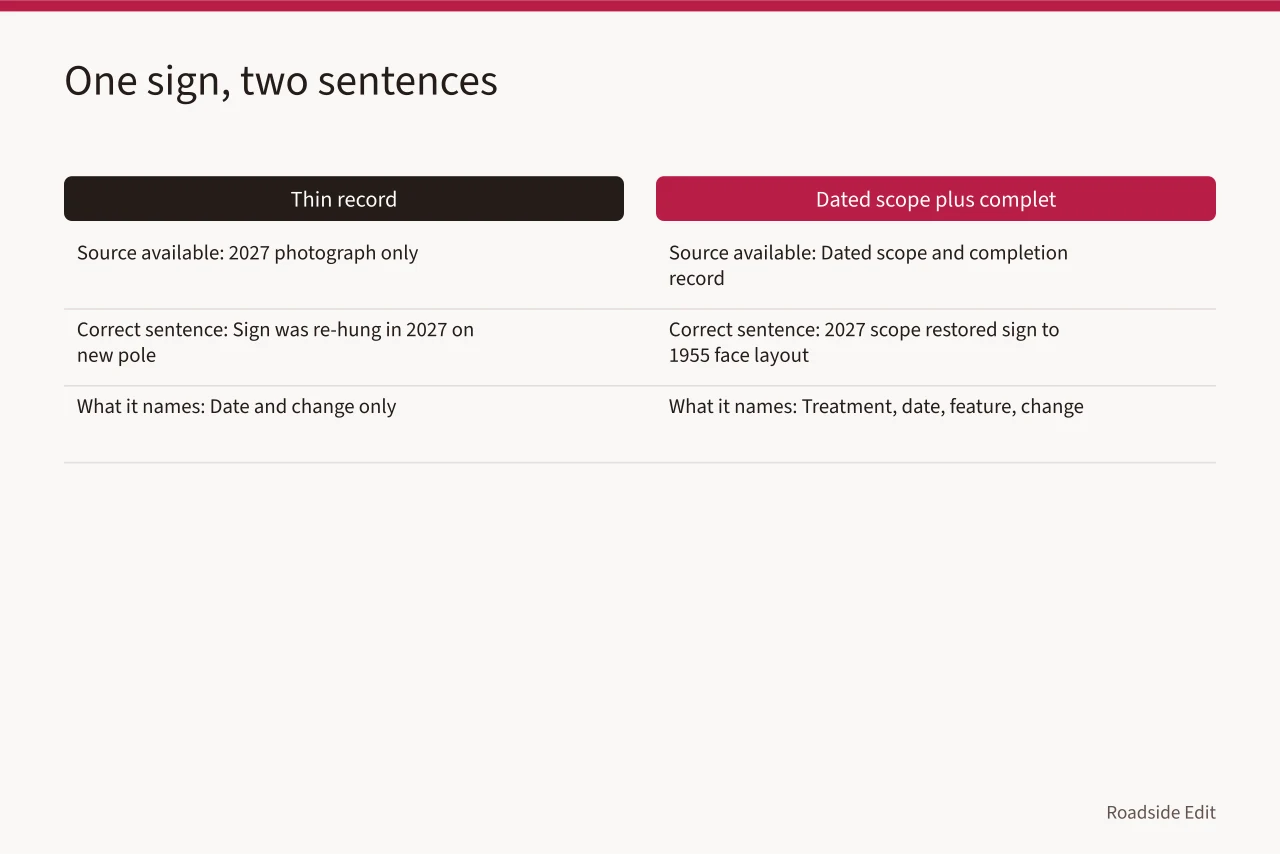
Two sentences are available, and only one is right for each source.
- If the only source is a 2027 photograph, write: "The sign was re-hung in 2027 on a new pole."
- If the source is a dated scope plus a completion record, write: "The 2027 scope restored the sign to its 1955 face layout and re-hung it on a new pole at the original corner."
The second sentence is longer because it carries more. It names the treatment, the date, the feature and the change. The first sentence is honest but thin, and it is the correct choice when the record is thin.
Additions and new uses
A compatible use often needs an addition: a kitchen, a restroom, an accessible entrance. The NPS guidelines help owners and reviewers apply the Standards during planning, and they do not give case-specific advice. Review the NPS guidelines for rehabilitating historic buildings.
For federal tax-incentive projects, review weighs the addition's effect on the building and, where relevant, the district. Read NPS guidance on new additions to historic buildings. That is one program's review context. It is not a ruling on a local project, and it is not a substitute for the adopted ordinance your local landmarks commission applies.
So write "the 2027 application describes a rear addition," not "the addition is compatible." Compatibility is a finding. Findings come from a reviewer, and you name the reviewer.
Common questions
Can a project be two treatments at once?
Yes. A rehabilitation scope can include restoration of one feature, such as a sign face, while other work is repair. Name each piece of work and the treatment it falls under, and cite the record for each.
Is a repainted sign always a loss?
No. Over-painting original enamel is a common failure, but repainting a face that was already painted in 1974 can be appropriate. The question is what the paint covers and what the record says about the earlier scheme.
What if the only source is a photograph?
Then write only what the photograph shows, with its date. A photograph supports "the facade carried a box sign in 2027." It does not support a treatment label, a completion date or a claim about what was authorized.