Guides
Roadside building options comparison: preservation, rehabilitation, restoration and reconstruction
Roadside building options compared for 2027 helps U.S. readers separate preservation, rehabilitation, restoration, and reconstruction using clear project records.
Roadside building projects often get one flattering word: a sign is "restored," a station is "preserved," a motel is "rebuilt."
Those words can be accurate only when the source record identifies the work and its goal. Otherwise, the word may turn a small repair, a future plan, or a new construction element into a larger claim than the evidence supports.
This guide compares four common treatment terms. It helps editors, owners, and businesses describe a project in a way readers can check. It is not a treatment recommendation, an eligibility opinion, or a repair manual for a specific property.
What to take away
- Preservation, rehabilitation, restoration, and reconstruction describe different project goals.
- Choose the term that the project record supports, not the term that sounds most impressive.
- Keep a treatment goal separate from a cost, a tax-incentive resource, and a claim that work is complete.
- Attribute provider information and disclose paid relationships beside commercial claims.
Compare the goal before comparing the work
The first question is not "Which option costs less?" It is "What is the documented goal?" A building may need a record of its existing condition. A business may seek a compatible use. A project may aim to show a documented earlier period. Another may create a new feature where none survives. Those are different paths.
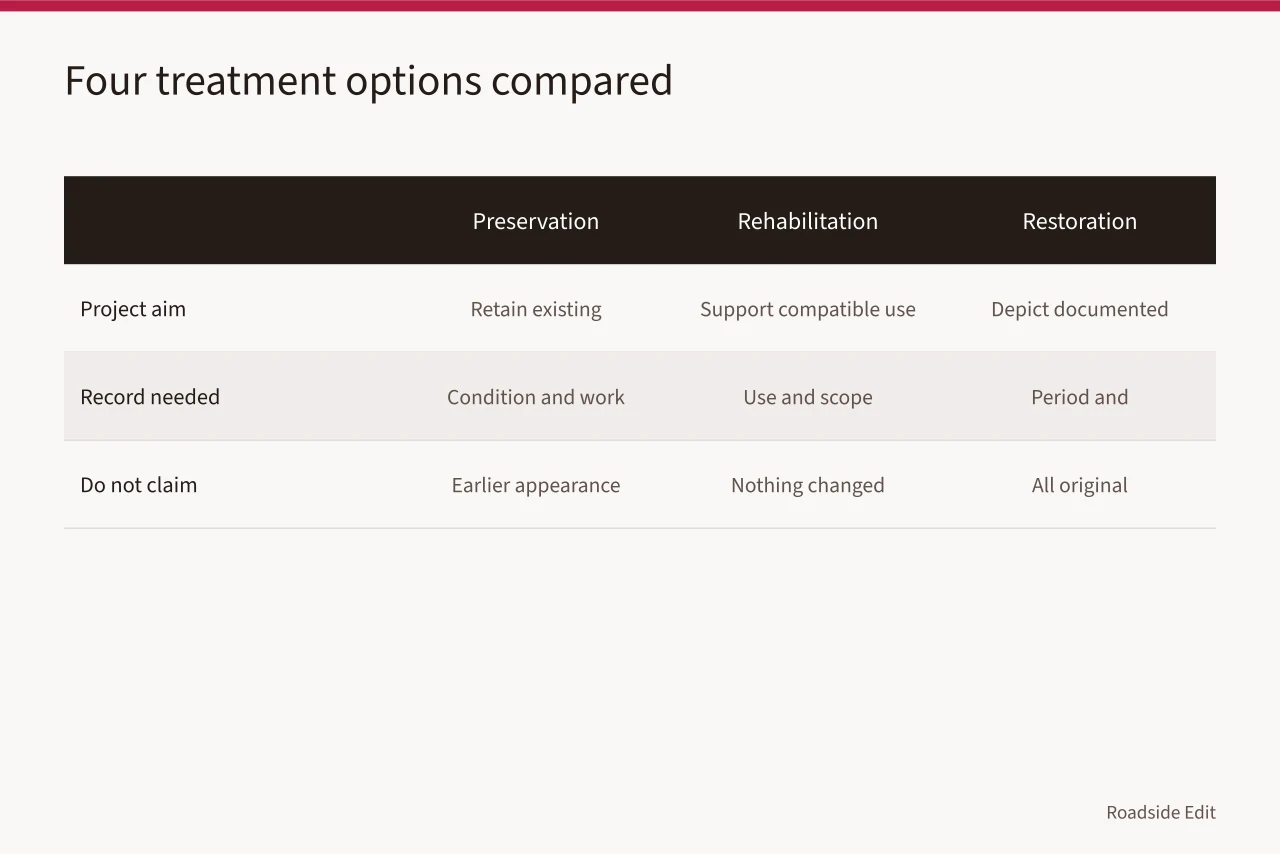
| Option | Project aim | Record an article needs | Do not claim without proof |
|---|---|---|---|
| Preservation | Retain and care for existing features | Feature, condition record, and stated work | A return to an earlier appearance |
| Rehabilitation | Support a compatible current or new use | Proposed use, scope, and retained features | That nothing changed |
| Restoration | Depict a documented period | Period selected and documentation used | That every detail is original |
| Reconstruction | Recreate a non-surviving feature | What is absent and evidence for the new work | That new material is historic fabric |
The National Park Service's preservation-by-topic page directs readers to guidance on the four treatment approaches. It is not a decision for a particular roadside building. It supports the basic editorial rule that project labels have distinct meanings and should not be used as interchangeable marketing language.
Option one: preservation of what remains
Preservation focuses on existing form, materials, and features. The article should identify the feature and the action the source describes: maintenance, stabilization, protection, or repair. If a source says a sign face was repaired, write that. Do not call the whole property restored.
The National Park Service's Preservation Brief 47 describes regular inspection and cyclical exterior maintenance as preventive care. It does not diagnose a roadside property from a photo. It supports distinguishing a defined maintenance task from a broader treatment claim.
Useful record fields include:
- Existing feature named by the source.
- Date and viewpoint of any image.
- Work status: planned, underway, or reported complete.
- Limit: what the record cannot establish.
This structure lets readers understand that a small action may matter without implying that every exterior issue has been resolved.
Option two: rehabilitation for a documented use
Rehabilitation becomes relevant when use is part of the project. A roadside property might remain in service, become a new business, or adapt a former building for another purpose. The article should keep the proposed use and the physical work in separate sentences. A new use can be proposed without being open. A scope can be approved without being complete.
The National Park Service's Standards for Rehabilitation describe a federal historic rehabilitation framework. The page does not decide whether any particular roadside project meets those standards. It supports stating the documented project goal rather than claiming compliance from a general description or an image.
When comparing an option with rehabilitation, ask: What use does the source name? What exterior features does the scope identify? Which features are described as retained, changed, or unknown? A provider statement may supply details, but it remains a provider statement unless another source confirms it.
Option three: restoration of a defined period
Restoration is narrower than ordinary repair. It calls for a source that identifies the period the project seeks to depict and the documentation that informs the work. If those records are absent, prefer lighter wording: repaired, repainted, stabilized, or updated.
An old postcard or photograph may be relevant. It does not make every color, sign component, or placement certain. The article should state exactly what the record shows and what remains unconfirmed. This keeps readers from assuming that a visual similarity proves a full historic match.
Option four: reconstruction of something gone
Reconstruction concerns a feature or place that no longer survives. The article should state what does not survive, who describes the new work, and which source supports the reconstruction claim. A modern replica can be valuable interpretation. It should not be presented as surviving historic material.
The distinction affects both captions and budgets. A provider quote for new construction does not measure the cost of preserving an existing feature. Keep the amounts and scopes in separate rows even when the two options concern the same roadside property.
Preserve a record trail for the choice
Each option should have its own evidence packet. Keep the public source, photo record, owner update, proposal, decision, and later correction together. A later article should not have to guess whether a project began as care, a reuse proposal, or a reconstruction plan.
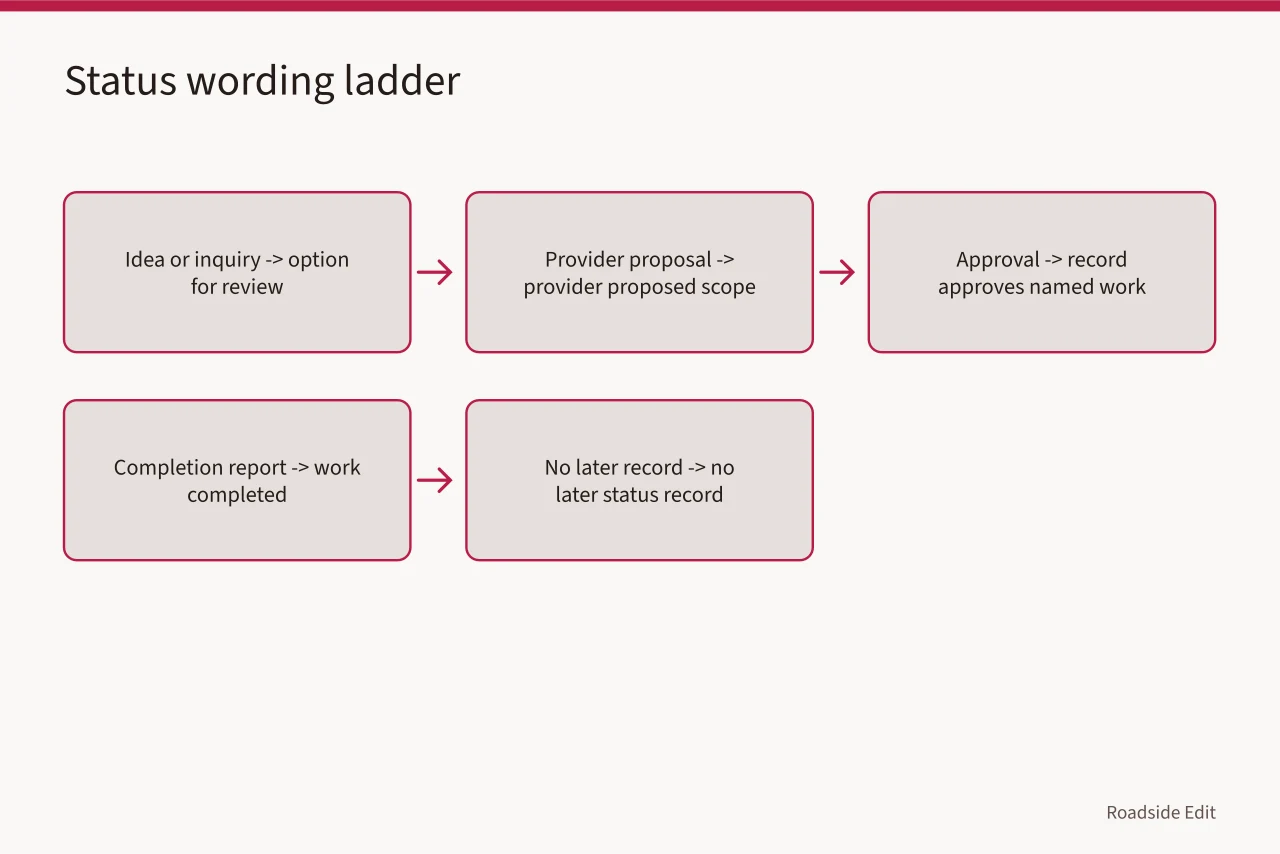
The National Archives agency recordkeeping requirements state that related records should be kept together when their relationship provides context. That policy governs federal agencies. For an editorial options file, the same practice keeps a proposed treatment from being confused with a later completion record.
| Status | Article wording |
|---|---|
| Idea or inquiry | "The file identifies an option for review." |
| Provider proposal | "The provider proposed the stated scope." |
| Approval | "The responsible record approves the named work." |
| Completion report | "The report states that the listed work was completed." |
| No later record | "The cited materials do not provide a later status record." |
Keep provider choices and paid listings transparent
Providers may want to describe their work or buy a placement beside an options article. Their information can be useful if it remains attributed and does not replace source-backed treatment facts. A provider can describe an offer, date it, and identify the scope. The article should not conclude that the service is suitable for a specific property without supporting evidence.
Put disclosure near the business claim, not in a remote footer. It helps readers judge the statement without turning it into an editorial endorsement.
Use four labels consistently: source-backed record, owner-supplied update, provider submission, and sponsored listing. That separation leaves room for business participation while protecting the historical and project record.
Compare budget notes after the scope matches
Options cannot be compared by total alone. A preservation option may involve recurring care. A rehabilitation option may include a new use and different approvals. Restoration may require a research record. Reconstruction may involve new work for an absent feature. Before comparing figures, line up the same fields: area, goal, included work, access, exclusions, source date, and status.
If those fields do not match, report the options as different. Do not calculate a blended average. The useful editorial finding may be that the current record supports more than one possible path but does not yet support a price comparison.
Read an options matrix without forcing a winner
An options article does not need to announce a winner. Its job is to show why the options differ and what record would let the responsible party make a later choice. A matrix helps readers compare the same fields without converting uncertain information into a score.
| Question | Preservation | Rehabilitation | Restoration | Reconstruction |
|---|---|---|---|---|
| What is the starting point? | Existing feature | Existing place and use | Documented earlier period | Feature that no longer survives |
| What should the file show? | Current record and care scope | Use and alteration scope | Period evidence and work scope | Evidence for new work |
| What remains separate? | Project price and completion status | Incentive claim and approval status | Visual similarity and documentation | New materials and historic fabric |
If the source packet cannot answer a column, leave it open. That is a useful result. It tells the editor which question belongs in the next request and prevents a choice from being presented as settled before the record supports it.
Final comparison check
- Does every treatment label match the source's documented goal?
- Are current claims dated separately from historical records?
- Does each option identify its scope, status, and evidence limit?
- Are reconstruction and repair kept distinct when the source distinguishes them?
- Do provider statements remain attributed and disclosed?
- Are cost figures compared only when their scope and assumptions match?
The clearest options article gives readers a choice they can understand. It does not force one word or one price to stand in for an unfinished project record.
Common questions
Can any repaired roadside sign be called restored?
No. Use "repaired" unless the source supports restoration and identifies the relevant historic period or documentation.
Does rehabilitation mean a building stays unchanged?
No. It concerns a documented compatible use while retaining the features the project identifies. The actual scope must come from the project record.
Can a provider list an option in this guide?
Yes, as attributed provider or sponsored material with a clear disclosure. It should not replace independent evidence about a particular property.
In this guide
- Roadside building options checklist: how to compare evidence before you chooseRoadside building options checklist for 2027 helps U.S. editors compare documented approaches, source terms, project stages, disclosures, and evidence limits.
- Roadside building options comparison: questions to ask before you publish a claimRoadside building option questions for 2027 help U.S. readers compare project goals, evidence, use, and authority before publishing a treatment claim.
- How to keep roadside building options records clean and correctableRoadside building options records guide for 2027 helps U.S. editors preserve option sources, project status, treatment wording, disclosures, and corrections.