Guides
Part of Roadside building options comparison: preservation, rehabilitation, restoration and reconstruction
How to keep roadside building options records clean and correctable
Roadside building options records guide for 2027 helps U.S. editors preserve option sources, project status, treatment wording, disclosures, and corrections.
An options record preserves why an approach appeared in an article and what the source actually said. It should distinguish a treatment term from a repair description, an application from an approval, and a business offer from independent evidence. This is how an editor keeps a useful comparison from becoming a property-specific recommendation.
What to take away
- Give every option an evidence card, status, and stated limit.
- Retain the source's wording instead of inventing a treatment label.
- Save scope and status changes as new versions.
- Keep provider submissions and paid placements separate from editorial evidence.
- Correct old option language when the source no longer supports it.
Open an option card for every path
An option card identifies the feature, source, treatment or work wording, stage, evidence, decision owner, and unanswered question. It can record a source saying preservation, rehabilitation, repair, reuse, or another term. It cannot decide which path is right for a specific building.
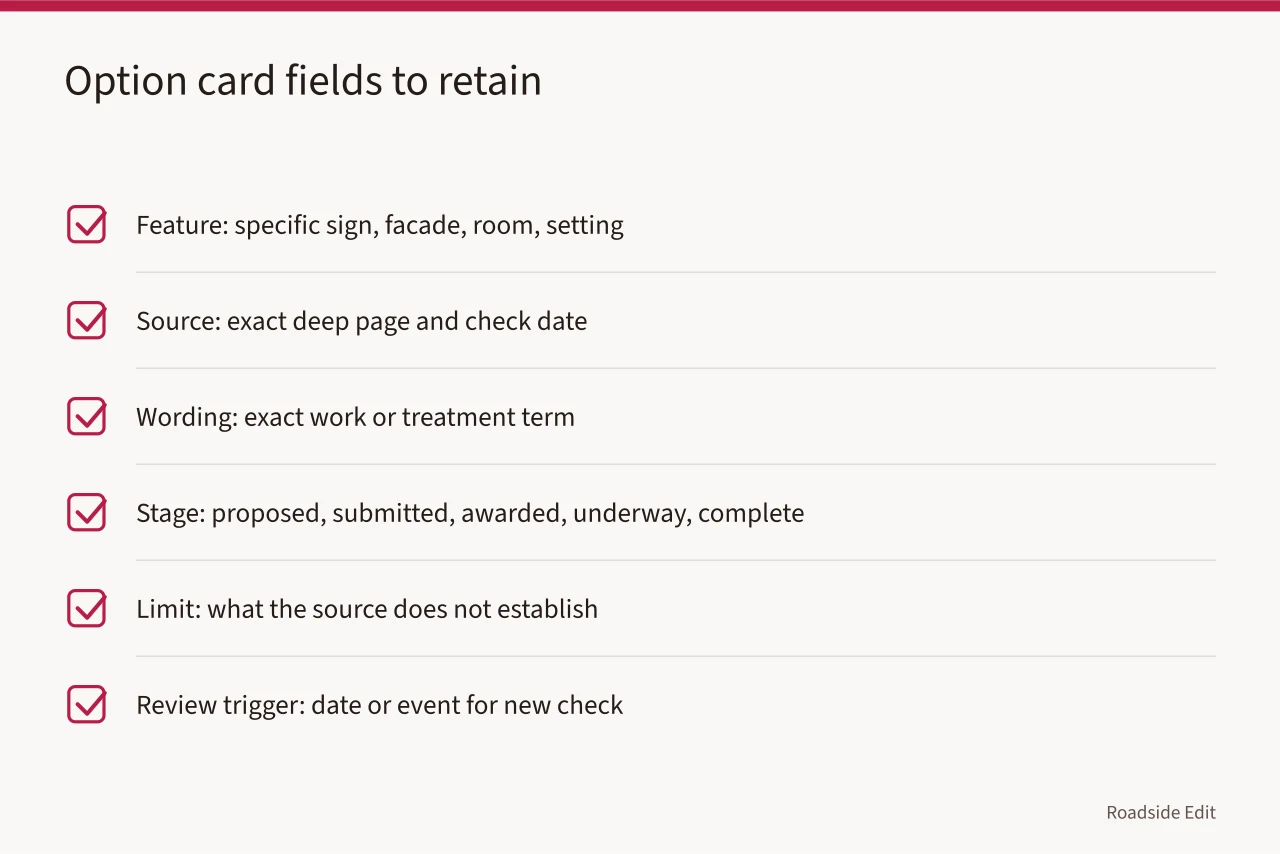
| Card field | What to retain |
|---|---|
| Feature | Specific sign, facade, room, or setting |
| Source | Exact deep page and check date |
| Wording | Exact work or treatment term used |
| Stage | Proposed, submitted, awarded, underway, or reported complete |
| Limit | What the source does not establish |
| Review trigger | Date or event requiring a new check |
The National Park Service's electronic certification submission guidance explains that Historic Preservation Certification Applications are submitted electronically. It supports a submission status only. It does not prove certification, eligibility, work completion, or a financial outcome for a particular property.
Keep treatment words tied to evidence
The National Park Service's Preservation Core overview distinguishes preservation, rehabilitation, restoration, and reconstruction in its treatment guidance. The framework is useful for checking terms. It does not classify an unreviewed roadside building. Record the term used by the source and do not decorate a basic repair with a more ambitious label.
If an article compares alternatives, each alternative needs its own card. A historical photo supports historical visual context. A project plan supports proposed scope. An award supports funding context. None of these alone proves a final result.
Version status changes instead of overwriting them
Project language can change from application to award, from plan to work, or from reported completion to a later correction. Create a new status record with the source and date. Retain the old record so the article's history can be reviewed.
The National Archives states that records tied to the same project, transaction, study, or subject should be retained together when the connection provides context. Read the National Archives recordkeeping requirements. The federal policy does not manage private editorial work. It supports maintaining option cards, source pages, status updates, and corrections as a single traceable record.
Separate commercial material
Providers may submit service descriptions or buy placements. Keep the original message, author, date, scope, payment or sponsorship status, and approved edits in a commercial file. An attributed provider statement can explain the provider's offer. It is not independent proof that a particular option is best or complete.
The Federal Trade Commission says advertising that resembles independent content should be recognizable as advertising. Read the FTC native-advertising guide. This does not rank options. It supports clear disclosure and a record boundary for paid or submitted material.
Correct a record when evidence changes
If a source changes its status, an image caption was too broad, or better documentation contradicts the article, create a correction entry. State the original wording, new wording, source, date, and reason. Then update the public page. Do not delete the earlier record and leave no explanation for the change.
At review, check that each option still has a specific source, the exact source term, correct stage, and a visible limit. Remove claims that cannot meet those checks.
Keep the review date beside every active option card. It tells a future editor when to recheck a source, status, or disclosure before using the record again.
Common questions
Does an application record prove an option was approved?
No. It proves submission only. Use a later record for approval, work, or completion.
Can a provider listing supply option evidence?
It can support an attributed description of that provider's service. It is not independent evidence that an option suits a property.
Why keep old status entries?
They show how the record changed, which source caused the change, and why the current wording is limited to the evidence available.