Guides
Part of Roadside building options comparison: preservation, rehabilitation, restoration and reconstruction
Roadside building options checklist: how to compare evidence before you choose
Roadside building options checklist for 2027 helps U.S. editors compare documented approaches, source terms, project stages, disclosures, and evidence limits.
An options article should compare documented approaches, not give a building a treatment label based on a photograph or a business pitch. A roadside sign, facade, motel unit, or former station can have several possible paths, but each path needs its own source, scope, and status. This checklist keeps that comparison factual.
It does not choose an approach for a property, determine eligibility, approve work, or assess building condition.
What to take away
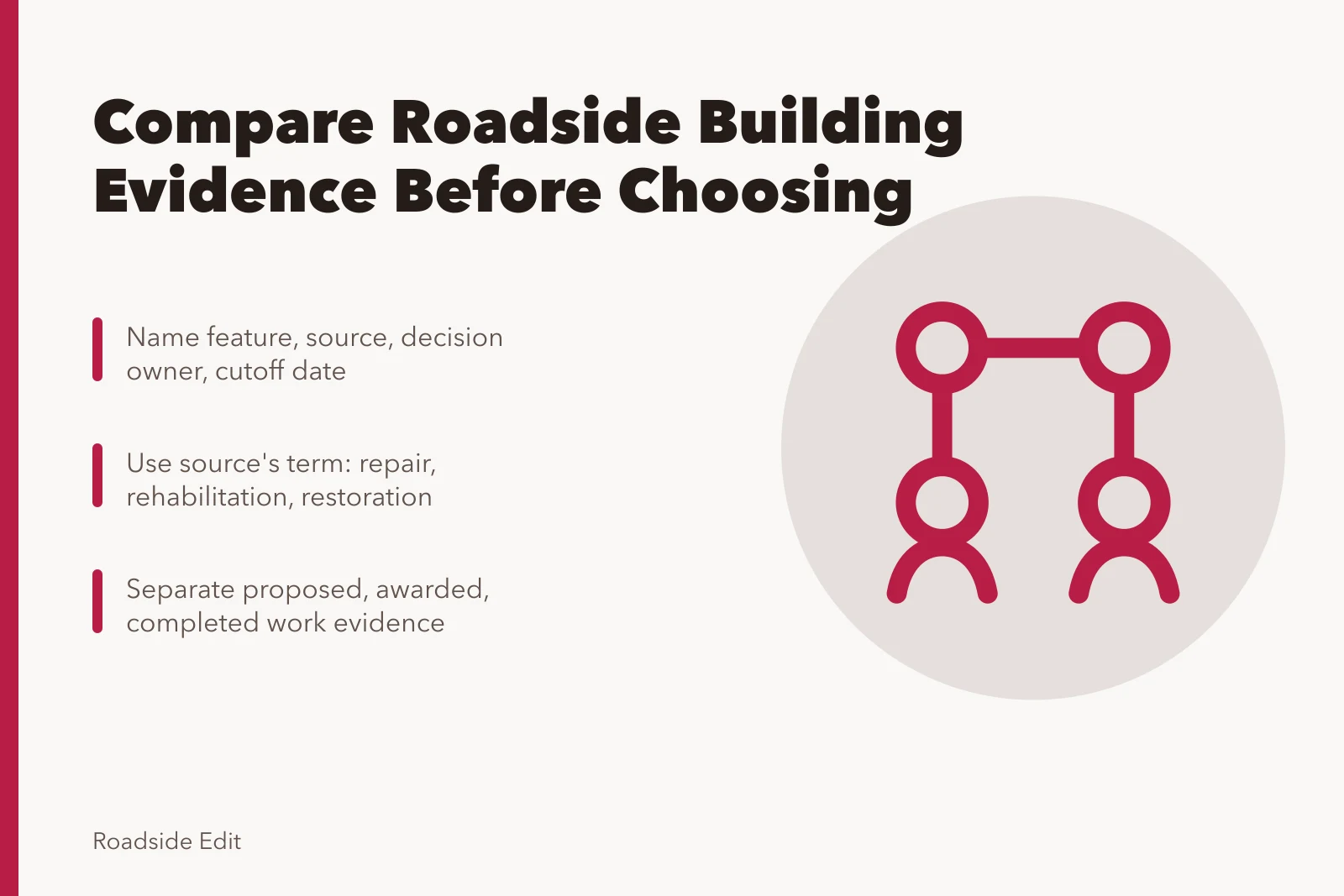
- Name the feature and the precise decision being compared.
- Use a source's actual treatment term instead of adding one yourself.
- Keep proposed, awarded, and completed work distinct.
- Record what evidence supports each option and what remains unknown.
- Label provider and paid-listing material as commercial information.
Define the comparison before listing options
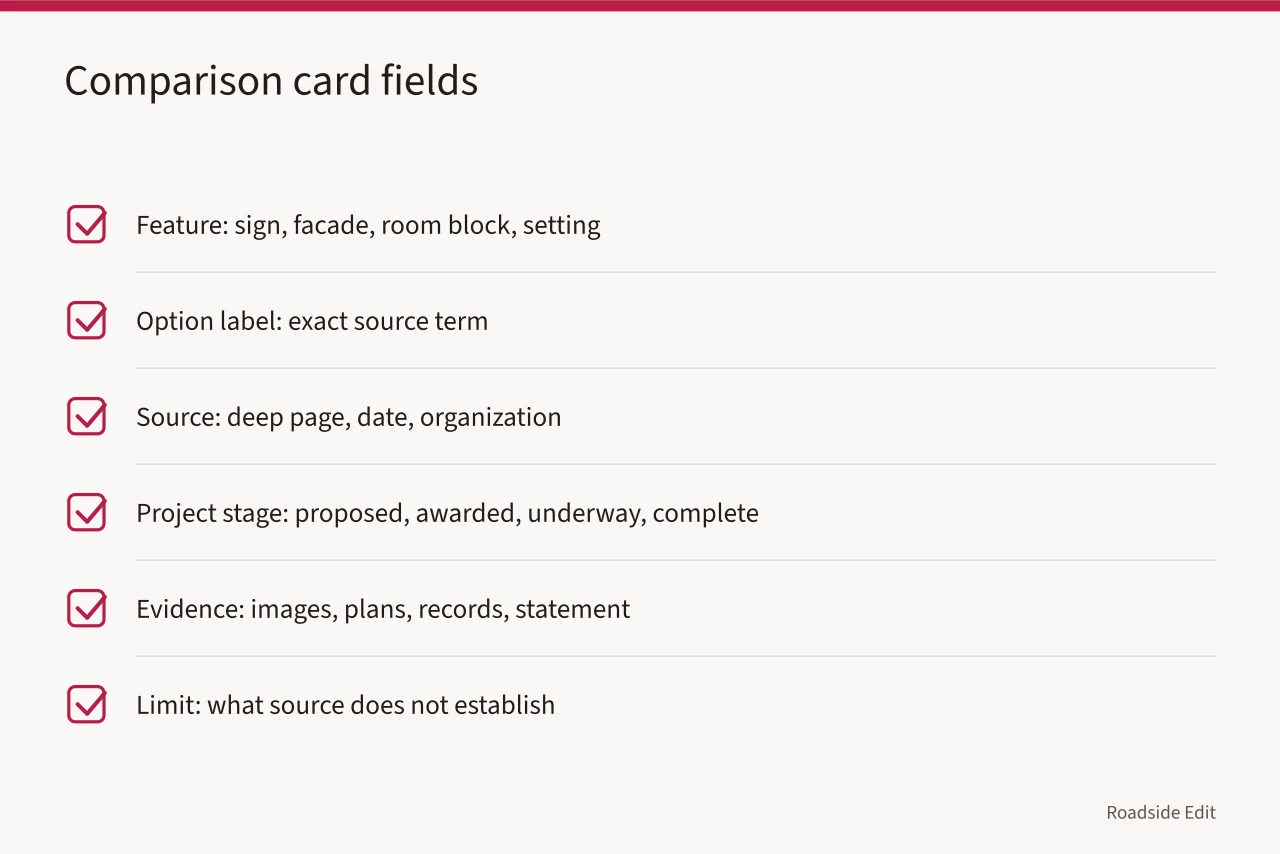
Start with one feature and a question: a sign face, storefront, roofline, interior use, or roadside setting. Do not compare a whole building's history with a single project proposal. The comparison card should name the feature, current evidence, available source, decision owner, and cutoff date.
The National Park Service's Preservation Core overview distinguishes preservation, rehabilitation, restoration, and reconstruction in its treatment guidance. That framework is useful for checking terminology. It does not classify a particular roadside building without project-specific evidence.
Use the source's words, not attractive substitutes
If a source says repair, write repair. If it says rehabilitation, attribute that term to the source. Do not convert every improvement into restoration or call an old feature original unless the evidence establishes it. Treatment language carries meaning and may depend on history, materials, intended use, and the project record.
The National Park Service's Secretary of the Interior's Standards guidance presents standards for preservation, rehabilitation, restoration, and reconstruction of historic properties. The guidance does not select a treatment for an unnamed or unreviewed roadside site. It supports matching a published term to a documented plan rather than choosing the term from a photo.
Compare evidence, not imagined outcomes
Every option needs a separate evidence line. A grant announcement may show planned funding. An owner update may describe an intended new use. A historic image may show a previous appearance. None of these alone proves that an outcome happened or is suitable.
| Record type | Can support | Cannot support |
|---|---|---|
| Historic photo | Recorded appearance at stated time | Current condition |
| Project plan | Proposed scope | Completed result |
| Award notice | Funding context | Final cost or work quality |
| Owner submission | Attributed current statement | Independent confirmation |
Check financial and program claims separately
An option may be associated with grant, tax, or other program language. Do not say a property qualifies unless the appropriate program source and property facts support that result. Record program context as context, then route an eligibility question to the responsible authority.
The National Park Service explains that the Federal Historic Preservation Tax Incentives program encourages private investment in historic buildings through federal tax incentives. It does not establish that a particular roadside property qualifies or that a proposed option will receive a credit. Use the page to explain the program at a high level, not to promise an outcome.
Separate listings from option evidence
Providers may offer repair, preservation, design, or documentation services. Record their stated service, date, and service area as submitted information. Do not present a provider profile as proof that a particular option is best for a named property. A paid placement should remain visibly disclosed.
The Federal Trade Commission says advertising that resembles independent content should be recognizable as advertising. Read the FTC native-advertising guide. This guidance does not evaluate preservation choices. It supports clear labeling and separate commercial records for provider claims.
Final options check
Before publishing, make sure each option has a named source, documented stage, stated scope, and limit. Remove any conclusion that depends on an unverified condition, unknown authority decision, or payment relationship. The article should help readers compare what records say, not make the decision for them.
Common questions
Can a photo establish which treatment a building needs?
No. It may provide visual context. A treatment choice requires appropriate project-specific evidence and responsible review.
Is a grant award proof that an option was completed?
No. It supports funding context and stated scope. Use a later source to describe work as underway or complete.
Can a provider listing recommend an option?
It may state the provider's own services when attributed and disclosed. It is not independent evidence that the option is suitable for a particular property.