Guides
Part of How to compare roadside architecture treatment options before you choose
How to write roadside architecture preservation notes without overclaiming a feature's history
Roadside architecture preservation notes for 2027 explain how to record visible material, maintenance, evidence, and limits without overclaiming a feature's history.
Good preservation notes make a roadside place easier to understand later. They say what was visible, what a record documents, and where the evidence stops. They do not turn weathering into a date, a street photograph into a structural assessment, or routine maintenance into proof that a feature is original.
What to take away
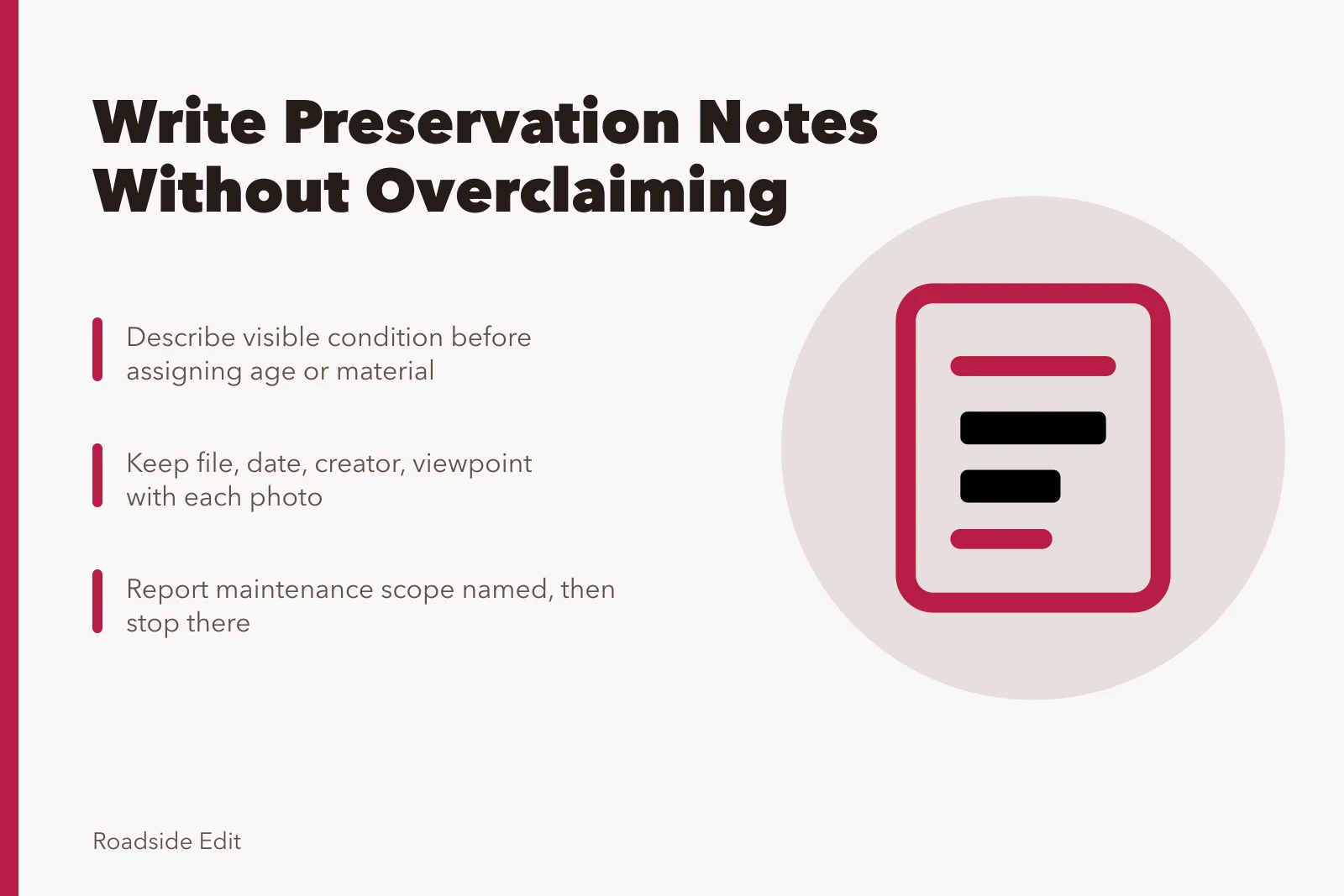
- Describe what you can see before assigning age, material, or historical status.
- Include the date, source, viewpoint, and access limit with each observation.
- Separate documented work from conclusions about original fabric.
- Use preservation vocabulary only when the relevant source supports it.
Write what the source actually shows
Begin with an observation, not an interpretation. "Paint loss is visible on the west-facing sign panel" reports a condition. "The original paint is failing" adds a claim about age and material that the photograph may not establish.
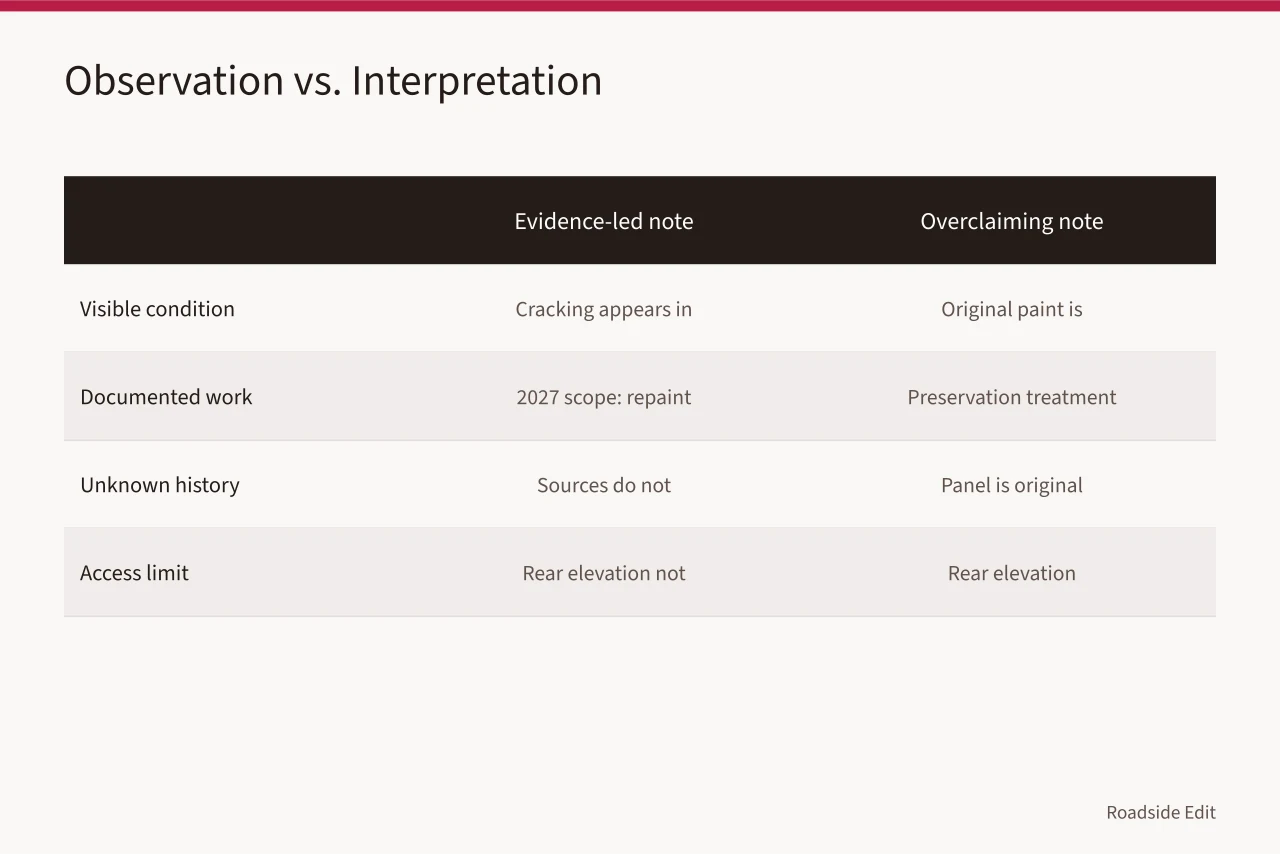
| Note type | Evidence-led wording |
|---|---|
| Visible condition | "Cracking appears in the painted panel in this dated photograph." |
| Documented work | "The 2027 scope describes repainting the panel." |
| Unknown history | "The reviewed sources do not establish the panel's installation date." |
| Access limit | "The rear elevation was not viewed from the public right-of-way." |
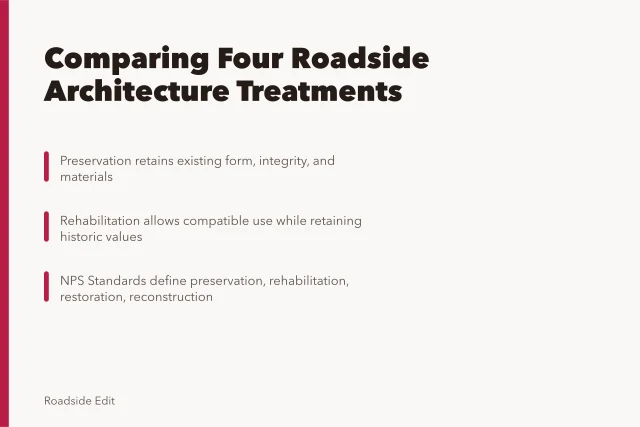
The National Park Service explains that preservation is one of four treatment approaches in the Secretary of the Interior's Standards. Read the NPS overview of the Secretary's Standards. That vocabulary helps writers describe a project record. It does not decide whether a particular roadside feature is historic, original, or officially treated.
Keep the evidence trail intact
Every note should identify its source. For a photograph, keep the original file, date, creator when known, and viewpoint. For a project document, retain the title, date, page, and stable source link. If another editor cannot find the source, the note is difficult to check and should not carry a major claim.
The NPS architectural and engineering documentation standards call for accurate material from reliable sources, with limitations stated so that the information can be independently checked. Review the NPS documentation standards. A short site note can follow that principle by identifying both the evidence and the boundary of the observation.
When information changes, make a new dated note rather than editing away the earlier one. The change may come from a later photograph, a new scope of work, a verified record, or a correction. Keeping the trail lets a writer explain which source supports the current wording.
Keep maintenance claims narrow
Maintenance may include cleaning, sealing, repainting, or a documented repair. The action alone does not prove an original finish, a building date, or a solved structural problem. Report the scope that a source names, then stop there unless another source supports a broader conclusion.
NPS treatment guidance describes preservation as a distinct approach from rehabilitation, restoration, and reconstruction. See the NPS treatment-approach overview. In practical writing, this means the term "preservation" should not be attached automatically to every repair. If the record calls the work repainting, say repainting.
Use a second source for any claim about a feature's history. A 1950s image can show that a sign was present then. It may not identify its manufacturer, material, or later alterations. A permit, catalog entry, survey form, or qualified report may answer a different question, but each should be cited for the fact it establishes.
Add a review note before publication
Read each observation against the source once more. Ask whether the sentence describes a visible condition, a document's scope, or an inference. If it is an inference, either identify it as one or reduce the sentence. This review prevents the article from turning an ordinary maintenance detail into an unverified history claim.
The NPS guidance for preservation treatment emphasizes retaining historic character and maintaining existing materials where appropriate. Read NPS guidance on preservation as a treatment. It is general guidance, not a finding about a named local project. Keep that distinction in every public note.
Common questions
Does weathering prove a feature is historic?
No. It records a condition at the time of the image or observation. Use a dated record before claiming when the feature was made or installed.
Should a note call work preservation?
Use the term when an applicable record or qualified source uses it. Otherwise, describe the specific documented action, such as cleaning, repair, or repainting.
Can a preservation note include an opinion?
Keep public notes factual. If an opinion matters, identify who expressed it and separate it from the source-supported description.