Guides
Part of How to plan a historic motel restoration across regions in 2027
How to spot warning signs in historic motel restoration claims for 2027
Historic motel regional warning signs for 2027 help writers catch broad climate claims, missing local evidence, unsupported treatment language, and scope drift.
A regional warning sign is an editorial cue that a sentence needs stronger evidence. It does not prove a local hazard or prescribe an adaptation.
What to take away
- Flag regional claims that lack a defined geography or date.
- Do not turn a planning framework into a property conclusion.
- Keep treatment concepts separate from project decisions.
- Use a correction note when newer evidence changes the context.
Watch for scope drift
NPS describes hazard planning for historic places as a process that can organize resources, assess risk, develop a plan, and implement it. Read NPS guidance on protecting historic places. That description does not confirm any risk at a motel.
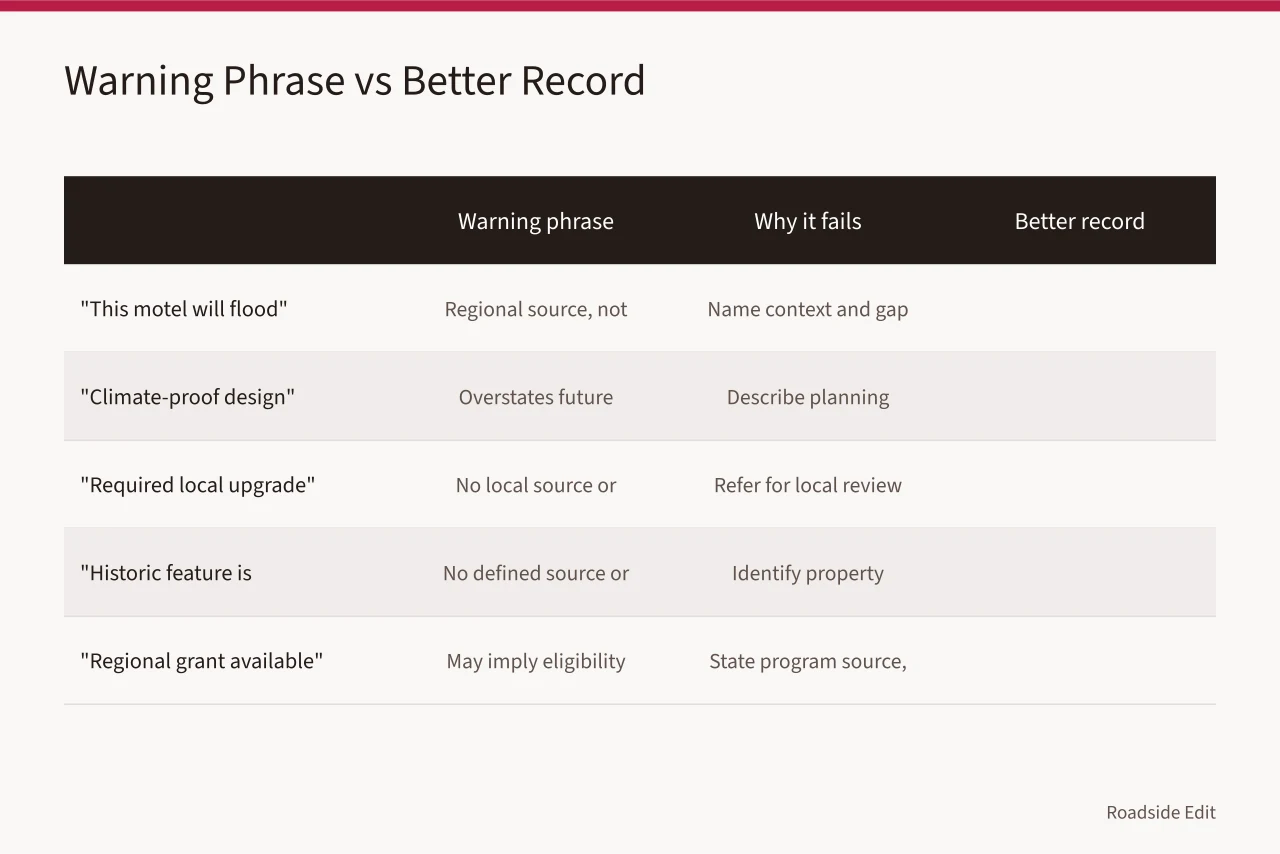
| Warning phrase | Why it fails | Better record |
|---|---|---|
| "This motel will flood" | Regional source is not property evidence | Name the regional context and evidence gap |
| "Climate-proof design" | Overstates a future result | Describe the planning question only |
| "Required local upgrade" | No current local source or applicability review | Refer the question for local review |
| "Historic feature is protected" | No defined source or status | Identify the property record and limit |
| "Regional grant available" | May imply eligibility | State the program source and verify current terms |
Match the claim to the geographic record
The NPS climate-context overview notes that effects on cultural resources are place-sensitive and that important threshold information may be incomplete. Read the NPS climate-context overview. A regional source can explain why a writer has a question. It cannot establish a condition, project need, or future outcome at a motel without property-specific evidence.
FEMA's mitigation-planning material describes integrating hazard mitigation into local planning and cultural-resource considerations. Review FEMA's mitigation-planning guide. It does not identify an applicable project, local requirement, or grant outcome. A warning guide should state that boundary before an article uses the source.
| Source supports | Article should not add |
|---|---|
| Regional context | A local hazard conclusion |
| Planning framework | A specific treatment or project decision |
| Program description | Eligibility or funding assurance |
| Historic image | Current condition or future performance claim |
Correct the claim, not just the citation
NPS documentation standards call for reliable sources and stated limitations that allow another person to verify a record. Read the NPS documentation standard. When a sentence overreaches, rewrite it so the geography, date, source role, and property connection match the evidence. Do not keep a strong claim and add a decorative link after it.
Keep local questions in the local review path
When a regional source raises a property question, record the question and the kind of current local or qualified evidence needed. Do not predict an answer. This keeps broad context useful without turning it into a claim that can affect an owner, community, or potential partner.
Use a correction note when a source is updated or a local record changes the context. Write the prior statement, new source, date, geographic boundary, and result.
A new report may narrow the relevant area, but it does not establish a property condition on its own. Preserve both records when they describe different scales or time periods. This helps review and keeps a revised regional summary from being read as proof of a local decision.
Keep the dated note with the source file for future review.
Maintain it.
Check before reuse
Ask whether the source geography matches the sentence, whether the date remains current, and whether a property record supports the connection. If not, reduce the sentence to what is actually known.
Do not remove a correction silently. Keep a dated note stating what changed and why. That helps a reader distinguish new evidence from a revised editorial claim.
Pause before making a promise
Statements about future protection, savings, grant outcomes, or code status need property-specific evidence. If that evidence is not available, keep the statement as an open planning question rather than a public promise.
This is especially important when regional material is being reused in an article aimed at local readers.
State the limitation beside the claim, not in a distant disclaimer.
Common questions
Does a warning sign identify a local risk?
No. It identifies a claim that needs a more careful source and, when appropriate, qualified local review.
Can an article state that a treatment is required?
Not without an authoritative, current, property-applicable source. Most editorial copy should describe the decision question instead.
Why is source geography important?
A regional statement may not apply to a city, neighborhood, or individual site. Geographic scope keeps the article accurate.