Guides
Part of Modern roadside design regional adaptation: a 2027 factor comparison for owners by U.S. region
How modern roadside warning signs document regional stress before planning review
Modern roadside regional warning signs for 2027 help owners document stress, separate observation from cause, and return changed conditions to planning review.
Regional planning is useful only when it returns to the real condition of a feature and its route. Warning signs are observations that may justify another review. They are not proof of climate cause, a safety finding, or an authorization to alter a site.
What to take away
- Record a visible condition before assigning a cause.
- Use repeated observations to revisit an existing plan.
- Keep weather context, feature condition, and ownership questions separate.
- Escalate changes that exceed approved care or affect a public route.
Conditions worth recording
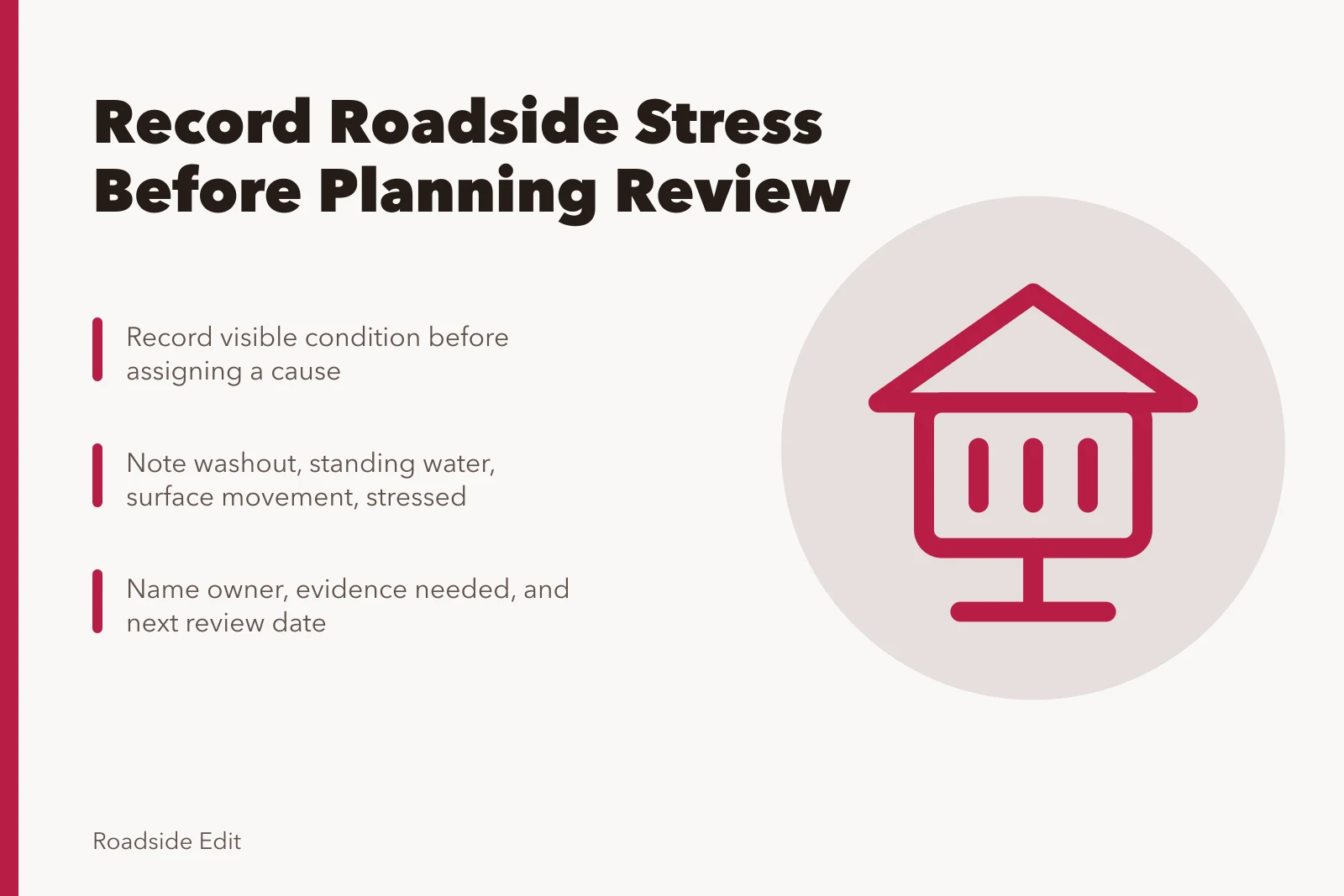
Recurring washout, unusual standing water, repeated surface movement, stressed vegetation, and a changed access route. New debris patterns, damage after a weather event, and repeated feature closures.
NPS climate-change strategy: condition assessment spots environmental stress cues and returns to planning when unexpected changes appear. Its cultural resources climate-change strategy covers cultural resources and does not identify roadside condition's cause.
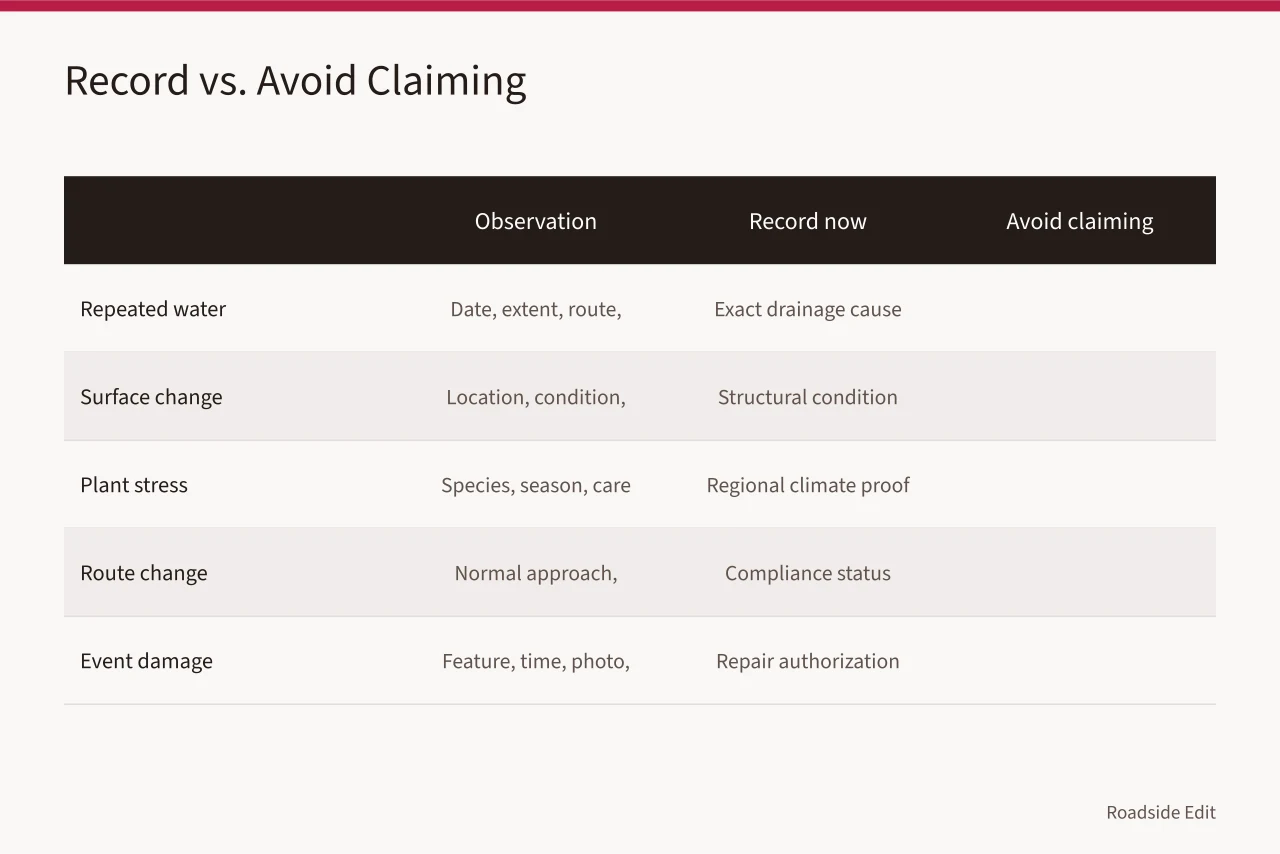
| Observation | Record now | Avoid claiming |
|---|---|---|
| Repeated water | Date, extent, route, weather context | Exact drainage cause |
| Surface change | Location, visible condition, prior record | Structural condition |
| Plant stress | Species if known, season, care history | Regional climate proof |
| Route change | Normal approach and current obstruction | Compliance status |
| Event damage | Feature, time, photo reference, report recipient | Repair authorization |
Return the issue to planning
Ask whether the condition is new, repeated, growing, or tied to an existing maintenance limit. Then name the owner, evidence needed, and next review date. A small observation can remain a maintenance note. A repeated or consequential condition may need a local authority, a new scope, or a qualified review.
NPS climate-adaptation planning says monitoring information can inform scenario consideration during planning. Read NPS climate-adaptation planning guidance. It does not turn a visual observation into a forecast. It supports the decision to revisit a plan when a new or repeated condition changes the questions the team needs to answer.
| Warning sign in the record | Appropriate next question |
|---|---|
| Same condition appears after several reviews | Is routine care still the correct scope? |
| Access route changes | Who owns and approves the affected area? |
| Regional source is cited without site evidence | What local record makes it relevant here? |
| Work is proposed without a current condition record | What observation or review must happen first? |
Preserve the record
Do not erase evidence with an unapproved fast fix. Keep original photos and add a later work record if someone acts. This allows the next review to distinguish between an observed condition and the result of a response.
Schedule a check after the responsible role responds. The follow-up should say whether the record remains open, changed to a separate review, or has a documented closeout. This is more useful than a vague note that the issue was "handled."
NPS documentation standards call for reliable source material and stated limitations so future readers can check the record. Read the NPS documentation standards. A routine regional review does not require formal heritage documentation. It should still state what was visible, what evidence was used, and what remains unconfirmed.
Watch for action without authority
Do not treat a regional source as permission to change a feature, route, drainage pattern, planting plan, or public-facing element. A document can raise a planning question. Ownership, local requirements, and site-specific review determine whether an action may proceed. If those items are unclear, the correct next step is a record and a referral, not an improvised treatment.
The referral note should identify the feature, direct observation, date, source that prompted the question, recipient, and requested decision. Keep the report factual and concise. A clear record lets the responsible party decide whether no action, more observation, a small approved task, or a separate review is appropriate.
NPS resilience guidance recommends assessing actual risks, feasible responses, and applicable requirements before adaptation work. Read NPS resilience guidance. Its context is historic buildings. The narrow lesson applies here: an adaptation label does not remove the need for a documented local decision.
Common questions
Does a weather event prove the cause of damage?
No. It provides context for an observation. Determining cause may require a different source or reviewer.
When should a condition return to planning?
When it repeats, changes the feature's intended use, affects access, exceeds routine care, or creates an unresolved authority question.
What should an initial report include?
Date, exact location, direct observation, weather context if relevant, report recipient, and next review point.