Guides
Part of Modern roadside design regional adaptation: a 2027 factor comparison for owners by U.S. region
How owners can keep modern roadside design records for 2027
Modern roadside regional records guide for 2027 helps owners track exposure, sensitivity, response capacity, condition notes, and unresolved local decisions.
Regional adaptation records should make a later decision easier to understand. They should not create a false prediction file. The goal is a dated history of the feature, the conditions observed, the regional context considered, and the people who own the next answer.
What to take away
- Store local observations and regional sources in separate fields.
- Record exposure, sensitivity, and response capacity without collapsing them into one score.
- Keep prior plan versions and unresolved questions available at handoff.
- Protect private contacts and access information from public copies.
Create the regional record
Start with a feature inventory, route description, condition history, maintenance log, source list, authority contacts, and open issue register. The National Park Service notes that vulnerability work can consider exposure, sensitivity, and adaptive capacity when developing recommendations. Its climate impacts in park cultural landscapes page concerns NPS landscapes and does not provide a vulnerability finding for a private roadside feature.
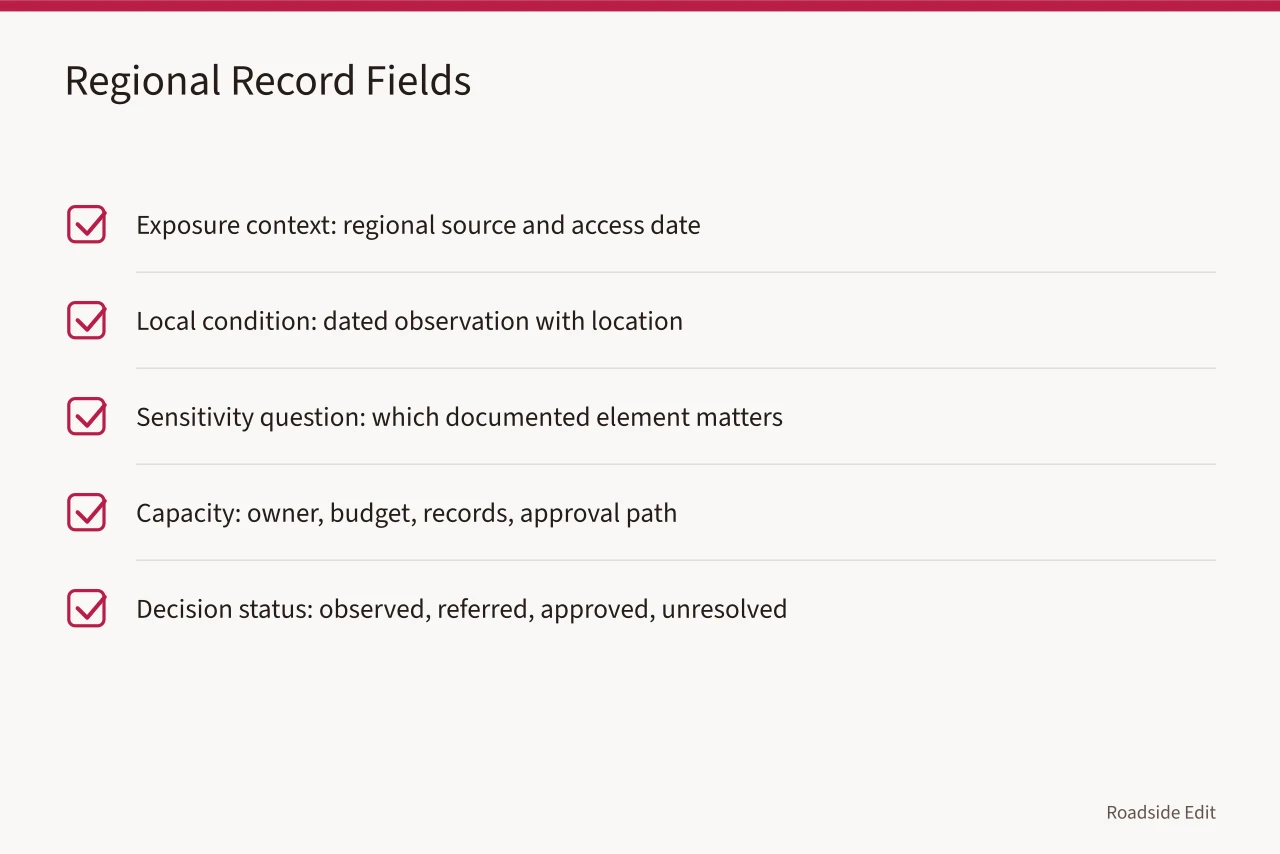
Use a change log
Each update should state what changed, why, who recorded it, and which earlier record it relates to. Do not overwrite a prior condition note. A later photo, repair, or decision belongs beside the original record, not in place of it.
NPS documentation standards call for reliable sources and stated limitations that allow later readers to check a record. Read the NPS documentation standards. A regional planning file is not formal heritage documentation. It should still show whether an entry is a local observation, regional context, provider statement, or unresolved question.
| Source type | Store with it | Do not treat it as |
|---|---|---|
| Regional reference | Publisher, date, area, and purpose | A property condition record |
| Local note | Date, location, observer, and limits | A cause determination |
| Decision record | Authority, scope, and effective date | Proof of completion |
| Work record | What occurred and supporting file | A future performance promise |
Make handoff possible
At a staff or vendor change, provide the index, latest local observations, source links, open authority questions, current care scope, and next review date. The receiving person should be able to tell what is known and what has not been confirmed.
Use a simple status vocabulary: observed, referred, approved, completed, or unresolved. Do not use "complete" for an item that only has a sent email or a pending answer. Consistent status words make an annual review more credible and help a new owner find the real next decision.
NPS climate-adaptation planning describes monitoring information as an input to planning under uncertainty. Read NPS climate-adaptation planning guidance. The source does not tell a roadside owner which response to select. It supports retaining both the original question and later observation so the planning basis remains visible when a regional source or local condition changes.
Keep working files separate from public copy
Working records may include private contacts, access details, proposals, and information that is not appropriate for a public article. The public version should explain the method at a general level and cite only sources that genuinely support a statement. Do not publish a regional risk label as proof that an individual business, property, or route will have a particular outcome.
At the annual review, check whether each regional source still reflects the area and question in the file. Confirm whether local observations changed, whether a referral received an answer, and whether an open item should move to a different owner.
When you add a replacement, retain the former source and plan version. That history lets a future editor explain why the local question changed without presenting the earlier context as an error.
Record the review date prominently.
NPS resilience guidance recommends documenting the property, actual risks, options, and relevant requirements before adaptation work. Read NPS resilience guidance. It is focused on historic buildings. The records lesson still applies: keep the local evidence and decision path available before making a public conclusion.
Common questions
What is the most important regional record?
A dated local condition history linked to the actual feature and route, not a general regional description alone.
Should public content include all source files?
No. Keep private contacts, security details, and sensitive records out of public copies.
Why retain older plan versions?
They show how evidence, ownership, or conditions changed over time.