Guides
Part of How to build a roadside architecture research plan before you start fieldwork
Roadside architecture context questions to ask before you publish
Roadside architecture context questions for 2027 show how to connect a roadside building to its route, town, photographs, and documentary evidence.
Roadside architecture context questions stop a building from being treated as an isolated object. They ask how a visible place relates to a road, a travel pattern, a town edge, a commercial strip, or a nearby attraction.
Context should sharpen the article, not become a reason to make broad claims about every traveler or business on the route.
What to take away
- Start with the exact place and route, then widen the view only when a source supports it.
- Treat current location, historic route, and business history as separate questions.
- Use a dated photograph or map to document an earlier condition, not to fill gaps by guesswork.
- Write down what the article cannot establish from the available record.
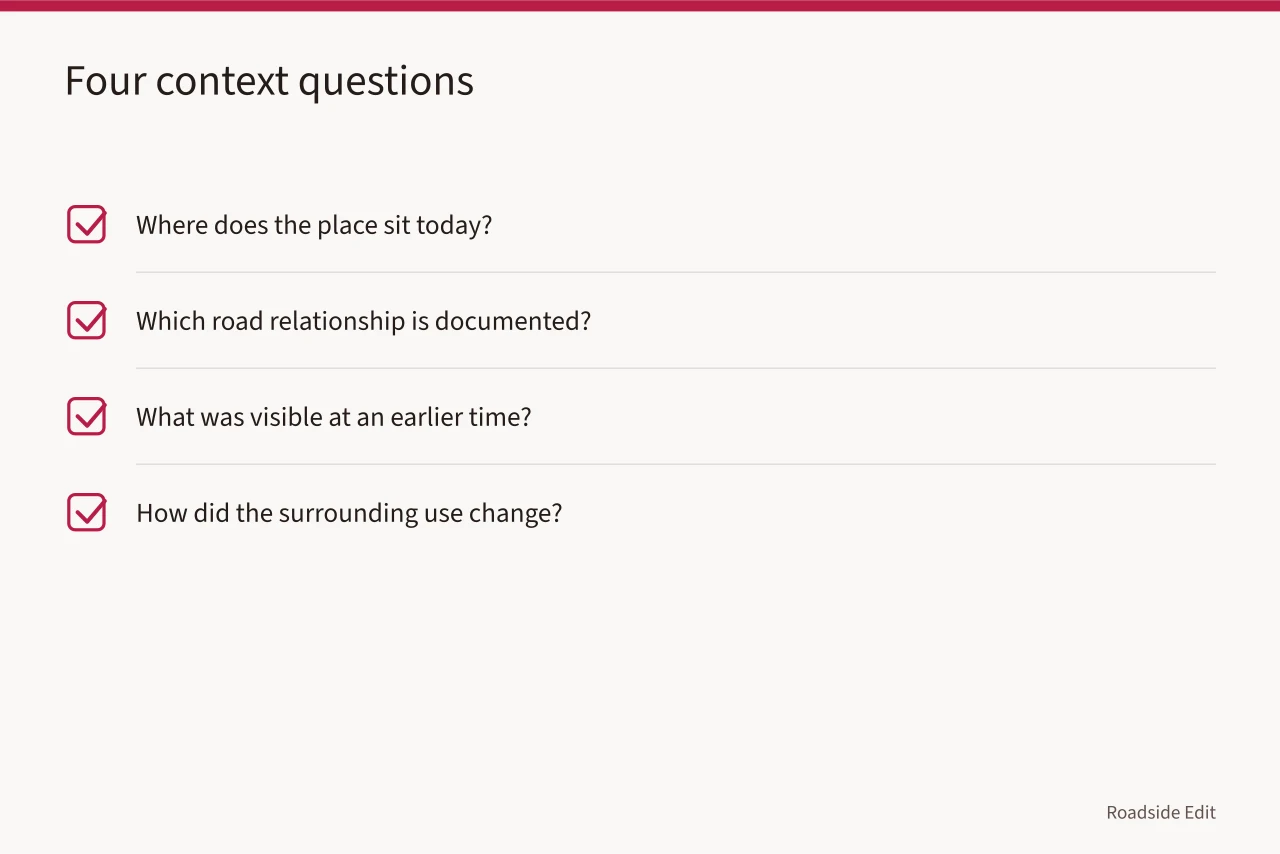
Ask four context questions
| Question | Evidence that may help |
|---|---|
| Where does the place sit today? | Current map, street view from a lawful source, field note |
| Which road relationship is documented? | Dated map, highway record, public survey |
| What was visible at an earlier time? | Item-level historic photograph or postcard |
| How did the surrounding use change? | Public records, local reporting, or a dated planning document |
These questions keep a writer from treating a famous road name as a complete explanation. A property may sit near an older route without facing it, or it may have been associated with a route during only part of its history. Give the relationship a date when the source allows it.
The Library of Congress describes its John Margolies Roadside America Photograph Archive as a documentary study of vernacular commercial structures along U.S. streets and highways from 1969 to 2008. Explore the Library of Congress Roadside America guide.
That collection can help locate context images and vocabulary. It does not prove the history of a place not shown in a specific, identified item.
The National Park Service discusses circulation systems such as roads, parkways, and trails in its guidance for cultural resources. Read the NPS discussion of circulation systems. It does not classify a particular roadside place. It supports treating a route and building as related evidence only when the record establishes their connection.
Compare without forcing a match
Put a current field image beside a dated source only when you can identify the same place. Compare fixed clues such as a roofline, lot corner, street pattern, or adjacent building. Explain which details are visible in both. If the match is uncertain, say so and leave it out of the article.
| Comparison note | Why it is safer |
|---|---|
| "The image is dated 1976 and labels the address" | It states the source information |
| "The matching location is not confirmed" | It preserves a research limit |
| "The current route name differs from the historic caption" | It separates time periods |
| "The photograph shows only the front elevation" | It avoids claims about unseen areas |
Turn context into reader-friendly prose
Lead with the present place, then add the documented past. Avoid turning a route designation into a style label or a claim of importance. Context belongs in the article when it helps readers understand why a sign faces a certain direction, why parking is set up a certain way, or why the building's setting changed.
Keep research and field notes distinct
Record a current observation with its date and viewpoint, and record a historical map or photograph with its source date and item reference. Do not merge them into one statement of unchanged property.
The National Archives describes records management as a lifecycle: creation, maintenance, use, disposition. Review the National Archives basic records-management concepts, and retain each source as a dated entry to keep a later comparison honest.
If a source includes people, vehicle information, or other private details, use only what the public context claim needs. The NIST Privacy Framework is a voluntary privacy-risk resource. It supports considering whether material is necessary and handled through established practices. It does not provide access permission or justify publication of private records.
Common questions
Does a road name prove a building was part of its history?
No. Use a dated source that links the property to the road, then state the relationship as narrowly as the evidence allows.
Can a historic photo establish the current condition?
No. It documents the condition shown on its date. Use current observation or current records for present-tense statements.
What if the surrounding context has changed completely?
Describe the current setting and then explain the earlier setting only where a dated source supports the comparison.