Guides
Part of How to build a roadside architecture research plan before you start fieldwork
How to keep a roadside architecture source log before you publish
Roadside architecture source log guide for 2027 explains how to record source pages, dates, claim limits, access notes, and corrections before publication.
A roadside architecture source log turns research into a usable editorial record. It says what the source is, when you accessed it, what sentence it supports, and what it cannot establish. That beats a bookmark list, because an editor can later check why a source was included.
What to take away
- Log the specific item page, not a homepage or broad search result.
- Record the source date and access date separately.
- Write the exact claim the source supports in plain language.
- Keep source limits in the same row as the supported claim.
Use one row per source item
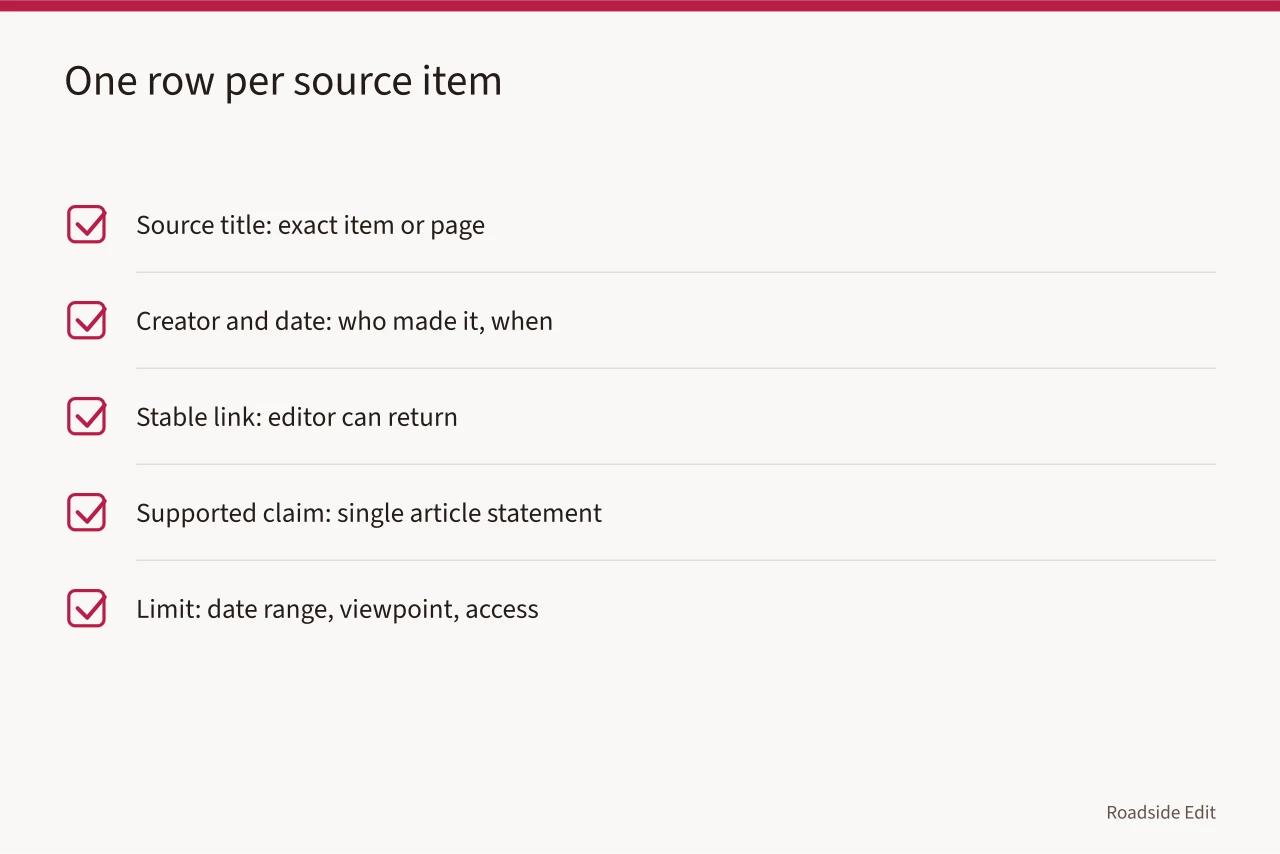
Do not give one broad collection page credit for a fact that appears in a specific photograph, catalog record, map, or report. If you use two items from a collection, make two rows. This creates a path back to the evidence when a caption, link, or sentence needs correction.
| Log field | Example purpose |
|---|
The National Archives points researchers to its Catalog for descriptions and digitized copies of image holdings, including historical photograph files from the Bureau of Public Roads. See the National Archives page on photographs and graphic works.
Use a catalog description as a lead, then cite the precise record you rely on. A general archive page does not confirm an individual photo's contents.
The Library of Congress explains that citations identify sources through core details such as author, title, version, sponsor, date, location, and access date where useful. Review the Library of Congress citation structure. A source log does not need a formal academic style, but it should capture enough detail to locate the exact item later.
Write limits honestly
Add a limit when a source covers only one time, one facade, one property name, or one perspective. A photograph may show a sign but not the rear of the building. A directory may list a business but not its building date. A public form may summarize a property's history but not establish its present use.
| Source type | Common limit |
|---|---|
| Historic image | Frame may omit the wider setting |
| Newspaper item | May repeat an unverified statement |
| Interview | Personal recollection has a stated viewpoint |
| Map | Shows what the edition records, not every use |
Review before publication
Read the source log beside the draft. If a sentence is broader than the entry, tighten the sentence. If a link does not open the item page, replace it. If no source supports a material claim, remove the claim or state the limit instead of writing around it.
The National Archives describes records management as a lifecycle including creation, maintenance, use, and disposition. Read the National Archives basic records-management concepts. Preserve a corrected source entry as a new dated record, rather than silently replacing the earlier research history.
If a source note includes personal information, private correspondence, or restricted access details, do not place it in the public article file. The NIST Privacy Framework is a voluntary privacy-risk resource. It supports considering whether information is necessary for the claim and handled through established practices. It does not allow publication of confidential material.
Source-log check before publishing
Read each material draft sentence against its log row. Check that the title or item number identifies the actual source, the link reaches the specific item page, and the source date matches the wording.
Make the limitation visible when the source shows only part of the place or covers only one period. If a correction arrives, add a dated row that explains what changed. A source log works when another editor can repeat this check without guessing which file or webpage the first writer used.
Common questions
Should a source log include private material?
It may name the record category and access limit, but it should not publish confidential files or personal information without authorization.
Can I use a search snippet as a source?
No. Open the specific source page and record the item that supports the article's claim.
What if a source changes after the article is published?
Update the article when needed and keep a dated correction note explaining the change.