Guides
Part of How to build a roadside architecture research plan before you start fieldwork
How to write a roadside architecture research brief before you draft
Roadside architecture research brief for 2027 gives editors a usable format for scope, sources, gaps, permissions, and publication limits before drafting begins.
A research brief is the decision sheet behind a roadside architecture article. It tells an editor what the story can prove, what it can only describe, and which questions should remain open. It is not a polished draft. Its value is in making limits visible before polished sentences hide them.
What to take away
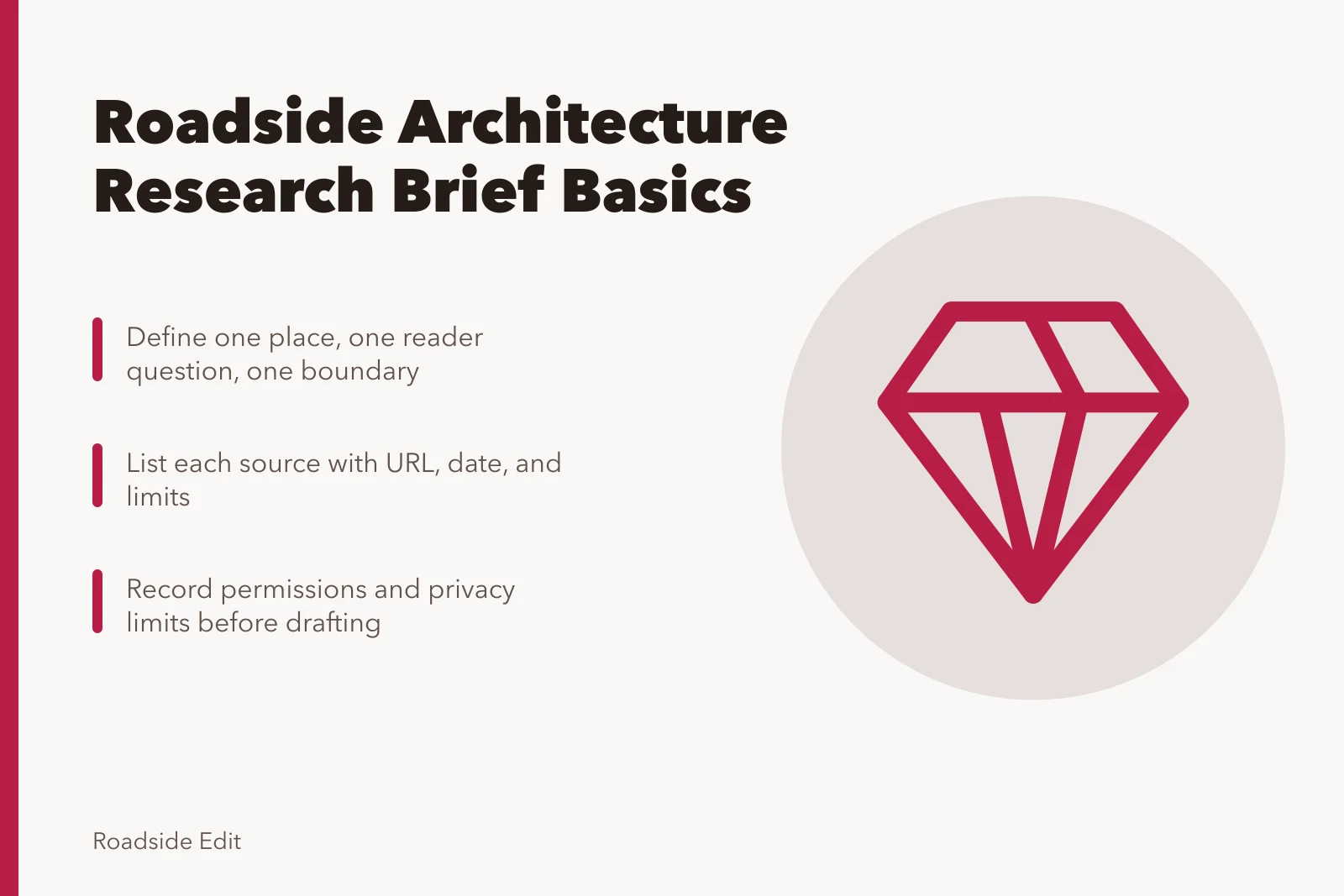
- Define one place, one reader question, and a narrow publication boundary.
- List individual records, images, maps, and interviews instead of writing "research completed."
- Separate observations, confirmed facts, and unresolved leads.
- Record permission and privacy limits before a photo or quotation reaches the draft.
Write the question before gathering every fact
Start with a question that the available evidence could reasonably answer. "What can a 1950s map and current photograph tell us about this roadside building's setting?" is workable. "The complete history of the building" is usually too broad for a single article.
The National Park Service's historical-documentation guidance describes a research design as a way to define scope and expectations from the information already available. Read the NPS guidance on historical documentation research design. A publication brief can use the same discipline without pretending to be formal preservation documentation.
Write a working angle in one sentence, then add an exclusion sentence. The first tells the writer what belongs. The second protects the article from claims about ownership, construction dates, or access that its sources do not establish.
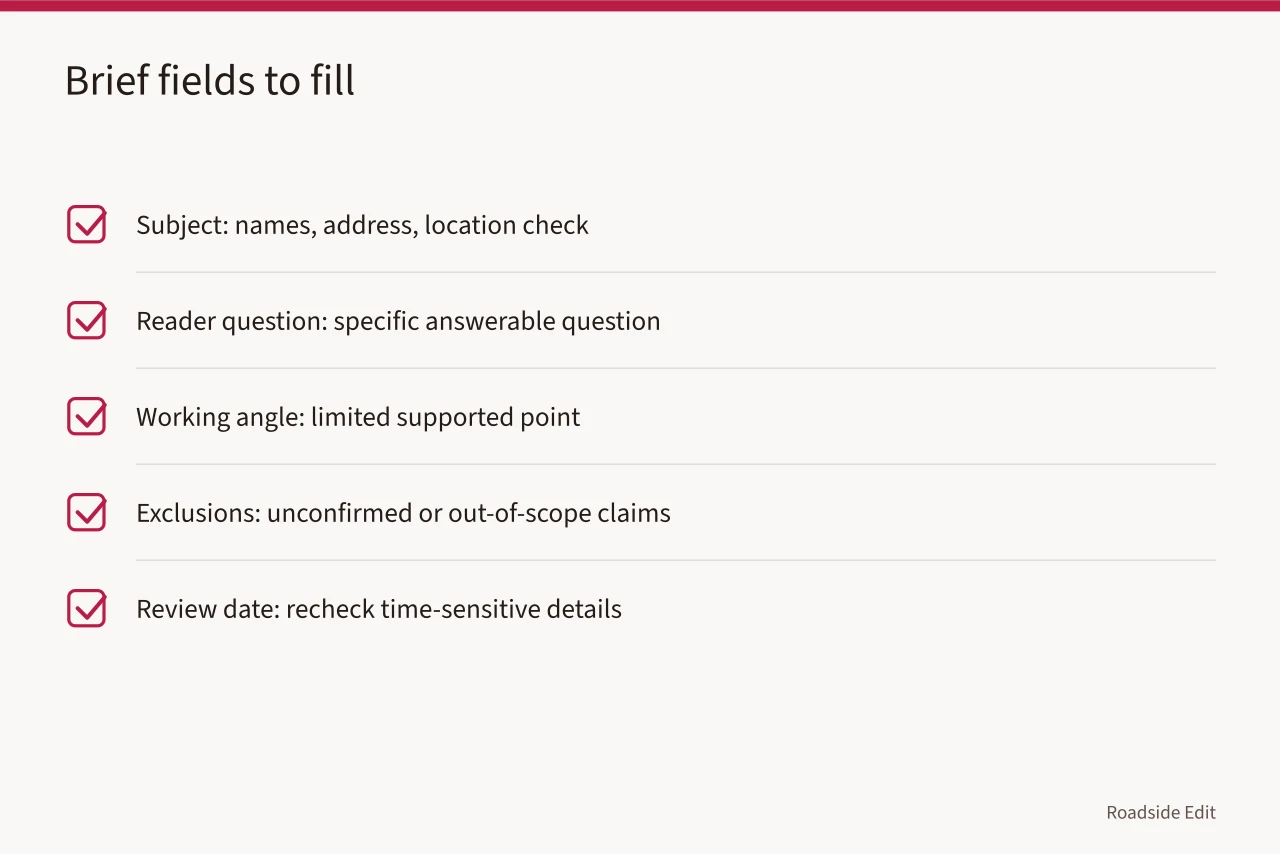
| Brief field | What to write |
|---|---|
| Subject | Current and historic names, address or coordinates, and location check |
| Reader question | The specific question the article answers |
| Working angle | The limited point supported by the available material |
| Exclusions | Claims that remain unconfirmed or outside the article's purpose |
| Review date | The date an editor should check time-sensitive details again |
Build an evidence list readers cannot see
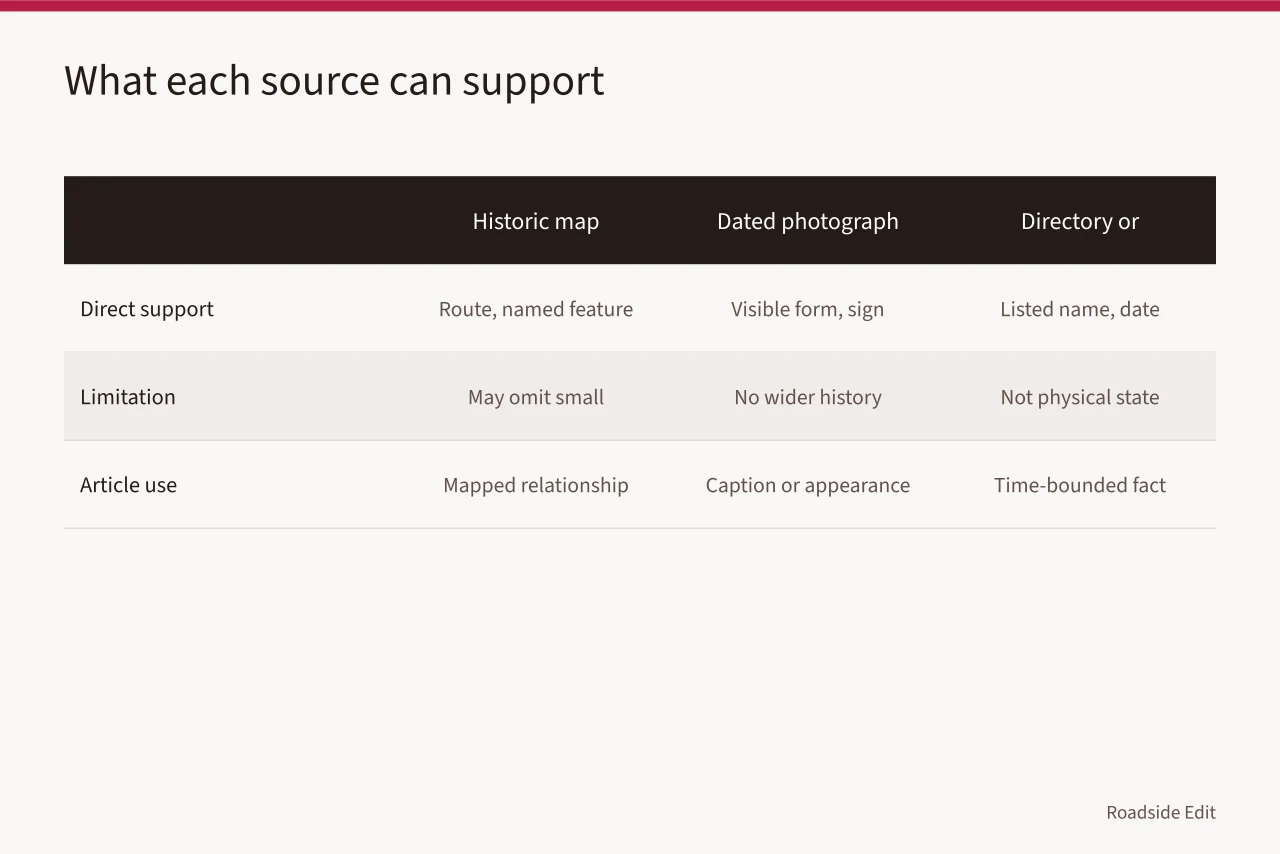
Use one row for each source. Include the stable URL or archive identifier, its date, what it directly shows, and what it does not show. A map may locate a road. A photograph may show a facade at the moment it was taken. An interview may preserve a person's recollection. None should be asked to do another source's job.
The Library of Congress advises researchers to consider a primary source's creator, purpose, audience, context, and agreement or conflict with other evidence. Use the Library of Congress primary-source analysis guidance. Those questions work well in a brief because they turn a vague source list into a reasoned account of why each item is being used.
| Source | Direct support | Limitation | Article use |
|---|---|---|---|
| Historic map | Route, named feature, or symbol on its edition date | May omit small structures or later changes | Describe the mapped relationship |
| Dated photograph | Visible form, sign, material, or condition | Does not prove a wider history | Caption or appearance claim |
| Directory or record | Listed name, address, or date | May not identify the building's physical state | Time-bounded fact |
| Interview | A person's firsthand recollection | Memory needs attribution and may need checking | Attributed account or research lead |
State uncertainty in the brief, not after publication
Gaps are useful. Put them in their own section: uncertain date, unclear address match, blocked view, conflicting name, unavailable permission, or a record that has not been read. Attach a next action to each gap only if it will change the article. Otherwise, keep the point out of the draft.
The Secretary of the Interior's documentation guidance calls for accurate work from reliable sources and clearly stated limits so others can verify it. Review the National Park Service standards for reliable historical documentation.
A web brief should follow that same plain rule. If a source does not support a claim, leave it out or clearly label it as a question.
This is also where you record conflicts. Do not erase a disagreement between a map, photograph, and interview just to make the eventual article read smoothly. Say which source supports which statement. If the conflict matters to a reader, include it with attribution. If it does not, choose a narrower angle.
Record permissions and publication limits
Add a small permissions block before writing starts. Note whether a photograph is your own, public domain, licensed, or awaiting approval. Do the same for interview quotations and private location details. Never treat access to a webpage as permission to reuse its image.
Roadside subjects sometimes touch on transportation planning or historic-preservation review. The Federal Highway Administration describes planning and environmental linkages as an approach for carrying planning information into later environmental review. See FHWA's historic-preservation planning report. An editorial brief is not a regulatory review. Mark that boundary plainly, especially when an article mentions a road project, historic resource, or proposed change.
End the brief with a drafting decision: proceed, narrow the question, wait for a record, or drop the story. That decision saves time because it gives the writer a defensible target rather than a folder of unranked material.
Common questions
Who should approve a research brief?
An editor or project lead who can assess the question, source list, permissions, and stated limits. Approval means the story is ready to draft within that boundary, not that every possible fact has been found.
Can a brief change after fieldwork?
Yes. Add the date and identify what new material changed. If a new source disproves the proposed angle, revise the question before drafting.
What makes a brief ready for drafting?
It identifies the place, answers a limited question, lists the evidence, and explains what the evidence cannot establish. It also notes any permission decision that affects publication.