Guides
How to choose a historic motel restoration provider in 2027
Choosing historic motel restoration help in 2027 starts with a clear scope, evidence-led questions, and records that make provider comparisons accountable.
Choosing help for a historic motel differs from picking a name from a directory. First, describe the decision needing help: research, condition documentation, planning, design, or permits.
That list can also include a limited repair scope or construction oversight. With the task clear, talks with prospective professionals are easier to compare and less likely to yield promises nobody can substantiate.
This article is a process for organizing a provider-selection record. It does not rank firms, verify credentials, assess a motel, set a fee, or tell an owner whom to hire. Requirements for licenses, procurement, public funding, accessibility, and permits differ by place and project.
What to take away
- Define the work before comparing people or firms.
- Ask each prospect for evidence that matches the specific role, not a broad claim of experience.
- Separate a proposal from a decision, and a decision from completed work.
- Keep qualifications, scope, fees, assumptions, and exclusions in different fields.
- Treat a source or photo as context unless it is actually a record for the motel in question.
Start with a decision brief
An owner who says, "We need restoration help," may mean several different things. They may need historical research before a plan is written, a condition assessment for a defined feature, drawings, or a code consultation.
They may need an estimate for a limited scope or someone to coordinate specialized work, and those are different assignments. A capable person for one may not fit another.
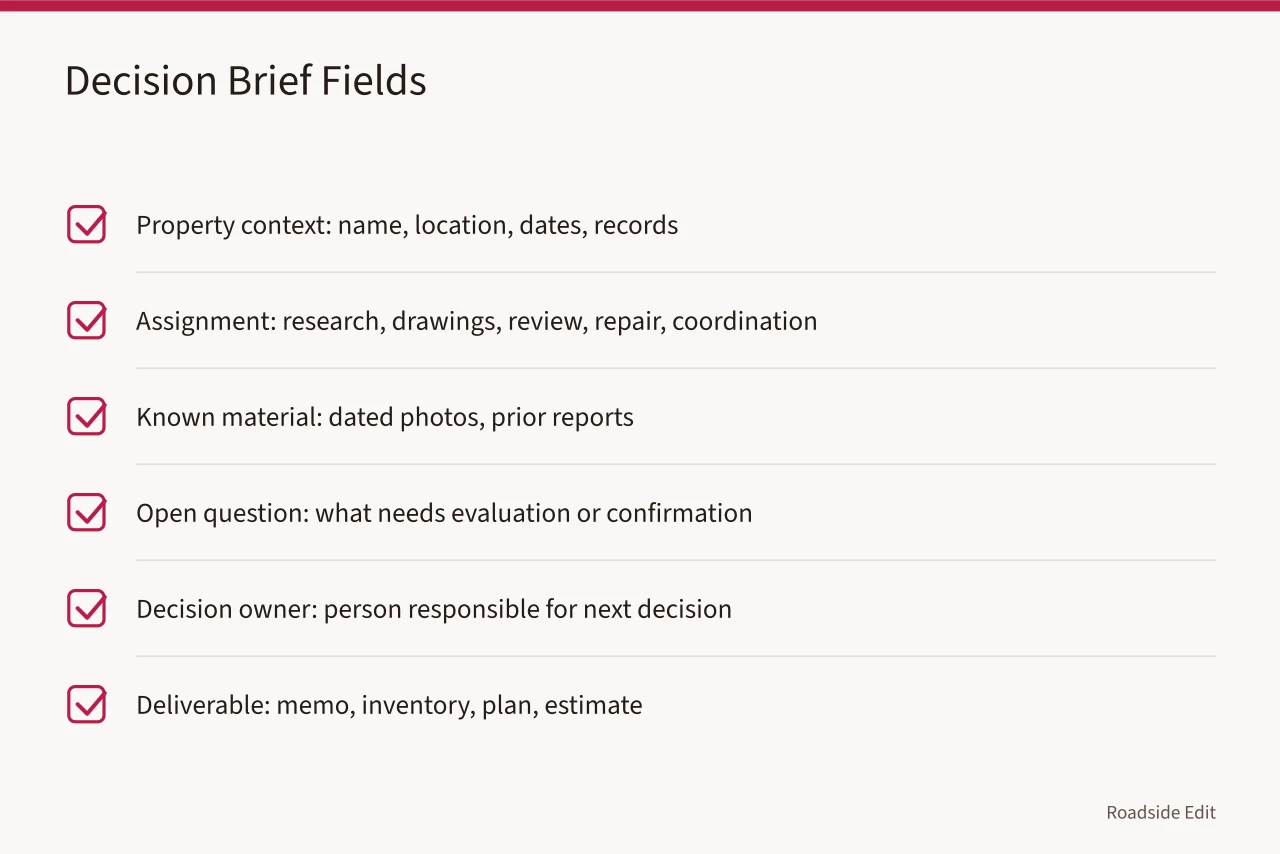
Write a short decision brief before the first call. It should identify the property, the feature or area in question, the purpose of the work, what is already documented, what is missing, and who will make the final decision. The brief does not need to diagnose a problem. It needs to prevent a vague request from becoming a vague proposal.
| Brief field | Useful entry | Avoid |
|---|---|---|
| Property context | Motel name, location, dates, known records | An unsupported statement that it is historic or eligible |
| Assignment | Research, drawings, review, repair scope, or coordination | "Fix everything" |
| Known material | Dated photos, prior reports, decision records | A memory presented as a verified fact |
| Open question | What needs evaluation or confirmation | A preselected answer disguised as a question |
| Decision owner | Person or group responsible for the next decision | An unnamed approval path |
| Deliverable | A memo, inventory, plan, estimate, or other defined item | A promise of a result without a defined output |
A short brief also gives each potential provider the same starting point. That makes later comparison fairer. If one person is asked to review a sign and another is asked to redesign an entire frontage, their responses cannot be compared as if they answer the same request.
The National Park Service notes that Historic Property Project Documentation can carry property information into later scope and design decisions. See the NPS documentation overview. It is not a private hiring template, but it supports the basic discipline of defining what information is known before asking a professional to act on it.
Match the role to the work
Historic motel projects often need several disciplines, because a historian may research records and an architect may prepare plans. A specialist may evaluate a narrow material issue, a contractor may describe a construction approach, and a local official may explain a permit process.
The goal is not a long team list but to avoid assigning one role another's conclusion.
A prospective contractor can explain the scope they are willing to price; a price proposal is not an assessment of historic significance. A preservation-oriented consultant can organize evidence and questions; a general planning memo is not a permit approval.
Record the role beside every document so later readers know what it can and cannot establish.
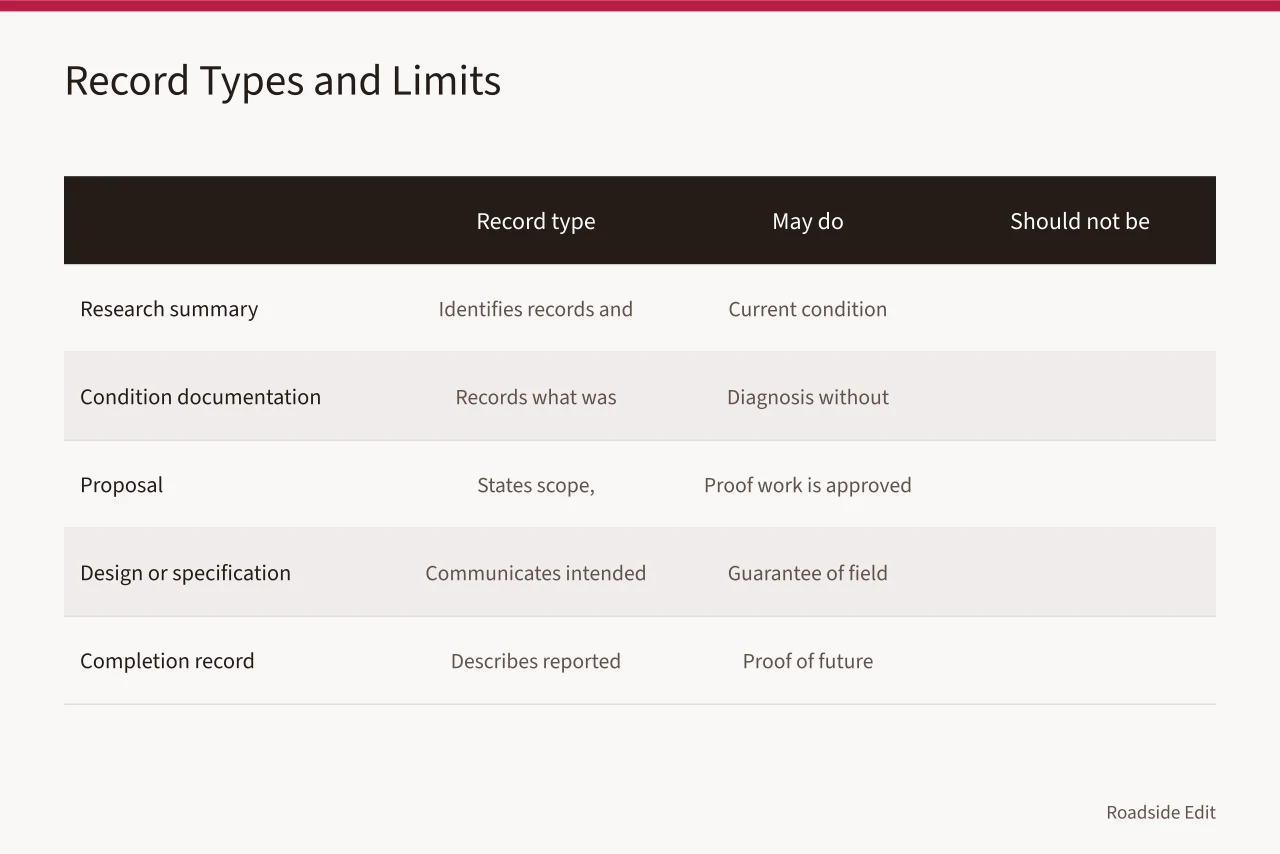
| Record type | What it may do | What it should not be treated as |
|---|---|---|
| Research summary | Identifies records, dates, and unanswered history questions | A current condition assessment |
| Existing-condition documentation | Records what was observed on a date | A diagnosis without the needed expertise |
| Proposal | States a prospective scope, assumptions, and price terms | Proof that work is approved or completed |
| Design or specification | Communicates a defined intended scope | A guarantee of field conditions or approvals |
| Completion record | Describes reported work and date | Proof of future performance |
For federal projects under Section 106, the Advisory Council on Historic Preservation tells applicants to hire qualified contractors and consultants with demonstrated capability. They must also keep adequate documentation for the administrative record. Read the ACHP Section 106 applicant toolkit.
That guidance applies to its own process. It still reminds us to tie capability to the actual assignment and keep records that show how a decision was reached.
Ask for evidence, not a sales narrative
The most useful comparison questions are specific enough to answer with documents, descriptions of prior work, references, and stated limits. Broad questions such as "Are you the best?" invite broad answers. A stronger question is, "What role did you hold on a comparable assignment, what was the stated scope, and what documentation can you share without disclosing private information?"
Request the same categories from each candidate and preserve answers as received. Do not rewrite a claim into a stronger claim.
If a provider says they worked on a project, record their stated role rather than assuming they led it. If the work is confidential, record that the material was not available for public review and ask for a different form of confirmation.
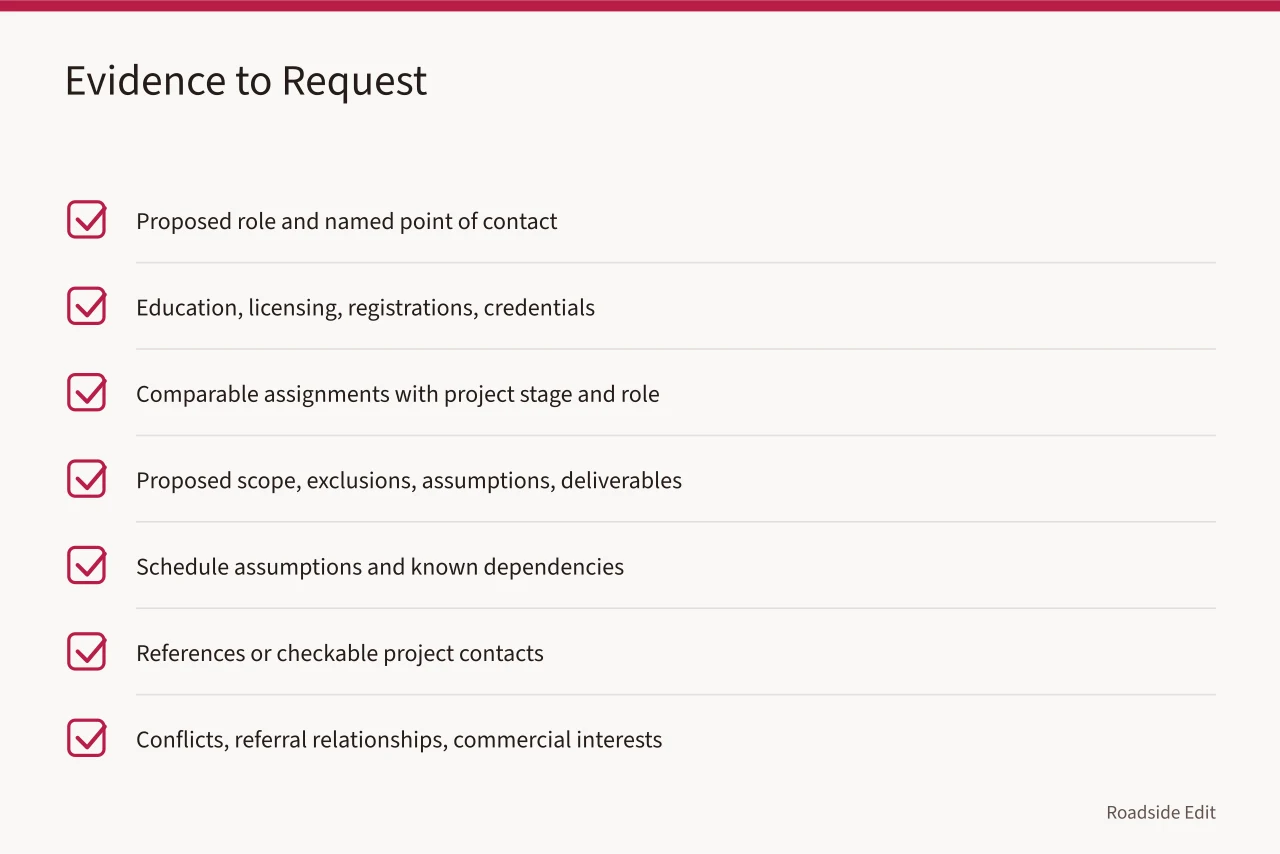
Evidence categories to request
- A description of the proposed role and named point of contact.
- Relevant education, licensing, registrations, or credentials where they apply.
- Comparable assignments, with project stage and role described.
- A proposed scope, exclusions, assumptions, and expected deliverables.
- A schedule assumption and any known dependency on access, research, reviews, or approvals.
- References or other independently checkable project contacts, where appropriate and permitted.
- A statement of conflicts, referral relationships, or commercial interests that could affect the assignment.
This is not a demand for private records. It is a way to distinguish a verifiable statement from a polished but vague one. Respect confidentiality, personal information, security details, and client restrictions. A provider who cannot disclose a project may still explain the nature of their role and the limits on what can be shared.
NPS heritage-documentation standards call for reliable source material and stated limitations that enable later review. Read the NPS documentation standards. For a hiring file, that means retaining a provider's stated role and any limits on the evidence, rather than expanding a short claim into an endorsement.
Compare scope before price
Price is meaningful only when the scope behind it is visible. A lower figure may exclude travel, documentation, consultation, drawings, permits, testing, revisions, or follow-up. A higher figure may include one of those items. Neither figure tells a complete story by itself.
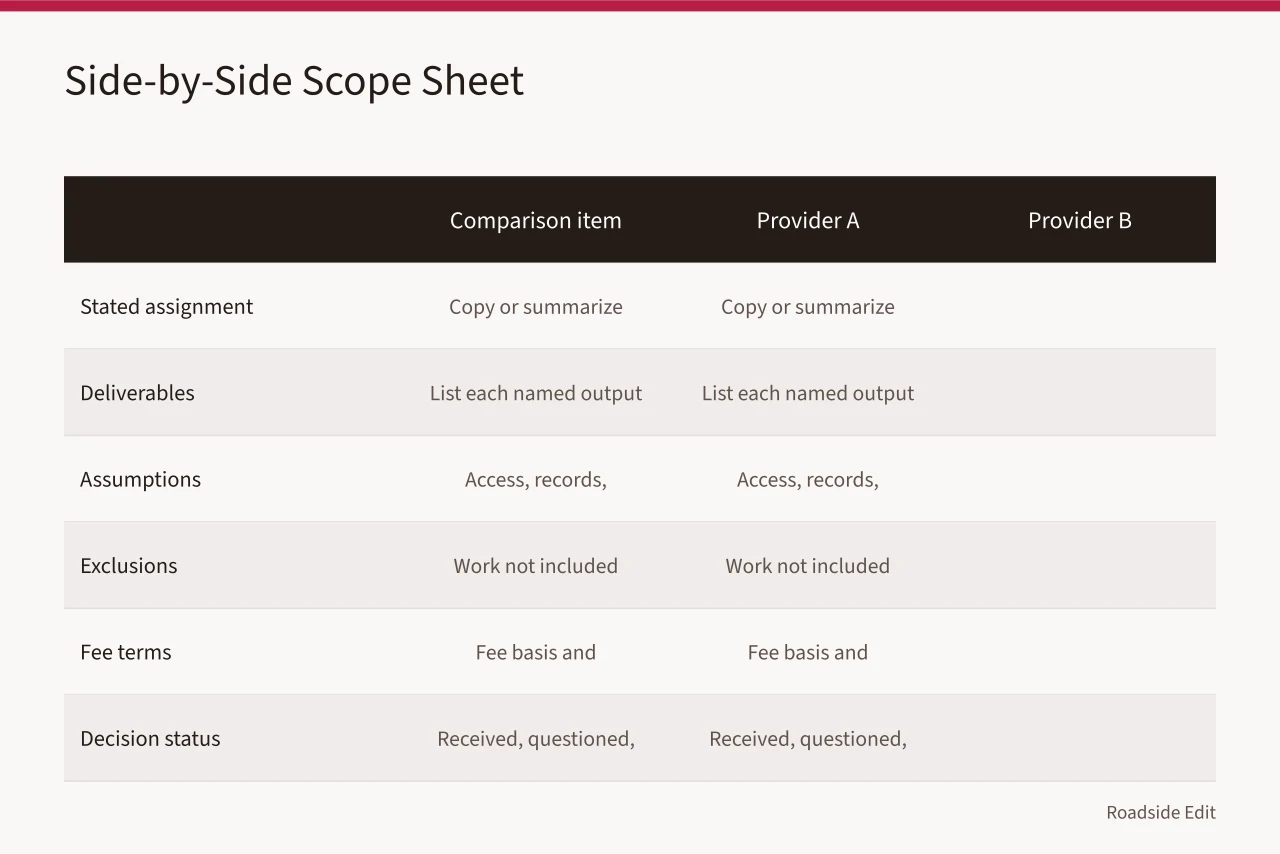
Build a side-by-side scope sheet. Use exact wording from proposals where practical. If language needs a plain-English note, label the note as the owner's summary rather than treating it as a provider statement. Keep changes dated. A revised proposal should not overwrite the first version; the comparison needs to show what changed.
| Comparison item | Provider A | Provider B | Open question |
|---|---|---|---|
| Stated assignment | Copy or summarize the proposal | Copy or summarize the proposal | Are the assignments truly comparable? |
| Deliverables | List each named output | List each named output | What format and level of detail apply? |
| Assumptions | Access, existing records, timing | Access, existing records, timing | Which assumption needs confirmation? |
| Exclusions | Work not included | Work not included | Who handles the excluded work? |
| Fee terms | Stated fee basis and revision terms | Stated fee basis and revision terms | What event changes the fee? |
| Decision status | Received, questioned, shortlisted, selected | Same status vocabulary | Who records the decision? |
Avoid converting a comparison into a public endorsement. An article or business profile can say that a provider submitted a stated scope if the record supports it. It should not state that a provider is the right choice, the lowest-risk choice, or likely to produce a certain result without evidence that directly supports that claim.
GSA explains that estimates evolve as requirements and scope become clearer. Review GSA cost-management guidance. Its federal guidance does not establish a private project price. It does reinforce the need to compare the terms around a number, not the number alone.
Preserve a clean decision trail
Provider selection is easier to explain later when the record shows the sequence. Keep the original request, all comparable proposals, question-and-answer notes, revisions, reference-check notes, conflicts disclosures, decision rationale, and any final agreement in one project file. Mark the status of each item: received, clarified, revised, selected, declined, or closed.
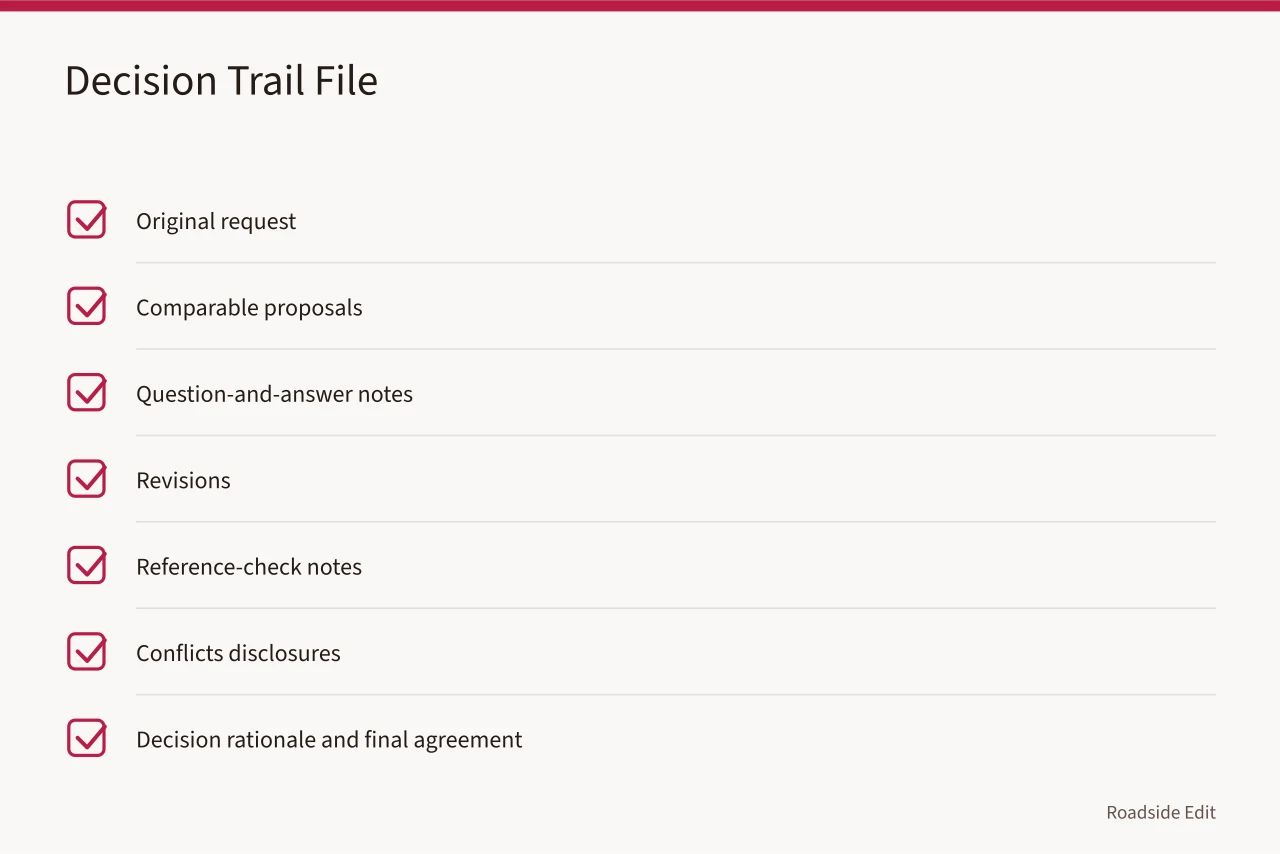
Do not publish private proposals, personal contact information, security-related details, or unverified allegations. If a public article describes the process, keep it to documented process, not private evaluation.
"The owner compared stated scope and deliverables" is a process statement. "The other firms were unqualified" is a conclusion that needs much stronger evidence and may not belong in public copy.
Use a simple selection sequence
The following sequence keeps a search from drifting into a series of informal promises.
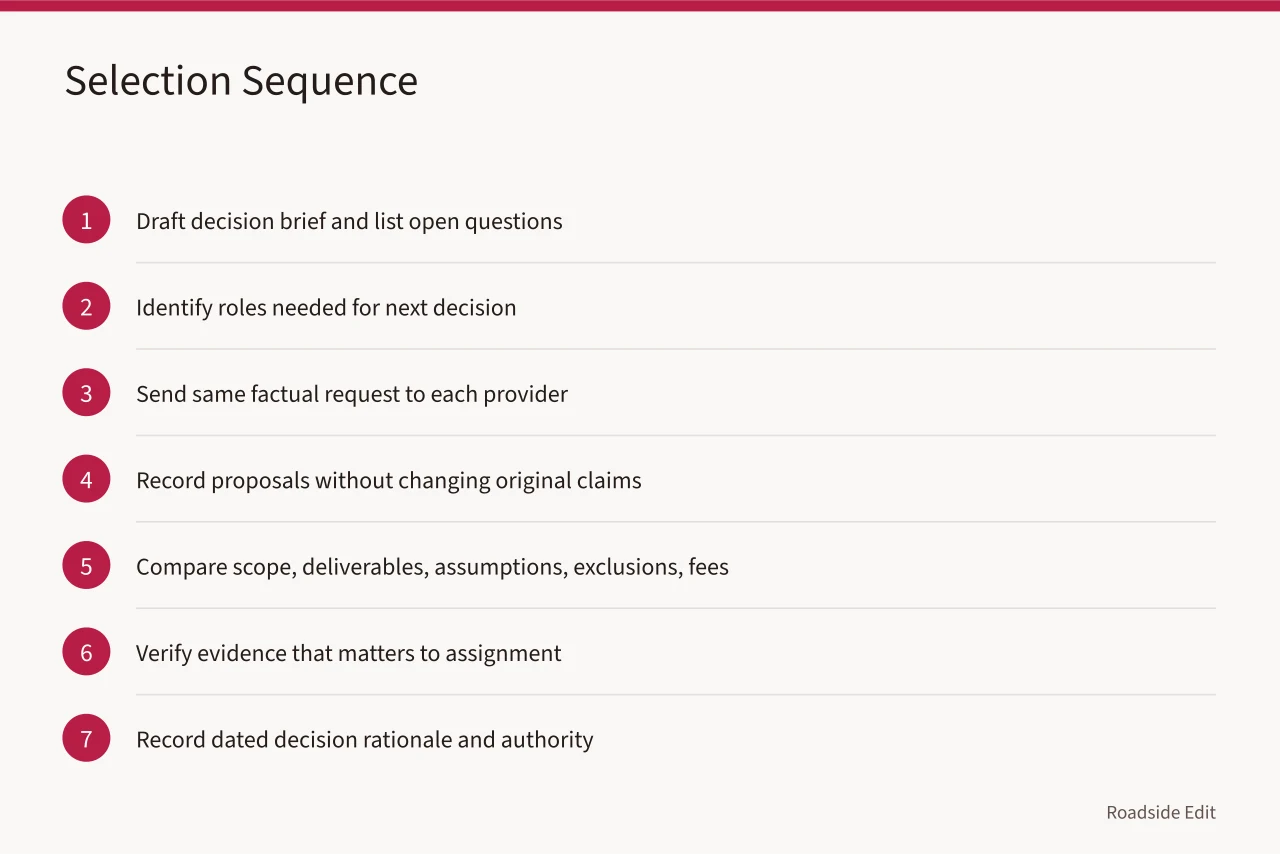
- Draft the decision brief and list unresolved questions.
- Identify the roles needed for the next decision, not for every possible future task.
- Send the same factual request to each prospective provider.
- Record proposals and questions without changing the original claims.
- Compare scope, deliverables, assumptions, exclusions, and fee terms.
- Verify the evidence that matters to the stated assignment.
- Record a dated decision rationale and the authority that made it.
- Keep later revisions, work records, and corrections separate from the original selection record.
The sequence is deliberately modest. It does not replace legal advice, procurement rules, professional review, local licensing requirements, or a property-specific assessment. It gives an owner a way to ask better questions and preserve a useful record.
When a paid placement is involved
A paid placement, sponsorship, referral, or advertising relationship needs its own label. Payment for visibility does not prove a provider's skill, verify a project, or establish that a business is appropriate for a particular motel. Keep commercial language separate from factual evidence.
If a business appears in a future list or directory, identify the basis for inclusion: paid placement, self-submitted profile, editorial research, or a documented public listing. Do not turn a sponsor statement into a claim about historic-property performance. This protects the business from overstatement and gives readers a clearer way to interpret the page.
Common questions
Does this guide recommend historic motel restoration providers?
No. It provides a question-and-record framework. A provider decision requires property-specific scope, local requirements, and the decision maker's own review.
Is the lowest proposal automatically the best comparison point?
No. Compare the stated scope, deliverables, assumptions, exclusions, and fee terms before drawing a conclusion from price.
What should be public after a provider is selected?
Publish only supported process information that is appropriate to share. Keep private proposals, personal contacts, security details, and unverified claims out of public copy.