Guides
Part of How to build a roadside architecture safety checklist that stays useful
Roadside architecture safety observation checklist: what to shoot and when to stop
Roadside architecture safety observation checklist for 2027 sets clear limits for lawful exterior notes, photos, and responsible follow-up later.
Use this safety observation checklist to set limits before taking notes or photos at a roadside place. It is designed for a lawful exterior view. It does not authorize entry, site testing, or a conclusion about the building's condition.
What to take away
- Check your location before you check the building.
- Record the feature, date, viewpoint, and what cannot be seen.
- Stop when access becomes uncertain, restricted, or unsafe.
- Send a concern through a responsible route rather than investigating it.
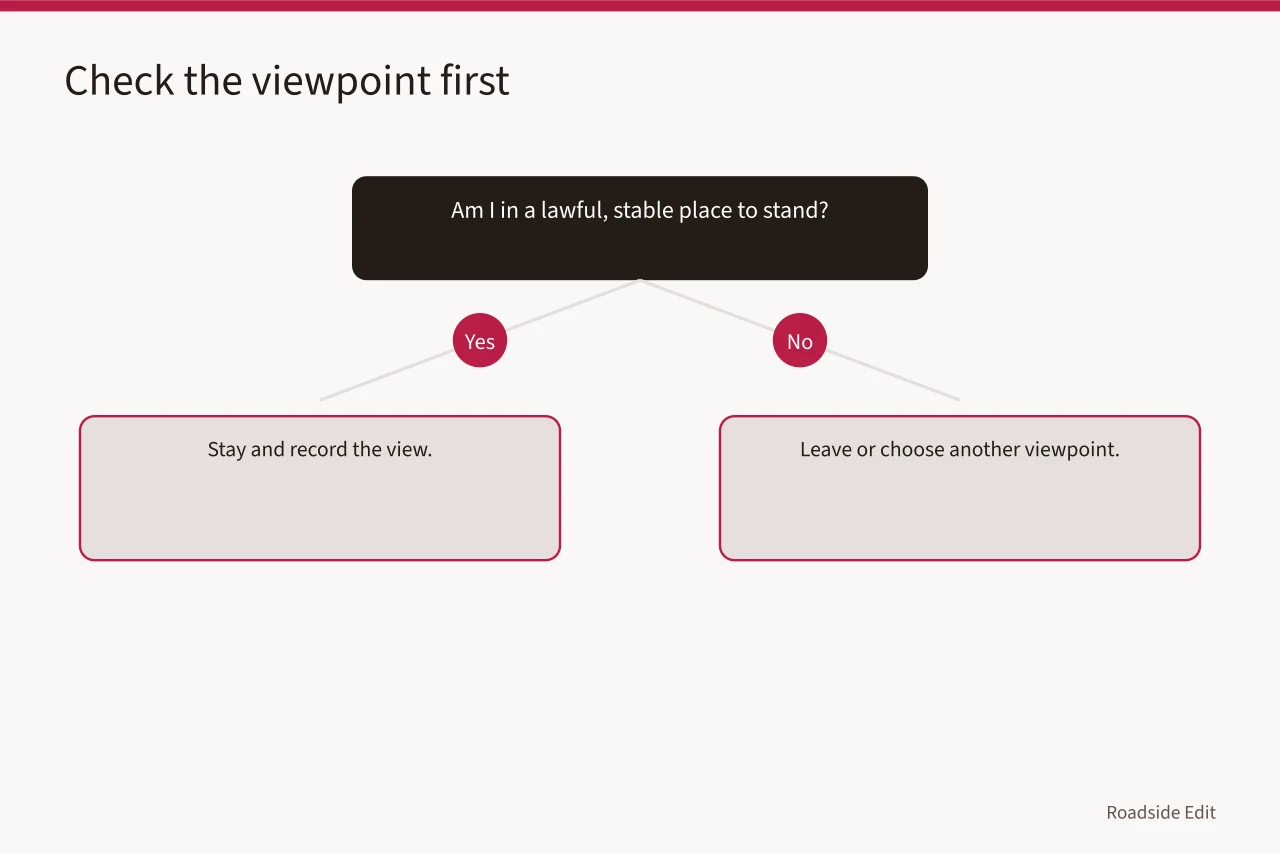
Check the viewpoint first
| Question | Safe answer |
|---|---|
| Am I in a lawful, stable place to stand? | If not, leave or choose another viewpoint. |
| Am I blocking a road, driveway, or sidewalk? | Move on rather than creating a new access problem. |
| Is this a public view or an owner-approved visit? | State the limit in the note. |
| Does the photo reveal a private detail? | Do not publish it unless there is a clear, lawful reason. |
Record the observation
- Give the feature a plain label, such as "west sign panel" or "front canopy."
- Capture one broad image and one closer image only from the same lawful area.
- State the visible change without explaining its cause.
- Add what was not observed: interior, rear elevation, roof, attachment, or ownership status.
- File the note with its date and the prior comparison image if one exists.
NPS HABS measured-drawings guidance states safety is ultimately the project supervisor's responsibility, and vacant or deteriorating buildings can require work at heights. Review NPS HABS guidance for measured drawings
A public observation is not a HABS project, but the safety boundary is still useful: do not treat a photo task as permission to take a risk.
The record does not need to be elaborate. The NPS documentation standards use photographs and written data together to describe a historic resource. See the NPS documentation standards. For a public-facing article, a date, viewpoint, feature name, and stated limitation can be more useful than a dramatic image with no context.
Know when to stop
| Situation | What to do |
|---|---|
| The feature is behind a fence or closed gate | Do not enter or reach through it. |
| The roadway has no safe stopping or walking location | Leave without the image. |
| A loose-looking feature is near your route | Keep distance and do not try to inspect it. |
| You see a possible emergency | Use the appropriate local emergency route from a safe location. |
Keep cameras and equipment simple
Do not climb, lean equipment against a structure, cross a barrier, or use a damaged ladder to get a better angle. Workplace ladder rules are not a public photography checklist, but they offer a clear caution about equipment defects. OSHA requires portable ladders with visible structural defects to be removed from service until repaired. Read OSHA's ladder rule.
A roadside observer does not need to decide whether a ladder is safe. The reasonable choice is to stay at ground level or leave.
Use a camera or phone only where you can watch traffic, footing, and access. If a wider view means stepping into a travel lane, driveway, construction area, or unstable shoulder, skip it.
A useful article can say a feature was not photographed from a safe public viewpoint. That limitation is part of the record, not a failure in the story.
Treat drones as a separate activity
A drone is not a workaround for a fence, roofline, or closed site. The Federal Aviation Administration says recreational flyers must keep aircraft within visual line of sight, yield to other aircraft, and follow the rules that apply to their flight.
Check the FAA's current recreational flyer requirements. Those rules concern airspace and do not grant property access or settle privacy questions.
For that reason, do not add drone footage to a roadside article simply because an exterior view is hard to obtain. Use an owner-provided or properly authorized image when one is available, credit its source, and describe the image date. If no lawful, well-contextualized image exists, publish a text-led note instead.
Common questions
Can I use a drone for an exterior observation?
Not as a casual substitute for access. Follow applicable aviation rules, property boundaries, and privacy limits. A drone does not permit a person to bypass a restriction.
Should I touch a sign to see whether it is loose?
No. Record only what is visible and use an appropriate reporting path if there is a concern.
What is the minimum useful note?
The date, feature label, lawful viewpoint, visible condition, and one clear limitation are enough for a useful first record.