Guides
Part of Choosing help for roadside architecture: a 2027 guide to named providers and criteria
Roadside architecture provider checklist: how to compare scope and evidence
Roadside architecture provider checklist for 2027 helps U.S. owners compare roles, written scope, evidence, and stated limits without false endorsements.
What to take away
- Start with the work needed, then compare people or firms against that defined role.
- Request a written deliverable, assumptions, and exclusions before comparing fee or experience claims.
- A portfolio item or title can support a narrow statement. It does not prove fit for a new project.
- Keep the candidate's own statements separate from public records and reference notes.
Prepare a scope card
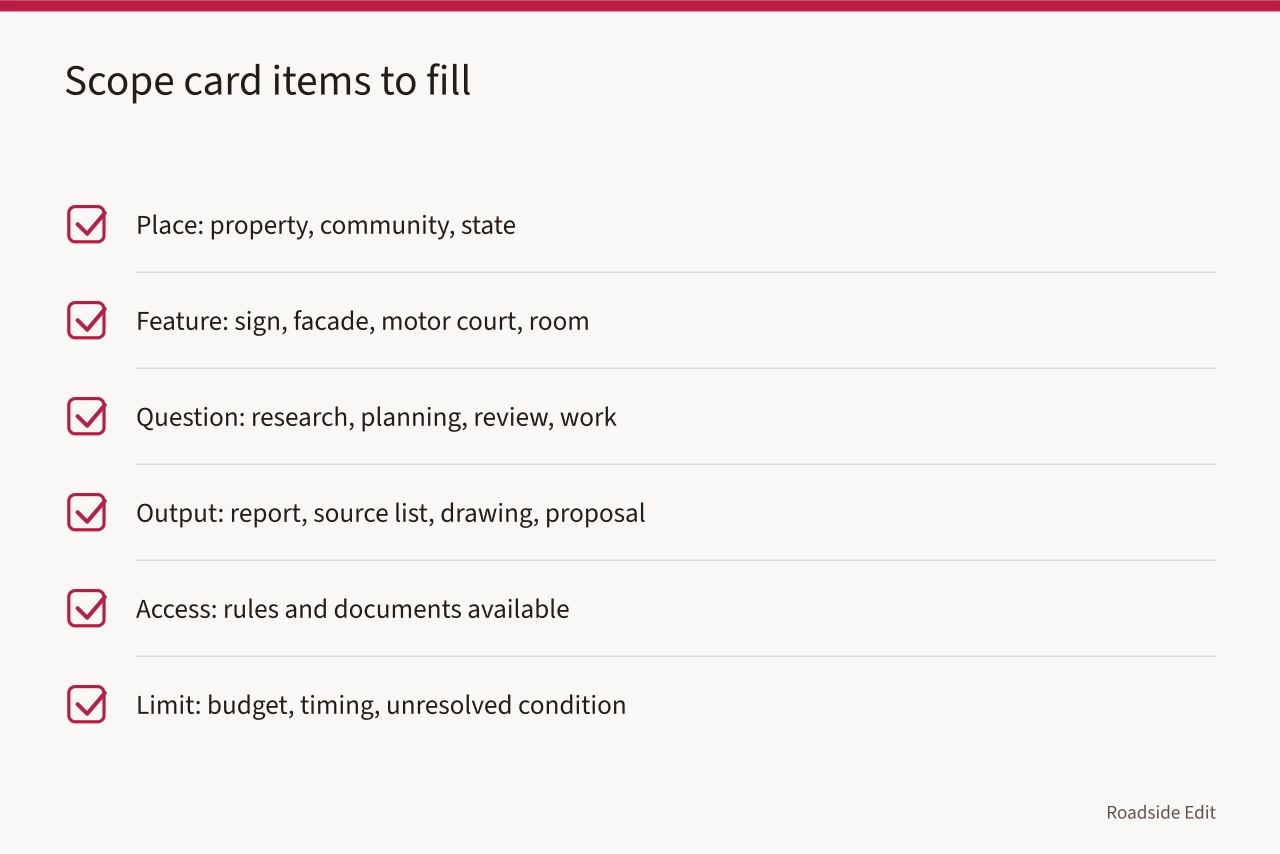
A roadside project can involve research, photography, historical documentation, planning, design, technical review, construction, or editorial work. These are not interchangeable roles. Before contacting a provider, write a short scope card. It gives every candidate the same starting information and makes later comparisons possible.
| Scope-card item | Include this |
|---|---|
| Place | Property name, community, and state |
| Feature | One sign, facade, motor court, room, or document set |
| Question | Research, planning, review, or work question to answer |
| Output | Report, source list, drawing, proposal, or another named record |
| Access | Known access rules and documents already available |
| Limit | Budget boundary, timing, or unresolved condition |
NPS consultant inquiry guidance suggests looking at relevant education, past successful work, and the quality of prior work through appropriate program or preservation-office contacts. Use the NPS inquiry guidance as a screening model. That page concerns nomination assistance. It does not choose a provider for a private roadside project.
Run the candidate checklist
Ask the same core questions of each candidate. Do not turn a polished response into an endorsement. The purpose is to identify what each person says they can provide and what evidence supports a limited statement about experience.
- Does the response identify the correct property and feature?
- Does it name the role the candidate would perform?
- Does it describe a specific deliverable?
- Can the candidate explain their role in comparable work?
- Are access, records, timing, and review assumptions stated?
- Does the response name exclusions or work another person must provide?
- Is there a written way to confirm important statements later?
| Do not rely on | Ask for instead |
|---|---|
| A general claim of expertise | Comparable work and the candidate's stated role |
| A portfolio image alone | A description of the deliverable and work boundary |
| A fee without scope | A written scope and assumptions |
| A title without context | Relevant education, experience, and task connection |
The NPS Professional Qualifications Standards describe minimum education and experience criteria for certain identification, evaluation, registration, and treatment activities, while noting that complex tasks may need additional expertise. Read the NPS qualifications standards. The standards help frame questions about a role. They do not certify a particular provider or guarantee suitability for a particular job.
Check evidence by source type
A provider may supply a biography, resume, portfolio, project example, reference, credential, or proposal. Each item has a different value. Put its source next to the claim it supports. If a provider says they performed a role in a past project, describe it as their statement unless an independent record confirms it.
| Evidence item | It may support | It does not establish alone |
|---|---|---|
| Provider biography | Stated education or service area | A project award or current capacity |
| Public license record | Status in the listed jurisdiction | Experience with this exact feature |
| Portfolio item | A cited example of past work | Every role involved in the project |
| Reference note | What the reference says it observed | A guaranteed result for new work |
| Proposal | The offered scope and assumptions | An approved project decision |
NPS procurement guidance describes written evaluation factors and experience with historic resources as part of its program process. Review NPS contracting and procurement guidance. It is not a universal private-procurement rule, but it supports using a written method instead of comparing candidates by impression alone.
Preserve the limits in the comparison
A candidate may have strong experience and still not offer the role you need. Another may offer a clear scope but need additional records or site access before giving a fee. Record those limits without calling them faults. Keep direct contacts and unpublished documents out of public copy unless disclosure is appropriate and authorized.
GSA's preservation checklist calls for considering comparable experience, specialist competency, and reference checks at relevant project stages. Review the GSA preservation checklist. It is a federal tool, not a private selection mandate. Its useful lesson is simple: evidence should match the task and be recorded in a way another reviewer can follow.
Common questions
Should every candidate have the same type of experience?
No. The experience should match the defined role. Research, design, documentation, and construction work may need different evidence.
Can a public agency recommend a private provider?
Ask the agency about its own policy. Do not assume a referral practice or authority from a general web page.
What is the most important item to write down?
The proposed deliverable and its limits. They make it possible to compare responses without guessing what each candidate offers.