Guides
How modern roadside design cost planning works before you commit to a number
Modern roadside cost planning for 2027 helps U.S. teams compare scope, timing, care, assumptions, options, and records without presenting false project prices.
Modern roadside cost planning makes uncertainty visible. It does not start with a total. It starts with a stated purpose, a defined site portion, available records, and questions that could change the work.
This prevents an early idea from becoming a price, a vendor offer from becoming selected scope, or a completed expense from being confused with a future allowance.
This guide is for U.S. readers organizing an early roadside project discussion. It does not estimate a particular property, determine value, choose a supplier, interpret purchasing rules, or establish an approval. Conditions such as ownership, utilities, traffic, drainage, historic features, local processes, labor availability, weather, and timing can change the next useful cost record.
What to take away
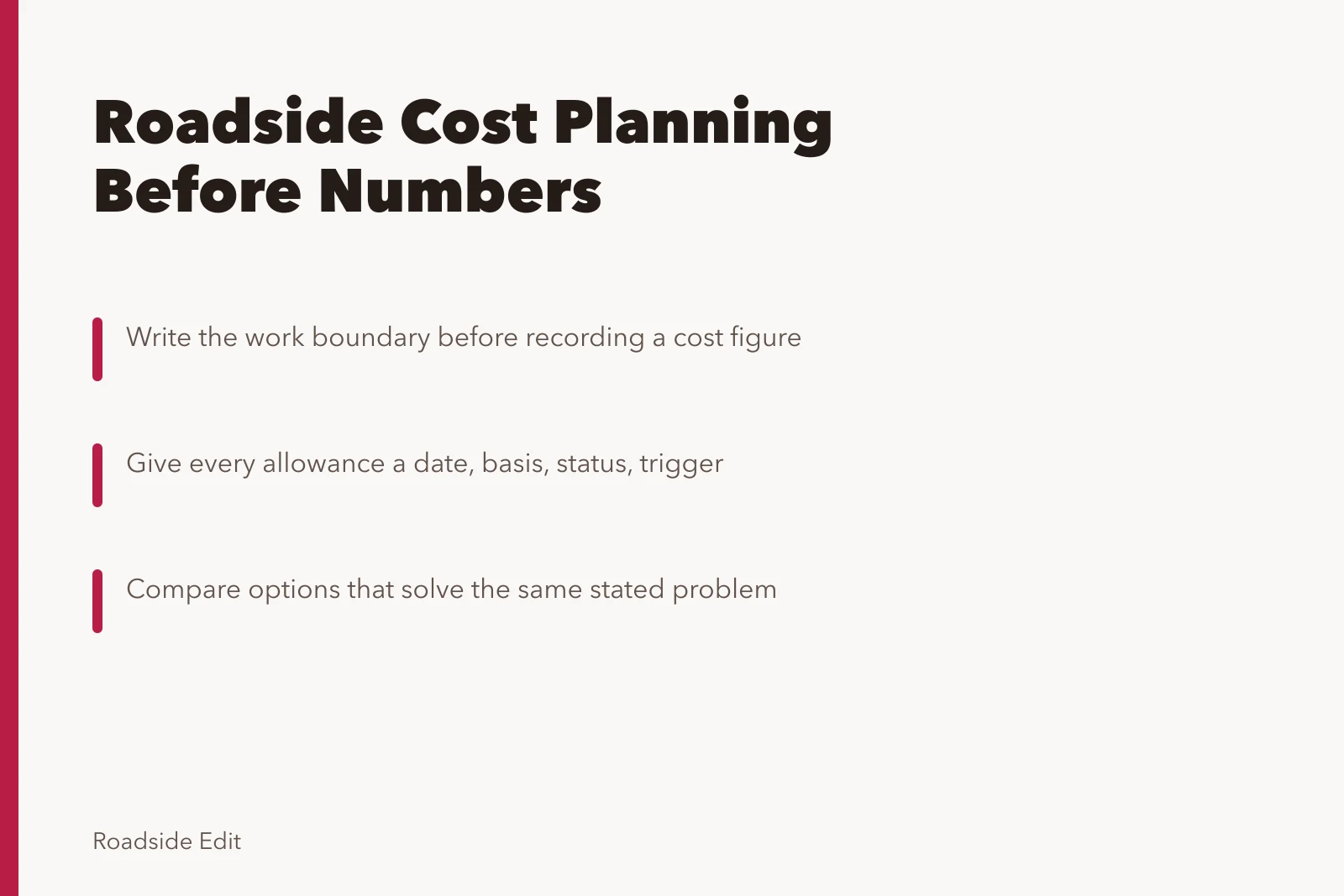
- Write the work boundary before recording a cost figure.
- Separate investigation, concept work, selected scope, and ongoing care.
- Give every allowance a date, basis, status, and change trigger.
- Compare options that solve the same stated problem.
- Keep vendor statements, editorial lists, and paid placements distinct from project evidence.
Begin with the decision, not the number
An early budget note should explain what decision it is helping someone make. A note could support a choice between two entry concepts, decide whether to commission an existing-condition survey, or identify what information is needed before a future phase. It should not imply that a property has authorized construction just because a number appears in a spreadsheet.
The Federal Highway Administration describes life-cycle cost analysis as comparing initial and discounted future costs over a project segment's life. Its process starts with alternatives, activity timing, and cost estimates, then calculates a total. Read FHWA's life-cycle cost overview.
That method is a transportation analysis tool, not a price list for an individual roadside property. For a planning file, the useful lesson is that an opening cost is only one part of an option's record.
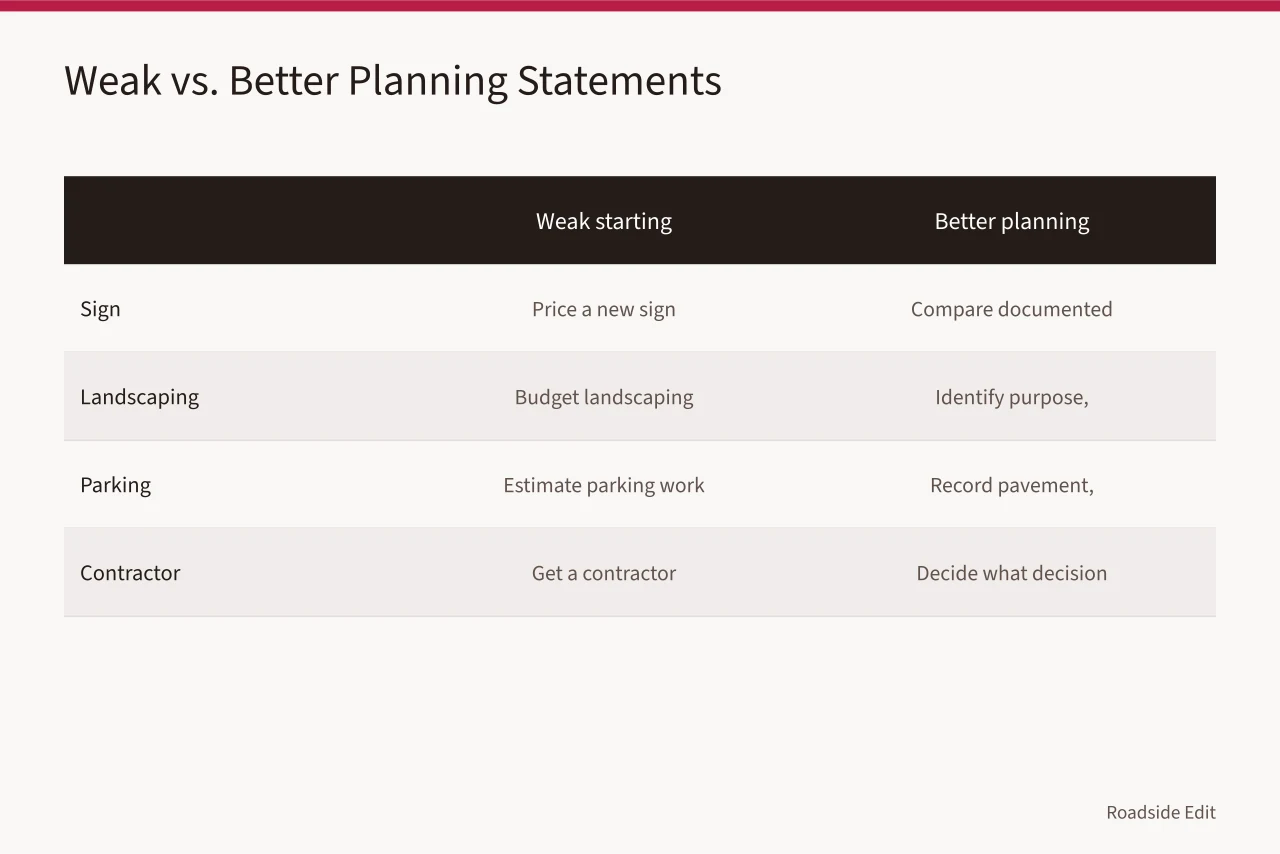
Use a decision statement that a reader can test:
| Weak starting point | Better planning statement |
|---|---|
| "Price a new sign" | "Compare two documented ways to improve entrance orientation" |
| "Budget landscaping" | "Identify the purpose, area, care role, and missing site information for a planting concept" |
| "Estimate the parking work" | "Record the pavement, route, drainage, and operational questions that define a future scope" |
| "Get a contractor number" | "Decide what evidence is required before a request can describe the work consistently" |
The better statement does not make the work slower. It makes later changes understandable. If the team learns that a utility line, street process, or existing feature affects the option, the cost record can show why it changed.
NPS preservation-planning standards say the scope of an activity must be defined so it can be completed with available budgeted resources. Read the NPS planning standards. Those standards address preservation planning, not a price guide for a roadside project. They support the same discipline: define the task before treating a total as a budget.
Divide costs by status
One of the most useful habits is giving each cost-related entry a status. Use terms that describe the record, not terms that make a number seem more certain than it is.
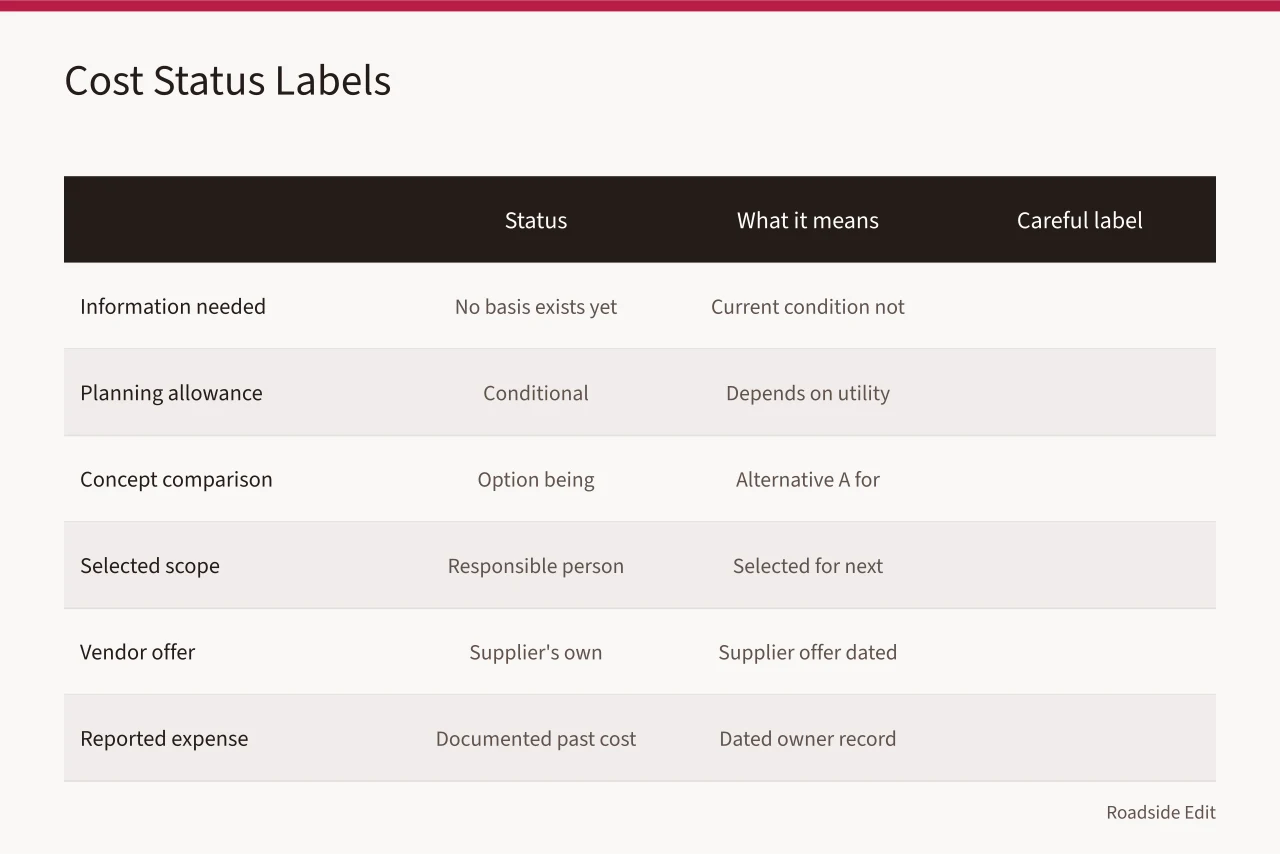
| Status | What it means | Example of a careful label |
|---|---|---|
| Information needed | No basis exists yet | "Current condition not documented" |
| Planning allowance | A conditional placeholder | "Allowance depends on later utility confirmation" |
| Concept comparison | An option is being considered | "Alternative A for orientation review" |
| Selected scope | A responsible person advanced the item | "Selected for next review, not reported complete" |
| Vendor offer | A supplier's own proposal | "Supplier-provided offer dated May 2026" |
| Reported expense | A documented past cost | "Reported from a dated owner record" |
Never merge these labels into a single total without explaining the parts. An allowance is not an offer. An offer is not a contract. A contract is not a completed expense. Each has a different source and a different reason for existing.
Describe the scope in layers
Roadside work often touches more than a visible element. A sign can involve location, visibility, power, maintenance, adjacent landscaping, building identity, and public-facing information. A path can involve the street edge, pavement, water, planting, lighting, parking, and the entrance. A cost plan becomes more useful when it records those layers rather than placing one broad label beside one broad number.
Start with four layers:
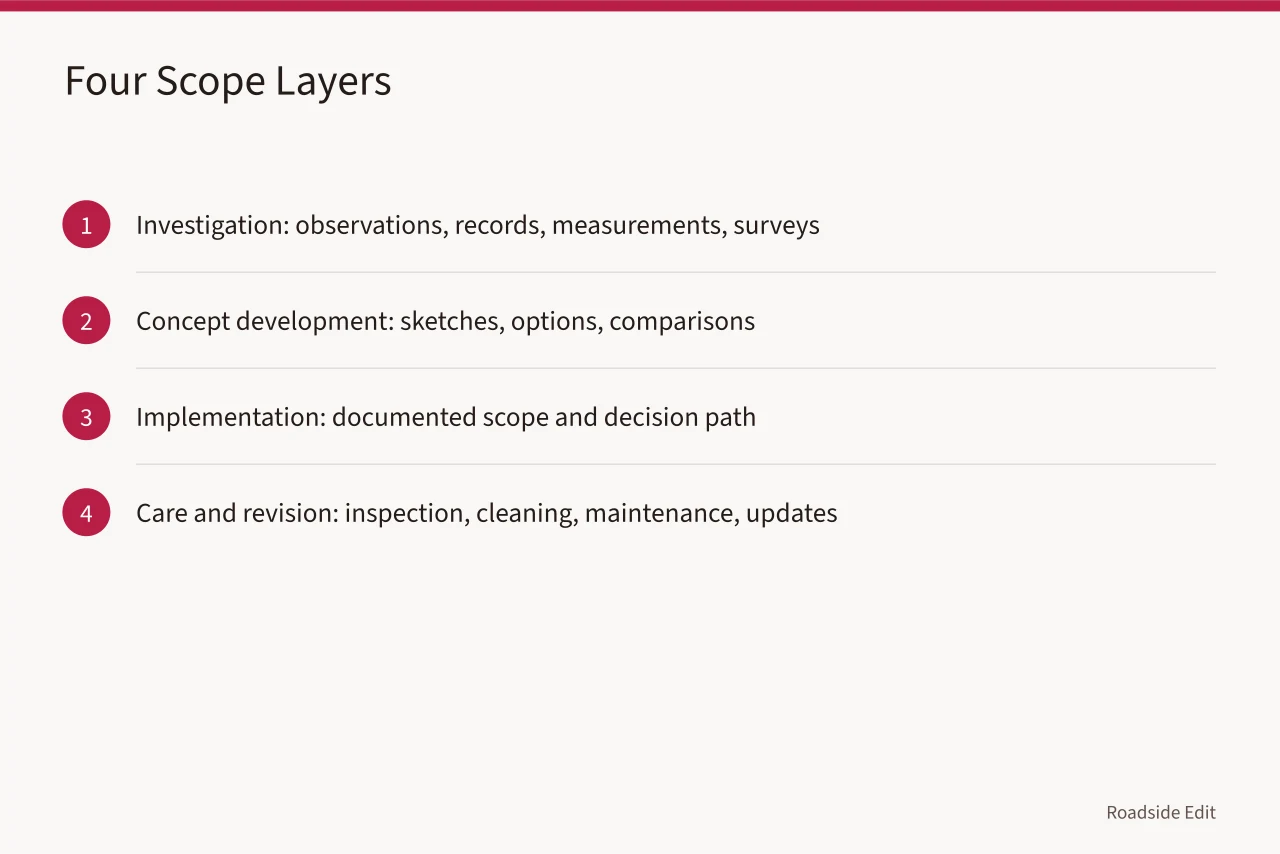
The layers can overlap in real life, but the record should say which layer an entry belongs to. For example, a photograph may support an investigation record. It does not support a statement that a sign replacement has been approved or priced correctly.
GSA states that project scope is used to create the cost estimate and should be developed before estimating. See GSA's scope-and-estimate process. Its process is federal, not a private property requirement. It provides a clear reason to separate early research from a scope that a provider can actually price.
Compare alternatives on equal terms
Options should be compared against the same user task and the same known limits. If one option is a detailed specification and another is a rough idea, the comparison is not fair. Build a short option card for each alternative.
| Field | Question to answer |
|---|
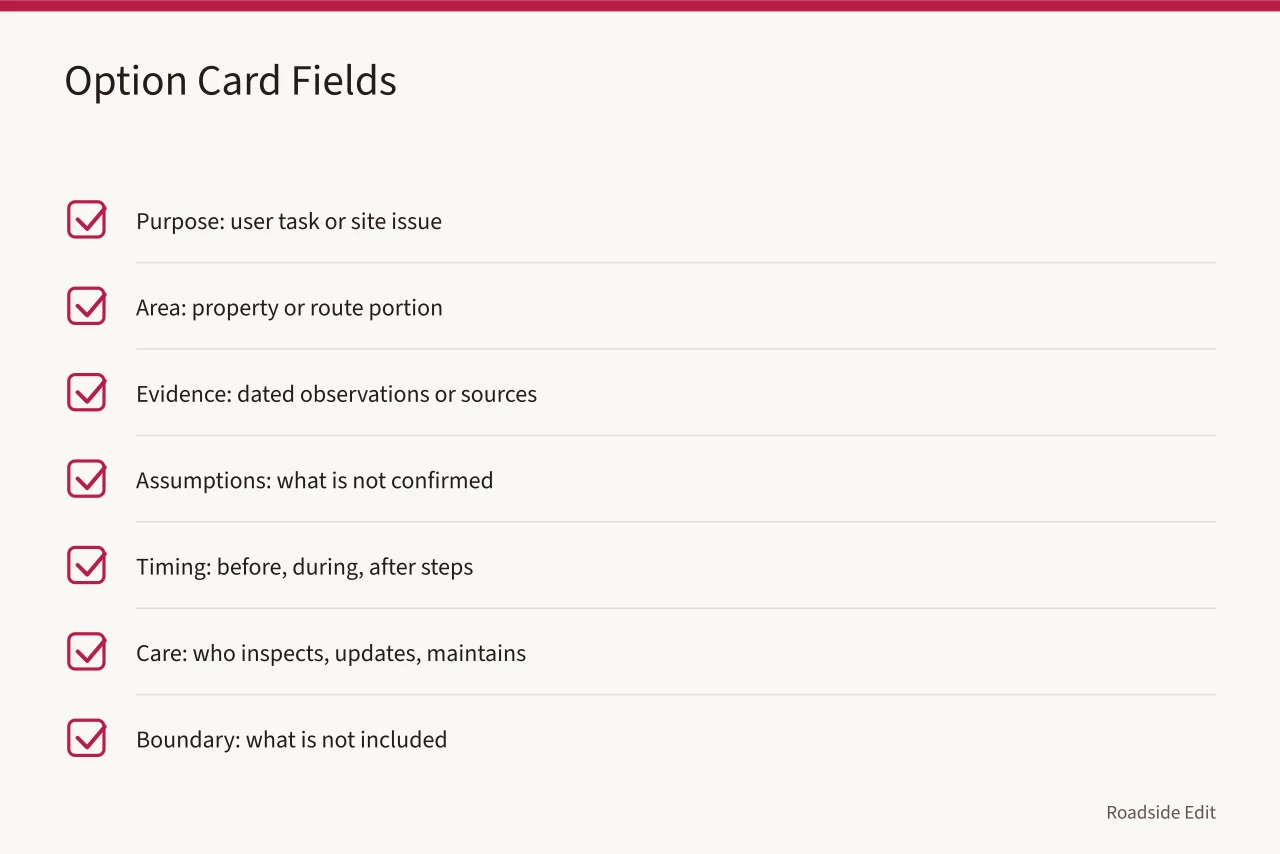
The comparison may show that neither option should move forward until a missing condition is reviewed. That is a valid cost-planning result. It is more useful than choosing the lowest visible starting number without a shared scope.
Set up assumptions and change triggers
Every early estimate or allowance has assumptions. Write them down plainly. An assumption could concern the work area, material availability, access timing, condition of a surface, source of power, or the person responsible for care. Do not hide an assumption in a description that reads like a fact.
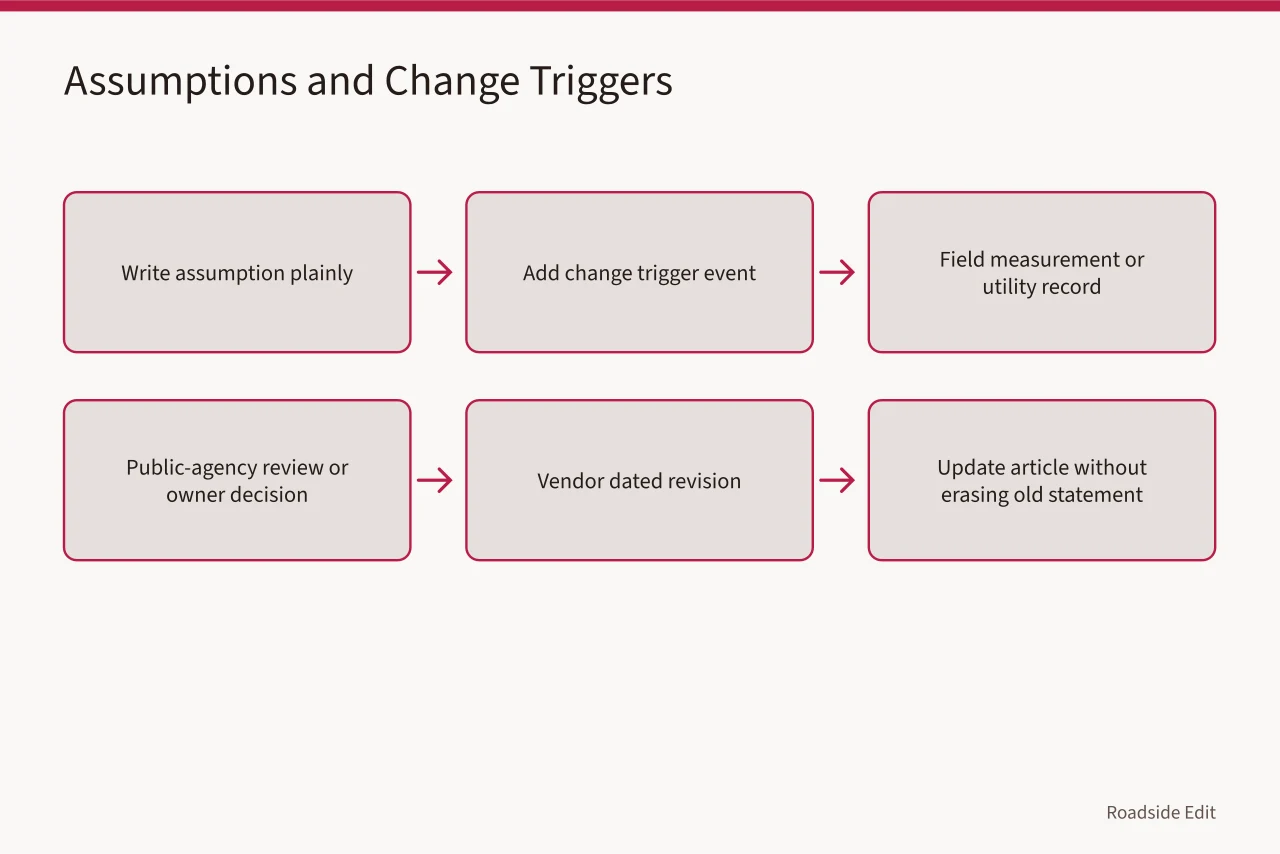
Then add a change trigger: the event that would make the entry no longer reliable. Examples include a current field measurement, a new utility record, a public-agency review, an owner decision, a change in intended use, or a vendor's dated revision. This gives a future editor a way to update an article without pretending the old statement was never made.
GSA explains that estimates change as project scope and requirements become clearer. Review GSA cost-management guidance. Its estimate stages and figures belong to GSA projects, so this guide does not reuse them as private-project cost ranges. The source supports retaining the stage and assumptions behind every figure.
Keep content and commercial material separate
A future article can include a service provider, local project, comparison list, or sponsored placement, each needing a clear role label.
A provider description may explain the business's offerings, but it is not proof the site is safe, approved, lower cost, or successfully completed. Keep the business statement, the factual site record, and the paid-placement disclosure in separate fields.
The same rule applies to price claims. A list can identify the date and source of a publicly available range or offer, but it should not transform that source into a universal local cost. State what the source covers and what it does not cover.
Create a handoff-ready cost file
Before a planning article moves to another writer or into a CMS, gather the documents that explain the numbers and the limits around them:
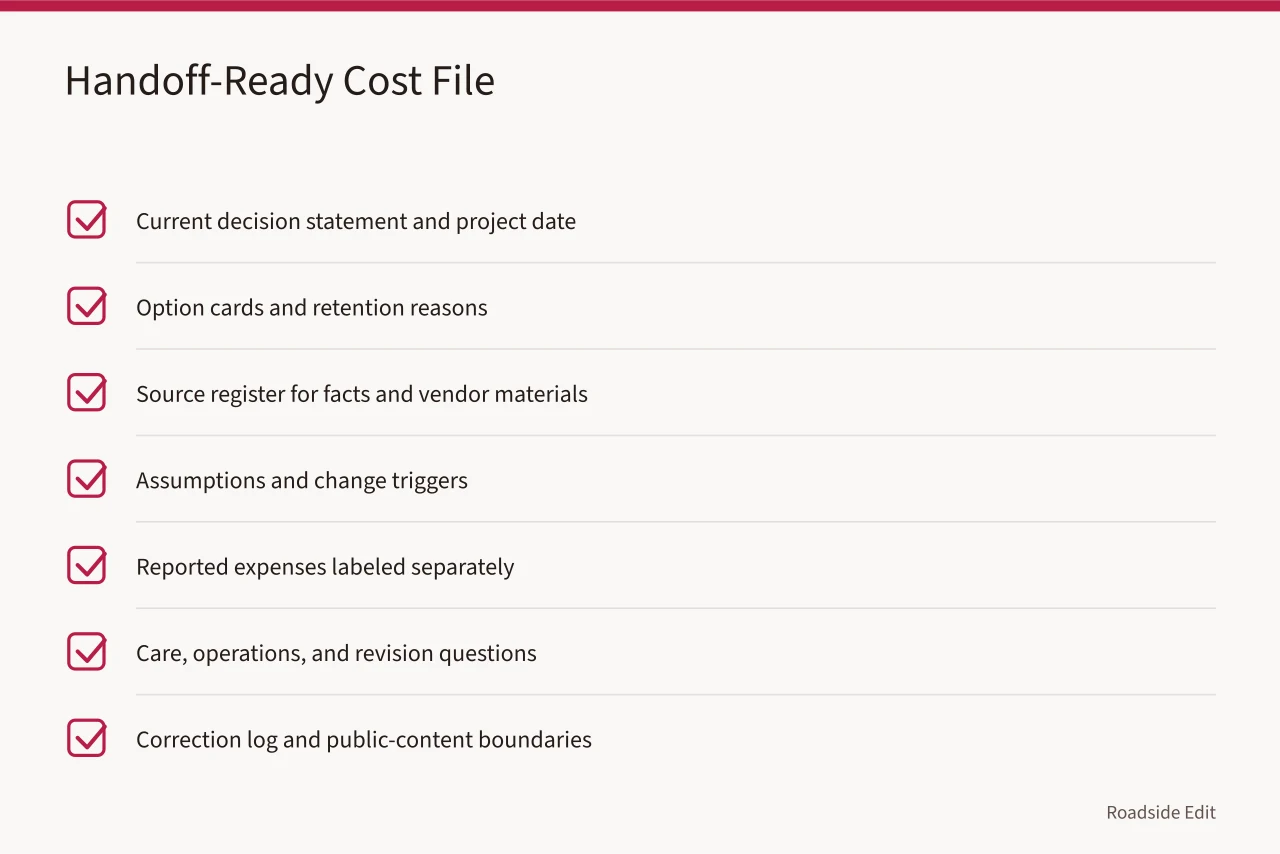
This handoff package makes a later update less dependent on memory. It also makes it easier to spot a number that was copied out of context.
Review the record before a commitment
Before a planning note is treated as a commitment, ask whether the decision owner has the current scope, whether the cited condition still reflects the site, and whether the next action belongs to investigation, selection, or implementation. A clean record can still be incomplete. Its value is that it shows what must be completed instead of concealing that gap.
If a new fact changes the option, revise the option card, the assumption register, and any public article that relied on the earlier version. A correction should identify the date and the reason for the change. This protects a reader from mistaking an old planning range for an active decision.
The same practice applies to lists or reviews. An editor should retain a dated source for any price-related statement, state whether the material was contributed or paid for, and remove a claim when its supporting record is no longer available.
Common questions
Is a planning allowance the same as a project budget?
No. An allowance is a labeled conditional placeholder. A project budget requires its own scope, authority, and current records.
Should maintenance appear in an early comparison?
Yes, when it is relevant to the alternatives. Label it as a future care question rather than an established cost if it has not been documented.
Can an article publish a supplier's price?
Only with clear attribution, date, scope, and context. It should not be presented as a universal or guaranteed project cost.