Guides
Part of How modern roadside design cost planning works before you commit to a number
How to write modern roadside cost planning budget notes that hold up
Modern roadside budget notes for 2027 separate scope, assumptions, exclusions, allowances, estimate stage, and approved work without making price promises.
Budget notes should make the boundary of a number easy to see. They are most useful when they distinguish a current planning assumption from an approved scope or a reported past expense.
What to take away
- Initial cost is not the whole cost story.
- An exclusion field keeps later disagreements visible.
- Allowances require a trigger and an owner.
- A cost note should not overrule missing site information.
Use a full-cost lens carefully
GSA says estimates evolve as scope and requirements become clearer through a project life cycle. Read GSA cost-management guidance. That federal process does not calculate costs for a specific roadside feature. It helps a planning team avoid calling an opening amount the complete cost of an option.
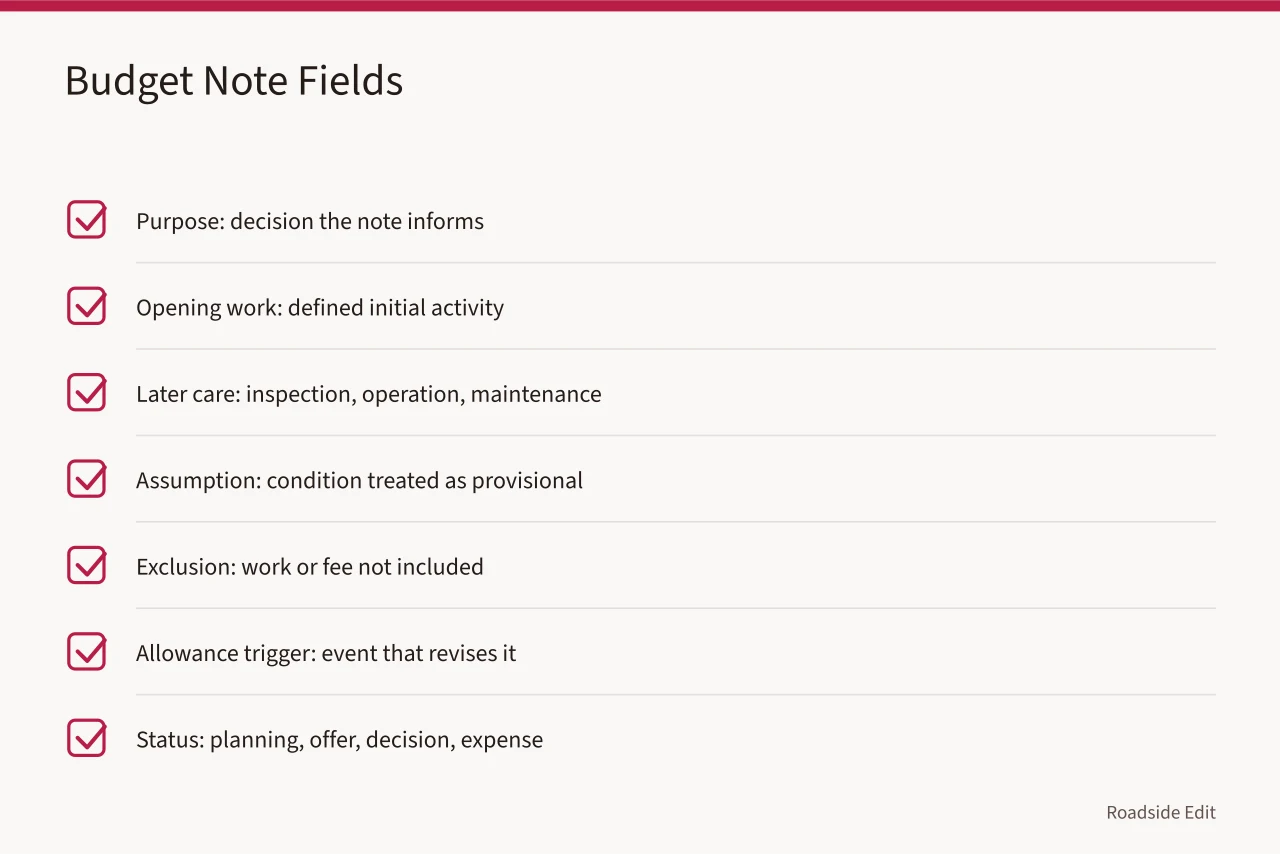
| Note field | What it should say |
|---|
Keep allowances honest
An allowance should name the uncertain condition it represents. It may depend on an investigation, a field measurement, a decision about use, a revised supplier proposal, or a required review. Do not include it in a public total as if it were already committed.
When work is phased, give each phase its own entry. This prevents a later possibility from making the first decision look more expensive or more complete than it is.
Keep the entry readable for someone who did not attend the original discussion. State the work boundary, the evidence available at that time, and the fact that an allowance is conditional. This is more useful than a total with no explanation.
If the owner chooses to proceed, create a new decision record instead of renaming the old planning note. That preserves the difference between early budgeting and an authorized action.
Record the source and stage of each number
Every amount needs a source field. The field might identify a planning estimate, design estimate, supplier proposal, approved change, invoice, or paid expense. Add the document date, author, scope version, and whether the number is a range, fixed fee, allowance, or reported amount. A number without those details is a reminder to investigate, not a figure ready for comparison.
GSA explains that its scope of work is used to create the cost estimate and should be developed before the estimate. See GSA's scope-and-estimate process. Its rule applies to a federal authorization system. The transferable practice is to keep the work description beside the number, so a later reader can see what the amount was intended to cover.
| Budget-note status | Meaning | Do not call it |
|---|---|---|
| Planning figure | Early information for a possible decision | An approved project budget |
| Provider proposal | A response to a stated scope and terms | Proof of final cost |
| Authorized change | New work that passed a stated approval step | A correction to history |
| Reported expense | A documented amount for completed or billed work | A forecast |
This language matters in public copy. A future case study can describe the process used to record a cost decision without disclosing private terms or presenting a preliminary amount as a result.
Put uncertainty in a named field
Do not hide uncertainty inside a round total. Give it a short description, such as access not confirmed, existing condition not inspected, material selection pending, or external approval needed. Then add the event that would reduce or resolve the uncertainty. This turns a vague buffer into a question that someone can act on.
FHWA cost-estimating guidance for major projects calls for documented assessment and reassessment of risk and uncertainty, including contingencies tied to identified risk elements. Read FHWA cost-estimating guidance. The guidance is for transportation projects, not roadside retail or hospitality work. It supports a simple discipline: explain the uncertainty behind a budget note rather than creating an appearance of false precision.
| Uncertainty | Next record to request | Decision owner |
|---|---|---|
| Existing condition | Dated field observation or report | Owner or designated project lead |
| Scope boundary | Revised work description | Requesting party |
| Approval path | Written requirement or response | Authority with jurisdiction or owner |
| Supplier term | Dated proposal revision | Provider and owner |
Connect the note to project documents
When a budget note refers to an older roadside building, sign, or feature, list the documents it relies on. The file might include a photograph date, drawing version, field note, preservation question, or prior report. Do not claim that a feature requires treatment based solely on a general image or an undated description.
The NPS architectural-preservation quality-review checklist includes existing conditions, work scope, treatment intent, drawings, specifications, and recordation among its review material. Review the NPS preservation QA checklist. It is not a private budgeting system. It shows why cost notes gain meaning when their assumptions can be traced to clear project documents.
Common questions
Is a lifecycle view always required?
No. Use the level of analysis appropriate to the decision, while stating what is and is not included.
What makes an exclusion useful?
It tells readers which work, condition, or fee the note does not cover.
Can a planning note become a reported expense?
Only after a reliable record supports the completed cost and the status is updated.