Costs
Part of Gas station preservation provider selection: how to choose help in 2027
Gas station preservation provider selection: budget notes before you approve 2027 work
Plan 2027 preservation hiring budgets for former gas stations by comparing scope, assumptions, allowances, exclusions, and decision-ready deliverables.
The budget for choosing preservation help is not one number that proves a project cheap, expensive, ready, or approved. Early costs often buy information needed for later decisions.
A research task, site review, concept study, and environmental assessment serve different purposes, while a design package, permit process, and construction scope also differ. Combine them too early, and a proposal becomes hard to compare.
What to take away
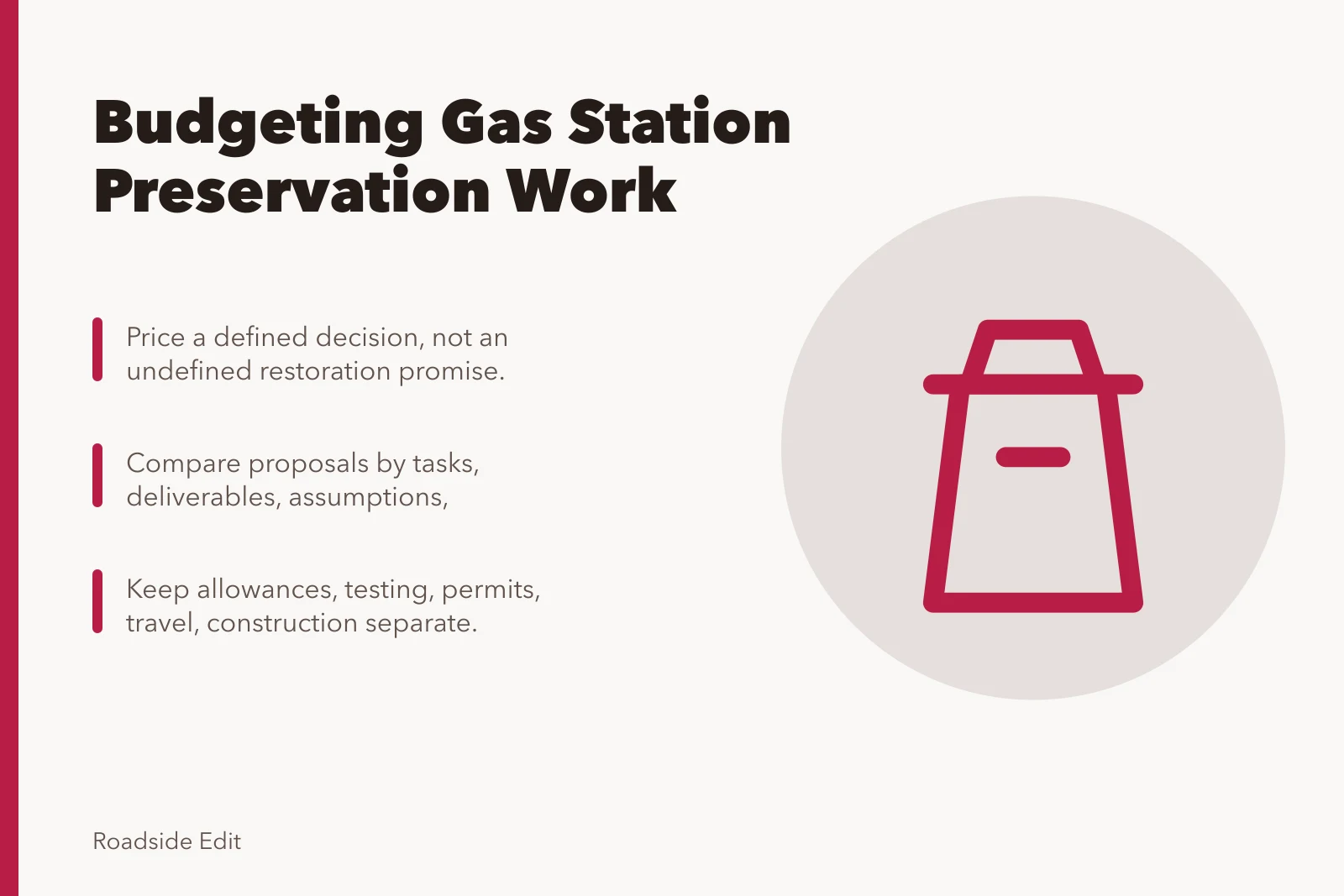
- Price a defined decision, not an undefined promise to restore a station.
- Compare proposals by task, deliverable, assumption, and exclusion before comparing totals.
- Keep allowances, testing, permits, travel, and construction work visibly separate.
- Report the stage and date with every budget figure that appears in public copy.
Start with the next decision
Write down what the budget is intended to buy. It might fund a records review and limited field observation, a preservation planning memo, a condition assessment, or drawings for a defined repair. The deliverable should let the owner decide what happens next. It should not be described as a construction budget if it only covers early planning.
A useful first question: what decision will this fee support? An owner may need enough information to retain a preservation architect, ask an environmental professional for a separate scope, seek a grant, or postpone work until access improves.
Each decision needs a different level of detail. A good proposal states the decision it informs. It does not imply a short research assignment settles every question about repair, contamination, code, or redevelopment.
| Budget line | Ask the provider | Avoid assuming |
|---|---|---|
| Research and records | What sources and reporting are included? | That an old photo confirms current condition |
| Field work | Which areas, features, and access arrangements are covered? | That a visit answers every structural or environmental question |
| Design or specifications | What decisions must be made first? | That drawings include approvals or bidding support unless stated |
| Testing and specialists | Is this included, allowed for, or excluded? | That an allowance is a confirmed price |
| Meetings and revisions | How many are included and who approves changes? | That unlimited coordination is included |
| Public reporting | What can be stated publicly about the work? | That a planning fee proves a complete project budget |
Normalize the proposals
Put each proposal in the same columns. List planned tasks, people, hours or fee basis when available, deliverables, assumed records. Add access conditions, travel, tests, approvals, exclusions.
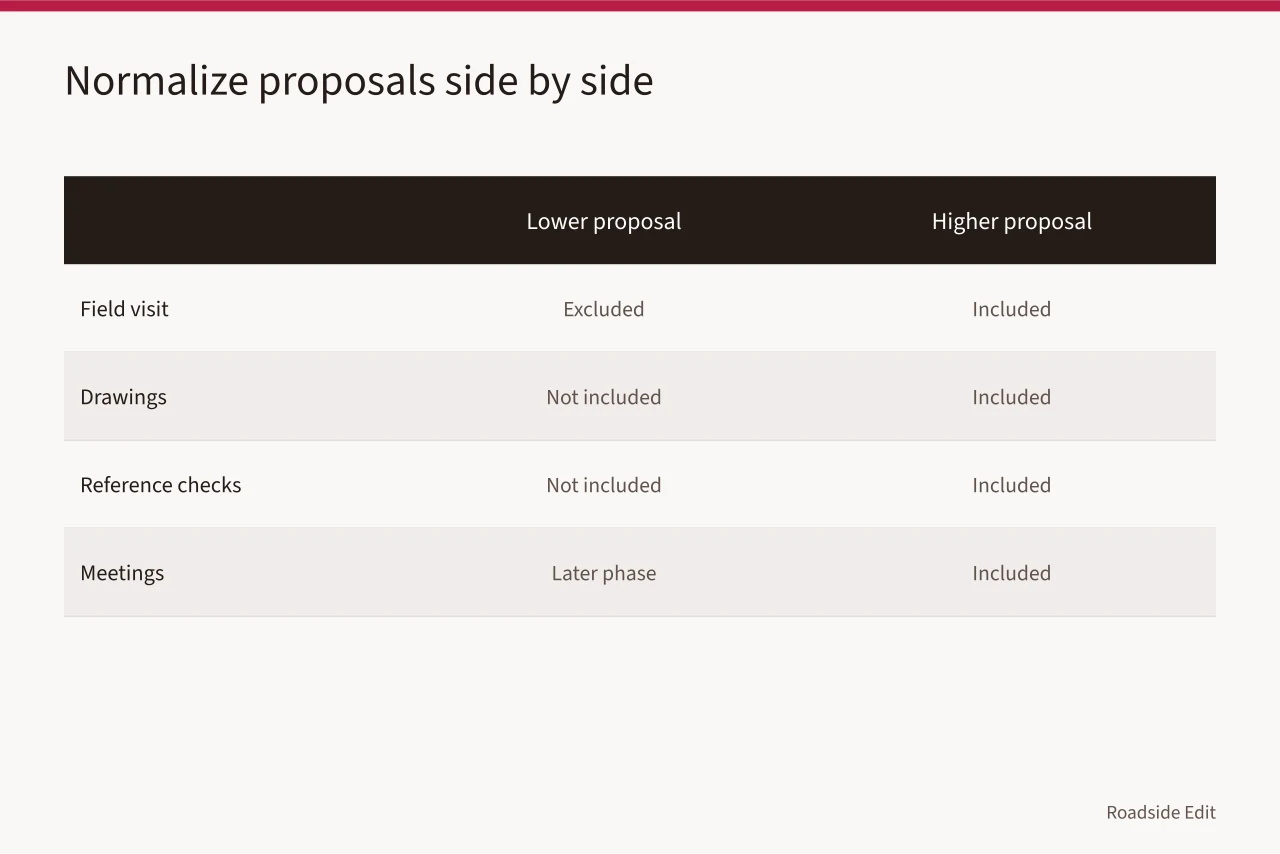
The exercise exposes differences without declaring one firm better: a lower proposal may exclude a field visit, while a higher one may include drawings, reference checks, or meetings another provider has placed in a later phase.
EPA guidance for Brownfields grant recipients emphasizes evaluating the reasonableness of cost or price proposals for the services described in the request. Read EPA's contractor-procurement guidance. Its rules apply to the program described there, not every private project. The transferable lesson is narrower: price becomes meaningful only when it is connected to a clear scope of services.
Do not force a provider to invent precision. If an existing building has limited records or restricted access, a planning proposal can state what it will inspect, what it will not inspect, and what could require later authorization. Federal acquisition guidance uses an independent government cost estimate as a planning tool before receiving offers.
GSA's cost-estimate guidance makes the same distinction in a public-procurement setting: an estimate supports an acquisition decision, while an offer is evaluated against the stated requirement. It does not set prices for private preservation work. It is a useful reminder to compare like with like.
A comparison sheet can expose a false bargain
Use one row for each proposal and one column for each decision point, and keep the original proposal beside the comparison sheet so no qualification is lost.
A lower total may depend on the owner supplying records, arranging access, selecting finishes, or hiring a separate specialist, while a higher total may include a written condition report and a meeting that save time later. The comparison is not a scorecard. It shows what each number actually buys.
| Comparison question | Why it matters before approval |
|---|---|
| What is the final deliverable? | A memo, report, and drawing set carry different decisions forward. |
| Who pays for added testing? | A separate allowance may become an owner cost later. |
| What records are assumed? | Missing deeds, photographs, or plans can change research time. |
| What ends the assignment? | A clear endpoint limits accidental expansion of a preliminary scope. |
Keep evidence and permission separate
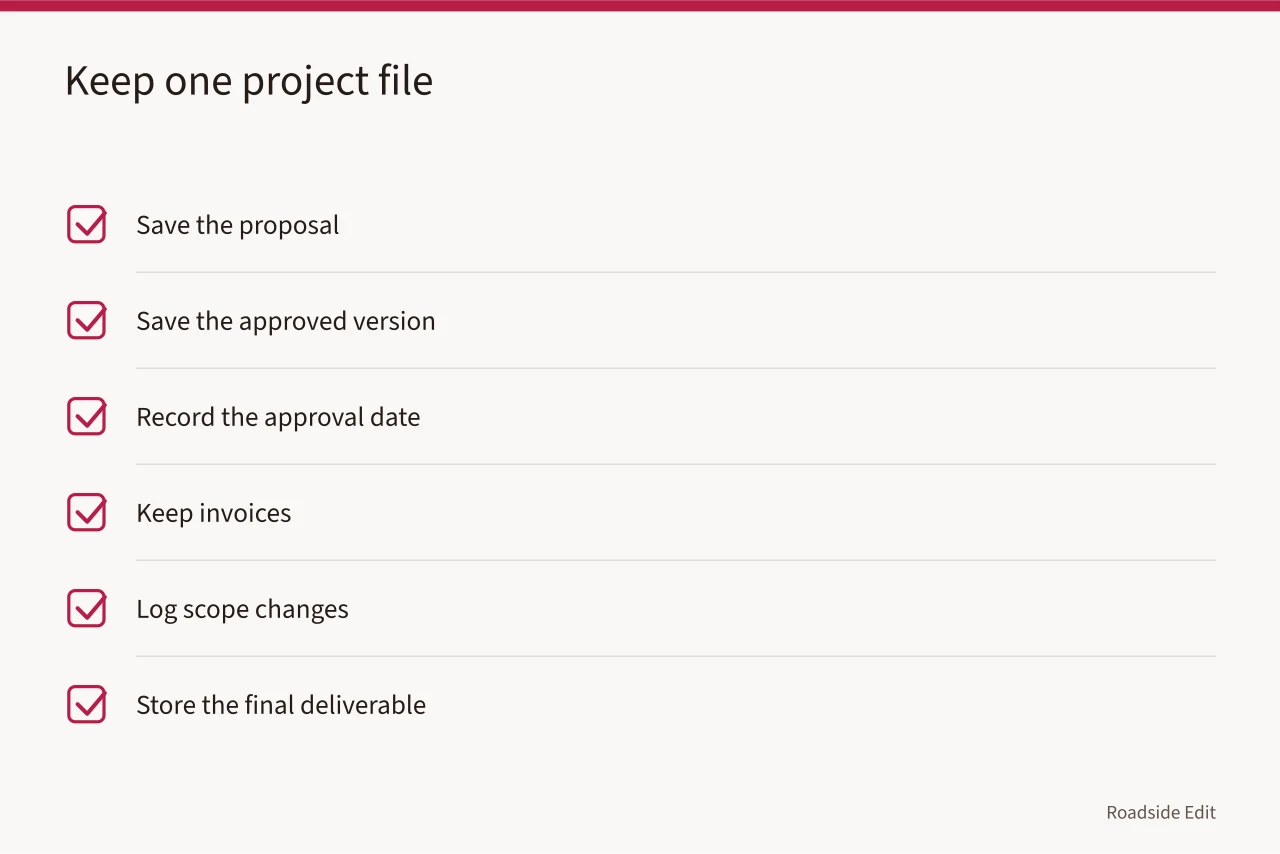
Record keeping is part of cost control. Save the proposal, the version approved, the date of approval, invoices, scope changes, and the final deliverable in one project file. The National Archives describes records management as a process for creating, maintaining, and disposing of records.
Its records-management overview is written for federal records, but its basic sequence is useful here: preserve a reliable account of what was decided and when. A file that holds only a final invoice cannot explain why the work changed.
This matters when someone later asks what a budget line meant. A note such as "field observation added after owner granted access" says more than a revised total. It also protects the editorial team. Writers should use the approved description of the work, not infer progress from a number in an invoice or a provider's marketing material.
Record changes instead of hiding them
Unknown conditions can change an assignment. Do not promise that nothing will change. State the assumptions and set a process for revising the work.
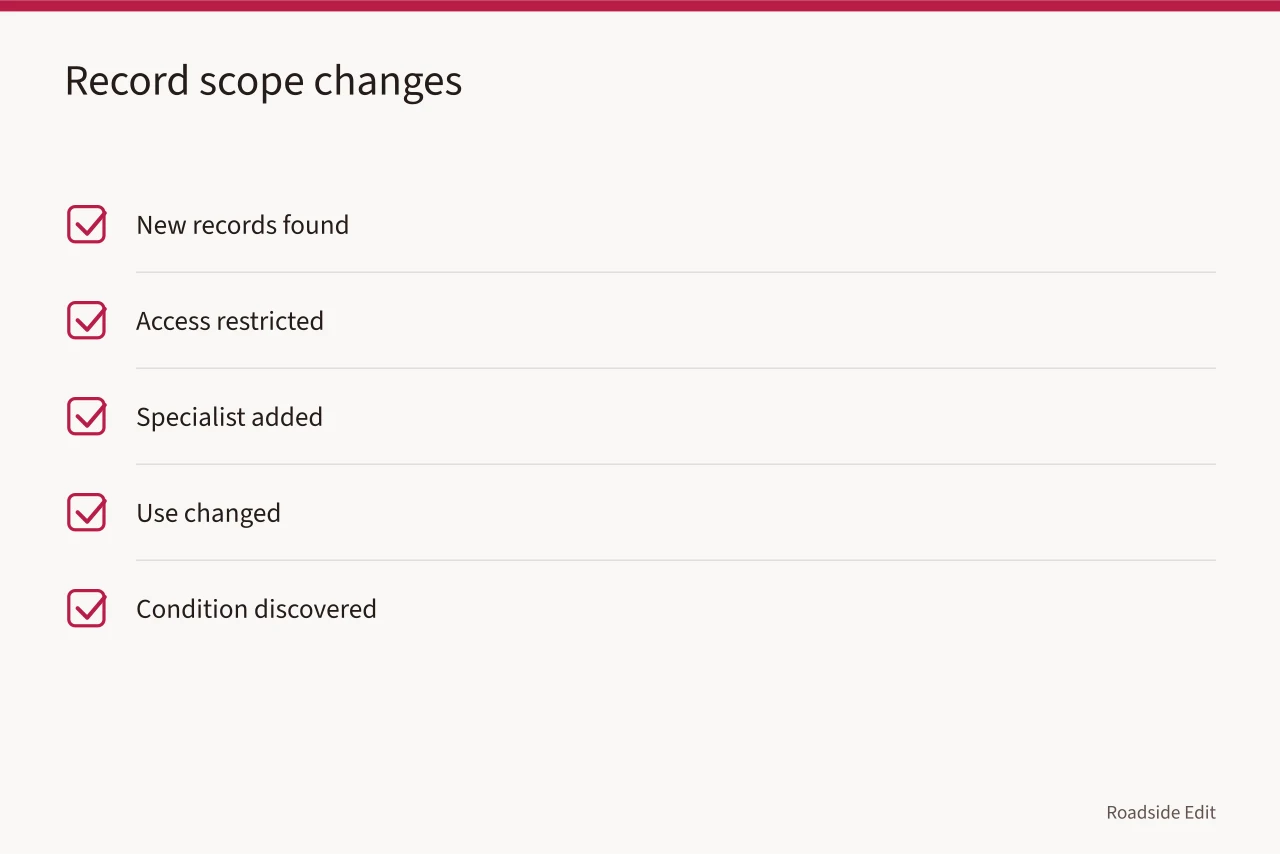
Keep a dated note when new records, restricted access, an added specialist, a changed use, or a discovered condition affects the scope. Public copy must stay accurate: "The owner is funding a preliminary assessment" is not the same claim as "The station has secured a full restoration budget."
If a provider funds an article, list, or other paid placement, put a plain disclosure near the material. The FTC's endorsement guidance says material connections consumers would not expect need clear, conspicuous disclosure.
The guidance does not require an editor to publish a fee or turn a proposal into a market-rate study. Instead, identify the sponsorship and keep the editorial description tied to documented scope.
Use an approval gate before the next phase
Before authorizing another phase, ask the provider to restate the remaining question, the work needed to answer it, the deliverable, and the newly known exclusions. The owner can then decide whether the earlier work made that phase worthwhile. This short checkpoint also prevents a preliminary assignment from drifting into design or construction support without a new written agreement.
For public articles, use cautious labels. "Planning budget" and "assessment fee" are stronger than a bare dollar figure because they tell readers what the number covers. If a number is not approved for publication, leave it out. A useful article can explain how to compare preservation budgets without claiming that every former station should cost the same.
Common questions
Is an allowance the same as a quoted price?
No. An allowance reserves a planning amount for work that may still need definition. Keep it separate from fixed, described services.
Can an early planning budget be reported as a total project budget?
No. Identify the stage, included tasks, date, and material exclusions so readers do not mistake it for a complete project figure.
Should a paid placement mention a provider's quoted fee?
Only when the provider and owner approve an accurate, scoped statement. Avoid presenting a private quote as a universal market rate.