Reviews
Part of Gas station preservation provider selection: how to choose help in 2027
Gas station preservation provider questions to ask before you compare bids
Gas station preservation provider questions for 2027 help owners compare relevant experience, scope, team roles, records, and paid-listing disclosures.
A preservation provider can help an owner frame a site question, inspect an observed condition, or prepare a treatment plan. Those are different assignments.
The first conversation should make that difference plain before comparing a fee. This question set fits an older gas station or service building where the owner needs a useful scope, not a sales pitch.
What to take away
- Give each candidate the same written background and the same core questions.
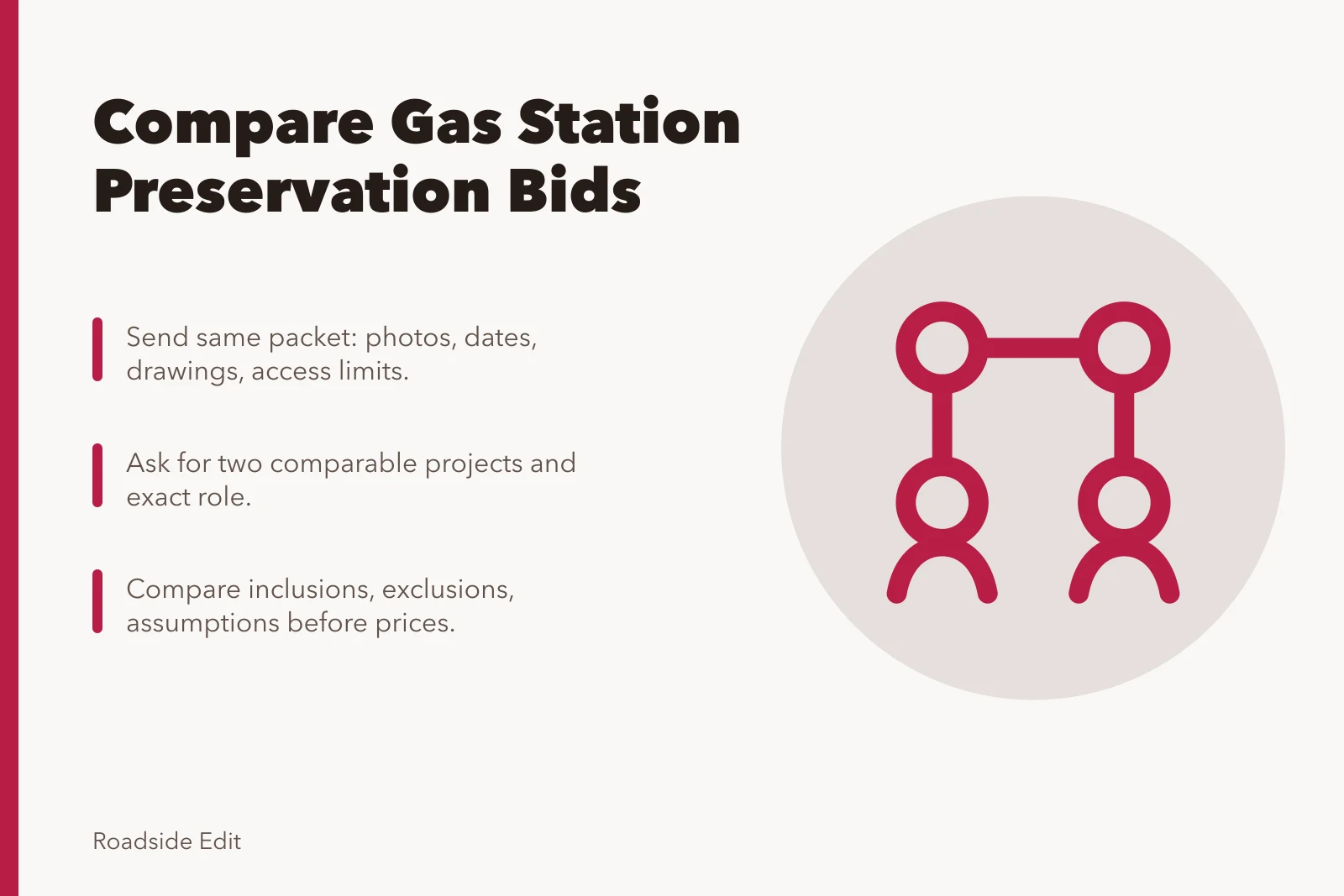
- Ask for the person's exact role on comparable work, not a list of firms or projects.
- Compare what each proposal includes, excludes, and assumes before comparing prices.
- Record the basis for the choice, including any limits in the available site records.
Start with the decision that needs help
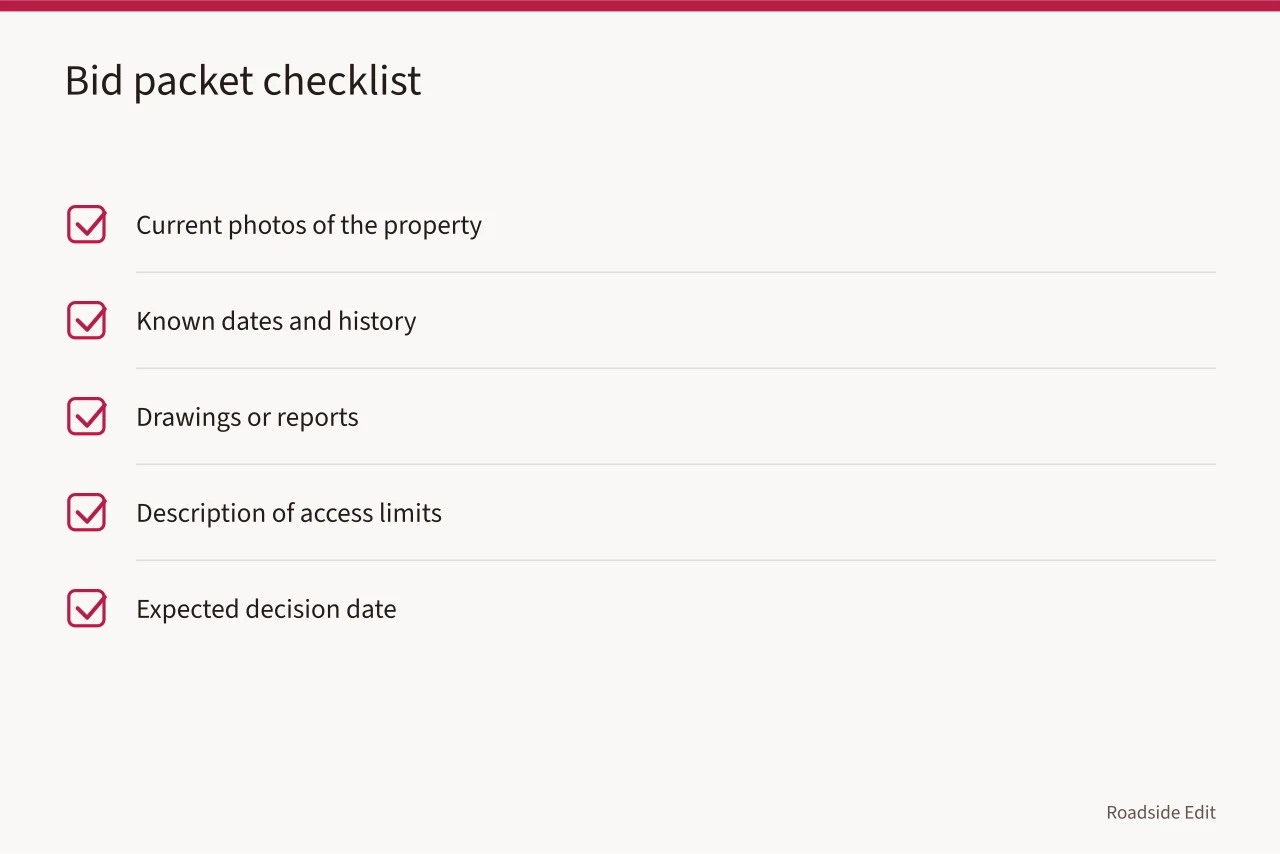
Write one sentence that identifies the immediate decision. It might be whether to stabilize a vacant canopy, document original materials before a repair, or decide what information is still missing. Then send each candidate the same basic packet: current photos, known dates, any drawings or reports, a description of access limits, and the expected decision date.
This approach keeps the conversation anchored to an assignment. It also makes weak proposals easier to spot. A provider who cannot say what they need to review, who will perform the work, or what the owner will receive at the end has not given the owner enough to compare.
Ask about comparable work, not broad familiarity
Past work matters when the comparison is specific. A provider may have worked on a hotel, a storefront, or a roadside building, yet have no useful experience with the condition or decision facing this property. Ask for two examples and then ask follow-up questions about materials, access, uncertainty, and the provider's role.
Federal contracting uses past-performance information as one input in source selection, and the Federal Acquisition Regulation's contractor performance section covers records on conformance to requirements, cost control, and schedule.
That federal rule does not control a private preservation hire. It shows why a general claim of experience is less useful than a clear account of work against an agreed scope.
Use questions such as these during each interview:
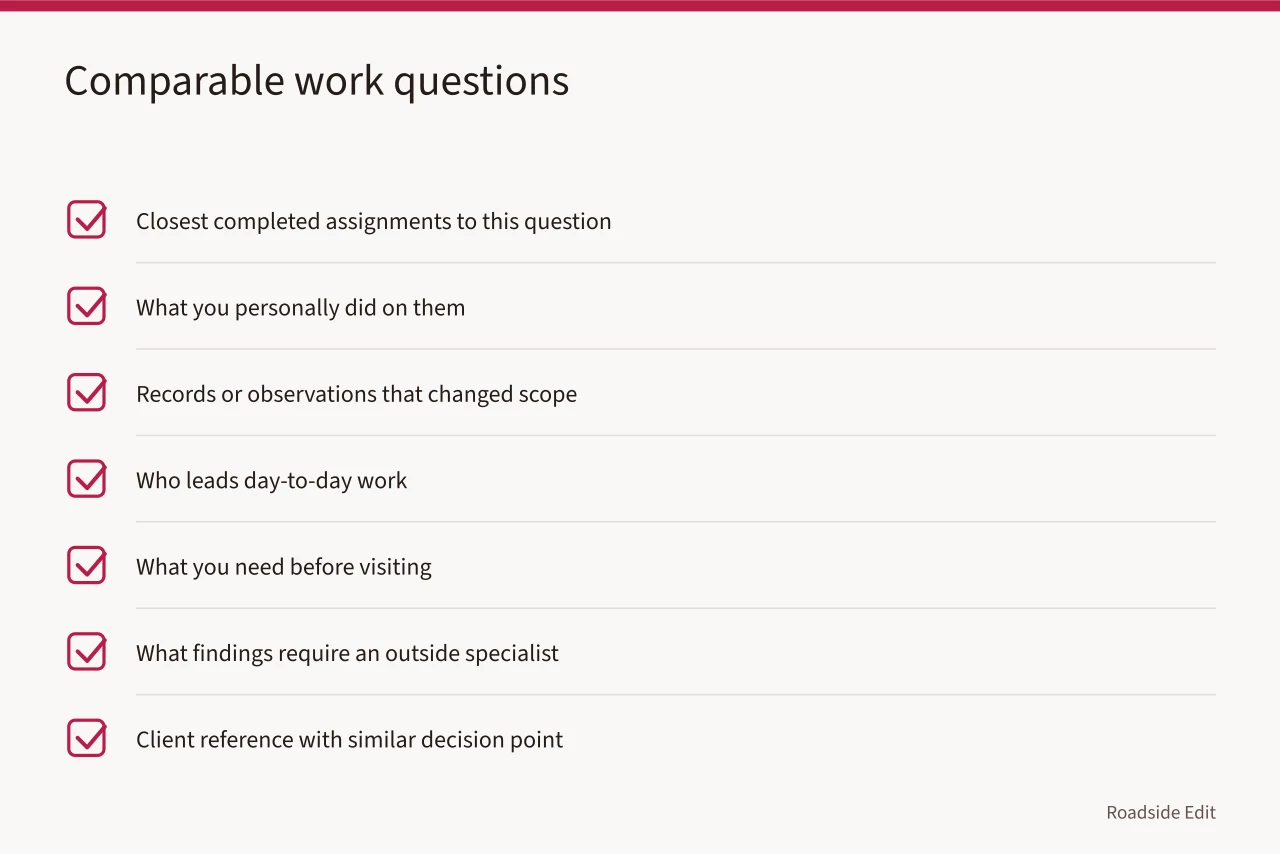
Do not treat a reference as a verdict. A former client can describe communication, timing, and whether a deliverable was usable. The owner still needs to judge fit for the present assignment.
Ask how the proposed work fits preservation treatment
The word "preservation" can cover very different work. One provider may propose a conditions assessment. Another may propose drawings for rehabilitation. A third may be offering construction services. Ask the candidate to name the proposed treatment, explain the evidence it will rely on, and state what it will not decide.
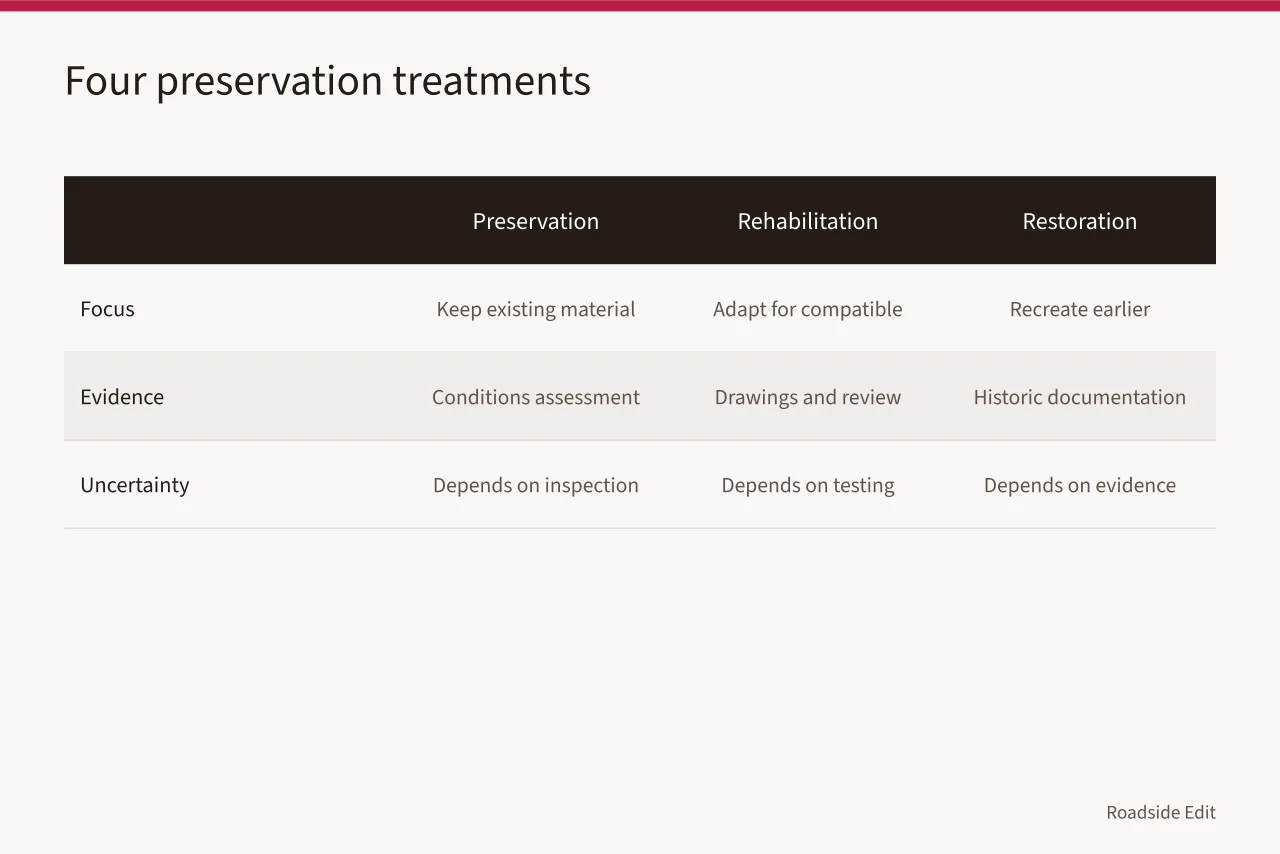
The National Park Service treatment standards distinguish preservation, rehabilitation, restoration, and reconstruction. They also describe standards for historic properties.
Those standards do not choose a treatment for a particular gas station. They give an owner a disciplined way to ask whether a proposal preserves existing material, adapts a property for a compatible use, or recreates an earlier appearance.
Questions for this part of the discussion include:
- What treatment are you proposing, and why does it fit the stated goal?
- Which existing features would be recorded before work begins?
- What evidence would support a repair, replacement, or alteration decision?
- Which assumptions depend on a later inspection or test?
- What would the report say if the evidence does not support a conclusion?
A careful answer can include uncertainty. That is often more useful than a neat conclusion that rests on a single photograph or an undocumented memory.
Confirm roles before awarding the work
Ask each candidate to identify the project lead, the person who will visit the site, and any consultants they expect to use. If the project has a federal, state, or local review requirement, ask whether the provider has worked within that process and whether a qualification standard applies. Do not assume that a professional title alone answers those questions.
The National Park Service professional qualification standards describe qualifications used in federal historic preservation programs for disciplines such as history, architecture, and archeology. They do not create a universal hiring rule for private owners. They are still a useful prompt to ask which discipline is needed, who is responsible for that work, and whether the assignment calls for another specialist.
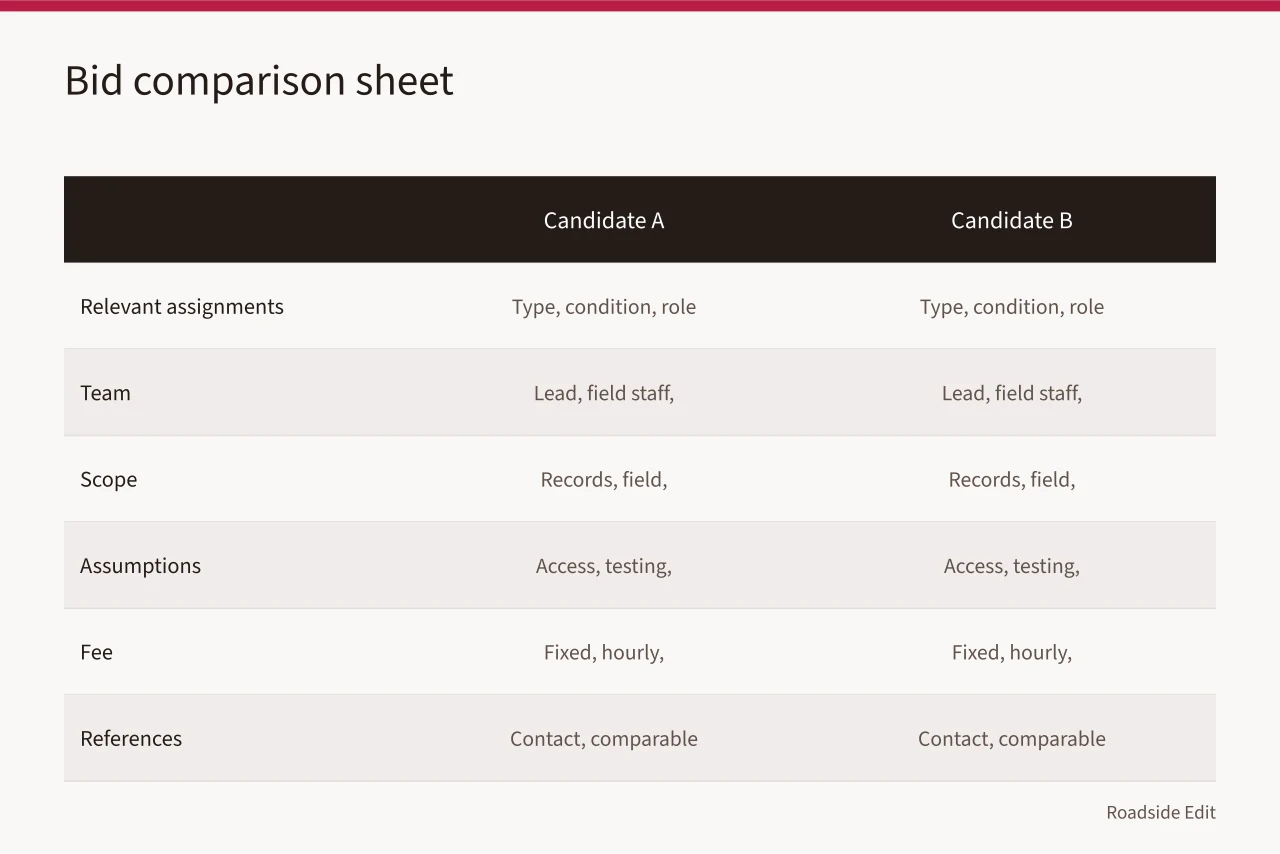
Use a simple comparison sheet after the interviews:
| Compare this item | What to record |
|---|---|
| Relevant assignments | Project type, condition, decision, and candidate role |
| Team | Named lead, field staff, and outside specialists |
| Scope | Records review, field work, meetings, deliverable, and exclusions |
| Assumptions | Access, testing, permits, missing records, and owner decisions |
| Fee | Fixed amount, allowance, hourly work, expenses, and change process |
| References | Contact, comparable issue, and questions still to confirm |
The sheet is not a scoring formula. It is a record of what each candidate actually offered. Keep it with the proposal files so that a later reviewer can see why the selected scope fit the decision then in front of the owner.
Separate a provider recommendation from public promotion
Some sites publish provider directories, project roundups, or paid placements. Those are editorial products, not proof that a provider is right for a particular property. If money or another material relationship affected the placement, the relationship should be plainly disclosed near the endorsement.
The Federal Trade Commission's endorsement guidance explains that a material connection between an endorser and a seller should be disclosed when consumers would not expect it. The guidance does not replace project-specific procurement or preservation review. It supports a simple boundary: paid visibility must not be presented as an independent technical finding.
Common questions
Should every provider get the same question list?
Yes. A common set creates a fair starting point and makes differences in scope easier to identify. Follow-up questions can address a specific answer or a missing detail.
Is the lowest fee usually the best choice?
No. A lower price may describe a narrower scope, fewer site visits, or a deliverable that cannot support the next decision. Compare the work promised before comparing the total.
Can a provider confirm that a building is officially approved for a project?
Only the responsible program or reviewing authority can make its own determination. A provider can explain the assignment, prepare materials, and identify questions that need formal review.
Can a paid directory entry count as a professional recommendation?
No. A paid entry can describe a provider's services if the commercial relationship is disclosed. It should not be treated as a technical conclusion about a property's condition or eligibility.