Guides
Gas station preservation provider selection: how to choose help in 2027
Choose gas station preservation help in 2027 with a clear scope, evidence-led questions, comparable proposals, and records that keep claims honest.
Choosing help for a former gas station is not mainly about the most polished website or lowest early number. It means matching a real question to the right kind of help.
A property may need historical research, condition assessment, environmental work, code analysis, design. It may need construction, a new operating plan, or several in a deliberate order. Calling it "restoration" makes proposals harder to compare and easier to publish a claim the records do not support.
This guide is for an owner, community group, or editor planning the conversation. It does not tell a reader which firm to hire or what a named property requires. It gives the project a practical selection record, so the eventual choice can be explained without turning marketing language into a professional conclusion.
What to take away
- Begin with the decision you need help making, not a vague request to "save" the station.
- Separate preservation, environmental, design, code, operating, and construction questions.
- Ask candidates for comparable evidence: relevant work, named roles, approach, assumptions, and deliverables.
- Do not compare prices until the proposed services are sufficiently alike to compare.
- Attribute business statements and avoid calling a project approved, safe, or complete without a current source.
Start with a problem statement, not a provider list
Write one page before contacting anyone. Identify the property, the known history, the proposed next step, the available records, access limits, and the question that needs an answer. A useful statement can be plain: "We need to understand the condition of the canopy and exterior materials before proposing repair options." It is much stronger than "We need a restoration expert."
The wording matters because a project contains different kinds of work. A historic consultant may help identify character-defining features and research records, while a design professional may develop drawings and coordinate code questions. An environmental professional may address site conditions, and a contractor may price and perform defined work.
One person can hold multiple roles only when the work, qualifications, and conflicts are clearly understood.
The Smithsonian's planning and construction process develops scope, selects an architect-engineer, verifies level of effort, and aligns requirements with stakeholder expectations. See the Smithsonian planning, design, and construction overview.
That describes an institutional process, not a rule for a private station. It still supports a first principle: define the work before assuming the provider category.
Map the questions to the type of help
Use a question map rather than a single catchall brief. It makes gaps visible and prevents a consultant from being judged on work that was never requested.
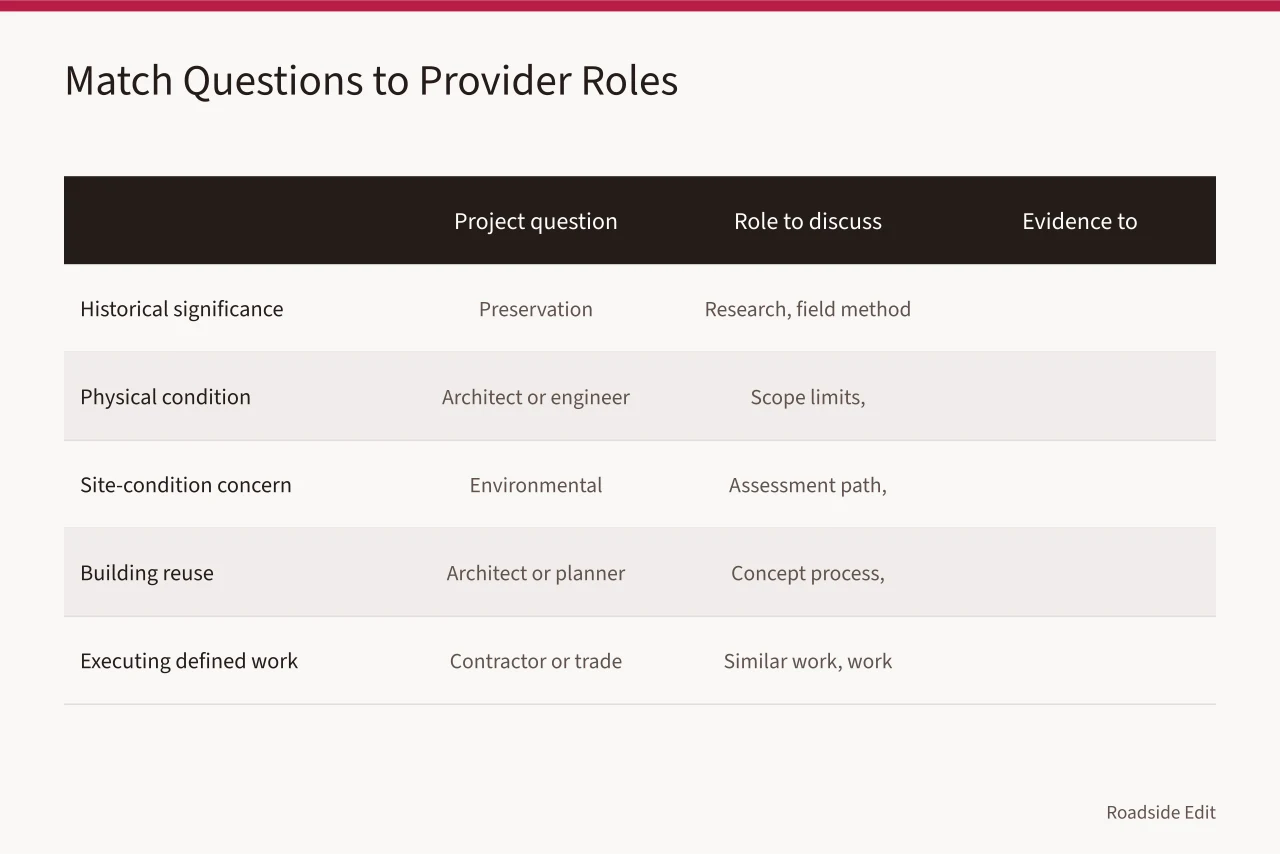
| Project question | Possible role to discuss | Evidence to request | Claim to avoid |
|---|---|---|---|
| What is historically significant? | Preservation researcher or qualified design professional | Relevant research, field method, sample deliverable | "Original" based on appearance alone |
| What is the current physical condition? | Architect, engineer, or specialized assessor | Scope limits, inspection method, exclusions | "Structurally sound" without a report |
| Is there a site-condition concern? | Appropriate environmental professional | Planned assessment path and regulatory limits | "Clean" because the site looks maintained |
| How can the building be reused? | Architect, planner, owner representative | Concept process, approvals to check, operating assumptions | "Ready to open" before approvals and operations exist |
| Who can execute defined work? | Contractor or specialist trade | Similar work, named lead workers, work plan | "Authentic restoration" without a documented approach |
The table does not assign a legal scope of practice. Local licensing rules, funding conditions, and property circumstances matter. Its purpose is editorial discipline: a paid placement, project update, or article should say which question is being addressed and who is responsible for it.
Build a short list with comparable evidence
Ask each candidate for the same small material set, as a long brochure is less useful than an easy-to-compare response; request relevant examples, not just any old-building project.
A former service station can combine vehicle access, canopy work, signage, petroleum history, and service bays. It can involve concrete, masonry, and a public-facing reuse plan. The closest example may not be another station, but the candidate should explain why it transfers.
Use a consistent request:
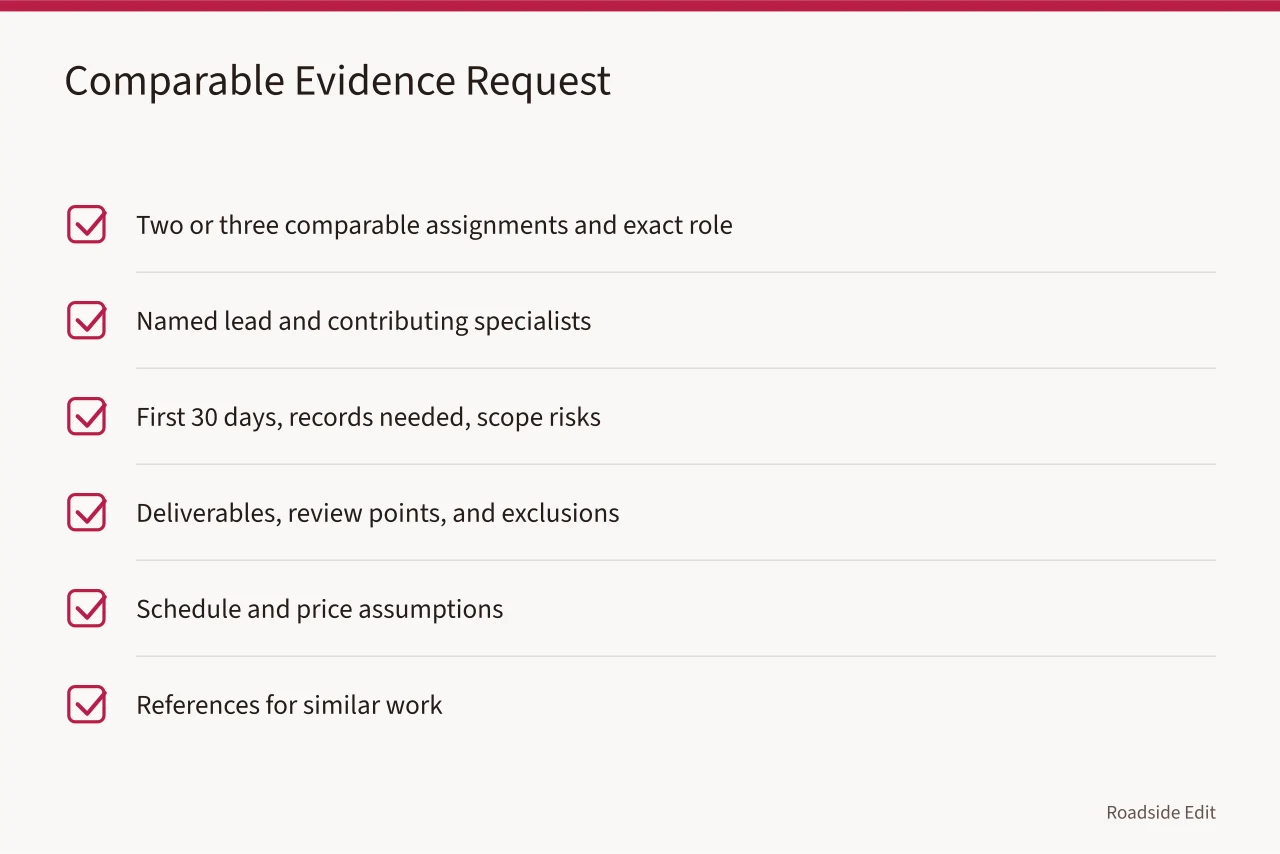
Do not treat a portfolio image as proof of the candidate's role. Ask whether the person led research, wrote specifications, managed construction, performed a trade, or worked only on a small component. The answer helps a committee compare work fairly and prevents an article from overstating a firm's connection to a project.
Use a scorecard that preserves judgment
A scorecard is a record of reasoning, not a machine that picks a winner. Assign weights before reviewing proposals, keep the written notes, and leave room for a disqualifying concern. The exact weights should follow the project, but a simple starting model is below.
| Factor | What a reviewer can look for | Example weight |
|---|
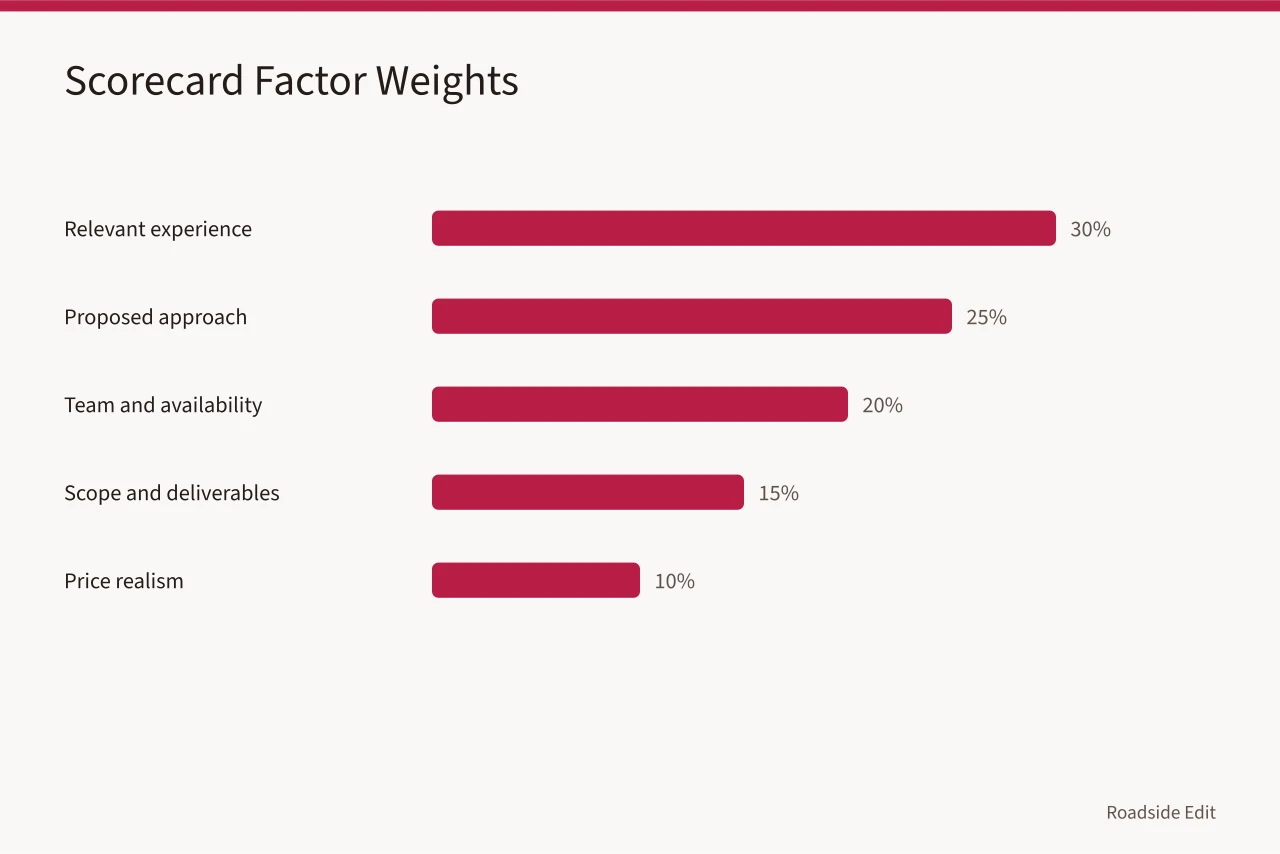
The score is not a substitute for checking references, conflicts, licenses, insurance, or locally required procurement rules. It also should not be used to disguise a decision that was already made. If a sponsor relationship exists, disclose it to the people scoring the work and keep the commercial relationship separate from the selection record.
Compare proposals only after clarifying the scope
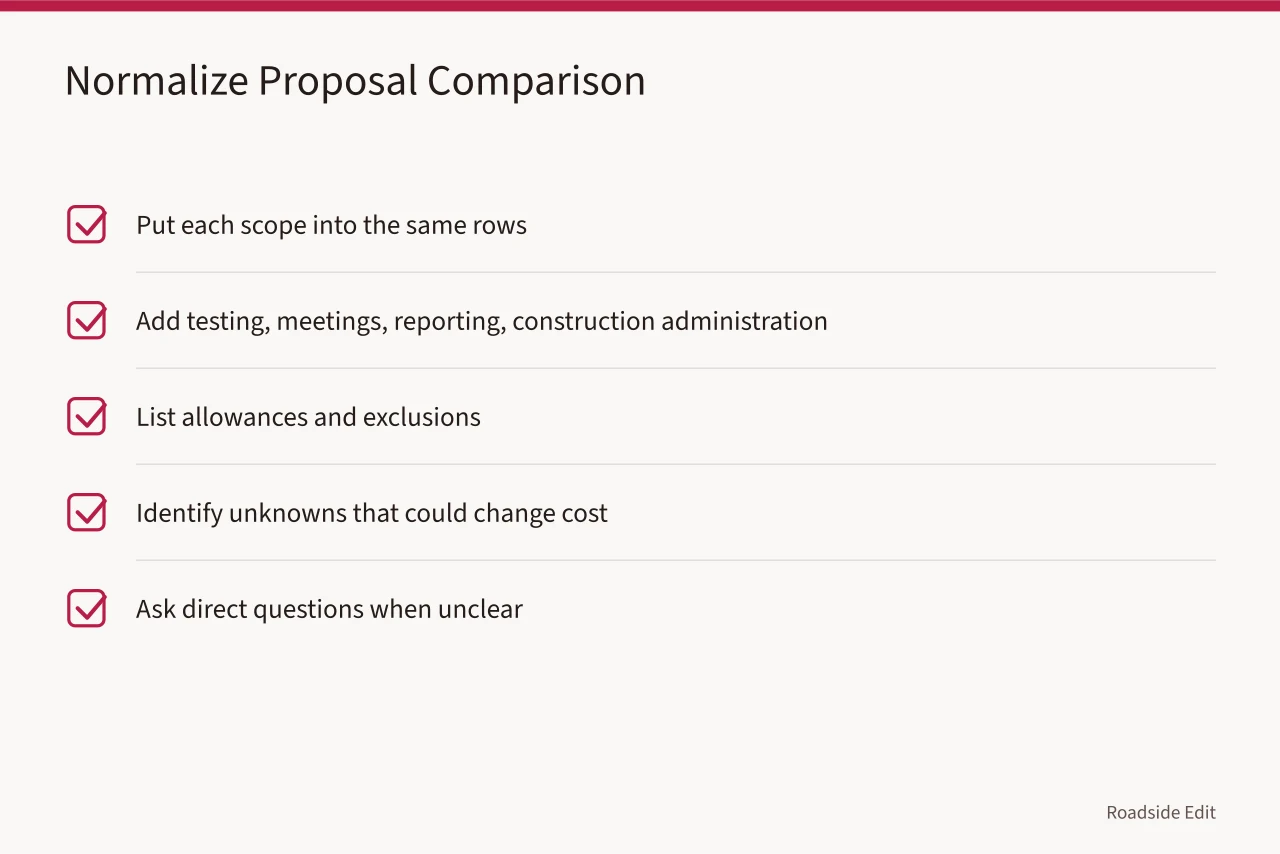
Ask direct questions when the comparison is unclear:
- Is the candidate proposing a preliminary review or a complete design package?
- Is a site visit included, and what areas are excluded?
- Does the price assume records, access, testing, or permits that have not yet been obtained?
- Which deliverable will let the owner make the next decision?
- What event would require pausing or revising the scope?
A better article reports the answer in context. It does not state that a project will cost a specific amount unless that figure is current, attributable, and clear about its scope. A range from an early concept is not a final contract value. A bid total is not a claim about eventual condition, approval, or operating success.
Plan for environmental and preservation work to meet, not blur
Former gas stations can involve both historic features and site-condition questions. Those questions need coordination, but they should not be collapsed into one confident statement. An owner may need environmental information before a reuse decision, and a project may need preservation information before a replacement decision. The correct order depends on the property and proposed work.
For editorial purposes, maintain separate records for environmental documents, historical evidence, condition observations, proposed treatment, and business announcements. Each record should show the date, source, scope, and reviewer. If an outside contributor supplies a claim, label it as supplied until the responsible party confirms it. Never imply that a marketer, photographer, or publisher has performed a professional assessment.
Agree on the working relationship before work starts
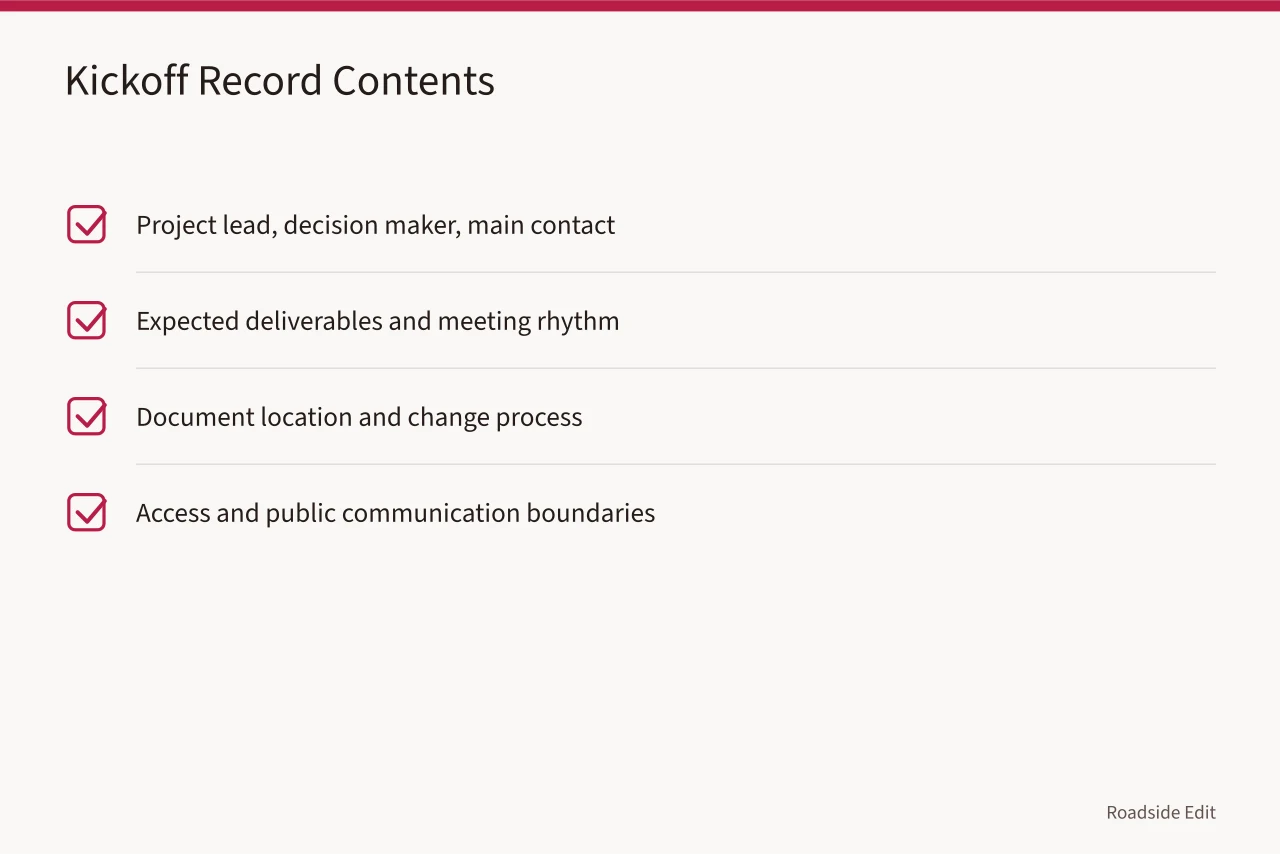
Writers and photographers must not enter closed areas, move materials, climb a canopy, or call conditions verified merely because a provider was hired.
Keep public language modest while the work is underway. "The owner has engaged a consultant to review existing documentation" is clearer than "The station is being restored." "A proposal is under review" is clearer than "The project is approved." The narrower wording protects readers and providers alike. It stays accurate when the scope changes.
The National Park Service publishes professional qualification standards for federal historic-preservation work. They do not prescribe a team for a privately owned station. They do reinforce the value of matching the required discipline, the individual role, and the proposed work instead of evaluating a candidate only through broad marketing language.
Keep selection materials in a retrievable file. The National Archives' records-management overview describes organizing records for future use. Preserve the original request, proposal, stated assumptions, reference notes, selection rationale, and later scope revisions. That record is what lets an editor say a professional was engaged for a specific task without implying a complete assessment or guaranteed outcome.
Any paid directory placement should identify the relationship plainly. The Federal Trade Commission's endorsement guidance addresses disclosures where material connections could influence an endorsement. It provides a sound editorial boundary: a sponsor can be described as a sponsor, while a selection decision remains tied to the owner's documented process.
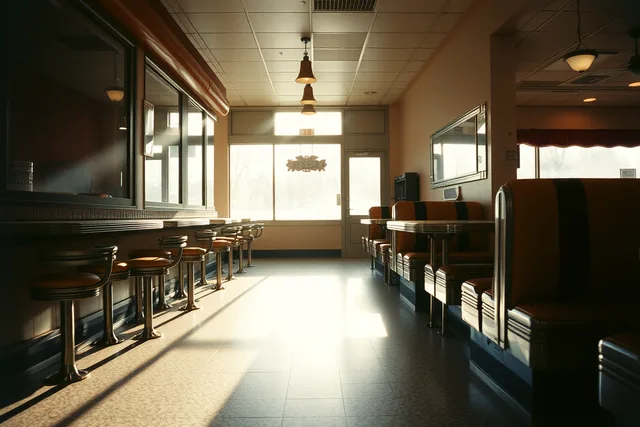
The image is illustrative only and does not document any other property's condition, project team, or approval status.
Keep a decision record after the choice
Save the request, candidate responses, comparison notes, conflict disclosures, and reference-check notes. Save final scope and material clarifications. They make the choice easier to explain to a board, funder, partner, or future editor and limit accidental exaggeration.
Months later, someone may remember a firm was 'chosen for experience' but forget whether that meant station research, masonry repair, code planning, or construction management.
The record can be simple. Its value comes from precision. State what was reviewed, who decided, why the selected scope fit the next decision, and what remains outside the engagement. If a new condition changes the work, add a dated note rather than silently rewriting the history.
Common questions
Should one company handle every part of a station project?
Not automatically. The best arrangement depends on the questions, required expertise, local rules, and project sequence. First define the decisions and evidence needed.
Is a low proposal proof that a provider is efficient?
No. A lower price may reflect a narrower scope, different assumptions, or excluded work. Compare services and deliverables before comparing totals.
Can a publisher call a project "restored" after a provider is hired?
No. Hiring a provider does not establish the treatment, approval, progress, or outcome. Describe only the documented stage of work.
In this guide
- Gas station preservation provider selection: build a scope checklist before you hireGas station preservation hiring checklist for 2027: define scope, compare qualified teams, document assumptions, and keep the selection record clear.
- Gas station preservation provider questions to ask before you compare bidsGas station preservation provider questions for 2027 help owners compare relevant experience, scope, team roles, records, and paid-listing disclosures.
- Gas station preservation provider selection: budget notes before you approve 2027 workPlan 2027 preservation hiring budgets for former gas stations by comparing scope, assumptions, allowances, exclusions, and decision-ready deliverables.
- Gas station preservation provider records owners should keep in 2027Keep better 2027 preservation-provider records for former gas stations, including scope, roles, references, decisions, changes, and public-claim support.