Guides
How to run a roadside renovation case study method that separates evidence from inference
Roadside renovation case study method for 2027: separate evidence from inference, preserve source limits, track project context, and report outcomes carefully.
A useful roadside renovation case study does not say, "this project worked, so copy it." It shows what happened at one documented place, why the source is credible, which facts belong to that case, and which questions remain open for another property. The method matters because a striking before-and-after photo or a popular local story can make a narrow result sound universal.
This guide is an editorial method for documenting U.S. roadside renovation examples. It is not an assessment of a property, technical direction, a prediction of cost or approval, or a recommendation that another owner use the same work, material, provider, or schedule.
What to take away
- Start with a defined case question and a named source, not an outcome headline.
- Separate direct evidence, attributed statements, observations, and editorial interpretation.
- Keep the original project's location, date, scope, funding context, and limitations visible.
- Do not treat a case-study result as a code, safety, access, budget, or materials conclusion for another property.
- Preserve a source ledger so a later editor can check every significant claim.
Define the case boundary
Every case study needs a beginning and an end. Identify the named property or project, its location, the period covered by the sources, the stated objective, the available records, and the article's question. For example, an article may ask how a documented rehabilitation used historic records to explain a window decision. It should not expand that question into whether every roadside building should use the same window approach.
The boundary also tells readers what has been excluded. A case study may not know the total cost, the full condition of the property before work, a private financing detail, or how the project performs years later. State those limits. A shorter honest case is more valuable than a long story built from inference.
Build an evidence table before writing
Create a table before drafting the narrative. It keeps the article from letting one source carry more than it can support.
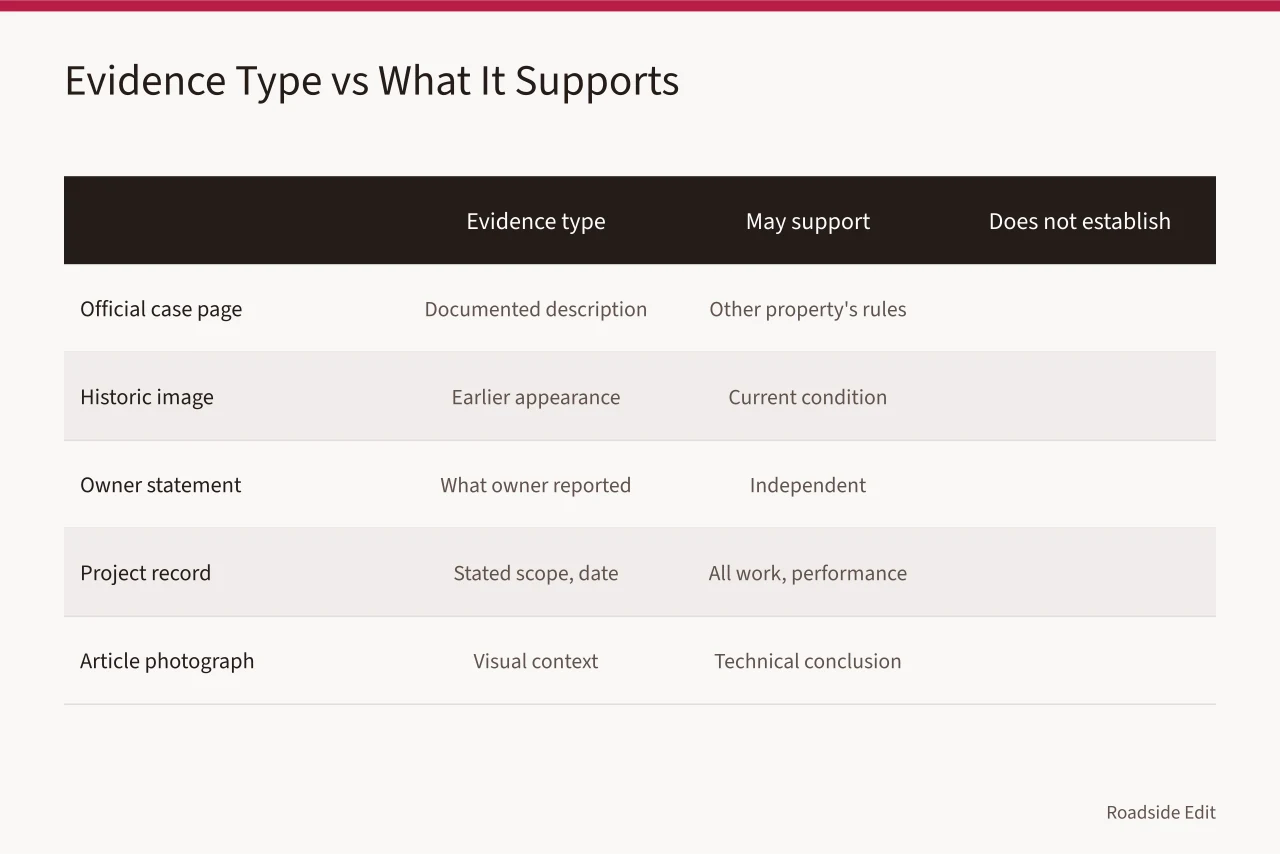
For each row, record the URL or file, publisher, publication date, project date if different, exact claim, and limitation. If a source conflicts with another source, do not hide the conflict. Record it, use the narrower supported sentence, and identify what information would resolve the difference.
Use the case as a documented example
The National Park Service's Matthews Stone Company case study describes a particular historic industrial complex and its rehabilitation work, including repairs, a continuing use, and window changes based on historic documentation. Read the NPS Matthews Stone Company case study. That source supports reporting the details it identifies about that project. It does not prove that a similar roadside building needs the same changes, has the same history, or qualifies for the same program.
This is the central case-study rule: name the subject, name the source, describe the documented action, and stop at the source boundary. The transferable lesson belongs at a different level. In this example, the lesson is that a project can use historic documentation to inform a specific decision. The lesson is not that a certain replacement is always compatible.
Distinguish the four voices in a case study
A strong piece clearly separates four kinds of statements:
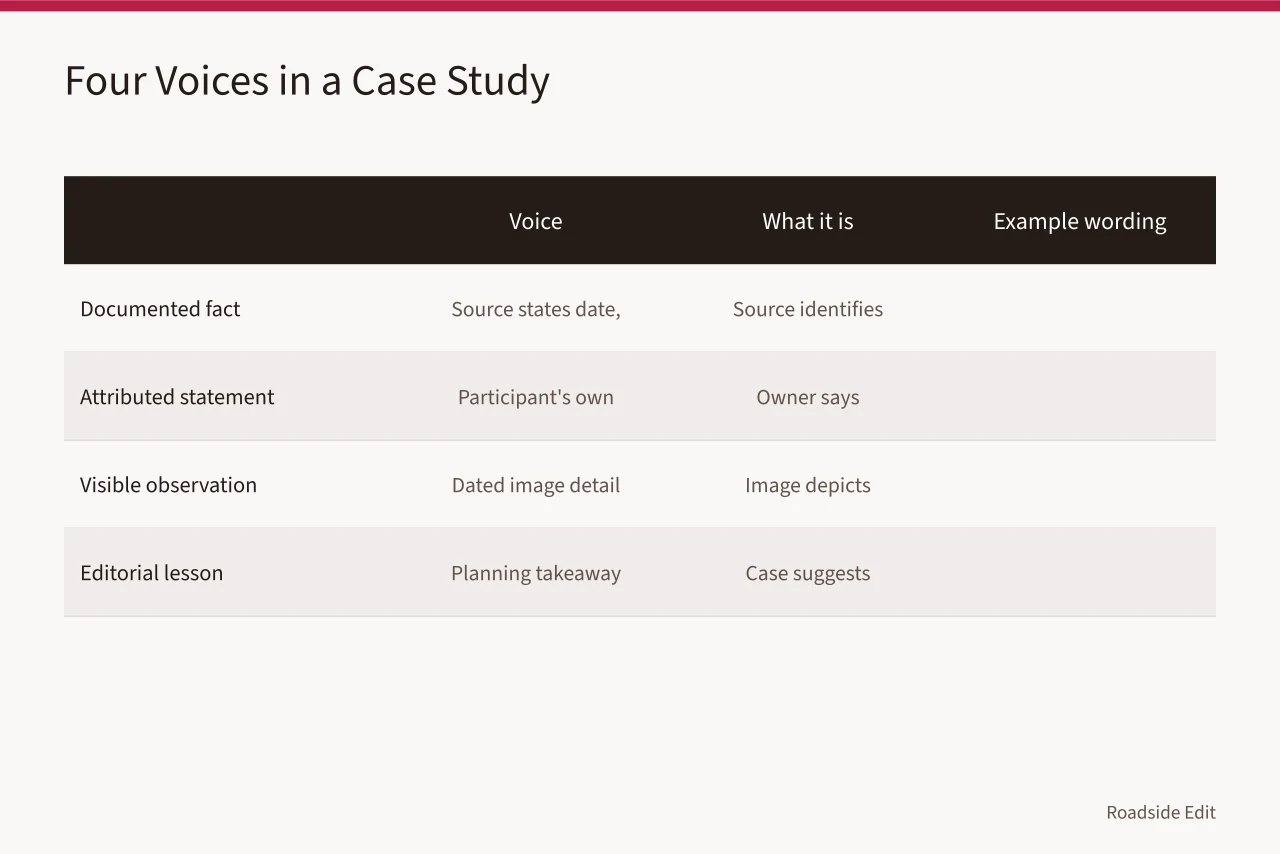
- Documented fact: a source identifies a date, feature, work item, or project status.
- Attributed statement: an owner, agency, sponsor, or participant says something that is presented as their statement.
- Visible observation: an authorized image visibly shows a limited detail at a stated time.
- Editorial lesson: the article explains what planning or reporting practice can be learned without claiming a universal project result.
Do not place an editorial lesson in the same grammatical form as a documented fact. "The case suggests a records-first approach" is a modest editorial lesson. "All roadside projects need this approach" is an unsupported universal claim. The difference protects the reader and makes the article more useful to a future researcher.
Keep money and outcomes in context
Case studies frequently contain a grant number, budget reference, incentive, or business outcome. Treat each as an attribute of that project and date. A grant reported in a case source does not identify a current program or amount for another location. A completed scope does not prove a market result. A public reopening does not prove that all technical, safety, or access questions are resolved beyond what the responsible record states.
If the source does not report a cost, do not manufacture one. If it reports one category of funding, do not call it the total project value. If an article needs a budget lesson, explain how the source labels the figure and what it excludes. This is particularly important for sponsored coverage, where a business may have an incentive to turn a case history into a sales promise.
Test the draft sentence by sentence
After drafting, make one quiet editorial pass for evidence drift. Read each factual sentence and place it in one of three groups: directly supported by the cited source, a clearly marked observation of a dated image, or a planning lesson drawn from the article's method. Anything else is a candidate for revision. This is faster and more reliable than adding a general source at the end of a long paragraph.
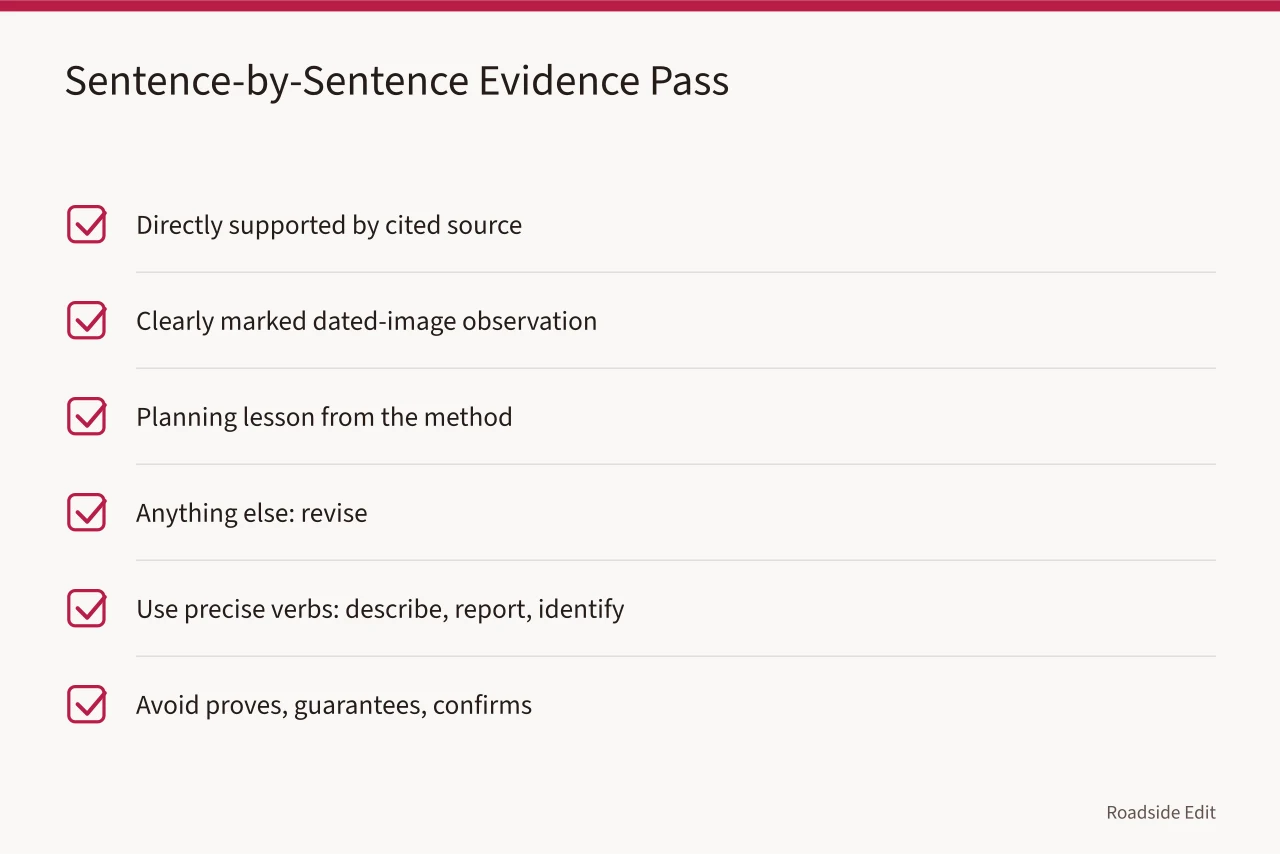
Use precise verbs. A source may describe, report, identify, depict, announce, or attribute. Those verbs tell the reader how close the article is to the underlying record. Avoid verbs such as proves, guarantees, establishes, and confirms unless the source actually makes and supports that high-confidence conclusion. An archived news item can document that something was announced; it is not evidence that the announcement later happened as intended.
Separate source facts from editorial work
An editor still has an important job after the sources have been collected. The editor can organize a complex chronology, compare the wording of records, identify a missing item, explain why a conclusion is limited, and frame questions for a reader. Those are legitimate editorial contributions when they are visible as such. They do not turn the publication into the authority for facts it has not independently established.
One practical test is to remove the article's conclusions and read only the attributed facts. If the remaining account is coherent, the source foundation is likely clear. Add the editorial lesson back in a final, labeled section. If the account collapses because it relies on a claim with no source, either find better support or delete the claim.
Use a small review checklist
Before scheduling a case study, ask these questions:
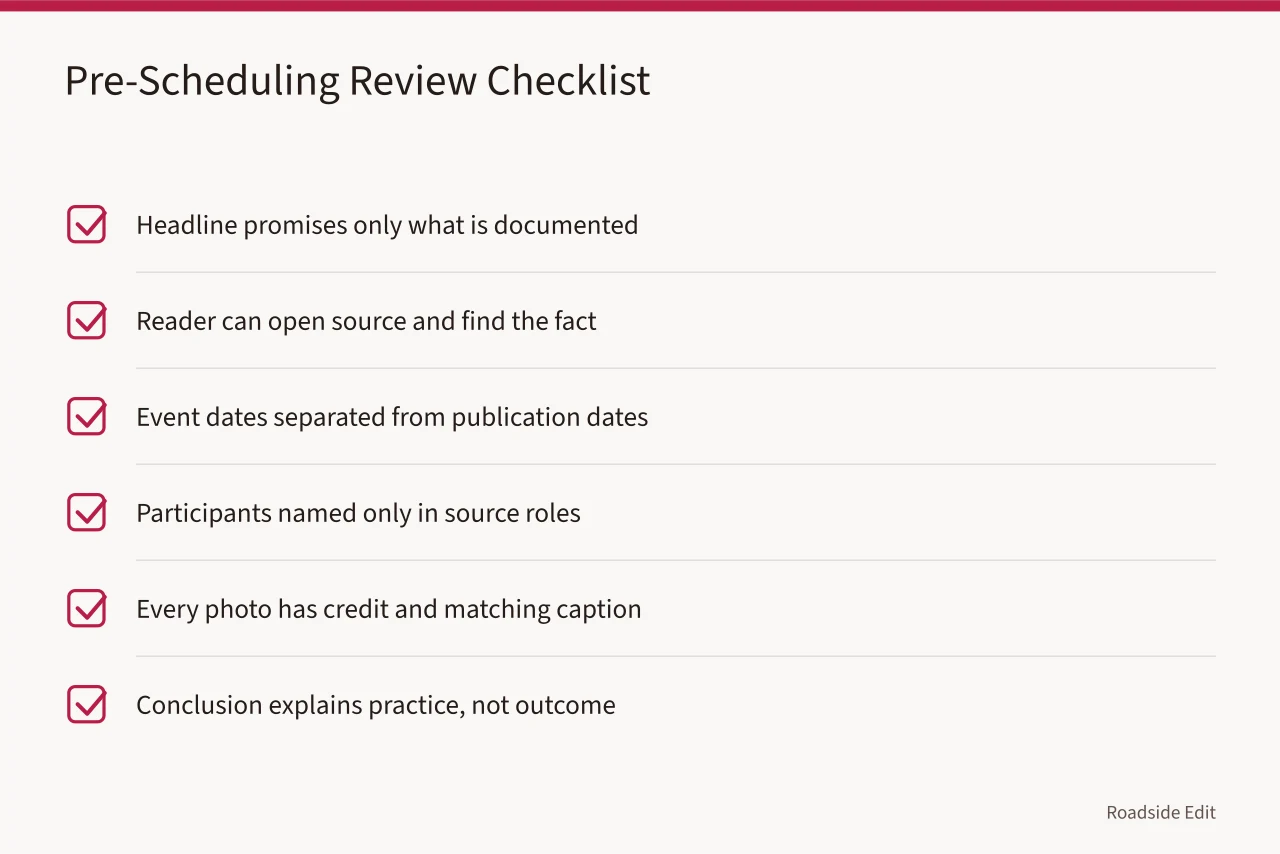
The goal is not to make a project sound less interesting. It is to make it possible for a reader, agency, property owner, or future writer to see why the article's interesting details deserve trust.
Include a change timeline
A simple timeline makes the method transparent:
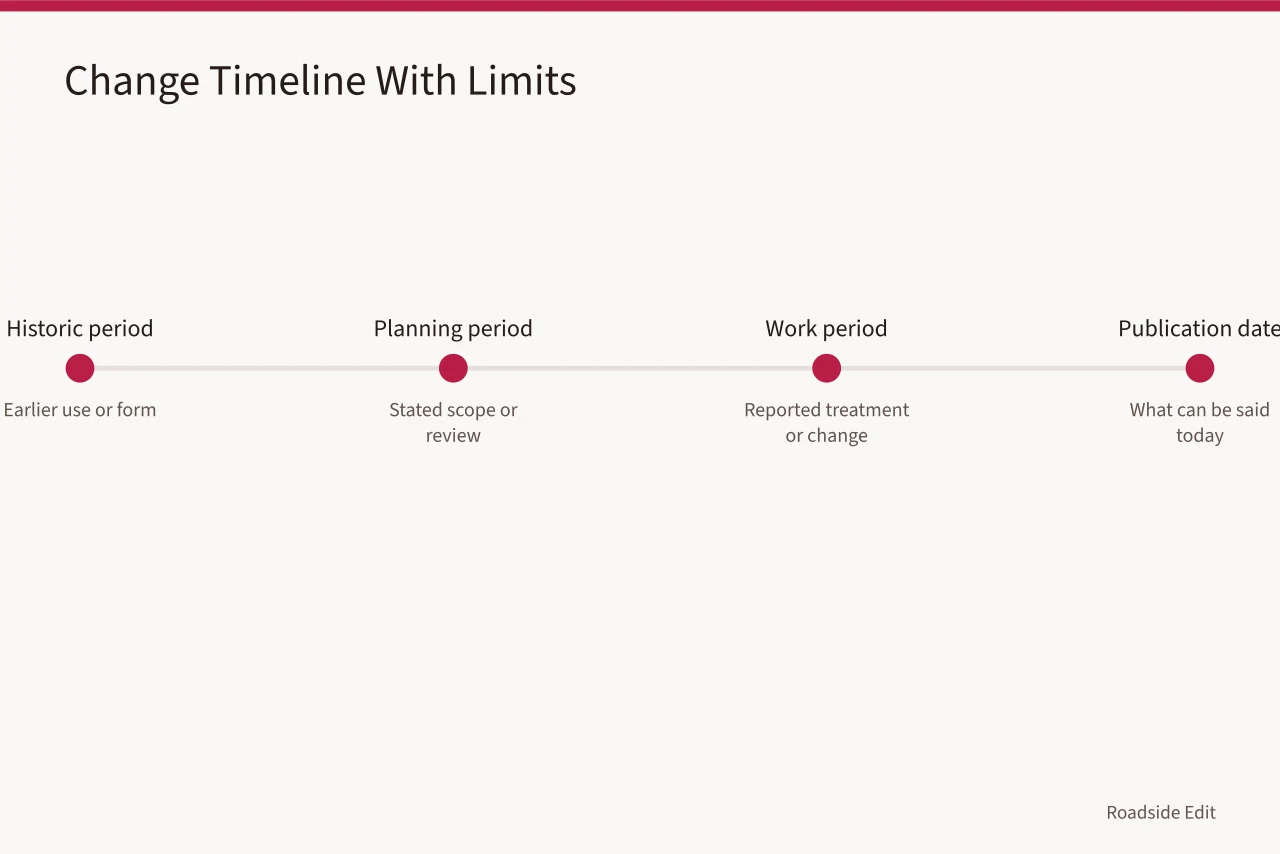
| Date or period | Source | Documented event | Limit |
|---|---|---|---|
| Historic period | Archive or historic record | Earlier use or visible form | Not present condition |
| Planning period | Official project source | Stated scope or review | Not completion |
| Work period | Project record | Reported treatment or change | Not future performance |
| Publication date | Article's source check | What can be said today | Recheck needed later |
The timeline should not invent a date simply because a source is dated. Keep the source date and the event date distinct. A case page updated in 2026 may describe work completed years earlier.
Write a transferable lesson carefully
End with a planning lesson, not a prescription. Good lessons include: begin with an evidence inventory; identify character-defining features before describing a treatment; keep scope and change records together; attribute a project claim; or distinguish a historic image from present condition. These lessons help readers ask better questions without pretending to decide another project's path.
Avoid phrases such as "proven solution," "best practice for every building," "guaranteed result," or "the only way." They usually move from evidence into promotion. A case study earns trust through bounded detail, not certainty.
Preserve the case file
Retain source captures where permitted, notes on what was checked, local media files and their credits, the source ledger, draft versions, and corrections. A later editor should be able to find the original support for each sentence and see why a claim was limited. When a source changes or disappears, add a dated note rather than silently changing the article's history.
The National Archives primary-source guide helps identify evidence created close to an event. The Library of Congress HABS, HAER, and HALS collection contains documented architectural and engineering records. The National Archives records-management basics support keeping a retrievable source file. They guide research method, not a conclusion about another project.
Common questions
Can one renovation case study recommend a treatment for another building?
No. It can offer a documented example and a planning lesson. Another building needs its own evidence and responsible review.
What if the source has no project cost?
Say that the source does not report a cost. Do not estimate one from an image, location, or unrelated project.
Can a sponsored business be the case-study source?
It can provide an attributed statement, but the article should identify it as such and avoid converting it into an independent endorsement.
In this guide
- Roadside renovation case study checklist: how to verify outcomes and sourcesRoadside renovation case study checklist for 2027: define the subject, test source support, separate outcomes from claims, disclose sponsors, and correct errors.
- Roadside renovation case study questions to ask before you cite oneAsk better 2027 roadside renovation case study questions about scope, chronology, sources, attribution, omissions, and the limits of a project example.
- How to organize roadside renovation case study records with clear limitsOrganize 2027 roadside renovation case study records with a source ledger, dated evidence notes, image credits, issue log, and clear limits for every claim.