Guides
Part of How to run a roadside renovation case study method that separates evidence from inference
Roadside renovation case study checklist: how to verify outcomes and sources
Roadside renovation case study checklist for 2027: define the subject, test source support, separate outcomes from claims, disclose sponsors, and correct errors.
A case study explains one documented project. It does not prove every roadside property should follow the same path. The best case studies stay narrow.
They state the question examined, the records reviewed, what changed according to those records, and what remains unanswered. This roadside renovation case study checklist turns six verification steps into a working sequence. Each step keeps a project feature from becoming a sales story built on inference.
What to take away
- Define one property, one time period, and one question before collecting material.
- Match every important claim to the record that supports it.
- Distinguish visible evidence, participant statements, documented actions, and editorial interpretation.
- Name the repository behind each record, such as a HABS drawing, a Sanborn map sheet, or a state survey file.
- Disclose a sponsor's role and correct a claim when a later source changes the record.
Step 1: Start with a question the evidence can answer
The opening question should fit the available records. "What did the documented project scope include?" can be answered with a dated scope document.
"Did this project save the town?" is broader. It needs evidence that a single project file rarely contains. A narrow question gives the case study a boundary and helps the writer decline irrelevant or unverified material.
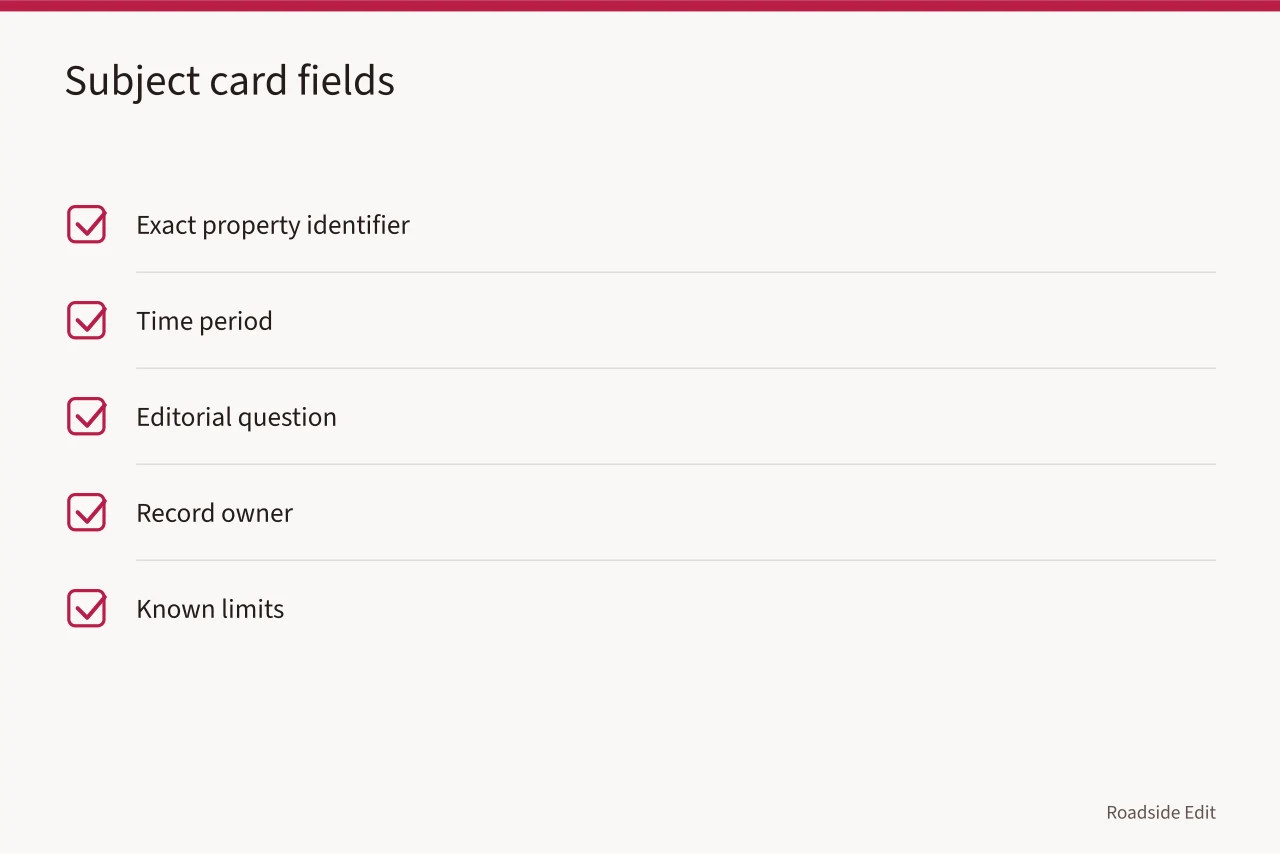
Create a subject card before drafting. It should contain the documented property name, location, and the project period under study. Add the alternate names used in reliable records and the person or organization that supplied each project statement. If two records use different names, record both and explain the difference only when a source does.
| Subject-card field | What it prevents |
|---|---|
| Property name and location as written in the primary record | A study that slides onto a similar property down the road |
| Alternate names used in reliable records | A name change that reads as a second project |
| Project period under study, with start and end dates | Earlier or later work pulled into the wrong decade |
| Person or organization that supplied each project statement | An unattributed claim that sounds like a finding |
| Known limits, such as missing cost data | A gap filled with inference |
Step 2: Build the evidence pack by record type
Do not collect links in one long list. Group them by what they can show.
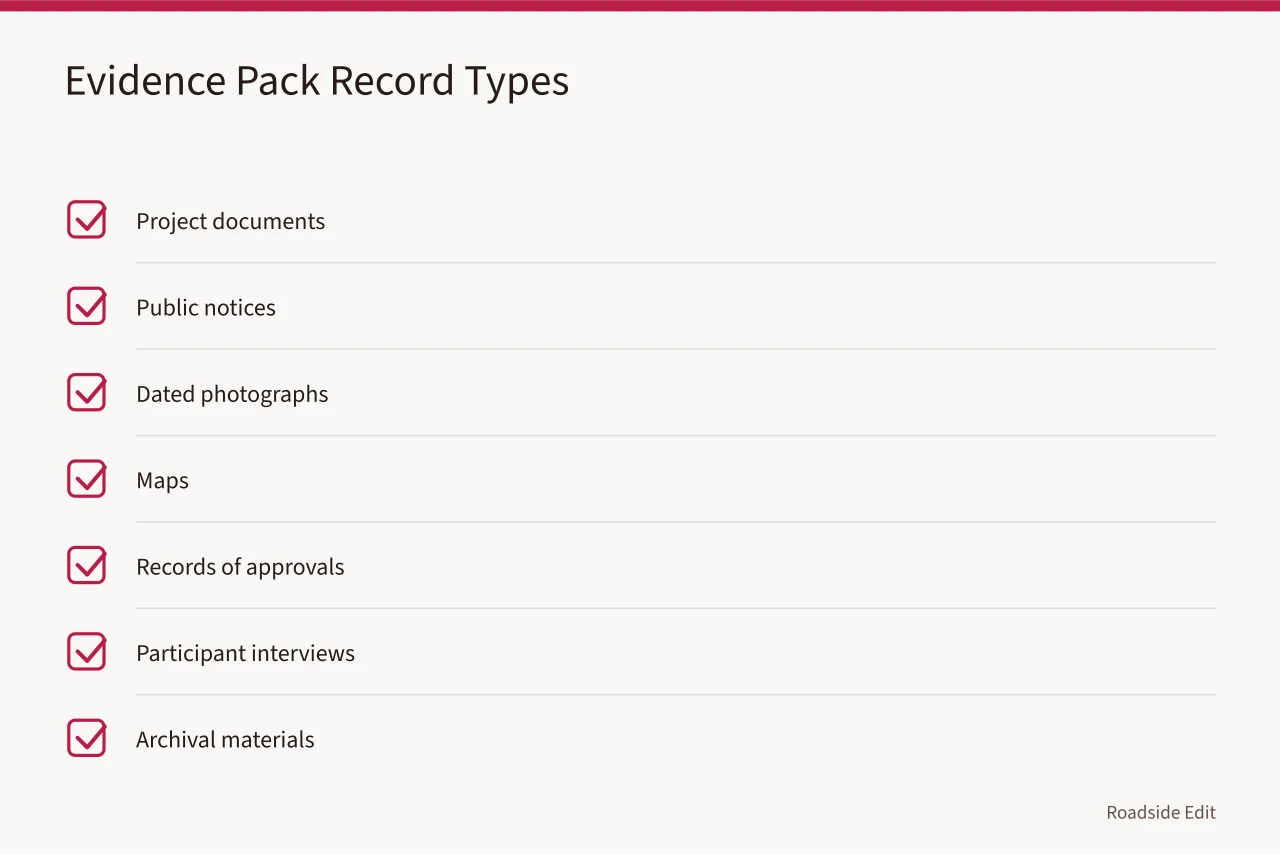
Project documents, public notices, and dated photographs go together. Maps, records of approvals, participant interviews, and archival materials go in a second group. Each item should have a date, a source location, the sentence it may support, and a note on what it cannot establish.
The Library of Congress runs the Historic American Buildings Survey, the Historic American Engineering Record, and the Historic American Landscapes Survey. Its HABS, HAER, and HALS collection can include photographs, measured drawings, written histories, and related materials.
Explore the HABS, HAER, and HALS collection.
A federal agency sometimes pays for that recordation as mitigation when a project affects a historic property. The documentation lives at the Library of Congress, and searching it is free.
Sanborn fire insurance maps, largely held by the Library of Congress, record building footprints and uses from roughly 1867 into the 1970s. USGS TopoView offers free topographic maps, historical editions included.
The Internet Archive's Wayback Machine stores dated snapshots of web pages, and its Save Page Now feature lets anyone request a new one. Google Street View carries a capture date on each image.
A state historic preservation office, or SHPO, holds survey files and determinations of eligibility. The Society for Commercial Archeology studies 20th-century roadside and commercial architecture and publishes the SCA Journal. Federal-aid work usually triggers Section 106 of the National Historic Preservation Act, which requires a federal agency to weigh the effects of an undertaking on historic properties.
Different records do different jobs. A measured drawing and a photograph may both be valuable. Neither automatically confirms a later repair, a funding decision, or current use.
The National Archives explains that a primary source is created at the time of an event or by a participant or observer. The value of a source depends on the question being asked.
Read NARA's primary-source guide.
Use that distinction to label evidence, not to rank every source as simply good or bad. A participant's memo may be the best source for a stated intention. It may not establish an independent result.
Step 3: Test every outcome sentence
Outcome language needs special care. "The project replaced windows" is a factual sentence when a reliable record says that work occurred. "The project improved safety" is a conclusion that needs evidence about the measure, the period, and the result. "The project was successful" is usually too vague to help a reader.
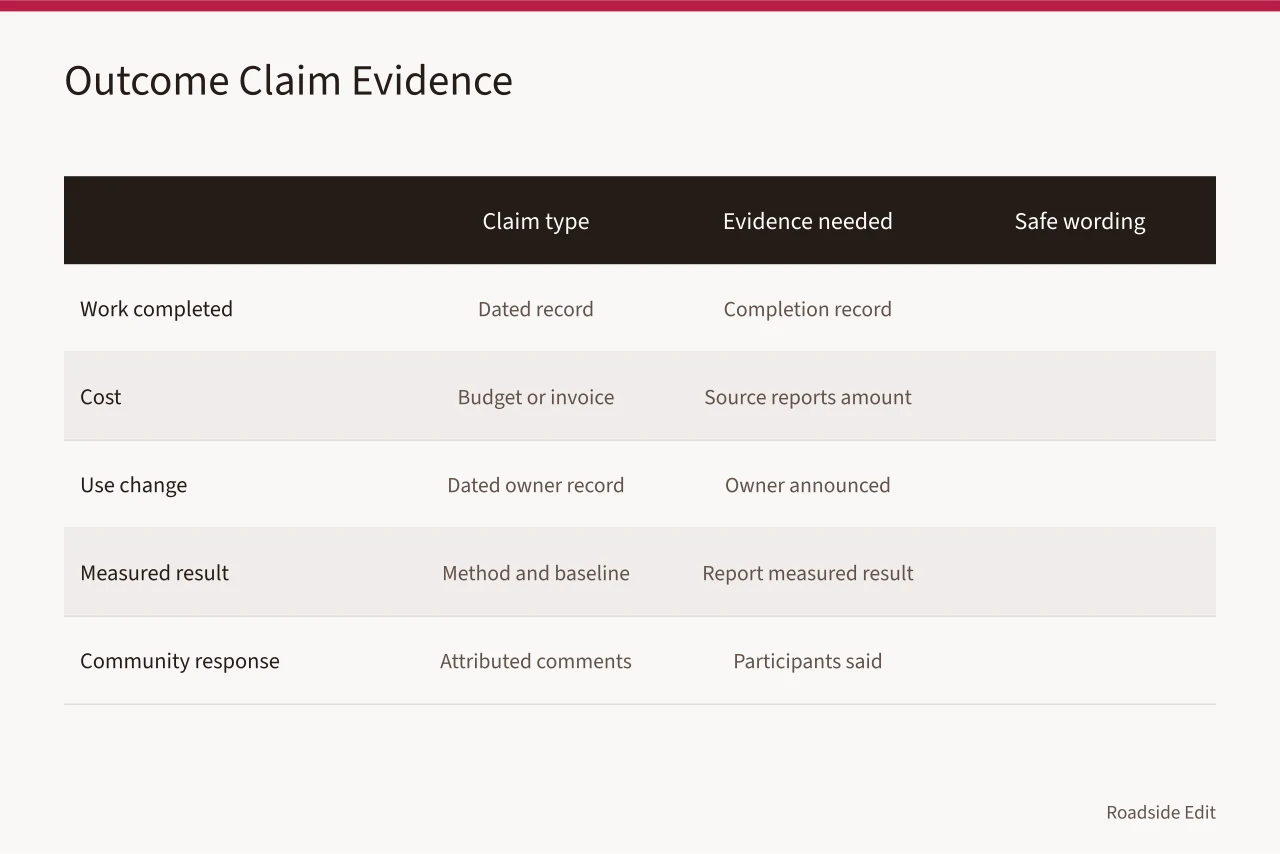
Before publishing an outcome, fill in this table:
| Claim type | Evidence needed | Safe case-study wording |
|---|---|---|
| Work completed | Dated record that identifies completed work | "The completion record lists [work]." |
| Cost | Budget, invoice, award, or other amount with scope | "The source reports [amount] for [defined scope]." |
| Use change | Current, dated owner or agency record | "The owner announced a proposed new use." |
| Measured result | Method, baseline, date, and result | "The report measured [result] using [method]." |
| Community response | Attributed comments or documented engagement | "Participants said [statement]." |
Do not convert a before-and-after image into proof of hidden work, public benefit, accessibility, code compliance, or financial return. The image can support a visible observation at the time it was made. Add the rest only if records support the added claim.
Step 4: Preserve sources so the article can be checked later
The source pack should let a later editor trace each important sentence without repeating the original research. Save a stable source link or permitted copy, the date reviewed, the author or issuer, and the relevant page, section, or image identifier. Keep the source's wording separate from the writer's paraphrase.
A state agency often holds the project file, and a public records request is the usual route to it. The federal Freedom of Information Act, 5 U.S.C. 552, generally gives agencies 20 business days to respond. State open records laws set their own deadlines, typically 10 to 30 business days.
National Archives recordkeeping guidance says records concerning a particular project, study, transaction, or subject should be maintained together to preserve their context. Review NARA's recordkeeping requirements.
Those requirements sit in 36 CFR Part 1220 and apply to federal agencies, not to every publisher. The method suits a case study because it keeps a later correction tied to the record that prompted it.
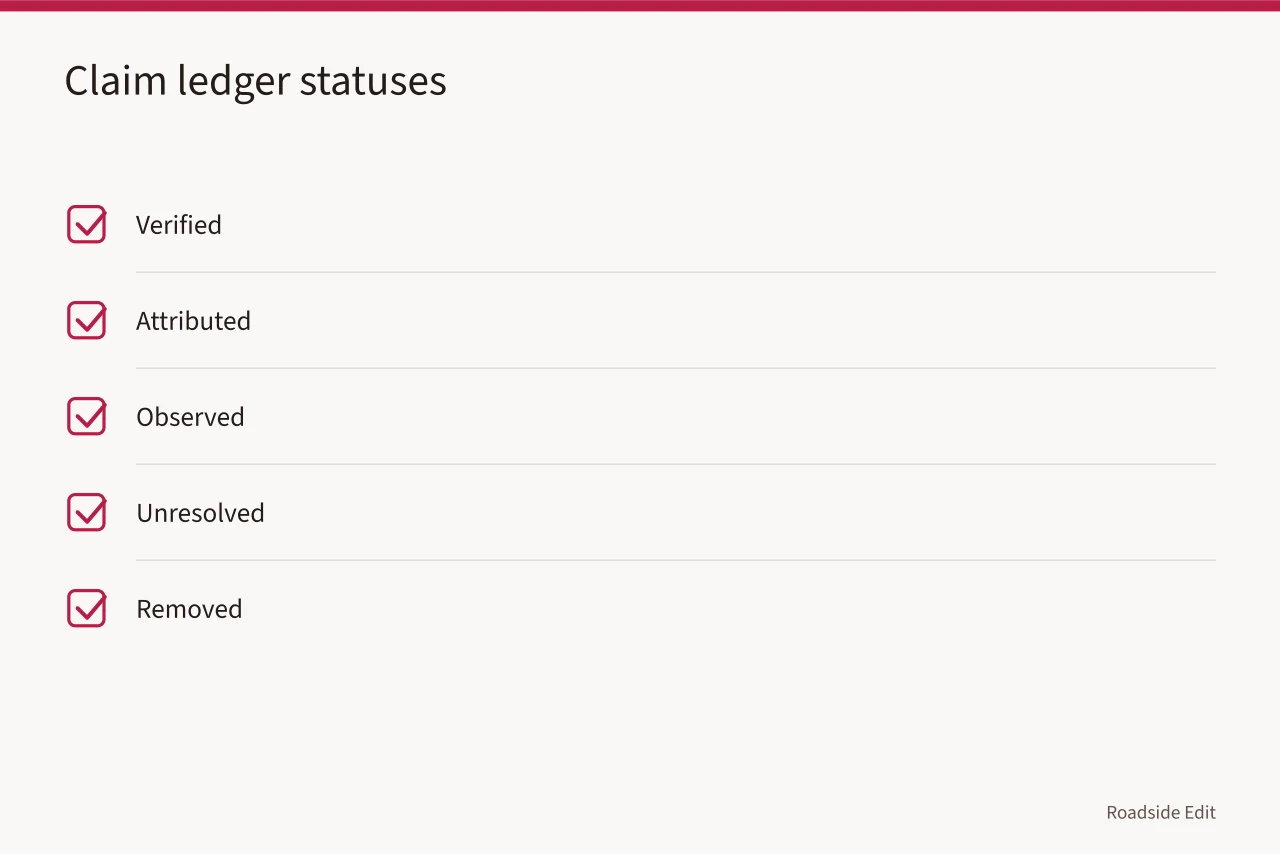
Use a claim ledger with a status field: verified, attributed, observed, unresolved, or removed. "Removed" matters. It tells the next editor that the article once considered a claim but did not have enough support to publish it.
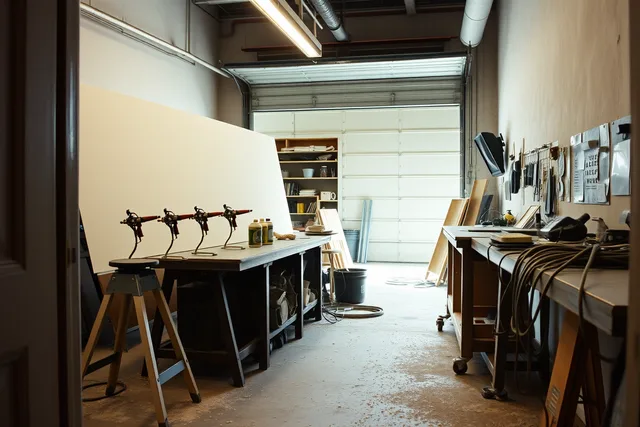
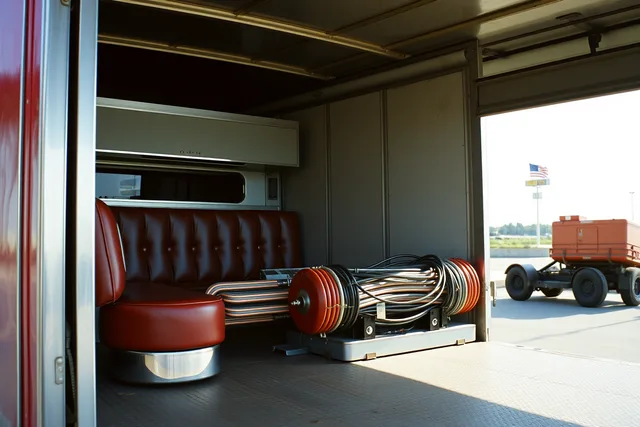
The image is historical context only. It does not document the scope, condition, ownership, cost, or outcome of another roadside renovation project.
Step 5: Disclose the sponsor and keep its voice visible
Case studies often involve a contractor, owner, brand, public program, or local organization that wants to explain its work. That material can be useful when it is attributed. It becomes misleading when a paid or connected participant's account reads as unqualified independent reporting.
The Federal Trade Commission says endorsements must be honest and not misleading. A material connection between endorser and marketer should be clearly and conspicuously disclosed when consumers would not expect it.
Read the FTC endorsement guidance.
The rule sits in the FTC's Guides Concerning the Use of Endorsements and Testimonials in Advertising, 16 CFR Part 255.
If a sponsor paid for the feature, supplied services, provided a product, or had another relevant relationship, disclose that fact near the case study. Identify sponsor statements as such.
Do not let disclosure replace evidence. A clearly labeled sponsor statement can still be too broad for the records. Attribute it, narrow it, or leave it out when the project file does not support the claim.
Step 6: Close with limits and a correction path
End the case study by naming what it does not show. It may not establish final cost, future maintenance, community-wide impact, or the outcome of a later approval. Those limits make the piece more useful because readers can tell which facts are settled and where further research belongs.
If a source changes, recheck the claim it supported. Add a dated correction when the published wording needs revision. Keep the original source note in the internal record and update related captions, tables, headlines, and promotional copy. A correction is part of responsible case-study reporting, not an embarrassment.
Common questions
Can a case study recommend a provider or treatment?
It can describe a documented choice and its stated result. It should not promise that the same provider or treatment is right for every property. A check of the National Register of Historic Places, maintained by the National Park Service, tells you whether a property is listed. Listing does not approve any particular repair method.
Is an owner interview enough to prove project completion?
An interview can support an attributed statement. Use a completion record or other appropriate evidence before presenting the work as independently confirmed.
What if the project cost is not published?
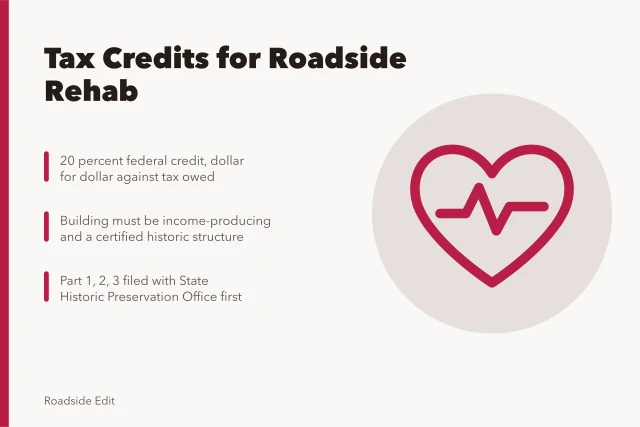
State that the records reviewed do not report a cost. Do not estimate one from images, dates, or an unrelated project. A federal historic rehabilitation credit works differently. The National Park Service and the IRS certify the work, and the credit equals 20 percent of qualified rehabilitation expenditures on a certified historic structure.